
Reviewed · WINE TOURS
Biblical Corinth Taste Faith & History with wine & Oil Tasting
Corinth gives you an unusually full slice of Greek history in a short day: ancient shipping, the world of Saint Paul, Roman ruins, a hilltop fortress, and the modern engineering wonder of the Corinth Canal. This private five-hour trip from Athens keeps the route compact, but it covers a lot.
I like the private format and the flexible drop-off. Your driver can collect you at a hotel, apartment, port, or other agreed point, then adjust stops for food, photos, or an activity such as bungee jumping. I also like the human touch: drivers including Nikos, Panos, Periklis, Andreas, and Christos are praised for clear explanations, friendly service, and good local suggestions.
The main caution is timing. Five hours is tight for this many stops, and entrance fees, lunch, wine tasting, and oil-tasting food cost extra. Ancient Corinth has also closed unexpectedly at times, so confirm the opening status before you go.
In This Review
- Key points to know before booking
- Why Corinth makes a smart half-day trip from Athens
- A comfortable private ride from Athens
- The Corinth Canal and the old Diolkos
- Isthmia, the games, and Saint Paul
- Artifacts inside the Isthmia museum
- Ancient Corinth and the Temple of Apollo
- The Archaeological Museum of Corinth
- Lunch, shopping, and the best view at Acrocorinth
- Wine and olive oil tasting: what to budget
- Is the $190.46 price good value?
- Who should book this Corinth tour?
- Should you book it?
- FAQ
- How long is the Corinth tour?
- Is pickup included?
- Is this a private tour?
- Are entrance fees included?
- Is lunch included?
- Are wine and olive oil tastings included?
Key points to know before booking
- A private Athens pickup: Your group travels alone, in a sedan for one to three people or a minivan for four to seven.
- A remarkable ancient shortcut: The Diolkos shows how Greek engineers moved boats across the isthmus long before the canal existed.
- A strong Saint Paul connection: Corinth and the Isthmian area bring the New Testament to life in a real geographical setting.
- Acrocorinth is the visual high point: The fortress rock offers broad views and a powerful sense of Corinth’s defensive role.
- Extra costs matter: The listed price is $190.46 per person, but entry fees, tastings, lunch, and an optional licensed guide are separate.
- Flexible but fast-paced: The route can be adjusted, yet five hours leaves little room for long museum visits or an unhurried meal.
Why Corinth makes a smart half-day trip from Athens

Corinth sits at the narrow isthmus joining mainland Greece to the Peloponnese. That position made it a natural checkpoint for armies, merchants, sailors, and pilgrims. The modern city lies about 5 kilometers from Ancient Corinth, so the tour links several nearby sites without the long road hours required by many Greek excursions.
The area also connects neatly to the life of Saint Paul. Corinth is known to Christian readers through First and Second Corinthians, and Paul spent time in the region during his missionary work. You are not simply looking at broken columns. You are following an old trade route and a place where religious, political, and commercial life crossed paths.
Ancient Corinth was one of Greece’s major cities. It had a reported population of about 90,000 in 400 BC. Rome destroyed the city in 146 BC, then rebuilt Corinth in 44 BC. Later, the Roman city became the provincial capital of Greece. That change explains why the archaeological remains mix Greek and Roman layers.
More Food Tours in Athens
- Greek Food Walking Tour in Athens
★ 5.0 · 4,740 reviews - Athens: Street Food Tasting Tour
★ 4.9 · 2,557 reviews - Small Group Greek Traditional Food Tour in Athens 20+ Tastings
★ 5.0 · 1,759 reviews
A comfortable private ride from Athens
Pickup is offered from an Athens hotel, Airbnb residence, or port. For an airport pickup, the driver waits in the arrival hall with a sign and monitors the flight. At a hotel, the meeting point is the lobby. At an apartment, it is the building entrance.
This arrangement is useful if you have luggage, children, or an awkward schedule. The vehicles have air-conditioning, WiFi, and bottled water. Child seats are available if requested in advance. Fuel and tolls are included, so you do not need to manage road charges along the way.
The private setup is the tour’s biggest practical advantage. A group of two does not share a bus with strangers, and a family can keep the pace manageable. The driver can also return you to the original pickup point or another agreed location.
Your driver is not automatically a licensed guide. The standard service includes an English-speaking driver with a strong command of Greek history. A licensed guide can be requested, subject to availability, for an additional €140 per person. If detailed archaeology is important to you, ask for this before booking rather than assuming the driver can provide a formal guided tour inside every site.
The Corinth Canal and the old Diolkos
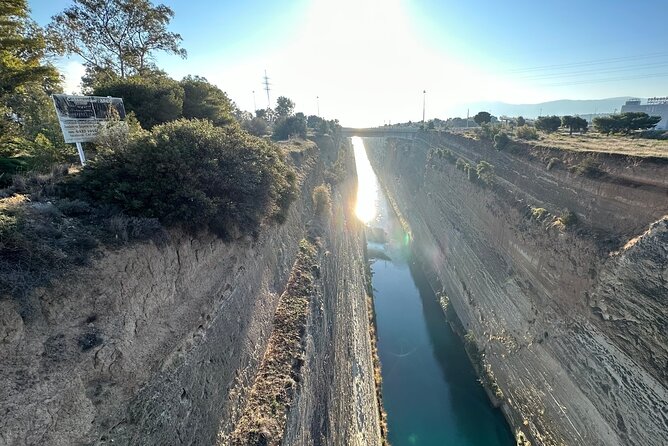
The first stop is the Corinth Canal, a straight cut through the isthmus linking the Gulf of Corinth with the Saronic Gulf. It separates the Peloponnese from mainland Greece, making the peninsula function like an island.
The canal was completed in the late 19th century, but the idea is much older. Before modern construction, a ship heading between the Aegean and Adriatic had to sail around the Peloponnese, adding roughly 185 nautical miles. The canal solved that problem by cutting through the narrowest point.
You get about 15 minutes here. That is enough for photos and a quick look, but not a long visit. The canal is best understood as an engineering stop, not a full attraction with a long program.
Nearby, the Diolkos offers a more surprising story. This paved trackway let ancient crews move boats overland across the isthmus on wheeled platforms. It ran for roughly 6 to 8.5 kilometers and operated from about 600 BC until the middle of the first century AD.
Think of it as an ancient boat railway. It allowed ships and cargo to avoid the dangerous voyage around the peninsula. The route also helped Corinth control movement between two seas. You spend about 20 minutes here, so listen closely to the explanation because the visible remains are modest compared with the idea behind them.
Isthmia, the games, and Saint Paul
Isthmia lies close to the canal and was the site of the Isthmian Games. These competitions ranked just behind the Olympic Games in importance across the Greek world. The location was practical as well as symbolic, since it sat at the meeting point of the Peloponnese and central Greece.
The Saint Paul connection gives this stop extra weight. Paul worked in the region as a tent maker and preached to people connected with the games. His presence places early Christianity beside one of the ancient world’s major athletic gatherings, not in an isolated religious setting.
You have about 30 minutes at Isthmia. That is enough for an introduction and a look at the setting, but the stop may feel brief if you want a detailed archaeological visit. It works best as context for the museum and for the later visit to Ancient Corinth.
More Historical Tours in Athens
- Historical Delphi One Day Tour with Arachova Stop & Expert Guide
★ 4.5 · 1,247 reviews - Historic Athens: Small Group Electric Bike Tour
★ 4.9 · 740 reviews - The History of Athens: Greek Mythology Private Tour
★ 5.0 · 138 reviews - Athens Highlights by E-Bike: Small-Group Historic Tour
★ 5.0 · 131 reviews
Artifacts inside the Isthmia museum
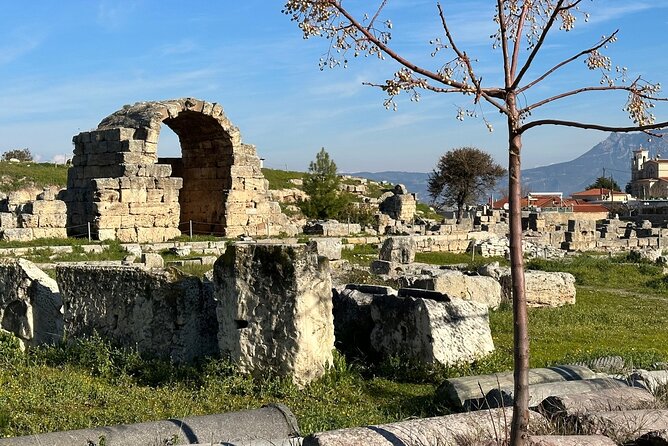
The Archaeological Museum of Isthmia requires a separate admission fee and receives about 20 minutes in this route. Its collection helps fill in what open-air ruins cannot show.
Objects include an archaic marble pediment from the first Temple of Poseidon, dating to the end of the seventh century BC. You can also see colorful glass panels found at the Temple of Isis in the harbor area of Kenchreai. These panels show harbor scenes, exotic places, animals, plants, ships, geometric designs, and figures linked with philosophers such as Homer and Plato.
Other displays include an imperial statue in the form of Zeus, an athletic victory stele, animal figurines, commercial amphorae, cult offerings, weapons, and finds from Mycenaean and Roman cemeteries. A small golden bull figurine is one of the more distinctive objects.
The short museum visit means you should not expect to study every case. Still, it gives useful detail before Ancient Corinth. You see how religion, trade, sport, and burial customs shaped the area over many centuries.
Ancient Corinth and the Temple of Apollo
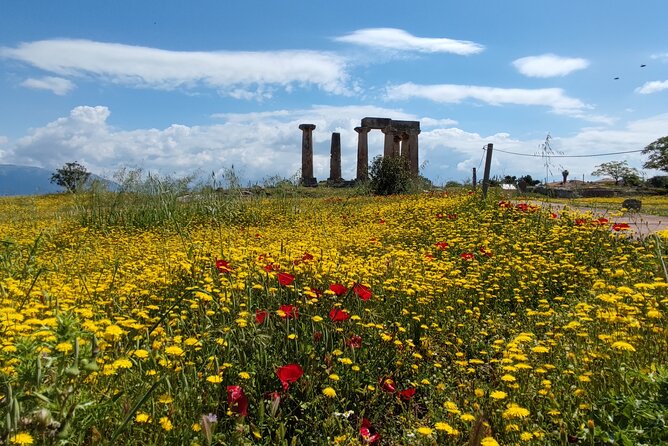
Ancient Corinth is the central archaeological stop. You get about an hour in the site, followed by a separate museum visit and time for lunch or shopping in the nearby settlement.
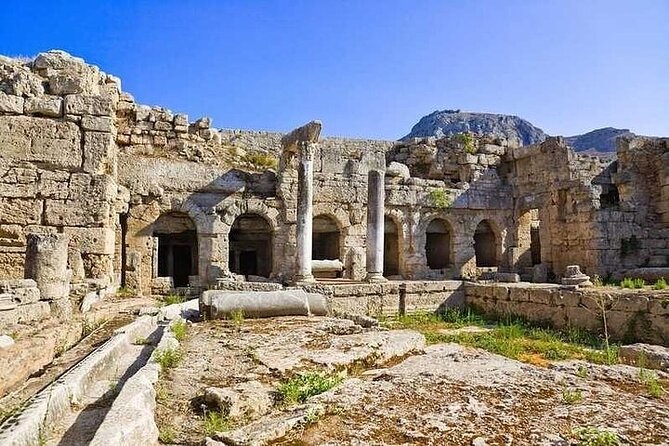
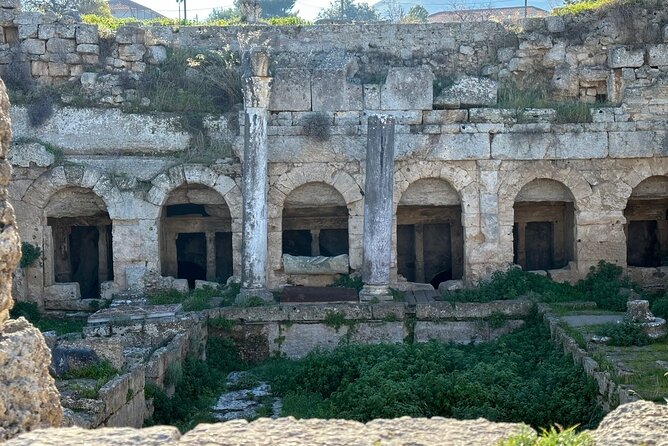
The ruins include the Agora, Lechaion Road, the Fountain of Peirene, a basilica, a stoa, an odeon, and the Hadgimoustafa spring. These are not isolated monuments. Together, they show the shape of a working city, with roads, public space, water systems, shops, religious buildings, and places for performance.
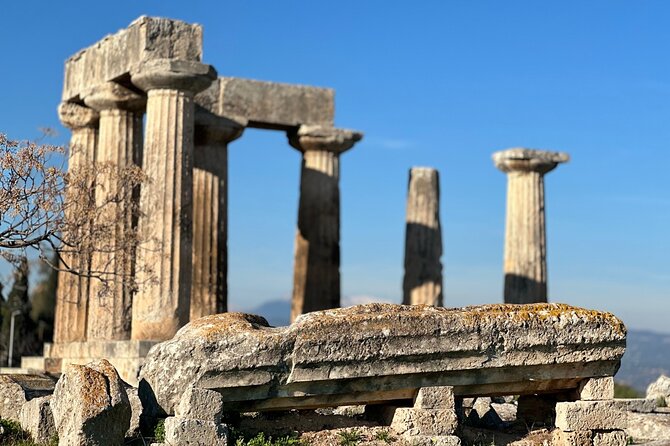
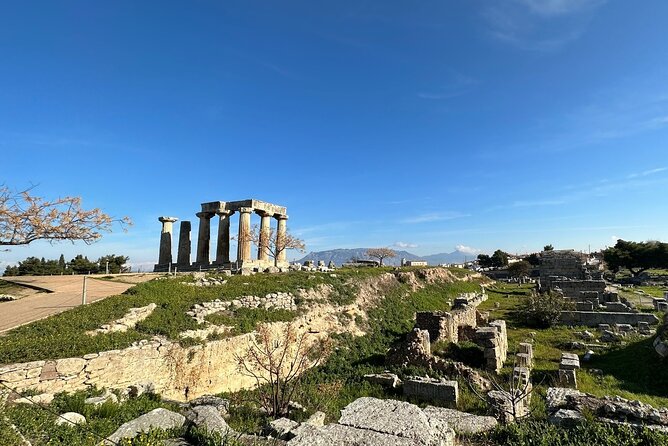
The Temple of Apollo is one of the clearest highlights. Built around 550 BC, it is among the earliest Doric temples in the Peloponnese and mainland Greece. Its large monolithic columns are especially notable. Only part of the temple remains, but the surviving stone gives you a strong sense of its scale and age.
The route allows about 15 minutes at the Temple of Apollo. That is enough to see the main remains and take photos, but I would not expect a slow, detailed examination of the entire site. If Ancient Corinth is your main reason for booking, tell the driver early and ask how much time can be protected there.
The archaeological entrance fee is listed separately at €15 per person. The same €15 figure is also listed for attraction entrance fees, so confirm exactly what your booking covers and what you will pay locally. The supplied cost details are not perfectly clear on whether every entrance is bundled or charged individually.
The Archaeological Museum of Corinth
The Archaeological Museum of Corinth sits within the archaeological site and was built in 1931 and 1932 to display finds from excavation work. You have about 30 minutes here.
The museum is important because it gives faces and objects to the city’s broad story. Outdoor ruins show streets and walls, while museum displays can show sculpture, pottery, household items, and religious objects. The museum also helps explain the shift from Greek Corinth to Roman Corinth after the destruction and rebuilding of the city.
The stop is short, so use the driver’s explanations to decide what deserves your attention. If you prefer museums to open-air ruins, you may wish to request more time here and trim one of the smaller stops.
Lunch, shopping, and the best view at Acrocorinth
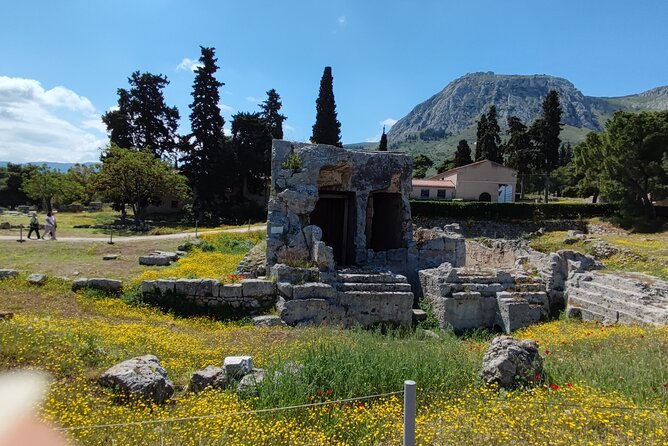
A 45-minute break is scheduled near Ancient Corinth for lunch and shopping. The meal is not included. This is a useful pause, especially after several archaeological stops, but it is not long enough for a leisurely restaurant experience if service is slow.
The day’s grand visual finish is Acrocorinth, the upper citadel of Ancient Corinth. The fortress occupies a massive rock above the ancient city. Its height and secure water supply made it a final defensive position for southern Greece, allowing whoever held it to control the isthmus.
You have about 30 minutes here. The castle and the view are the main rewards. Acrocorinth was repeatedly used as a defensive stronghold, and its position makes that purpose easy to understand. From above, the route through the isthmus becomes clear, and the earlier canal and ancient road stops make more sense.
Wear sensible shoes and allow for uneven ground. The provided details do not specify accessibility conditions, so ask the operator if anyone in your group has mobility limits. The visit is short, and you may need to choose between exploring the fortress remains and simply taking in the view.
Wine and olive oil tasting: what to budget
The tour title includes wine and oil tasting, but the cost details list these as optional extras. Wine tasting is listed at €15 per person. Oil-tasting finger food is listed at €80 per person, which is a substantial additional charge and worth clarifying before payment.
This matters because the tasting can change the feel of the day. The archaeological stops are information-heavy, while wine and oil offer a relaxed way to connect with Greek food culture. If tasting is central to your plans, ask exactly what is included, how long it lasts, and whether the €80 charge applies to your whole group or each person.
Do not assume lunch and tasting are part of the $190.46 price. Lunch is separate, and gratuities are also left to your discretion. The optional licensed guide costs €140 per person. Airport pickup costs an additional €60 per person.
Is the $190.46 price good value?
At $190.46 per person, this is not a budget outing. You are paying for a private vehicle, pickup and drop-off, fuel, tolls, air-conditioning, WiFi, bottled water, and a driver dedicated to your group. For two people, the price is easier to justify if you value privacy and flexible timing. For a larger group of up to seven, the private format can compare more favorably with several separate tickets on a group excursion.
The value drops if you expect a fully guided archaeological tour, included meals, and included tastings. Those are not part of the basic package. Add the €15 admission cost, lunch, wine tasting, and any oil-tasting charge before comparing prices.
The best value comes from using the driver’s flexibility well. Ask for extra time at Ancient Corinth if it matters most to you. If Acrocorinth is your priority, protect that stop. Previous arrangements have even allowed time for Zulu bungee jumping, followed by Acrocorinth, so the schedule can be adapted when discussed in advance.
Who should book this Corinth tour?
I would choose this experience if you want Corinth without renting a car, prefer a private ride, and like mixing major ruins with short historical stops. It suits couples, families, and small groups who want direct pickup and do not want to spend a full day on a large coach.
It is also a good fit for Christian history enthusiasts. The Corinth and Isthmia stops connect the physical setting with Saint Paul’s work, while the driver can add context during the road journey. The tour has earned a 4.9 rating from 28 reviews, with 96 percent recommending it, and the most praised qualities are friendly service, clear historical explanation, punctual pickup, and flexible routing.
I would be more cautious if you want long, quiet museum visits or a slow archaeological study. Five hours is ambitious for nine listed stops. Also check the operating status of Ancient Corinth before setting out. One booking found the main site and museum closed on a Tuesday because of filming connected with a production of The Odyssey. That kind of closure may be outside the operator’s control, but you should still confirm.
Free cancellation is available up to 24 hours before the start time. Changes made within 24 hours are not accepted, and poor weather can lead to a different date or a full refund.
Should you book it?
Book this tour if private transport and flexible local help matter more to you than a slow, formal guided visit. The Corinth Canal, Diolkos, Isthmia, Ancient Corinth, Apollo’s Temple, and Acrocorinth form a strong route, and the hilltop fortress alone can make the outing memorable.
Before booking, confirm three things: the opening hours of Ancient Corinth, the exact entrance fees, and the final cost of wine and oil tasting. Request a licensed guide if archaeology is your main interest. If you want a practical, history-filled escape from Athens with a driver who can adjust the day, this is a solid choice. If you want to study every ruin at leisure, plan a longer Corinth visit instead.
FAQ
How long is the Corinth tour?
The tour lasts approximately five hours.
Is pickup included?
Pickup and drop-off are offered from an Athens hotel, Airbnb residence, or port. Airport pickup is available for an additional €60 per person.
Is this a private tour?
Yes. Only your group participates. Groups of one to three use a luxury sedan, while groups of four to seven use a minivan.
Are entrance fees included?
No. Entrance fees are not included in the listed price. The supplied details list €15 per person for attraction admission and €15 for the Archaeological Site of Ancient Corinth. Confirm the exact charges before departure.
Is lunch included?
No. A 45-minute lunch and shopping stop is scheduled near Ancient Corinth, but the meal cost is separate.
Are wine and olive oil tastings included?
No. Wine tasting is listed at €15 per person, while oil-tasting finger food is listed at €80 per person. Ask the operator to confirm the final tasting arrangements and charges.
More Wine Tours in Athens
- Athens: Classic Cooking Class with Market Visit and Wine
★ 5.0 · 1,101 reviews - Athens: Food Market Visit and Cooking Class with Wine
★ 4.9 · 1,087 reviews - Athens: Swimming Cruise with Lunch, Wine & Live DJ on Board
★ 4.6 · 1,085 reviews - Best rated Acropolis Wine Tasting
★ 5.0 · 568 reviews
Recently reviewed around Athens
- Small-Group Women History in Ancient Greece Walking Tour★ 5.0 · 38 reviews
- Ceramic and Pottery Creative Workshop with Two Local Artists★ 4.0 · 57 reviews
- Athens: Wine Workshop Create your Own Wine under the Acropolis★ 5.0 · 77 reviews
- Athens: Greek Wines Tasting with Sommelier and Acropolis Views★ 5.0 · 88 reviews
- Hydra Private Day Trip by Ferry from Athens with Transfers★ 4.0 · 30 reviews
- Small-Group Wine Tour in Athens with Tasting★ 5.0 · 33 reviews
- Wine Trails Private Tour/ Nemea visit 3 wineries from Athens or Nafplion (10 h)★ 5.0 · 44 reviews
- Private Athens Transfer Airport/Port -Greek Tours-Hourly service★ 5.0 · 88 reviews
Wine Tours, compared.

Santorini Wine Adventure with 12 Wine Tastings, Tapas and Sunset
Read our review →
Santorini Wine Stories: Sunset Tour with Tasting & Dinner
Read our review →
Classic Cooking Class with Market Visit and Wine
Read our review →
Food Market Visit and Cooking Class with Wine
Read our review →
Swimming Cruise with Lunch, Wine & Live DJ on Board
Read our review →
Greek Cuisine Cooking Class in Santorini with Recipes and Wine
Read our review →
Santorini Highlights Small-Group Tour with Wine Tasting option
Read our review →Browse the lists this tour appears in