
Reviewed · HISTORICAL TOURS
Small-Group Women History in Ancient Greece Walking Tour
Athens looks different when you follow the lives of its women. This two-hour walk moves from Monastiraki to Philopappos Hill, using libraries, courts, meeting places, and old streets to explain the world of Athena, Penelope, Pandora, Sappho, Aspasia, and Agnodice. The focus is not only on famous myths, but also on marriage, education, work, slavery, politics, and daily limits.
I like the small group of no more than 12, which gives Maelle room to answer questions and keep the talk personal. I also like the route itself: the tour adds meaning to places you may otherwise pass quickly, then ends with one of Athens’s best Acropolis views from Philopappos Hill.
The main drawback is physical. This is an outdoor walk with uneven ground and a hill at the end, and it is not recommended if you have mobility problems. You also see the Ancient Agora from outside rather than entering the archaeological site, so this tour adds context instead of replacing a full Agora visit.
In This Review
- Key points to know before booking
- Why this Athens walk feels different
- Starting in Monastiraki Square
- Hadrian’s Library and women’s access to education
- Marriage, Eros, and the church near Monastiraki
- Athena at the Gate of Athena Archegetis
- A women-only festival at Dioskouron
- The Ancient Agora from the outside
- Areopagus and a woman who challenged the rules
- The Pnyx, democracy with a major exclusion
- Philopappos Hill and the Acropolis finale
- What the $44.71 price gets you
- Who should book this walk
- Should you book the Women History in Ancient Greece Walking Tour?
- FAQ
- How long is the Women History in Ancient Greece Walking Tour?
- Where does the tour begin?
- Where does the tour end?
- Does the tour enter the Ancient Agora?
- How many people can join the tour?
- Can I cancel the tour for a refund?
Key points to know before booking

- Women are the main subject, not a brief side note: The walk keeps female lives, choices, restrictions, and achievements at the center.
- Maelle leads a thoughtful two-hour route: Her presentation connects mythology with real women such as Aspasia, Sappho, and Agnodice.
- The route runs from Monastiraki to Philopappos Hill: Expect historic streets, public spaces, viewpoints, and several uphill or uneven sections.
- The Ancient Agora is viewed from outside: You will discuss women in public life, female slaves, and courtesans without entering the paid archaeological site.
- The tour ends with the Acropolis in view: Philopappos Hill gives the walk a pleasant finish and a useful photo stop.
- The price is $44.71 per person: That is fair for a focused two-hour guided walk, especially if you want history that standard Athens tours often leave out.
Why this Athens walk feels different
Most first visits to Athens revolve around temples, battles, male philosophers, and the birth of democracy. All of that matters, but it can leave a large gap. This walk asks a sharper question: what did Athens look like to the women who lived there?
That question changes the meaning of familiar places. The Agora is no longer just the center of public debate. The Pnyx is not simply the birthplace of democracy. The streets around the old city become places where women married, worked, worshipped, raised children, entertained men, or struggled against rules set by male citizens.
Maelle’s approach also brings mythology into the story without treating it as a substitute for fact. Athena, Penelope, and Pandora offer clues about how ancient Greeks imagined women, while Sappho, Aspasia, and Agnodice show what real women could achieve despite strong social limits.
I especially appreciate that the tour does not present ancient Greek women as one single group. A citizen wife, a slave, a courtesan, a Spartan woman, and a woman from a myth did not share the same life. The short stops cannot cover every distinction, but the route gives you a useful framework for seeing them.
More Historical Tours in Athens
- Historical Delphi One Day Tour with Arachova Stop & Expert Guide
★ 4.5 · 1,247 reviews - Historic Athens: Small Group Electric Bike Tour
★ 4.9 · 740 reviews - The History of Athens: Greek Mythology Private Tour
★ 5.0 · 138 reviews
Starting in Monastiraki Square
The meeting point is Pl. Monastirakiou 2, in the middle of Monastiraki. This is a practical place to begin because it is easy to reach by public transportation and familiar to anyone exploring central Athens.
The first ten minutes are used to meet the guide and set the scene. Do not expect a long introduction here. The value of starting in Monastiraki is that you are immediately in the old urban core, where modern Athens, Roman remains, Byzantine churches, shops, cafés, and archaeological sites sit close together.
A small group matters from the start. With a maximum of 12 people, you should be able to hear the guide more easily than on a large coach-style walking tour. The size also makes it simpler to ask about a character or custom that catches your attention.
Hadrian’s Library and women’s access to education
The next stop is Hadrian’s Library, where the discussion turns to the education of girls and women in ancient Athens. You spend about ten minutes here and do not need an admission ticket for the stop.
This is a useful early topic because education shaped nearly every other choice available to women. The tour helps you consider who was allowed to learn, what kind of learning was valued, and how a woman’s family and social position affected her options.
The site itself is a Roman-era monument, but the conversation reaches back to the social world of classical Athens. That contrast is helpful. Ancient buildings often survive more clearly than the lives of the people who used them, and a guide can connect the stones to people who left fewer physical traces.
You will not receive a full academic course in ten minutes. Instead, this stop sets up one of the walk’s main ideas: women’s absence from public records does not mean they were absent from society.
Marriage, Eros, and the church near Monastiraki

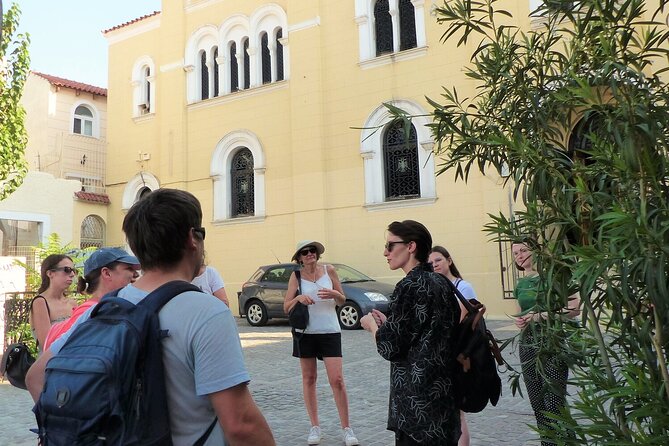
At the Holy Church of the All-Great Taxiarchs and the Virgin Mary Gregorousa, the tour spends about 15 minutes discussing marriage in Athens and Sparta, along with Eros, the passionate form of love.
The subject is more complicated than the familiar image of a romantic Greek wedding. Marriage in ancient Athens was closely tied to family, property, children, and social duty. Sparta followed different patterns, and the comparison helps you avoid treating all Greek women as if they lived under one common system.
The inclusion of Eros gives the discussion a human edge. Ancient ideas about love could include desire and passion, but marriage also served practical and political purposes. The tour asks you to hold both sides in view.
This stop takes place beside a later church, so do not expect a preserved ancient marriage site. The setting is mainly a useful place to talk, and the value comes from the guide’s explanation rather than from a major monument you enter.
More Walking Tours in Athens
- Athens: Acropolis and Parthenon Guided Walking Tour
★ 4.6 · 5,882 reviews - Greek Food Walking Tour in Athens
★ 5.0 · 4,740 reviews - Acropolis: Acropolis and Parthenon Guided Walking Tour
★ 4.7 · 3,442 reviews - Acropolis monuments & Parthenon Walking Tour with Optional Acropolis Museum
★ 5.0 · 2,678 reviews
Athena at the Gate of Athena Archegetis
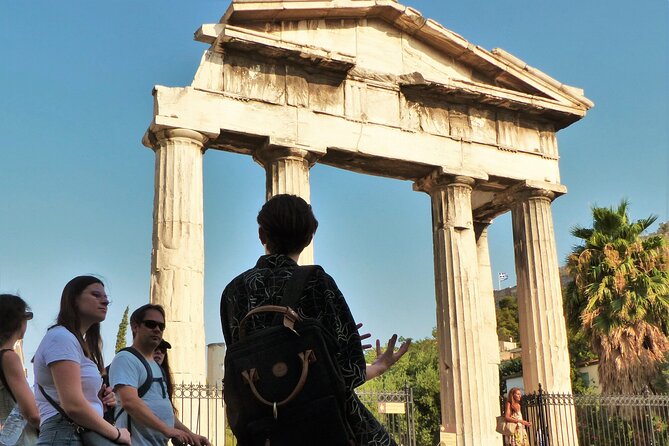
The Gate of Athena Archegetis is one of the route’s most satisfying stops because the architecture gives the mythology a physical setting. The tour spends about 15 minutes discussing married life in Athens and Sparta, along with the myths linked to Athena.
Athena is an especially useful figure for this subject. She is a powerful goddess associated with wisdom, strategy, and the city of Athens, yet the women who lived in that city had far fewer rights and public roles. That contrast says a great deal about the difference between divine female power and the position of real women.
Here you also return to the practical side of marriage. The tour helps you think about household life, social expectations, and the different pressures placed on women in Athens and Sparta. The stories are easier to remember because you are standing among ancient remains rather than hearing them in a classroom.
The stop is free and outdoors. Bring water in warm weather, and keep your attention on the guide rather than expecting a long period to explore the gate independently.
A women-only festival at Dioskouron
Dioskouron brings one of the more unusual subjects on the route: a mysterious ancient festival dedicated exclusively to women. The stop lasts about ten minutes.
This is the kind of detail that makes the walk feel different from a standard tour of Athens. Women may have been shut out of many public spaces, but religious life could offer special occasions for gathering, ritual, and shared identity.
The festival also complicates the simple idea that women were entirely private figures. Restrictions were real, but they did not erase female communities or religious roles. A women-only festival gives you a glimpse of social life that is otherwise hard to see through the surviving monuments.
Because the festival is mysterious, this part is better approached as an invitation to think rather than as a neatly finished story. Some ancient subjects come with firm evidence, while others survive through fragments and interpretation. A good guide makes that difference clear, and the walk’s approach encourages further reading.
The Ancient Agora from the outside
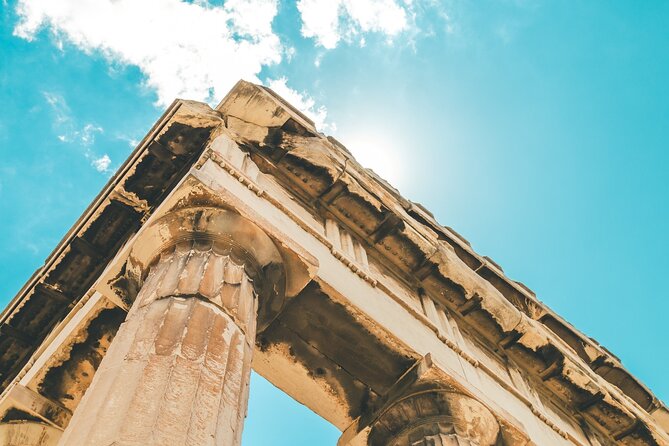
At the Ancient Agora, the group spends about 15 minutes looking toward the marketplace and center of public life. This is an important stop, but you should understand what you are buying: the tour does not enter the archaeological site.
From outside, the discussion turns to women in public space, as well as the lives of female slaves and courtesans. This is one of the strongest sections for understanding how status shaped daily experience. The phrase women in ancient Greece covers people with very different levels of freedom, money, legal protection, and social power.
The Agora also creates a sharp contrast with the private household. Men gathered here for business, debate, and civic life. Many citizen women were expected to remain away from such spaces, while enslaved women and courtesans could appear in public under very different conditions.
If the Agora is high on your Athens list, visit it separately before or after this walk. The entrance is not included in this stop, and you will gain much more from the archaeological site if you have time to see its buildings and grounds. The walking tour’s job here is to provide the social explanation.
Areopagus and a woman who challenged the rules
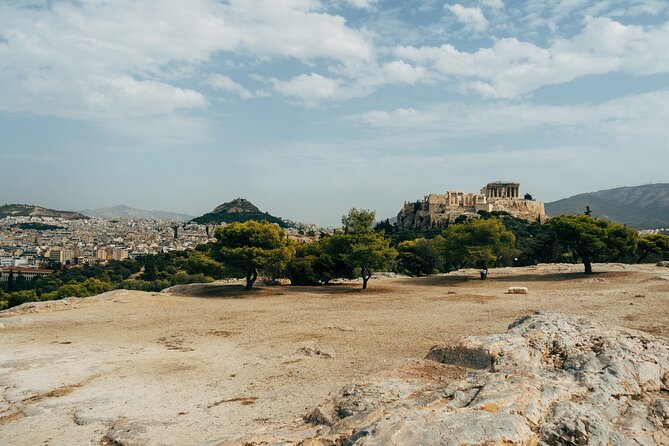
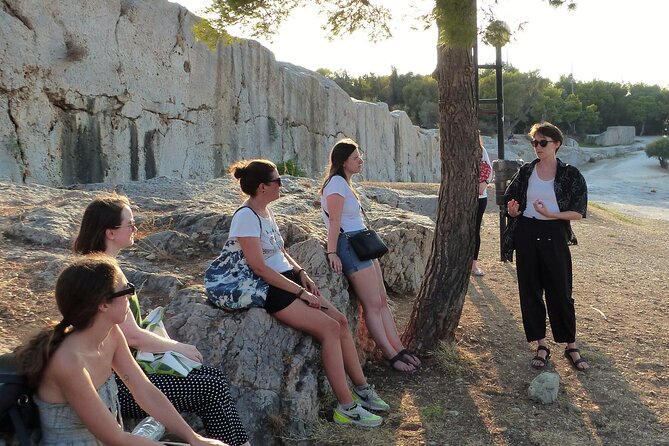
At the Areopagus, the tour explores the place where serious offenders were tried in antiquity. The stop lasts about ten minutes and introduces the story of a woman who risked a death sentence in order to change women’s rights.
This is one of the route’s most direct links between an ancient location and a story of resistance. The point is not that ancient women lived freely. They did not. The point is that restrictions were sometimes challenged by people willing to accept extreme danger.
The Areopagus is also a memorable physical stop, with exposed rock and wide views across the city. Take care on the uneven surface, especially if the ground is wet. The site rewards attention, but it is not a place to rush around while looking at your phone.
This section should appeal to anyone who enjoys history told through individual lives. Large political changes can feel distant. One person facing a harsh legal system makes the cost of those rules easier to understand.
The Pnyx, democracy with a major exclusion
The Pnyx is where the tour turns to Athenian democracy. About 15 minutes are spent at the place where citizens voted, with one essential qualification: only male citizens had that right.
For many people, the Pnyx is presented as a triumphant beginning for democratic government. This tour adds the missing question. Who counted as a citizen, and who lived under the decisions made there without having a vote?
You also hear about a woman who influenced Athenian politics during the Golden Age. That story shows that political influence and legal rights were not the same thing. A woman could shape ideas, relationships, or public decisions without being allowed to participate formally in the assembly.
This is perhaps the best stop for families and younger visitors because it invites discussion rather than passive listening. A 15-year-old interested in women’s rights should find plenty to think about, especially when the ideal of democracy is placed beside the people excluded from it.
Philopappos Hill and the Acropolis finale
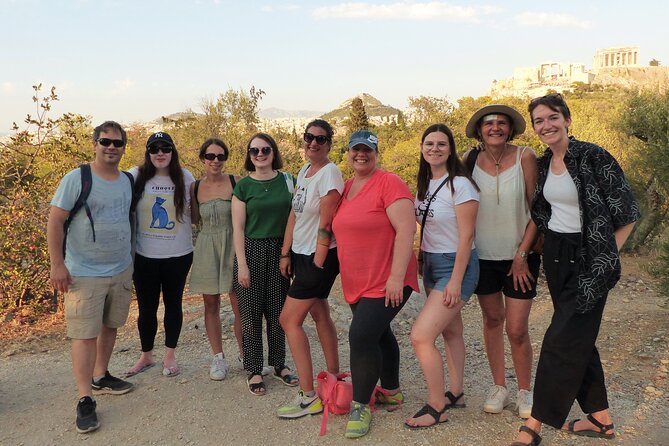
The final stop is Philopappos Hill, also called the Hill of the Muses. The tour spends about ten minutes here, among trees and open views, with the Acropolis as the backdrop.
Ending here is a smart choice. After discussions of marriage, education, law, work, religion, and political exclusion, you get space to pause and take in Athens from above. The view gives the walk a clear finish rather than leaving you beside another busy street.
The end point is listed as Philopappos Hill, with access back toward central Athens on foot and to the metro if needed. The hill is not a minor detail. It is the reason to wear sensible shoes and to think honestly about your mobility before booking.
You may also want to keep a little time after the tour for the view. The walk ends at a place suited to lingering, photography, and orienting yourself to the Acropolis and the central city.
What the $44.71 price gets you
At $44.71 per person, this is not the cheapest way to walk around Athens. You can see several of these places without paying for a guide. The value comes from the subject and the connections between stops.
A standard city walk may point out the Agora, the Pnyx, and the Areopagus, then move on to the next monument. This tour asks what each place meant for women, and it includes figures and themes you may not encounter elsewhere: Sappho, Aspasia, Agnodice, female slaves, courtesans, Eros, and a women-only festival.
The price also buys a small group rather than a crowd. That matters most if you want to ask questions or if you learn better through conversation. It matters less if you prefer to move at your own pace and read detailed signs.
There are no paid admissions built into the listed stops. Think of this as a focused guide service and walking route, not an archaeological ticket package. For a first or second day in Athens, I consider the price reasonable if this subject genuinely interests you.
Who should book this walk
I would recommend it to:
- People who have already seen the usual male-centered version of Greek history
- First-time visitors who want an early orientation to central Athens
- Parents traveling with older children or teenagers interested in equality and social history
- Anyone drawn to mythology but eager to compare myths with the lives of real women
- Visitors who prefer a small, conversational group
- History fans who want to understand how law, marriage, religion, and public space affected daily life
I would be more cautious if your priority is entering major archaeological sites. You do not go inside the Ancient Agora on this route, and the other stops are mainly outdoor viewing and discussion points.
The walk also suits people who can manage a two-hour route over uneven streets and a hill. Most participants can take part, and service animals are allowed, but the activity is not recommended for people with mobility issues.
Book with the local weather in mind. The experience requires good weather, and a poor-weather cancellation offers either another date or a full refund. You can cancel for a full refund up to 24 hours before the start time, but changes or cancellations inside that window are not refunded.
Should you book the Women History in Ancient Greece Walking Tour?
Yes, if you want Athens to be more than a parade of famous men, marble temples, and military victories. The tour gives you a clear subject, a manageable two-hour route, and a final Acropolis view that makes the experience feel complete.
I would place it early in an Athens visit, perhaps before a larger Acropolis or Agora visit. The stories about education, marriage, public space, and citizenship will help you notice what those major sites leave unsaid.
Skip it if you dislike walking, need step-free access, or want extensive time inside archaeological monuments. But if you want a thoughtful, unusual look at Athena’s city, Maelle’s walk fills a gap that many Athens tours never address. Its perfect five-star score from 38 ratings and 100 percent recommendation fit the experience’s main strength: it gives you a fresh way to understand places you may already have planned to see.
FAQ
How long is the Women History in Ancient Greece Walking Tour?
The tour lasts approximately two hours.
Where does the tour begin?
It begins at Pl. Monastirakiou 2, Athina 105 55, Greece, in Monastiraki Square.
Where does the tour end?
The tour ends at Philopappos Hill. The end point is close to central Athens on foot, with access to the metro if needed.
Does the tour enter the Ancient Agora?
No. The Ancient Agora is viewed from outside, and the discussion covers public life, women, female slaves, and courtesans.
How many people can join the tour?
The group has a maximum of 12 participants.
Can I cancel the tour for a refund?
Yes. You can cancel at least 24 hours before the experience starts for a full refund. If poor weather causes the tour to be canceled, you will be offered another date or a full refund.
Recently reviewed around Athens
- Ceramic and Pottery Creative Workshop with Two Local Artists★ 4.0 · 57 reviews
- Athens: Wine Workshop Create your Own Wine under the Acropolis★ 5.0 · 77 reviews
- Athens: Greek Wines Tasting with Sommelier and Acropolis Views★ 5.0 · 88 reviews
- Hydra Private Day Trip by Ferry from Athens with Transfers★ 4.0 · 30 reviews
- Small-Group Wine Tour in Athens with Tasting★ 5.0 · 33 reviews
- Wine Trails Private Tour/ Nemea visit 3 wineries from Athens or Nafplion (10 h)★ 5.0 · 44 reviews
- Private Athens Transfer Airport/Port -Greek Tours-Hourly service★ 5.0 · 88 reviews
- FLYING DRESS Photoshoot in Athens – Greece★ 5.0 · 47 reviews
Historical Tours, compared.
Historical Delphi One Day Tour with Arachova Stop & Expert Guide
Read our review →
Historic Athens: Small Group Electric Bike Tour
Read our review →
Half-Day Guided History and Culture Sightseeing Tour
Read our review →


Throne of Helios: The History of Rhodes in 9D Experience
Read our review →
The History of Athens: Greek Mythology Private Tour
Read our review →Browse the lists this tour appears in