
Reviewed · WALKING TOURS
Santorini: Akrotiri Prehistoric City Guided Walking Tour
Akrotiri is Santorini’s great archaeological surprise: not a ruined temple on a hill, but a whole Bronze Age city preserved beneath volcanic pumice. Streets, squares, workshops, pottery, and two- and three-story houses give you a sharper picture of daily life than a few isolated columns ever could. I like the licensed archaeologist guide and the chance to keep exploring after the formal walk. The main drawback is serious: meeting instructions and group handling have been unreliable, and the advertised private format has not always felt private.
I also like the freedom built into the 90-minute visit. You get an organized introduction, then time to slow down over details you missed or combine the site with a swim at the nearby beach. But at $424 for up to two people, before admission, this is a costly choice if the guide is late, hard to find, or absorbed into a much larger group.
In This Review
- Key points to know before booking
- Why Akrotiri is one of Santorini’s best history stops
- Meeting the archaeologist at the excavation entrance
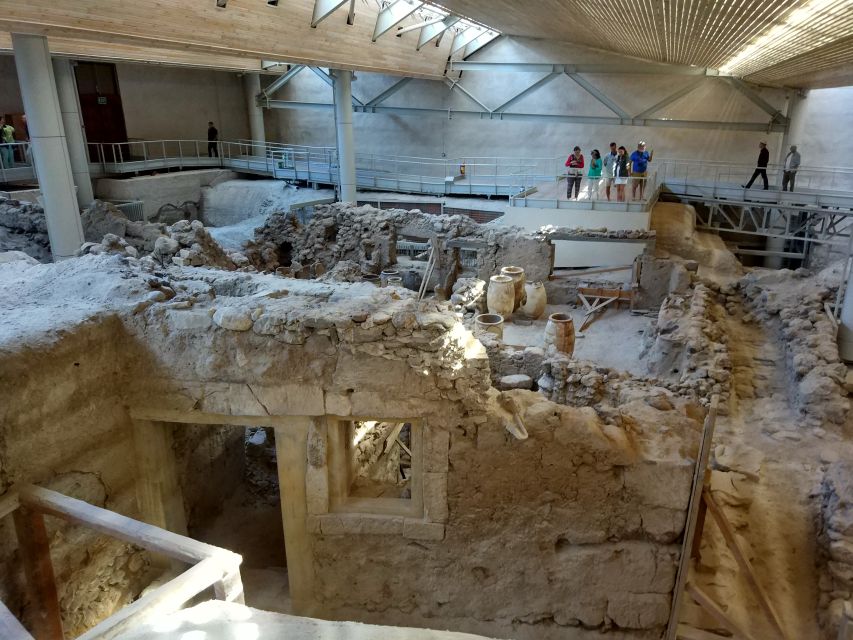
- Walking through a city preserved under pumice
- What the guided portion is supposed to add
- The private-group question
- Continuing on your own after 90 minutes
- Cost, tickets, and practical value
- Who will get the most from this visit
- Should you book the Akrotiri guided walk?
- FAQ
- Where does the tour meet?
- Is the entry ticket included?
- How long does the guided tour last?
- Can I explore Akrotiri after the guided tour?
- Is the tour private?
- What languages are available?
- Can I cancel for a refund?
Key points to know before booking
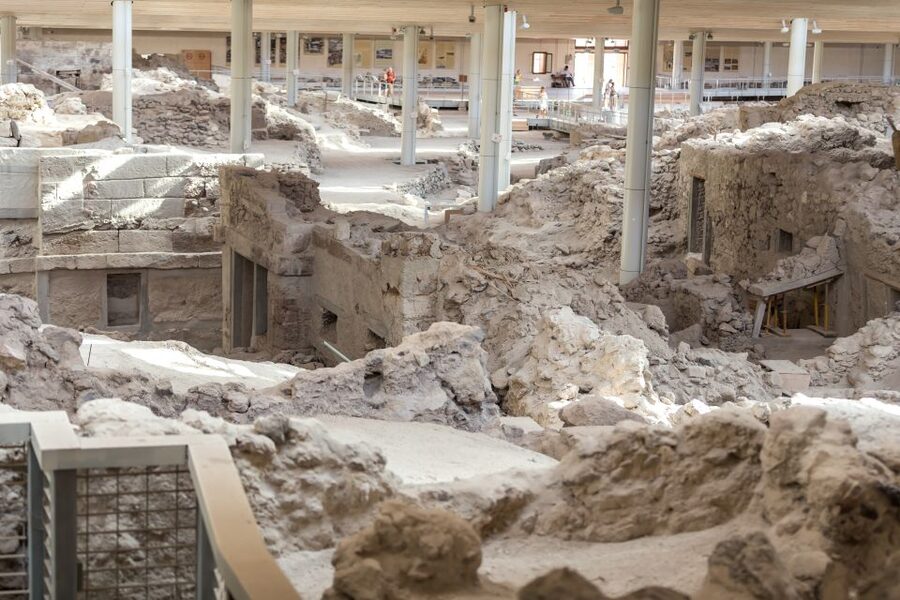
- Akrotiri is a buried city, not a single monument: You walk past streets, squares, workshops, pottery, and houses preserved under volcanic material for nearly 3,500 years.
- A licensed archaeologist leads the walk: The guide is meant to explain what you are seeing rather than simply point out ruins.
- The 90-minute format leaves room for more: After the guided portion, you can continue around the excavations at your own pace.
- The private-group promise needs care: The booking is for a private group, but some departures were combined with much larger groups.
- The meeting point is precise: Meet at the excavation entrance, after the ticket office, not simply somewhere in the wider Akrotiri area.
- Admission costs extra: The guide is included, but the archaeological site ticket is not.
Why Akrotiri is one of Santorini’s best history stops
Santorini is often treated as a place for sunsets, cliffside villages, and sea views. Akrotiri gives you a different island story. The settlement belonged to the Minoan Bronze Age world, and the volcanic eruption in the 16th century BC destroyed life on the island. Much of the city collapsed beneath the sea, while the rest disappeared under a thick blanket of pumice.
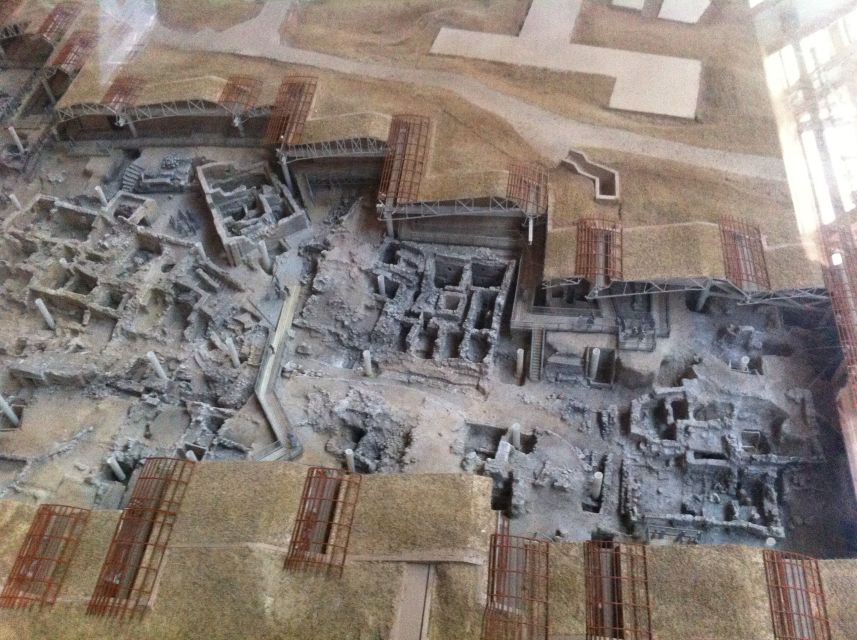
That covering is the reason so much survived. Excavations began in 1967 under Professor Spyros Marintos, revealing a planned city with roads, squares, houses, and workshops. You are not simply looking at broken walls. You are looking at the remains of an organized community that had homes, working spaces, and public routes.
The site’s connection with Atlantis adds a layer of drama, but the archaeology matters even without the myth. The Atlantis idea is a story attached to Santorini’s destruction. Akrotiri itself gives you physical evidence of a real settlement and a real catastrophe.
I would choose this visit if you want to understand what Santorini was before it became a holiday island. It also suits anyone who prefers human details to grand scenery. A pottery fragment, a narrow passageway, or the plan of a house can tell you more about ordinary life than a sweeping view from Oia.
More Santorini walks with a guide:
- Fira: Guided Foodie Walking Tour with Tastings
★ 4.9 · 474 reviews - Athens: Acropolis and Parthenon Guided Walking Tour
★ 4.6 · 5,882 reviews - Greek Food Walking Tour in Athens
★ 5.0 · 4,740 reviews
Meeting the archaeologist at the excavation entrance
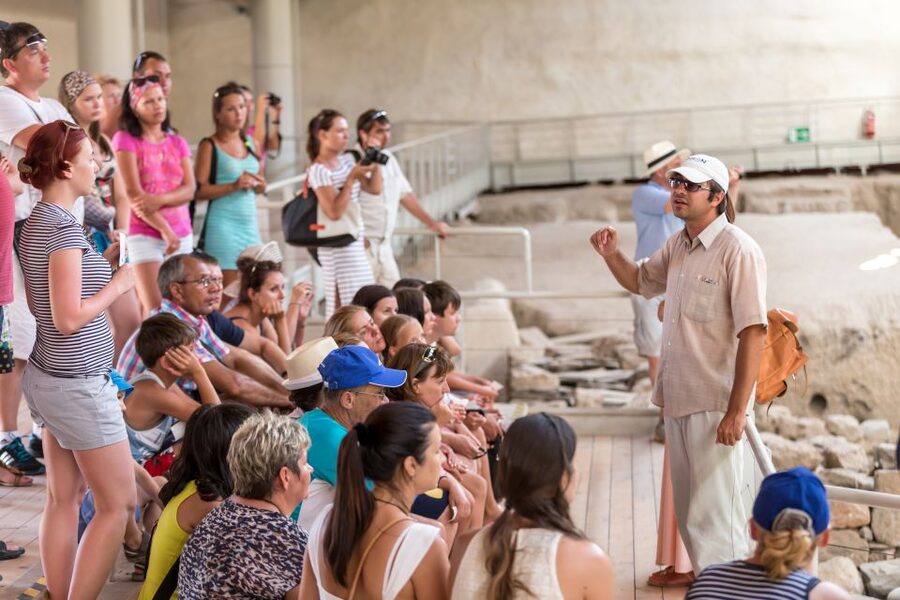
Your guide meets you at the entrance of Akrotiri Prehistoric City, after the ticket office. This detail matters. The tour does not include your entry ticket, so you first need to buy admission before reaching the meeting point.
The guide is a licensed archaeologist, and that is the central reason to pay for this experience rather than simply walk through alone. A good guide can explain how to read the remains: why a street is important, what a workshop suggests about local work, and how the layout of a building helps identify its use.
The available languages are English, French, Spanish, and German. No individual guide name is supplied with the booking information, so you should not expect to request a particular archaeologist unless the provider confirms one directly.
The meeting arrangement deserves extra attention. Several bookings had trouble locating the guide, and some people waited while a guide joined or started another group. In one case, the guide apparently left without identifying everyone. These are not small annoyances at an archaeological site, where the entrance area can be busy and a missed connection can cost much of your short visit.
I recommend arriving early, standing near the stated entrance, and making yourself easy to identify. Keep your phone available for provider messages, including spam folders if you booked hotel transport. If the booking confirmation gives a guide name or phone number, save it before leaving your hotel.
Walking through a city preserved under pumice
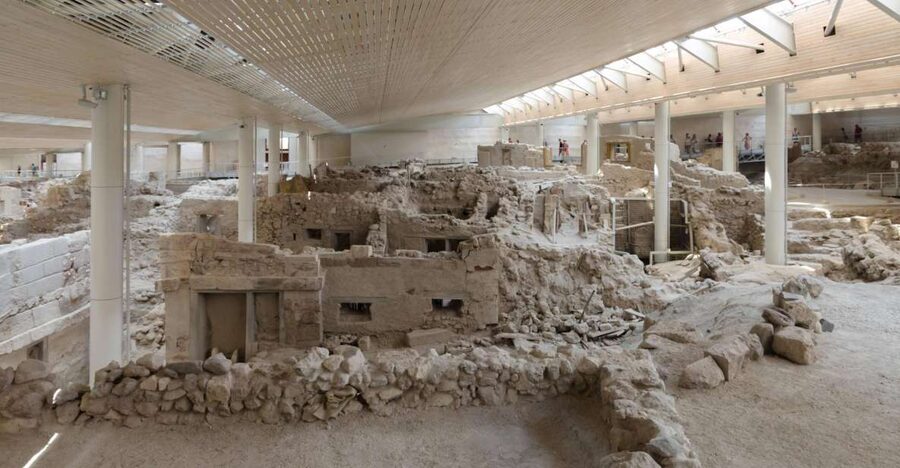
The guided walk takes about 90 minutes. During that time, you move through the excavated area and see the physical outline of Akrotiri rather than receiving a lecture detached from the ruins.
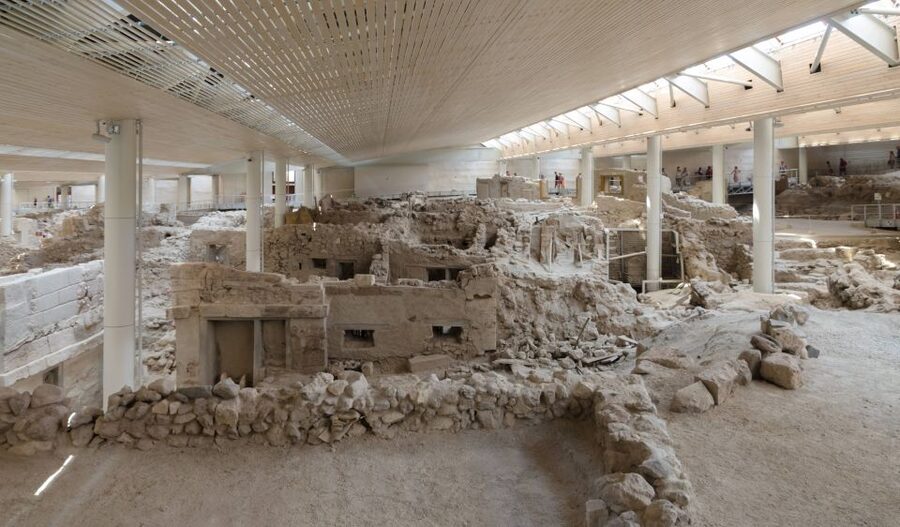
The roads and squares are especially useful for orientation. They show that this was not a random cluster of houses. You can begin to picture movement through the settlement, with people passing between homes, work areas, and open spaces.
The workshops add another layer. Pottery and other objects help connect the buildings with practical activity. I like this part of the visit because it keeps the city grounded. Akrotiri was not only a place of grand wall paintings or wealthy homes. It was also a working town.
The buildings are the site’s most striking feature. Some houses rose two or three stories, an unexpected sight when you think of ancient ruins. Their original interiors were decorated with wall paintings, and the preserved structure gives you a sense of height and planning that many Bronze Age sites cannot offer.
Do not rush past the passageways. They may look modest beside a large building, but they make the city easier to imagine. You can see how residents moved through the settlement and how tightly the buildings were arranged.
The guide’s job is to make these remains readable. Without context, an ancient wall can be just a wall. With explanation, the same wall becomes part of a house, workshop, street, or neighborhood. The strongest possible version of this tour should help you connect those pieces.
What the guided portion is supposed to add
A licensed archaeologist can provide more than dates. You need someone to explain what is certain, what is inferred, and why the excavated structures matter. The booking promises insight into the ancient civilization of Santorini, which is exactly the right goal for a site that can otherwise feel quiet and abstract.
One particularly useful feature is the contrast between preservation and destruction. The eruption ended the city, but the pumice also protected it. That tension gives the visit its force: the same event that ruined Akrotiri helped preserve its streets and houses for almost 3,500 years.
The guide can also help you read scale. Two- and three-story homes do not merely look impressive. They suggest a settlement with planning, construction skill, and enough social organization to support substantial buildings. Pottery and workshops point toward daily production and trade, though the supplied details do not promise a specific explanation of each object.
The experience is at its best when you ask questions. Ask about the roads, the squares, the workshops, and the wall paintings. Ask how archaeologists know a building had more than one floor. The tour is short, so direct questions help you get more value from the time.
More Santorini trips worth a second look
- Santorini Classic Catamaran Cruise with BBQ, Drinks and Transfers
★ 5.0 · 3,933 reviews - Half-Day Exclusive Catamaran Cruise in Santorini with Meal and Open Bar
★ 5.0 · 2,975 reviews - Santorini Gold Catamaran Cruise with Snorkel, BBQ & Open Bar
★ 4.8 · 2,822 reviews - Private Santorini Tailor Made – Choice of the Guest!
★ 5.0 · 1,972 reviews
The private-group question
On paper, this is a private group for up to two people. That setup should offer a quieter pace and a chance to ask questions without competing with a busload of people.
In practice, group handling appears to be the largest weakness. Some departures placed small bookings into much larger groups, including a bus tour group. One account described roughly 30 people with one guide. Another said the guide was difficult to hear because the group was too large.
That changes the experience completely. A private visit should allow you to stand close enough to hear, stop when a detail interests you, and receive answers suited to your interests. In a large group, you may get a general talk and little time for personal questions.
There were also reports of guides leaving before every booking had been gathered, guides arriving late, and a guide not being sent at all. In one situation, another guide kindly allowed the booking party to join a different tour, but that was not a substitute for the private experience that had been paid for.
I would not ignore these operational concerns simply because Akrotiri itself is excellent. The site can be visited independently, and several people felt that doing so was the safer choice after a failed meeting. If the provider confirms your guide and group size before the day, the risk is easier to manage.
Continuing on your own after 90 minutes
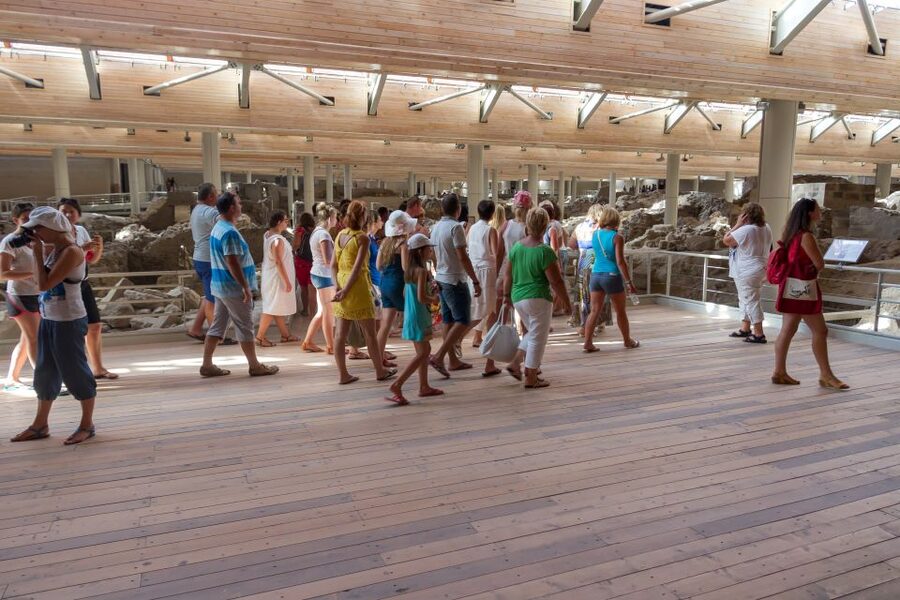
The formal tour ends with free time to explore independently. This is valuable because 90 minutes can feel quick at a large archaeological site, especially when the guide is explaining the basic story and answering questions.
Use the extra time to revisit the areas that caught your attention. You might spend longer with the pottery, compare the size of the buildings, or follow the roads and passageways at a slower pace. The supplied information does not specify a separate audio guide or additional commentary, so your independent time is self-guided.
The freedom also lets you combine the archaeology with the nearby beach. After walking through the excavations, you can go for a swim. That makes this a flexible half-day idea, although the tour itself lasts only 1.5 hours and the ticket does not include admission to the site.
This combination works well for couples. One person can linger over archaeological details while the other prefers the sea. You are not forced to leave as soon as the guide finishes.
Cost, tickets, and practical value
The listed cost is $424 for a group of up to two. Since admission is not included, your final cost is higher. For a couple, that is a major spend for a 90-minute guided walk.
The price can make sense if you receive the service promised: a dedicated licensed archaeologist, clear meeting support, and a private pace. It makes less sense if you are placed with a large group or given only a short generic introduction.
The strongest praise for the experience focuses on the site and the amount there is to learn. That distinction matters. Akrotiri is worth seeing, but the value of this particular booking depends on the guide operation.
You can also reserve now and pay later, which helps if your island schedule is still changing. Free cancellation is available up to 24 hours before the activity for a full refund. If you choose hotel transfer, pickup information is sent separately after booking, so check your spam folder as well as your main inbox.
The tour is listed as wheelchair accessible. Because the supplied information does not describe every surface or route in detail, contact the provider if you need to confirm a particular access requirement.
Who will get the most from this visit
I would recommend the format to a couple or small family that values expert explanation and does not want to research Akrotiri alone. It is also a good match for travelers who want a focused historical stop followed by independent time.
The language choice helps if you prefer English, French, Spanish, or German. The short duration suits a packed Santorini schedule, especially when you want to continue to the beach afterward.
I would be cautious if you are paying specifically for privacy, need a tightly managed meeting, or have only one chance to visit before leaving the island. The reports of missing guides, late arrivals, unclear instructions, and large merged groups are too consistent to dismiss.
If you book, confirm three things in writing: where the guide will stand, how you will identify one another, and whether the group will remain private for up to two people. Those answers will tell you much about the service you are likely to receive.
Should you book the Akrotiri guided walk?
Book it if Akrotiri is a priority and you want an archaeologist to give meaning to the streets, workshops, pottery, and multi-story houses. The archaeological site is special, and the option to continue alone gives you welcome freedom.
I would not book this at $424 without first confirming the guide and private group arrangement. If the provider cannot give clear answers, visit Akrotiri independently and save the money. The ruins are the real prize, while the service has shown enough warning signs to require careful checking.
FAQ
Where does the tour meet?
Meet your assigned guide at the entrance of the Akrotiri Excavation Site, after the ticket office.
Is the entry ticket included?
No. The archaeological site entry ticket is not included in the tour price.
How long does the guided tour last?
The guided walking tour lasts 1.5 hours, or 90 minutes.
Can I explore Akrotiri after the guided tour?
Yes. Free time to continue exploring the site on your own is included.
Is the tour private?
The activity is advertised as a private group for up to two people. Confirm this with the provider because some departures were combined with larger groups.
What languages are available?
Live guiding is available in English, French, Spanish, and German.
Can I cancel for a refund?
Yes. You can cancel up to 24 hours in advance for a full refund. You can also reserve now and pay later.
Recently reviewed around Santorini
- Small-Group Tour: Best of Santorini★ 4.7 · 42 reviews
- Santorini: Private Sightseeing Tour with Local Guide★ 4.9 · 105 reviews
- Santorini: Wine Tour with Sunset in Oia★ 4.6 · 199 reviews
- Santorini: Tour of Wineries with Wine Tasting & Food★ 5.0 · 279 reviews
- From Santorini: Volcano Cruise With Oia Sunset★ 4.3 · 97 reviews
- Santorini Wine Roads: Tour of 3 Wineries with a Sommelier★ 4.8 · 79 reviews
- Santorini Volcano, Hot Springs Adventure★ 3.6 · 54 reviews
- Santorini: Small-Group Highlights Tour of Venetian Castles★ 4.9 · 83 reviews
Walking Tours, compared.




Acropolis monuments & Parthenon Walking Tour with Optional Acropolis Museum
Read our review →
Knossos: Knossos Palace Skip-the-Line Guided Walking Tour
Read our review →

Athens Authentic Greek Food Walking Tour (Small Group)
Read our review →
Early Morning Acropolis & Old Athens Guided Walking Tour
Read our review →Browse the lists this tour appears in