
Reviewed · WALKING TOURS
Small Group Corfu Walking City Tour
Corfu’s old town is best understood on foot, and this small-group walk takes you from grand squares to quiet lanes in about two hours. Guide Efi leads the route through Venetian, British, French, and Greek chapters of the city, pointing out details you could easily miss on your own.
I like the eight-person limit, which leaves room for questions and keeps the walk personal. I also like the central meeting point by the Old Fortress, plus the practical advice about local food, kumquat products, olive oil, shops, and cafés.
The main consideration is the walking itself. Corfu’s old town has cobbled streets, heat in summer, and enough uphill or uneven ground to make comfortable shoes and water essential. The tour is not recommended for babies or toddlers, pregnant people, or those with physical limitations, heart conditions, or asthma.
In This Review
- Key points at a glance
- Why a walking tour works so well in Corfu Town
- Starting near the Old Fortress
- The Esplanade and Liston
- The Old Fortress from the outside
- Saint Michael and Saint George Palace
- City Hall Square and San Giacomo
- Campiello, Corfu’s oldest quarter
- Saint Spyridon and everyday Corfiot life
- How the guide shapes the experience
- Is $78.44 a fair price?
- Timing, weather, and what to bring
- Who should book this walk?
- Should you book the Corfu walking tour?
- FAQ
- How long does the Corfu walking tour last?
- How large is the group?
- What language is the tour offered in?
- Where does the tour begin?
- Where does the tour end?
- Are hotel or port transfers included?
- Are entrance tickets included?
- What should I bring?
- Is the tour suitable for people with mobility or health concerns?
Key points at a glance
- A compact two-hour introduction: See the major sights of Corfu Town without giving up an entire day.
- A genuine small group: The maximum is eight people, so questions are easier and the guide can keep the pace flexible.
- A history-led walk: Learn how Venetian, British, French, and Greek influences shaped the city.
- Major sights from the outside: Visit the Esplanade, Liston, Old Fortress, Saint Michael and Saint George Palace, City Hall Square, and Campiello.
- Useful local advice: Get suggestions about Corfiot olive oil, kumquat products, pastry shops, tavernas, wine cellars, and shopping.
- A central start and finish: The walk begins and ends in central Corfu Town, with no hotel or port transfer included.
Why a walking tour works so well in Corfu Town
Corfu Town can look easy to cover on a map. The old center is compact, and many of its main sights sit close together. But the city’s story is layered, and its architecture can blur together if you do not know what you are seeing.
A guide gives the streets a clear order. Instead of viewing the Esplanade, Liston, churches, palaces, and narrow lanes as separate photo stops, you begin to see how different powers shaped the city over time. That context is the main reason to book this walk.
The route stays outside the buildings. You should not expect interior visits to the Old Fortress, Saint Michael and Saint George Palace, City Hall, or Saint Spyridon Church. The value comes from orientation, explanation, and the chance to notice architectural details while moving through the city.
I would schedule this near the beginning of your stay. Once you know the old town’s layout, you can return to the places that caught your eye, choose a café with more confidence, and shop for local products without wandering in circles.
More Walking Tours in Corfu
- Corfu Town: Guided Walking Tour and Local Food Tastings
★ 4.9 · 313 reviews - Taste Corfu: Private Corfu Food Walking Tour
★ 5.0 · 82 reviews - Corfu: Gastronomy Walking Tour
★ 4.9 · 78 reviews
Starting near the Old Fortress
The stated meeting location is at the Statue of Count Von Der Schulenburg, on Agoniston Politechniou in central Kerkira. The tour is also described as starting at the Old Fortress Gate, so check your confirmation carefully for the exact meeting instructions before setting out.
This is a useful starting area. The Old Fortress sits beside the Esplanade and helps you get your bearings at once. You are not beginning in a distant suburb or waiting for a transfer. Hotel, port, and other pickup services are not included, so you need to reach the meeting point yourself.
The walk returns to the same area at the end. That makes the tour easy to combine with your own plans, though you should leave a little room afterward if the guide spends extra time answering questions. One small group once continued for roughly 45 minutes beyond the planned two hours, showing that the pace can stretch when the group is engaged.
The Esplanade and Liston
The Esplanade is the first major space to give you a sense of Corfu’s scale. It is one of Greece’s largest and most attractive squares, with open lawns, paths, mature shade trees, and carefully maintained gardens.
After narrow old-town lanes, the Esplanade feels broad and airy. It also gives you a clear view toward the Old Fortress. This is a good place to understand the city’s position and defensive past before turning into the denser historic center.
Along the edge of the square, the Liston arcade brings a different mood. Its covered gallery is lined with cafés and bars, making it one of the easiest places to pause and watch daily life unfold. The architecture reflects Corfu’s French period, and the arcades give the area a polished, formal appearance.
I especially like this opening sequence because it balances scenery with context. You get a large public square, a fortress, and a café-lined arcade before entering the more complicated network of streets. If you have only just arrived in Corfu, this is a helpful way to get oriented quickly.
The Old Fortress from the outside
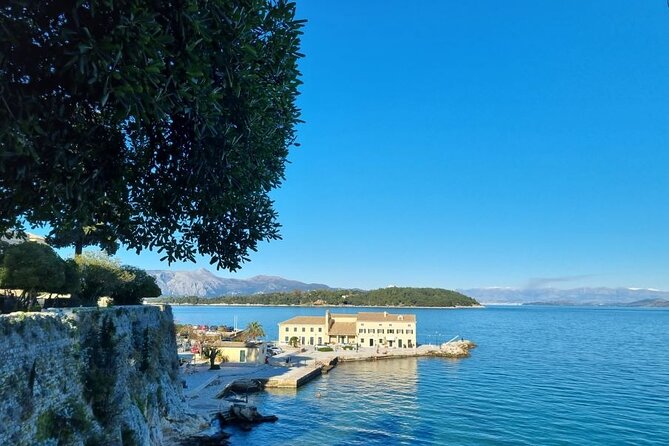
Opposite the Esplanade, the Old Fortress recalls the Venetian era and dates in part to the 14th century. You will admire it from outside during this walking tour rather than taking a full fortress visit.
That distinction matters. If you want to climb through the fortress grounds, inspect its defenses, or spend time at its own sights, you will need a separate visit and additional time. This tour uses the fortress mainly as a landmark and a way to explain Corfu’s strategic importance.
From the outside, it still makes a strong impression. Its position beside the water and the Esplanade shows why this was such a valuable defensive site. Your guide can connect what you see to the city’s Venetian past, then move you onward to the civic buildings and older neighborhoods.
More Corfu walks with a guide:
- Corfu: History and Culture Walking Tour
★ 4.9 · 55 reviews - Corfu: Small Group City Walking Tour
★ 5.0 · 51 reviews - Small-group Corfu Town Historical Walking Tour
★ 5.0 · 39 reviews - Corfu: Old Town Guided Walking Tour Small Group
★ 4.8 · 36 reviews
Saint Michael and Saint George Palace
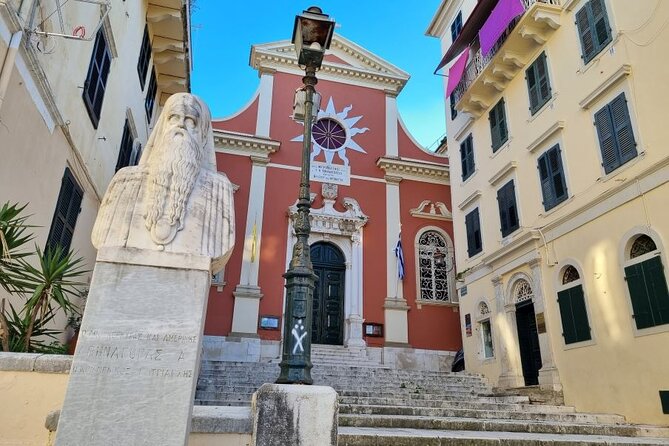
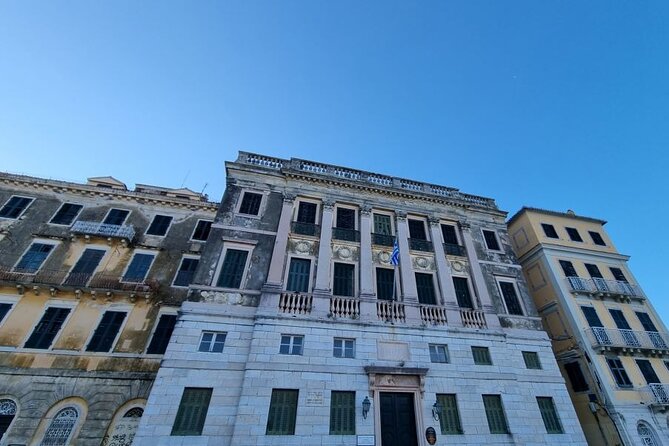
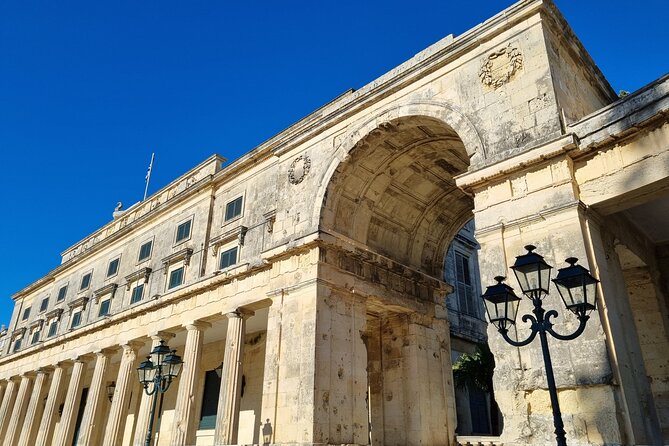
Near the Esplanade, the Neoclassical Palace of Saint Michael and Saint George is one of Corfu’s grandest buildings. It was built between 1819 and 1823 and gives the route a sharp change in architectural character.
The palace helps show that Corfu’s story did not end with Venetian rule. Its formal Neoclassical design belongs to another period and another set of political influences. Seeing it in sequence with the Old Fortress and Venetian mansions lets you compare the city’s changing styles without needing a museum lecture.
Again, the experience is an exterior visit. You are stopping to examine the building, hear its place in Corfu’s past, and continue through town. That makes the tour efficient, but anyone hoping to explore palace interiors should plan extra time separately.
City Hall Square and San Giacomo
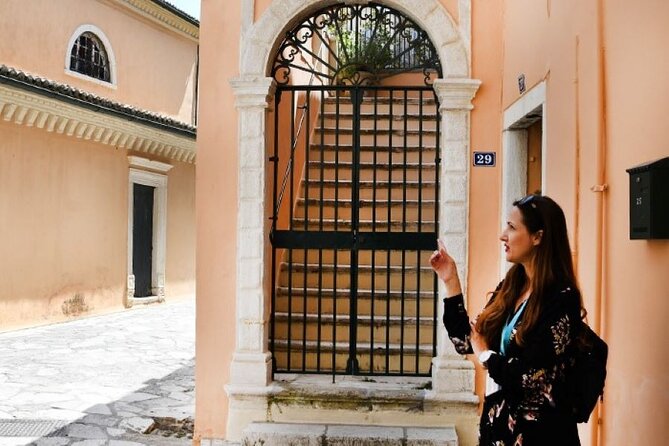
The route continues to City Hall Square, where the Dimarcheion, or Town Hall, provides another architectural highlight. The building was expanded in 1903 but began as a meeting hall for Venetian nobility.
Beside it is the Episcopal Church of San Giacomo, built in the 17th century. This close pairing gives you two useful points of comparison: a civic building tied to the Venetian elite and a church rooted in the city’s religious life.
Small details can be easy to miss here. A guide helps you look beyond the building’s front and understand why the square mattered. I find this kind of stop more rewarding than simply ticking off a famous church, because it explains how power, religion, and public life occupied the same small part of the city.
Campiello, Corfu’s oldest quarter
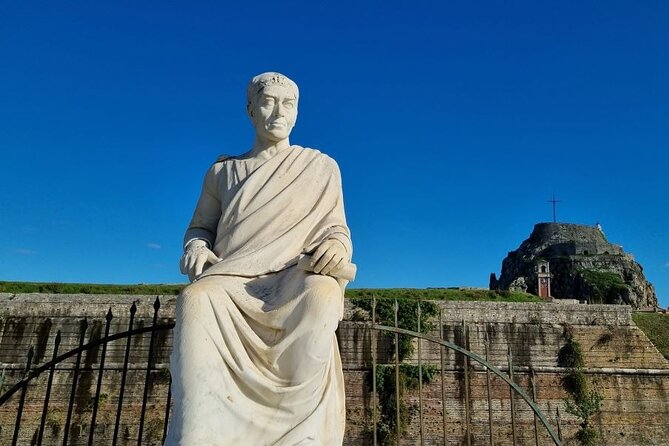
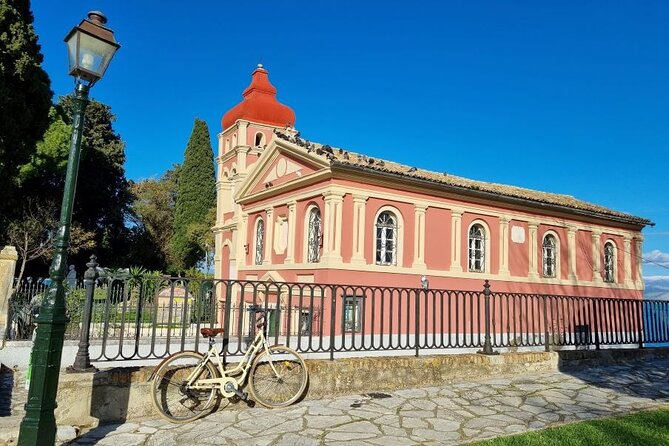
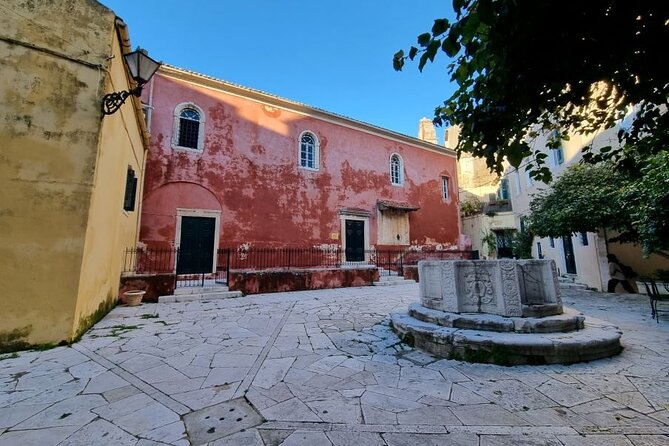
Campiello is one of the most atmospheric parts of the walk. This is the oldest quarter of the island, with narrow cobbled streets, small squares, and some of Corfu’s most appealing architecture.
The area rewards a slow pace. You may find yourself looking upward at balconies and old façades, then turning into a lane that feels much more intimate than the formal Esplanade. This is where a small group helps. Eight people can move through tight streets with less fuss than a large coach group, and the guide has a better chance to point out small features.
Campiello is also where Corfu feels most like a lived-in town rather than a collection of monuments. The route is not only about grand buildings. It is about how the old streets connect, how the city’s scale changes, and how the past remains part of ordinary daily life.
The cobblestones can be uneven. If you have weak knees, balance concerns, or difficulty walking for two hours, take the physical warning seriously. The tour does not suit every visitor, even though most people can participate.
Saint Spyridon and everyday Corfiot life
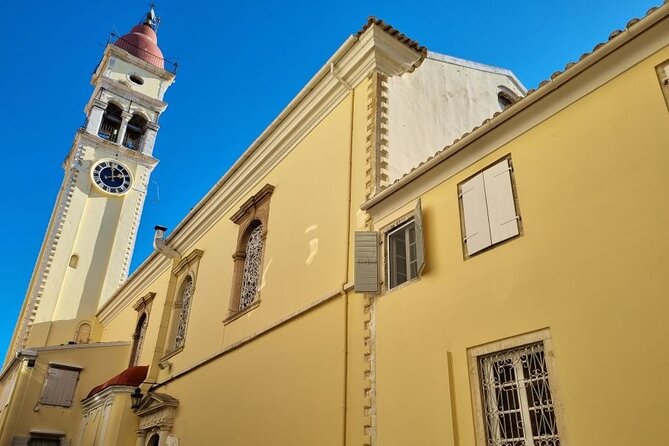
The walk includes the Church of Saint Spyridon, dedicated to Corfu’s patron saint. The church holds the relics of Saint Spyridon, making it one of the most important religious sites in town.
You should treat this as a meaningful cultural stop, not just another façade. Your guide can explain why Saint Spyridon matters to Corfiot identity and how the church fits into the old town’s daily life. As with the other sights, the listed experience focuses on viewing the city from outside, so confirm separately if you want a longer interior visit.
The surrounding streets bring the tour into present-day Corfu. Shops and stalls sell local products, including kumquat goods and Corfiot olive oil. You may also pass pastry shops, tavernas, and wine cellars offering local wines.
This is one of the most practical parts of the walk. You are not just learning where the landmarks are. You are getting ideas for what to taste, what to look for in shops, and where to return after the tour. I would write down suggestions as you go, since a two-hour walk gives you plenty of impressions but not always enough time to remember every name.
How the guide shapes the experience
The guide is a major part of this tour’s value. Efi is specifically associated with the walks, and the experience depends on her ability to explain Corfu’s past in a clear sequence rather than burying you under dates.
The best version of a history walk connects each period to something in front of you. The Venetian fortress, British-era palace, French-influenced Liston, neoclassical buildings, churches, and Greek customs all become part of one story. Efi is also noted for answering questions and adjusting the pace rather than simply reciting prepared facts.
That personal approach is helped by the group size. With no more than eight people, you can ask about a building, stop for a quick explanation, or request advice on food and shopping. A larger group often makes that kind of exchange harder.
The flexibility has one tradeoff. The advertised duration is about two hours, but a particularly curious group may take longer. If you have a ferry, shore excursion, meal reservation, or other fixed appointment, do not plan the timing too tightly.
Is $78.44 a fair price?
At $78.44 per person, this is not the cheapest way to see Corfu Town. You can walk the streets for free, and many of the sights are visible from public spaces without an admission charge.
The comparison is not really free walking versus paid walking. It is independent sightseeing versus two hours of organized explanation in a group capped at eight. If you value historical context and want a local guide to connect the sights, the price can be reasonable, especially at the start of a short stay.
The tour includes the professional guide and taxes. It does not include drinks, tips, admission fees, or transfers from your hotel or port. Since the main route is an exterior walk, you are paying chiefly for the guide’s time and interpretation, not bundled entry tickets.
I would consider it good value for a first visit, a short port stop, or anyone who prefers to understand a city before exploring alone. If you already know Corfu’s history and simply want to photograph the main sights, the cost may feel less worthwhile.
Timing, weather, and what to bring
Two hours sounds modest, but Corfu’s sun and cobblestones can make the walk feel substantial. In summer, bring a hat, sunscreen, comfortable shoes, and water. The advice to carry water is worth following, especially since the route includes extended walking and may include little shade in open areas.
During cooler months, conditions can change quickly. Bring a light jacket, coat, umbrella, or rain jacket according to the forecast. The experience requires good weather, and poor conditions can lead to a new date or a full refund.
The tour is offered in English and uses a mobile ticket. Confirmation is provided at booking. Service animals are allowed, and the meeting point is near public transportation, though transfers themselves are not part of the experience.
Audio recording and video filming are not permitted. If you want a personal record, rely on written notes and photographs where appropriate, while keeping your attention on the guide and the streets around you.
Who should book this walk?
I would recommend it to first-time visitors who want a clear introduction to Corfu Town. It also suits people staying in the old town who have already seen a few buildings but want the story behind them.
It works particularly well for history-minded visitors, couples, solo visitors, and small family groups with older children who can manage two hours on foot. The small size makes it easier to ask questions and easier to hear the guide in narrow streets.
You should think carefully before booking if you dislike guided sightseeing, want long interior visits, or have a tight schedule that cannot tolerate a slower or longer finish. The physical warning is also important. This is a real walking tour, not a sightseeing ride with occasional stops.
The tour has a 98 percent recommendation rate and a 4.9 rating from 57 ratings, which fits the experience’s strongest points: Efi’s clear storytelling, the steady pace, and the chance to see much of the old center in a single outing. The most useful praise is not that the walk is simply pleasant. It is that the history remains understandable while you are moving.
Should you book the Corfu walking tour?
Book it if you want context, orientation, and local suggestions more than admission tickets. In two hours, you can see Corfu Town’s signature public spaces, major façades, oldest quarter, patron-saint church, and shopping streets, all while building a useful mental map.
The price makes the most sense at the beginning of your stay, when the guide’s food and shopping tips can shape the rest of your time. Bring water, wear shoes suited to cobbles, and allow some flexibility after the scheduled finish.
Skip it if you want a self-guided stroll or a full interior tour of the fortress, palace, and churches. For most first visits, though, this is a focused and friendly way to meet Corfu Town before exploring it at your own pace.
FAQ
How long does the Corfu walking tour last?
The tour lasts approximately two hours. It may run longer if the group has many questions or takes extra time at the sights.
How large is the group?
The maximum group size is eight people. This keeps the walk more personal and gives you a better chance to ask questions.
What language is the tour offered in?
The tour is offered in English.
Where does the tour begin?
The listed meeting point is the Statue of Count Von Der Schulenburg on Agoniston Politechniou in Kerkira. The tour information also describes the start as the Old Fortress Gate, so check your booking confirmation for the exact meeting instructions.
Where does the tour end?
The activity ends back at the meeting point.
Are hotel or port transfers included?
No. Transfers from hotels, the port, or other locations are not included.
Are entrance tickets included?
The walk includes outside views of the listed sights, and no admission tickets are included. Fees and taxes for the tour itself are included.
What should I bring?
In summer, bring a hat, sunscreen, comfortable shoes, and water. In cooler or wet weather, bring a light jacket, coat, umbrella, or rain jacket.
Is the tour suitable for people with mobility or health concerns?
The tour is not recommended for babies or toddlers, pregnant people, people with physical challenges, or those with cardiovascular issues or asthma. Most other participants can take part, but the route involves extended walking on cobbled streets.
Recently reviewed around Corfu
- Private Airport Transfer Service in Corfu★ 5.0 · 33 reviews
- Cooking Classes and olive oil tasting.The real taste of Greece!★ 5.0 · 56 reviews
- Elysium Transfer & Rental Services, Greece★ 5.0 · 48 reviews
- Paragliding Tandem Flight in Corfu★ 5.0 · 167 reviews
- Visit Corfu Private Tour – The Best Way to Discover Corfu★ 4.5 · 51 reviews
- Best Corfu Tour with Boat Trip & Old Town for Cruise Passengers★ 4.5 · 107 reviews
- The Amazing Glyfada Beach★ 4.0 · 43 reviews
- Leisurely Tour of Corfu★ 4.0 · 151 reviews
Walking Tours, compared.



Acropolis monuments & Parthenon Walking Tour with Optional Acropolis Museum
Read our review →
Knossos: Knossos Palace Skip-the-Line Guided Walking Tour
Read our review →

Athens Authentic Greek Food Walking Tour (Small Group)
Read our review →
Early Morning Acropolis & Old Athens Guided Walking Tour
Read our review →Browse the lists this tour appears in