
Reviewed · ATHENS TOURS
Athens, Piraeus, and Coastline: Blue Hop-On Hop-Off Bus
The best thing about this bus pass is its reach. For about $14 per person, you can connect the cruise port, central Athens, and the seaside suburbs without paying for separate taxis. I especially like the direct pickup at Piraeus cruise terminals and the chance to use the pass over two days, not just for one quick city loop.
I also like the freedom to mix serious sightseeing with a beach stop. The Acropolis and Panathenaic Stadium are on the city routes, while Agios Kosmas, Glyfada, and Vouliagmeni Lake give you a change of pace. The main caution is traffic and route timing. A bus may arrive quickly in one part of the city, yet the ride back toward Athens or Piraeus can slow to a crawl.
In This Review
- Key points to know
- Four bus lines, one easy Athens plan
- From Piraeus cruise terminals to the Acropolis
- The Orange Line and Athens’s historic center
- The Yellow Line toward Glyfada and the Riviera
- The Green Line and Vouliagmeni Lake
- Timing, traffic, and the art of getting off wisely
- Price, comfort, and overall value
- Who should book this Athens bus pass?
- Final call: a smart buy with one important warning
- FAQ
- How long is the Athens, Piraeus, and Coastline bus ticket valid?
- Which bus lines are included?
- Can I board at the Piraeus cruise terminals?
- Does the ticket include admission to the Acropolis or museums?
- Is the audio guide available in English?
- Are earphones provided?
- Is Wi-Fi available onboard?
- Is the bus wheelchair accessible?
- Can children ride for free?
Key points to know
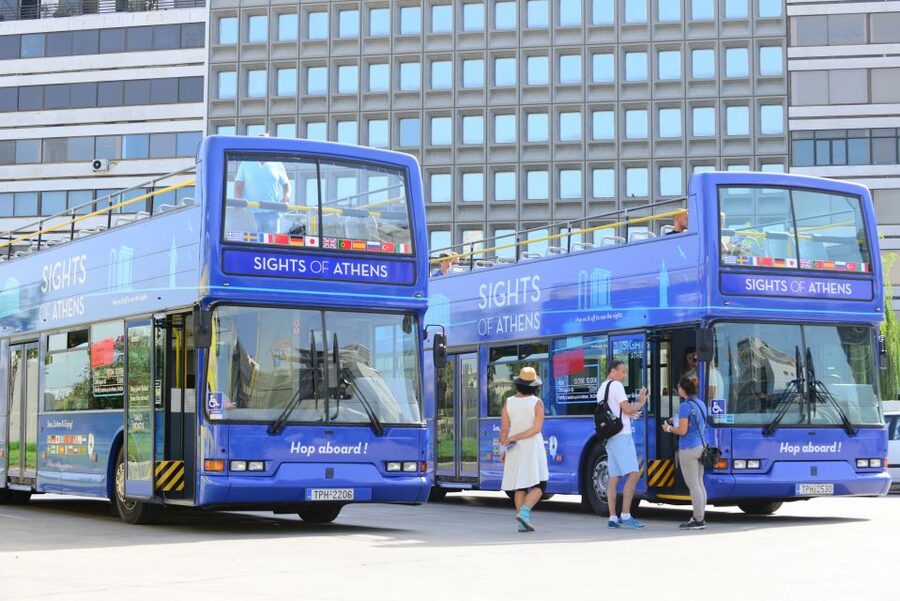
- Four routes on one ticket: Cover Athens, Piraeus, Glyfada, and Vouliagmeni with the Orange, Blue, Yellow, and Green lines.
- Excellent for cruise passengers: Board near Cruise Terminals A, B, or C and ride toward the Acropolis instead of walking or arranging a taxi.
- Two days of use: Activate the ticket once, then use it for the included operating period of two days.
- A practical beach escape: The coastal lines reach Agios Kosmas, Kavouri Oceanis, Glyfada, and Vouliagmeni Lake.
- Useful onboard extras: Recorded commentary comes in 16 languages, with disposable earphones and Wi-Fi included.
- Plan around the last bus: Departure times can vary by route, and missing the final service can make a port return stressful.
Four bus lines, one easy Athens plan
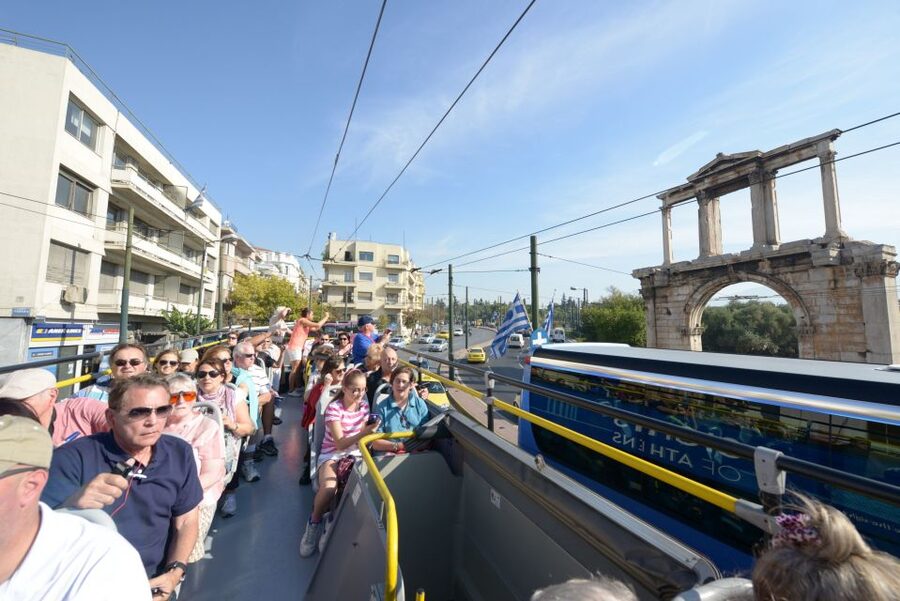
This is less a guided tour than a flexible transport pass with a sightseeing soundtrack. You choose the stops, decide how long to stay, and reboard when you are ready.
The ticket covers four lines:
- The Blue Line links Piraeus with Athens.
- The Orange Line circles central Athens.
- The Yellow Line runs toward Glyfada and the Athenian Riviera.
- The Green Line continues toward Vouliagmeni.
The ticket is valid for two days from first activation. The included information describes this as a one-day ticket with a complimentary second day, but for your planning purposes, the useful fact is simple: once activated, you have two days to use the network.
That extra day matters. You can spend the first day on the historic center and save the second for the coast. Or, if you arrive from a cruise, use the first ride as a transfer into Athens and return to Piraeus the following day.
More Athens trips worth a second look
- Athens: Acropolis & up to 5 Archaeological Sites Combo Pass
★ 4.4 · 12,619 reviews - Athens: Acropolis Ticket with Optional Audio or Live Guide
★ 4.2 · 11,055 reviews - Athens: Acropolis, Parthenon & Acropolis Museum Guided Tour
★ 4.8 · 9,316 reviews
From Piraeus cruise terminals to the Acropolis
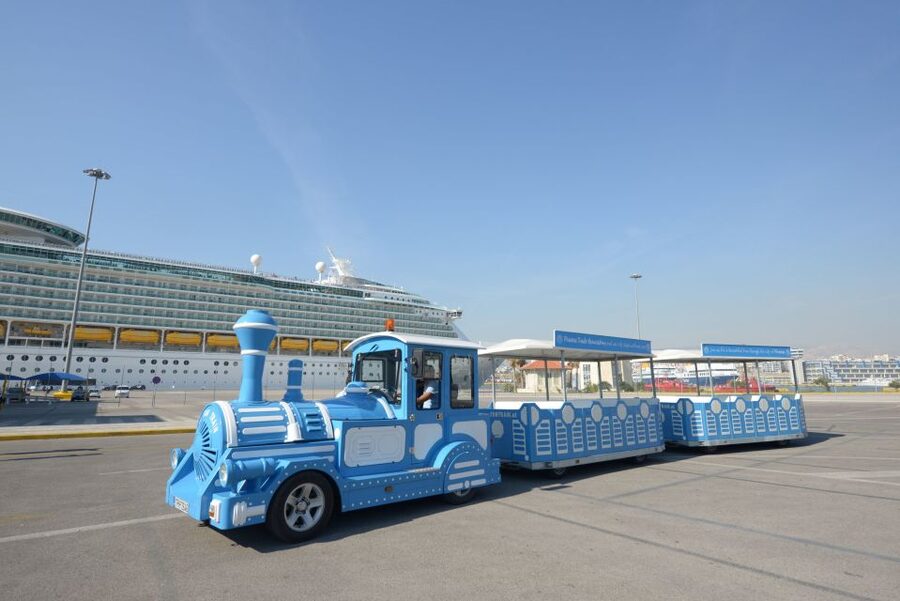
The Blue Line is the most useful part of the experience for cruise passengers. Buses operate from Cruise Terminals A, B, and C at Piraeus, placing the pickup close to the ships. That can save you a long walk through the port area and avoids the uncertainty of finding a taxi during a busy arrival period.
The ride toward central Athens is straightforward, but allow extra time for traffic. Under light conditions, the Acropolis stop can be reached quickly. One recent departure from Terminal C reached the Acropolis in about 20 minutes, though normal traffic can make the trip closer to 30 minutes or more.
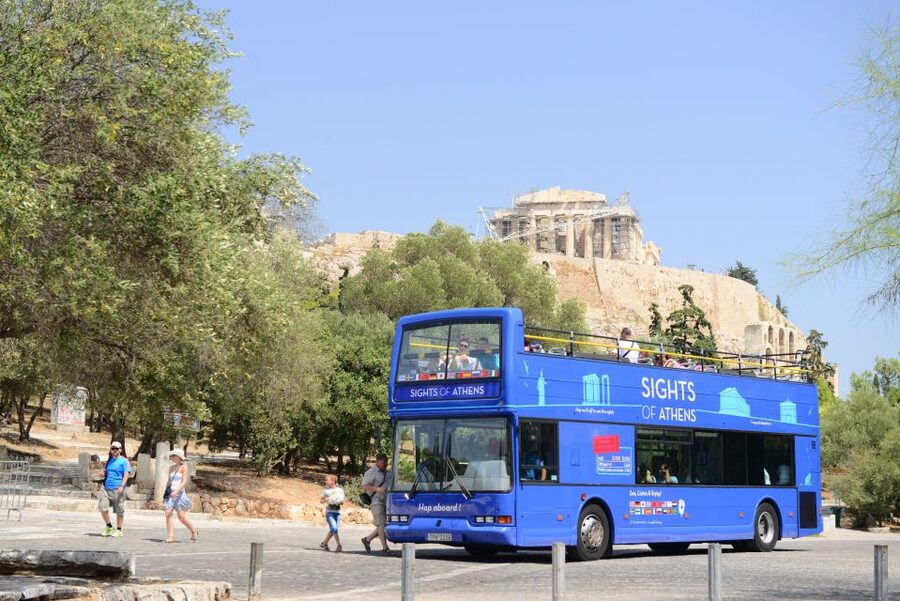
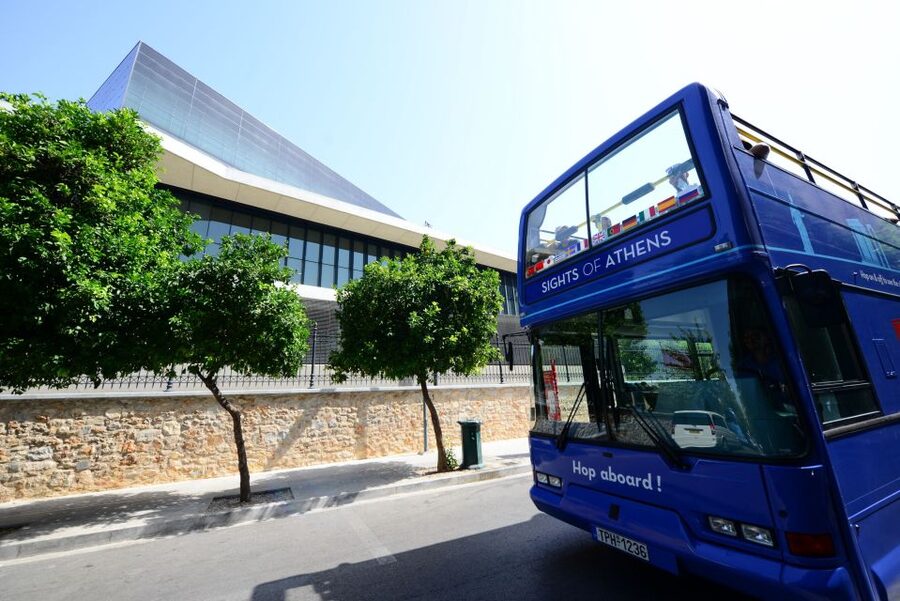
At the Acropolis stop, you are well placed for the Acropolis complex and the Acropolis Museum. The bus does not include admission, timed entry, or a guided visit, so arrange those separately if you want to go inside. The bus gets you close, but you still need comfortable shoes for the uphill walk and the stone surfaces around the archaeological site.
This stop works particularly well if you have booked a separate Acropolis tour. Get off, visit the monument, and return to the same general area for the next bus. Look carefully for the marked stop, since the area can be crowded and several sightseeing buses may be operating nearby.
The Blue Line also gives you access to Piraeus sights such as Pasalimani yacht marina and Mikrolimano, an older harbor area with restaurants and waterfront views. If you have time before returning to your ship, these stops offer a more local port experience than simply waiting near the terminal.
One detail deserves careful attention: Piraeus has more than one cruise terminal. Check your ship’s terminal before boarding the return bus. Terminal A and Terminal B are not next door, and walking between them with luggage can take much longer than expected. If you are unsure, ask the staff before leaving the bus.
The Orange Line and Athens’s historic center
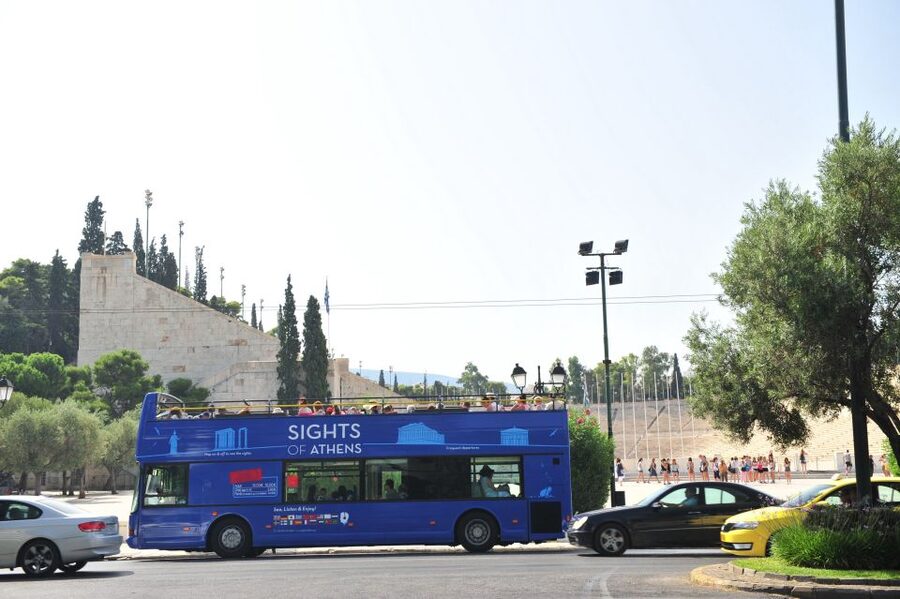
The Orange Line is the main city sightseeing route. It passes the central attractions that most first-time visitors want to see, and it is useful even if you plan to walk much of Athens.
The route reaches the Plaka district, the old neighborhood below the Acropolis. This is a good place to leave the bus and wander on foot through narrow lanes, small shops, and traditional streets. The bus gives you orientation, but Plaka is best experienced at walking speed.
Near Hadrian’s Gate, you can see the surviving Roman entrance to the area around the Temple of Olympian Zeus. The temple itself is one of the city’s most impressive ancient sites, with huge columns that show the scale of the Roman project. Admission is separate, so decide in advance how many paid monuments you want to enter.
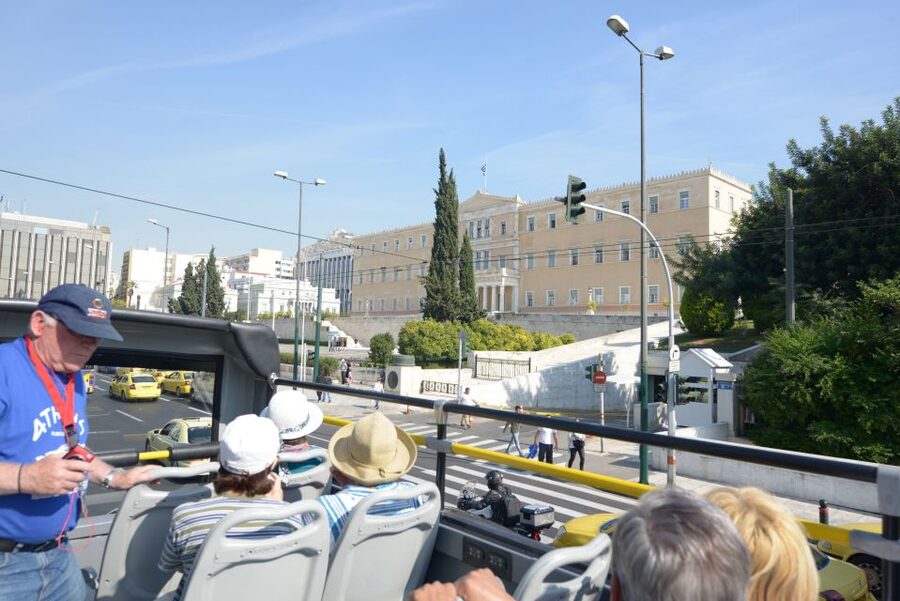
At Syntagma Square, the bus stops near the Hellenic Parliament. This is where you can watch the guards in their distinctive uniforms and continue along Ermou, Athens’s main shopping street. Syntagma is also a useful transfer and orientation point, though traffic and crowds can make boarding less orderly than at quieter stops.
The Panathenaic Stadium is another worthwhile stop. Built of white marble, it hosted the first modern Olympic Games in 1896. Even if you do not enter, the view from outside gives you a strong sense of the stadium’s unusual horseshoe shape.
The route also reaches the National Library, the National Archaeological Museum, Monastiraki Square, Kotzia Square, and Thission. Monastiraki is especially useful for a break, with its flea market and central location near the Ancient Agora area. Thission is a pleasant place to continue on foot, with views toward the Acropolis and a more relaxed café setting.
The bus commentary helps connect these scattered sights. Audio is available in English, Greek, Spanish, French, German, Italian, Portuguese, Russian, Arabic, Hebrew, Turkish, Dutch, Finnish, Chinese, Japanese, and another listed language set that includes the main European options. Free earphones are supplied when you board.
The commentary is recorded, not delivered live by a guide. That makes it easy to listen in your own language, though sound quality can vary by bus. Some passengers have found static or loose headphone connections, so bring your own wired earphones if you have a compatible pair and want a backup.
The Yellow Line toward Glyfada and the Riviera
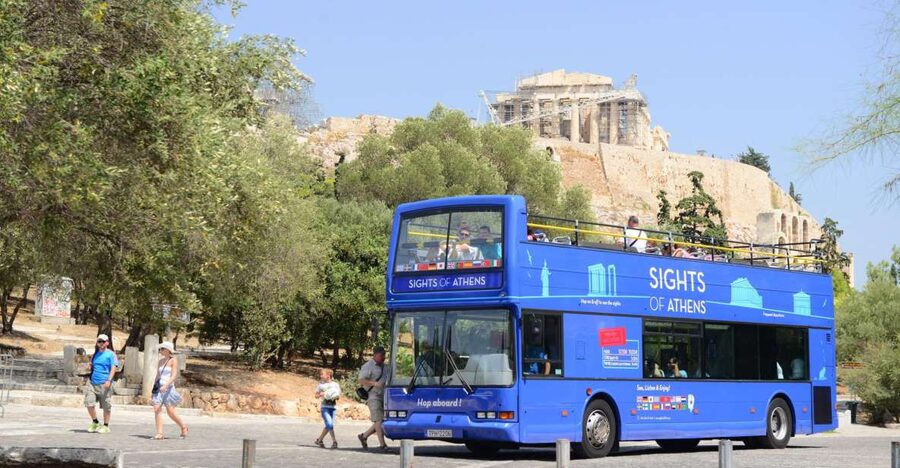
The Yellow Line changes the mood completely. It begins around the Planetarium stop and follows the coast toward Glyfada, passing modern developments, marinas, and seaside areas.
The route includes the Stavros Niarchos Foundation area and Marina Alimou. These stops show how Athens extends beyond its ancient core, with public spaces, waterfront facilities, and newer cultural projects. You will not get a full guided visit to each place, but the bus offers a useful overview without requiring several separate taxi rides.
Marina Flisvou is a good stop for a waterfront pause, especially near sunset. Agios Kosmas is the practical choice if you want time for swimming or sunbathing. Bring a swimsuit, towel, and sun protection if you plan to make the coast a real part of your day. The required practical items are simple: comfortable shoes, sunglasses, and a sun hat.
Glyfada is the line’s main destination and a good place to get off for cafés, shopping, and a more polished suburban atmosphere. The route description points to luxury department stores and seaside bars. This is not the ancient Athens experience, but it gives you a look at how the capital spends its leisure time.
The drawback is distance. The coastal route can take a large part of the day, particularly on the return toward central Athens. Traffic increases the risk of a late arrival, so do not schedule a tight ship departure or airport connection after a Riviera outing.
A different kind of day out, same corner of Greece:
- Athens: Cape Sounion & Poseidon Temple Sunset Half-Day Trip
★ 4.8 · 8,241 reviews - Athens: Acropolis and Parthenon Guided Walking Tour
★ 4.6 · 5,882 reviews - All Day Cruise -3 Islands to Agistri,Moni, Aegina with lunch and drinks included
★ 5.0 · 4,958 reviews - Greek Food Walking Tour in Athens
★ 5.0 · 4,740 reviews
The Green Line and Vouliagmeni Lake
The Green Line continues south toward Vouliagmeni. Its main appeal is the mix of beaches, water, and a few less expected historical stops.
Kavouri Oceanis is one of the designated beach areas. It is a sensible choice if your priority is a swim and a few quiet hours by the water. Vouliagmeni Lake offers a different setting, with thermal baths and striking surroundings. Admission to the lake and other attractions is not included, so check the current entry arrangements before committing your whole day to the stop.
The line also passes the Allied Forces Cemetery and the Byzantine Museum. These stops make the route more than a beach shuttle, but they will appeal most if you have an interest in military or religious history. If your schedule is short, choose one or two stops rather than trying to cover every point on the line.
The coastal routes are best treated as scenic rides with selected stops, not as a fast way to move between places. You might spend longer waiting for a bus at a less central stop, and departure information is not always displayed as clearly as you would want. Ask a representative for the next bus and the final service before walking away from a stop.
Timing, traffic, and the art of getting off wisely
Hop-on hop-off buses work best when you accept that they are sightseeing vehicles first and point-to-point transport second. If you want to reach a stop on the other side of a loop, riding the entire circle may take longer than walking across the street and boarding in the opposite direction.
Athens traffic is the main variable. Some rides are quick, while the return from the coast or the approach to central Athens can be slow. Heat adds to the problem in summer, especially on an open upper deck. Carry water, and use the air-conditioned lower deck when the sun becomes too strong.
Buses may arrive about every 15 minutes on some Athens sections, but waits can be longer on the Piraeus or coastal routes. At busy Acropolis stops, buses returning to the cruise port can fill quickly. You may need to wait for the next one, and a transfer between lines can create another queue.
The open rooftop gives you the best views and a pleasant breeze when moving. Some buses have roofs and some do not, so you may not always get the exact seating arrangement you want. The lower deck offers shade and air conditioning, though a few buses have older interiors and occasional air-conditioning leaks.
Keep an eye on the last departure for every route. This is especially important at Acropolis, Glyfada, Vouliagmeni, and Piraeus. Do not rely only on a driver’s announcement for your stop. Watch the route map, listen for the audio, and confirm the pickup point before getting off.
Price, comfort, and overall value
At about $14 per person, this is an inexpensive way to combine transport and sightseeing. You do not get attraction admission, but the pass can still save money if you would otherwise use taxis between Piraeus, the Acropolis, central Athens, and the coast.
The two-day validity makes the price particularly attractive. One possible plan is:
- Day one: Blue Line from Piraeus to the Acropolis, then Orange Line for Plaka, Syntagma, and the Panathenaic Stadium.
- Day two: Yellow Line to Agios Kosmas or Glyfada, then Green Line toward Vouliagmeni if time allows.
You can also use the pass simply as a port transfer on one day and a city tour on the next. That flexibility is more valuable than trying to squeeze every stop into one long ride.
The service is wheelchair accessible, with low-floor buses and a designated wheelchair space. Children aged four and under ride free. Free Wi-Fi is included, though connectivity is not guaranteed on every bus, so download maps or tickets before setting out.
Free cancellation is available up to 24 hours before the activity, and you can reserve without paying immediately. Those terms are useful if your cruise schedule or Athens plans are still shifting.
Who should book this Athens bus pass?
I would choose it for a first visit, a short stay, or a cruise stop when you want a broad view with little planning. It is also a good fit if your group includes people who tire easily, since you can rest between stops rather than walk across the city in the heat.
You will get the most from it if you plan selectively. Pick the Acropolis and two or three central stops, then reserve a separate half-day for the coast. Trying to visit every museum, monument, marina, and beach in two days will leave you mostly on buses.
Independent visitors who prefer local buses, the metro, or long walks may find the loops slower than necessary. The commentary is useful for orientation, but it is not a substitute for a specialist guide inside the Acropolis or the museums.
Final call: a smart buy with one important warning
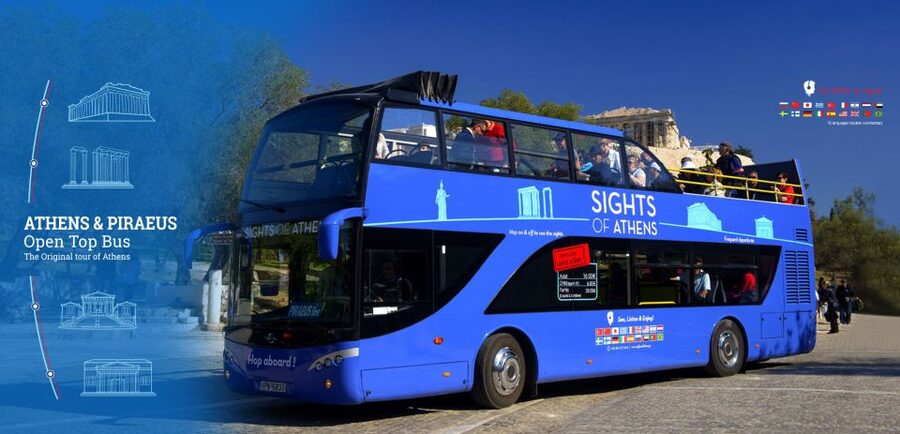
Book this pass if you want a low-cost way to connect Piraeus, central Athens, and the Riviera, especially if you have two days or a cruise arrival. The direct port pickup, four routes, audio commentary, and beach access give it more range than a standard city loop.
Skip it if your schedule is extremely tight or you need guaranteed point-to-point timing. Traffic, full buses, unclear departure displays, and occasional long waits can turn a simple transfer into a race. Know your cruise terminal, confirm the last bus, carry water, and use the pass as a flexible sightseeing tool rather than a precise timetable.
FAQ
How long is the Athens, Piraeus, and Coastline bus ticket valid?
The ticket is valid for two days from the time you first activate it. The package is also described as a one-day ticket with one complimentary day.
Which bus lines are included?
You can use four lines: the Orange Line in Athens, the Blue Line in Piraeus, the Yellow Line toward Glyfada, and the Green Line toward Vouliagmeni.
Can I board at the Piraeus cruise terminals?
Yes. Pickup points are available at Cruise Terminals A, B, and C in Piraeus Port.
Does the ticket include admission to the Acropolis or museums?
No. Admissions to attractions are not included. The bus takes you near major sights, but you need separate tickets to enter them.
Is the audio guide available in English?
Yes. Recorded commentary is available in English and 15 other languages, including Greek, Spanish, French, German, Italian, Portuguese, Russian, Arabic, Hebrew, Turkish, Dutch, Finnish, Chinese, and Japanese.
Are earphones provided?
Yes. Disposable earphones are provided when you board the bus.
Is Wi-Fi available onboard?
Free Wi-Fi is included on board. Connectivity may not work on every bus, so do not rely on it as your only source of maps or travel information.
Is the bus wheelchair accessible?
Yes. All buses have low-floor access and a designated wheelchair space.
Can children ride for free?
Children aged four and under get free admission.
Recently reviewed around Athens
- Small-Group Women History in Ancient Greece Walking Tour★ 5.0 · 38 reviews
- Ceramic and Pottery Creative Workshop with Two Local Artists★ 4.0 · 57 reviews
- Athens: Wine Workshop Create your Own Wine under the Acropolis★ 5.0 · 77 reviews
- Athens: Greek Wines Tasting with Sommelier and Acropolis Views★ 5.0 · 88 reviews
- Hydra Private Day Trip by Ferry from Athens with Transfers★ 4.0 · 30 reviews
- Small-Group Wine Tour in Athens with Tasting★ 5.0 · 33 reviews
- Wine Trails Private Tour/ Nemea visit 3 wineries from Athens or Nafplion (10 h)★ 5.0 · 44 reviews
- Private Athens Transfer Airport/Port -Greek Tours-Hourly service★ 5.0 · 88 reviews
Athens Tours, compared.

Acropolis & up to 5 Archaeological Sites Combo Pass
Read our review →

Acropolis, Parthenon & Acropolis Museum Guided Tour
Read our review →
Cape Sounion & Poseidon Temple Sunset Half-Day Trip
Read our review →

All Day Cruise -3 Islands to Agistri,Moni, Aegina with lunch and drinks included
Read our review →