
Reviewed · ANCIENT CORINTH TOURS
Full Day Biblical Ancient Corinth Canal Mycenae Epidauvro Nafplio
The big idea here is simple: one long day links several major Peloponnese sights without asking you to change hotels. You cross the Corinth Canal, walk through the citadel of Mycenae, and finish in handsome Nafplio, with biblical, Bronze Age, Venetian, and modern Greek stories along the way.
I like the private-car setup and the flexible pickup. I also like the human scale: drivers such as Gianny, Yiannes, Chris, Ioannis, Costas, Michael, and Dimitrios have been praised for careful driving, useful history, good communication, and adapting the pace to each group. The main consideration is the schedule. Nine or ten hours is a lot of road and sightseeing, and the advertised mention of Epidauros is not matched by a timed stop in the detailed program.
In This Review
- Key points before you book
- What this full-day Peloponnese trip is really like
- Corinth Canal: a 15-minute engineering stop
- Cenchreae and the biblical Corinth connection
- Ancient Corinth and the Bema of Paul
- The Temple of Apollo and Acrocorinth
- Mycenae: the day’s most dramatic ancient stop
- The Treasury of Atreus and the museum
- Nafplio and the climb to Palamidi
- Nafplio old town, Bourtzi, and Syntagma Square
- What the $277.09 price includes
- The driver can make or break the day
- Who should book this tour?
- Should you book it?
- FAQ
- How long does the tour last?
- Is this a private tour?
- Where can pickup take place?
- Is airport pickup included?
- Are admission fees included?
- Is lunch included?
- Does the tour include Epidauros?
- What is the cancellation policy?
Key points before you book
- The Corinth Canal is a quick but worthwhile opening stop, with a sharp view into the narrow waterway.
- Ancient Corinth brings the Apostle Paul’s story to life, especially around the Bema and Roman Forum.
- Mycenae gives you the day’s strongest ancient monument, including the Lion Gate and Treasury of Atreus.
- Nafplio supplies the prettiest finish, with old streets, Syntagma Square, fortress views, and a seaside lunch stop.
- The car and driver are the practical advantage, especially for a private group of one to seven people.
- Entrance fees, lunch, and a licensed site guide cost extra, so budget beyond the advertised $277.09 per person.
What this full-day Peloponnese trip is really like
This is not a leisurely tour of one archaeological site. It is a packed sampler of the northeastern Peloponnese, built for people who want to see a lot from Athens in one outing.
You leave the city behind and spend the day moving through very different chapters of Greek history. Corinth connects to the ancient world and the New Testament. Mycenae reaches back to the Bronze Age and the stories of Agamemnon. Nafplio shifts to Venetian fortresses, early modern Greece, and a pleasant old town by the sea.
The private format matters. Your group alone takes the vehicle, and pickup can be arranged from an Athens hotel, apartment, port, or another agreed point. Groups of one to three use a luxury sedan, while four to seven ride in a minivan. Cars include air-conditioning, Wi-Fi, and bottled water.
The driver is not automatically a licensed guide. That distinction matters at archaeological sites. Your English-speaking driver can explain history and help shape the day, but a licensed guide to accompany you inside the sites is not included.
More Ancient Corinth, Mycenae and canal trips:
- From Athens: Mycenae, Epidaurus & Nafplio Full Day Trip
★ 4.8 · 2,438 reviews - From Athens: Mycenae, Epidaurus & Nafplio Full-Day Tour
★ 4.5 · 1,580 reviews - From Athens: Ancient Corinth Day Trip with Canal & VR Guide
★ 4.6 · 1,073 reviews
Corinth Canal: a 15-minute engineering stop
The Corinth Canal is the first quick photo stop, and it gives you an immediate sense of the geography. The waterway cuts across the narrow Corinth isthmus, linking the Gulf of Corinth with the Saronic Gulf. In practical terms, it separates the Peloponnese from mainland Greece.
The canal was built in the late 19th century, but the idea is far older. Ancient ships had to sail around the Peloponnese, adding roughly 185 nautical miles to their route. Periander, the ruler of Corinth in the sixth century BC, is credited with considering a canal, though ancient engineers could not carry out the plan. Instead, ships were moved across the isthmus on the diolkos, a stone track.
You get only about 15 minutes here, so think of it as an orientation stop, not a full visit. The narrow cut, steep sides, and passing boats make it memorable, but you will not have time for a long walk or a detailed exploration.
Cenchreae and the biblical Corinth connection
The Corinthia portion includes Kechries, the modern village associated with the ancient port of Cenchreae. This is one of the stops that gives the trip its biblical angle.
According to Acts 18:18, Paul stopped at Cenchreae during his second missionary journey and cut his hair after fulfilling a vow. In his Letter to the Romans, he also refers to Phoebe, a woman connected with the local Christian assembly.
The stop lasts about 15 minutes and is free. Its value is mainly historical and interpretive rather than visual. You will want your driver to explain the connection clearly, since there is not a long scheduled visit here.
Ancient Corinth and the Bema of Paul
Ancient Corinth receives a larger block of time, about 45 minutes, followed by another 30 minutes for the archaeological museum. This is where the day’s biblical focus becomes most concrete.
The Roman Forum was the public center of ancient Corinth. At its heart is the Bema, an elevated platform where officials addressed the public and handled legal matters. Christian tradition connects it with Paul’s appearance before the Roman proconsul Gallio around AD 52.
Gallio reportedly refused to treat Paul’s case as a criminal matter, seeing it as an internal religious dispute. That small episode helps you picture Corinth as a busy Roman city where trade, politics, law, and competing religious beliefs met in public view.
The wider site includes the Lechaion Road, shops, temples, fountains, a basilica, the Agora, and the Fountain of Peirene. The remains are spread across an open area, so comfortable shoes and sun protection make sense.
The Archaeological Museum of Ancient Corinth helps put the stones into context. It was built in the early 1930s to display finds from excavations at the site. You may find the museum especially useful after seeing the Forum, since objects and architectural fragments give shape to a city that can otherwise feel like a wide field of ruins.
Admission is not included. The itinerary assigns 10 minutes to the Temple of Apollo and another 10 minutes to the Agora, so the actual time inside Ancient Corinth may feel brief if you want a careful museum visit as well.
More Athens trips worth a second look
- All Day Cruise -3 Islands to Agistri,Moni, Aegina with lunch and drinks included
★ 5.0 · 4,958 reviews - From Athens: Delphi Full Day V.R. Audio Guided Tour
★ 4.6 · 3,028 reviews - Athens Full Day Private Tour
★ 5.0 · 2,903 reviews - Athens Greece Full Day private tour
★ 5.0 · 785 reviews
The Temple of Apollo and Acrocorinth
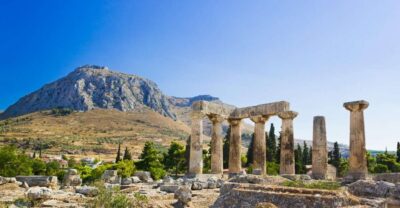
The Temple of Apollo is one of the oldest Doric temples in mainland Greece and the Peloponnese. Its large monolithic columns date to the sixth century BC, around 550 BC, and provide one of the clearest visual reminders of Corinth’s early importance.
You have about 10 minutes here. That is enough for photographs and a short explanation, but not a slow architectural study.
Acrocorinth is the massive rock above the ancient city. Its fortress controlled the route into the Peloponnese, which explains why the site was used again and again as a defensive position. A reliable water supply made it useful during sieges.
The scheduled visit is only about 15 minutes, and reaching the upper fortress itself would require more time than this tour appears to allow. You should treat Acrocorinth as a viewpoint and historical landmark, not as a full castle walk.
Mycenae: the day’s most dramatic ancient stop
Mycenae is the strongest reason to choose this trip if you have not already visited the site. The fortified citadel gave its name to the Mycenaean civilization, which flourished roughly from 1600 to 1100 BC.
At its height around 1350 BC, the citadel and lower town may have held about 30,000 people across 32 hectares. You enter through huge Cyclopean walls, so named because later Greeks imagined that only giants could have moved such stones.
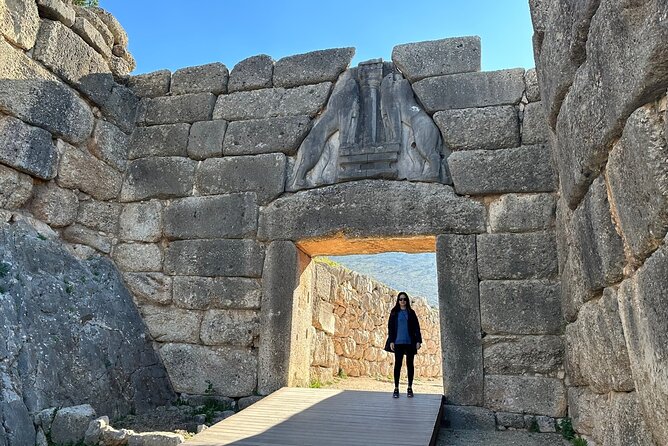
The central approach is the Lion Gate, built around 1250 BC. Two lions or lionesses face one another above the entrance, forming the most famous surviving piece of Mycenaean sculpture. It is also the only monumental relief of Bronze Age Greece that remained visible and known in later classical writing.
The one-hour Mycenae visit includes time for the citadel, while the Lion Gate receives a separate 19-minute allocation. You will see the Tomb of Clytemnestra, the walls, the old royal center, and the approach to the burial sites, but you should not expect an unhurried archaeological study.
The site is exposed and uneven. The steep approach and rough stone surfaces can be tiring, especially after the earlier Corinth stops. I would wear shoes with a firm sole and save some energy for Nafplio.
The Treasury of Atreus and the museum
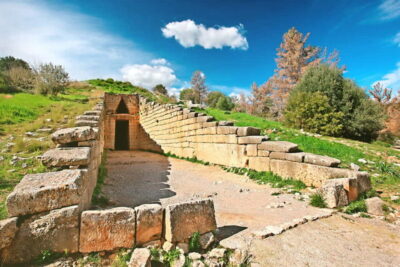
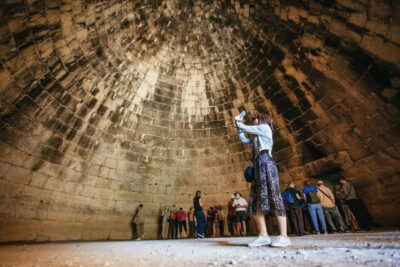
The Treasury of Atreus, also called the Tomb of Agamemnon, is a large tholos tomb cut into the hillside at Mycenae. Its beehive-shaped interior is made from carefully laid stone, and the lintel above the entrance weighs about 120 tons.
The tomb is dated to around 1250 BC. The name connects it with the legendary royal family, but the actual person buried there is unknown. Heinrich Schliemann saw the monument in the 19th century and later excavated the shaft graves within the citadel.
You get about 15 minutes at the citadel and Treasury of Atreus. The tomb is worth the short walk because its scale is easier to appreciate in person than in photographs.
The Archaeological Museum of Ancient Mycenae receives another 15 minutes. It covers the citadel, graves, homes, and other remains, with many visible structures dating from the city’s high point between 1350 and 1200 BC.
Here again, the pace is the tradeoff. If you are passionate about Bronze Age archaeology, you may wish the schedule allowed more time. If you are seeing Mycenae as part of a first overview, the combination of Lion Gate, walls, tomb, and museum gives you the essential picture.
Nafplio and the climb to Palamidi
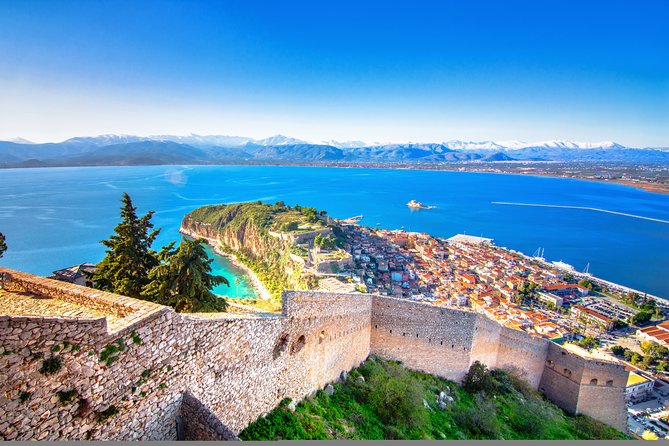
After the ancient sites, Nafplio feels like a change of scenery and rhythm. The town served as Greece’s capital until 1834 and combines Venetian, neoclassical, and Ottoman-era elements.
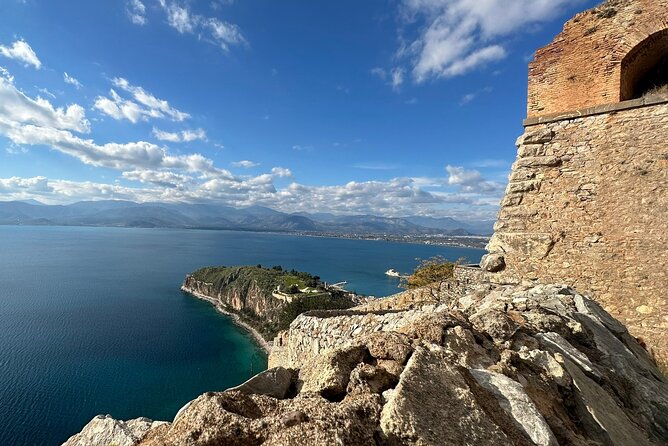
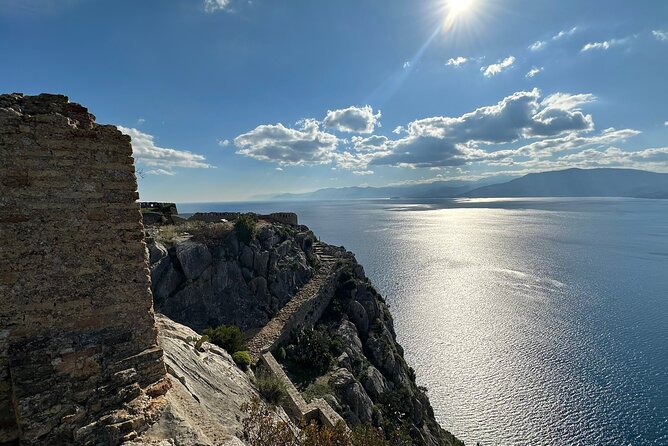
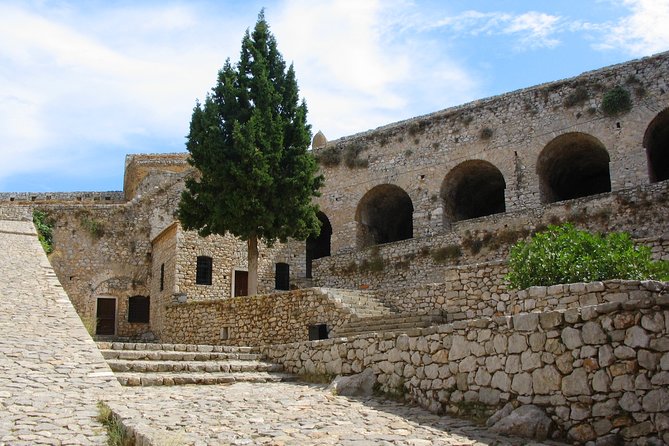
Palamidi Castle rises on a 216-meter hill above town. The Venetians built the fortress during their second period of control, from 1686 to 1715. From the walls and openings, you can look across Nafplio, the Argolic Gulf, and the surrounding countryside.
The town-to-fortress stairway is commonly called the 999 steps, though the actual count is often given as 913 from the town, with more steps inside the fortress. The itinerary gives you 30 minutes here, so the full climb from the old town and a complete fortress visit may not fit comfortably.
If your group wants the view but not the stair workout, ask the driver how far the vehicle can take you and what time is realistic. The fortress also includes the prison associated with Kolokotronis, adding a more sobering note to the visit.
Nafplio old town, Bourtzi, and Syntagma Square
You have about two hours in Nafplio, including time for lunch at a traditional seaside tavern. Lunch is not included, so the final cost depends partly on what you order and how long you linger.
The old town is easy to enjoy on foot. Cobbled streets, stone stairways, flowered balconies, and old houses gather around Syntagma Square. The square is the town’s natural center and carries important political history from the first years of the modern Greek state.
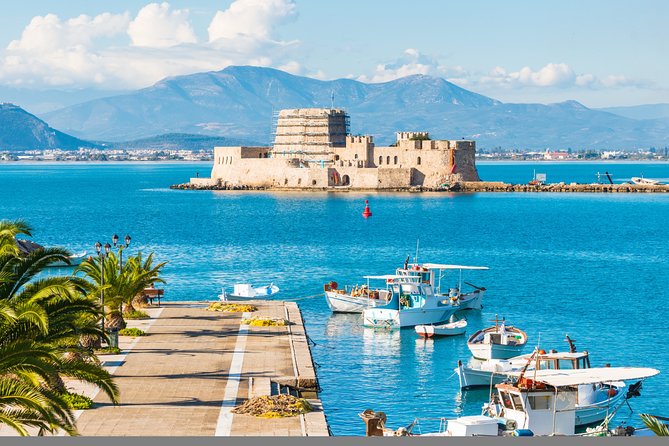
Bourtzi is the small fortress on the islet of Agioi Theodoroi. The Venetians built it in 1473 and called it Castello dello Soglio. Later Ottoman rulers used the word Bourtzi, meaning fortress, and that name stuck.
A boat ride to Bourtzi takes less than 10 minutes, but the boat and admission costs are not included. The schedule assigns an hour, which may allow the crossing if boats are operating and timing cooperates. Ask before counting on the visit, particularly because the whole day already runs on a tight clock.
The Akronafplia Fortress is the oldest part of Nafplio. It later became part of the wider Venetian and Frankish defenses, then served as a prison and eventually gained a hotel complex. The stop is about 15 minutes, mainly for the setting and views.
The Lion of the Bavarians offers a final piece of 19th-century history. Carved into the rock, the sleeping lion commemorates Bavarian soldiers who died in Nafplio in 1833 during a typhoid epidemic. You receive about 30 minutes here, including time around the small park.
What the $277.09 price includes
At $277.09 per person, this is not a budget bus outing. It is priced as a private transport and driver service, with the cost making more sense for a small group that can share the vehicle.
The price includes pickup and return, a modern private car, air-conditioning, Wi-Fi, bottled water, and an English-speaking driver with historical knowledge. For one or two people, the price is easier to compare with the cost of arranging several separate transfers. For a group of four to seven, the per-person value can improve because the vehicle cost is shared.
You still need to pay entrance fees at the archaeological sites, any Bourtzi boat or admission charge, lunch, and gratuities. A licensed guide is also extra. Add those items before comparing this tour with a larger group excursion.
The private format also buys you flexibility. Drivers have adjusted timing, offered choices, arrived early, sent arrival messages, and waited patiently when groups needed more time. That service can matter more than a small price difference on a long day.
The driver can make or break the day
The strongest pattern in the feedback is the quality of individual drivers. Gianny was praised for professionalism, trust, careful driving, and a comfortable car. Yiannes was singled out for explaining the past throughout the day and arranging stops around the group’s needs.
Chris received especially strong praise for conversation, historical explanations, and adjusting the route after learning what the group had already seen. Costas was noted for arrival messages, bottled water, early arrival, safe driving, solid English, and a restaurant recommendation with a fine view.
Michael was described as patient when the group ran late or wanted extra time, while Dimitrios was appreciated for offering choices and information without rushing anyone. Ioannis was also praised for answering questions and taking good care of the group.
These names are useful examples, not a promise that one specific driver will be assigned to you. Still, they show what you should expect from the best version of the service: a careful driver who adds context, communicates clearly, and helps you decide where to spend your limited time.
Who should book this tour?
I would choose this tour if you have one free day from Athens and want a broad introduction to the Peloponnese without driving yourself. It suits couples, families, and small groups who value a private vehicle, hotel pickup, and the ability to adjust the pace.
It is also a good match for anyone interested in several periods of Greek history at once. You get Paul and Roman Corinth, Bronze Age Mycenae, Venetian and early Greek Nafplio, and the engineering story of the canal.
I would hesitate if you want long, quiet visits at every site. The day includes many stops, and some receive only 10 to 15 minutes. I would also ask the operator to confirm the Epidauros plan before booking, since the title and general description mention it but the detailed stop list does not provide a visit time.
Free cancellation is available up to 24 hours before departure. The experience depends on good weather, with a different date or full refund offered if poor weather causes cancellation.
Should you book it?
Book this tour if coverage and convenience matter most. You can see Corinth, Mycenae, and Nafplio in one private outing, with a driver who may add far more value than a standard transfer.
Before paying, confirm three points: the exact Epidauros arrangement, which entrance fees you will need to cover, and whether a licensed guide can be added. If you accept the fast pace and budget for extras, this is an efficient way to reach several major sites beyond Athens.
FAQ
How long does the tour last?
The tour lasts approximately 9 to 10 hours and ends back at the agreed meeting point unless you arrange another drop-off point.
Is this a private tour?
Yes. Only your group participates. Groups of one to three people use a luxury sedan, while groups of four to seven use a minivan.
Where can pickup take place?
Pickup is offered from an Athens hotel, Airbnb or apartment residence, or port. Airport pickup is available for an additional cost.
Is airport pickup included?
No. Airport pickup and drop-off are optional services with an additional charge.
Are admission fees included?
No. Entrance fees for the attractions are not included. A licensed guide to accompany you inside the archaeological sites is also not included.
Is lunch included?
No. A lunch stop is scheduled in Nafplio, but the cost of the meal is paid separately.
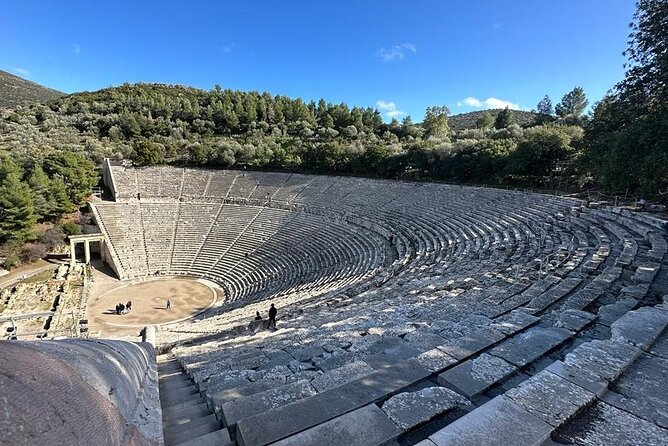
Does the tour include Epidauros?
Epidauros is named in the tour title and general description, but the detailed schedule provided does not list a timed stop there. Confirm the exact plan with the operator before booking.
What is the cancellation policy?
You can cancel at least 24 hours before the start time for a full refund. Changes or cancellations made less than 24 hours in advance are not accepted for a refund. The tour may also be rescheduled or refunded if poor weather causes cancellation.
Recently reviewed around Athens
- Small-Group Women History in Ancient Greece Walking Tour★ 5.0 · 38 reviews
- Ceramic and Pottery Creative Workshop with Two Local Artists★ 4.0 · 57 reviews
- Athens: Wine Workshop Create your Own Wine under the Acropolis★ 5.0 · 77 reviews
- Athens: Greek Wines Tasting with Sommelier and Acropolis Views★ 5.0 · 88 reviews
- Hydra Private Day Trip by Ferry from Athens with Transfers★ 4.0 · 30 reviews
- Small-Group Wine Tour in Athens with Tasting★ 5.0 · 33 reviews
- Wine Trails Private Tour/ Nemea visit 3 wineries from Athens or Nafplion (10 h)★ 5.0 · 44 reviews
- Private Athens Transfer Airport/Port -Greek Tours-Hourly service★ 5.0 · 88 reviews
Ancient Corinth Tours, compared.
Ancient Corinth Day Trip with Canal & VR Guide
Read our review →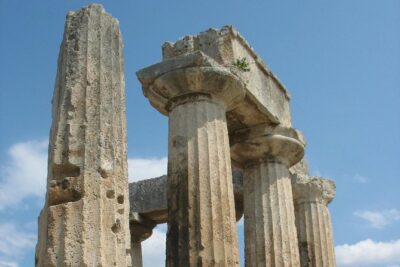
Private Biblical Tour Ancient Corinth & Isthmus Canal from Athens
Read our review →
4-Day Classical Greece Tour: Epidaurus, Mycenae, Olympia, Delphi, Meteora
Read our review →
Ancient Corinth & Nafplio Full Day Trip with Swim
Read our review →
Mycenae and Nafplion Day Trip from Athens with Official guide
Read our review →
Browse the lists this tour appears in