
Reviewed · ACROPOLIS & ACROPOLIS MUSEUM TOURS
Acropolis and Acropolis Museum (Small Group Afternoon Walking Tour)
The smartest feature of this Athens tour is its order: you visit the Acropolis Museum before climbing to the Acropolis. That lets you see the sculptures and models first, then recognize the places and buildings you encounter above. Guides such as Nikos, Nicholas, and Nic are praised for making the connections clear.
I like the small group limit of 10 and the 4 pm start. You get a better chance to hear the guide, ask questions, and avoid some of the worst midday heat. The afternoon light also works beautifully for city views and photographs. The main catch is cost: the advertised $61.47 price does not include €50 in entrance tickets, paid in cash to the guide.
In This Review
- Key points to know before booking
- Why the museum-first plan works so well
- The Acropolis Museum’s best displays
- Walking the south slope to the Acropolis
- Reaching the Propylaea and Parthenon
- Afternoon light, heat, and crowd levels
- Price, tickets, and the real value
- Meeting point and walking demands
- Who will get the most from this tour
- A clear verdict on the Acropolis afternoon tour
- FAQ
- What time does the tour start?
- Where does the tour meet?
- Where does the tour finish?
- How long does the full experience last?
- How is the time divided between the two main stops?
- Is the tour offered in English?
- Are entrance fees included?
- Do children pay the entrance fees?
- How many people can join the tour?
- Is hotel pick-up included?
- Is the tour physically demanding?
- Can I cancel for a full refund?
Key points to know before booking
- Museum first, Acropolis second: The sculptures, models, and archaeological finds give useful context before the uphill walk.
- A genuinely small group: The maximum is 10 people, and some departures may feel almost private.
- Afternoon timing helps: The 4 pm start can mean cooler conditions, softer light, and fewer people than at peak morning hours.
- Budget for €50 in cash: The Acropolis costs €30 and the museum €20, though people under 18 receive free entrance with identification.
- Expect real walking: The route includes slopes, steps, ancient marble, and uneven surfaces. Shoes with good traction are wise.
- The guide makes the difference: The strongest part of the experience is the live explanation, especially inside the museum and around the Parthenon.
Why the museum-first plan works so well

The Acropolis can be hard to read at first. You see columns, broken statues, scattered stones, and a famous temple that has been photographed from every angle. Without context, it is easy to admire the view but miss what you are looking at.
This tour begins at the Acropolis Museum, at Makrigianni 4, near the Acropolis Metro station. Before going inside, your guide points out the remains of an ancient Athenian neighborhood beneath the museum. The modern building is designed above the excavation, so you begin with a reminder that ancient life existed here at street level, not only on the hilltop.
Inside, the opening displays use models of ancient Athens and the Acropolis to establish the basic layout. This is useful preparation for the walk later. You can see how the sanctuary fit into the city and how the monuments related to one another.
The museum stop lasts about 1 hour and 30 minutes. The entrance fee is not included, so you pay €20 in cash to the guide. The guide handles the ticket purchase, and the tour includes skip-the-line service, although the exact entrance procedure can vary.
More Museum Tours in Athens
- Athens: Acropolis, Parthenon & Acropolis Museum Guided Tour
★ 4.8 · 9,316 reviews - Athens: Mythology of Delphi, Museum and Arachova Guided Tour
★ 4.6 · 4,008 reviews - Athens: Acropolis, Parthenon & Acropolis Museum Guided Tour
★ 4.8 · 3,579 reviews
The Acropolis Museum’s best displays
The first major section focuses on finds from the slopes of the Acropolis. These objects help fill in the daily and religious life of the site. They also keep the hill from feeling like an isolated collection of temples. The Acropolis was part of a working city, with shrines, processions, workshops, homes, and public spaces around it.
On the first floor, you see sculptures from the earlier Parthenon, built in the sixth century BC. Look closely for traces of original color. Ancient Greek sculpture was not always the plain white marble image familiar from modern museums and monuments. Even small surviving marks of paint change the way you picture the sanctuary.
The archaic statues are another highlight. Among them are the calf-bearer and the Kritios Boy, two works that show how Greek sculpture changed over time. The calf-bearer has a formal, symbolic quality, while the Kritios Boy points toward a more natural treatment of the human body.
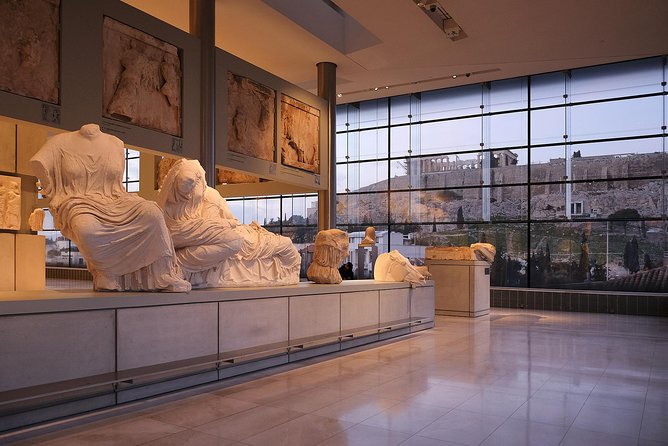
The Caryatids are especially helpful to see in the museum. These sculpted maidens once supported the porch of the Erechtheion on the Acropolis. Seeing them at close range lets you study their clothing, posture, and carved details before standing near the building they decorated.
The third-floor Parthenon Gallery is the museum’s great visual payoff. Its glass walls provide views toward the Acropolis, while the sculptures are arranged to explain the Parthenon’s design and decoration. Your guide discusses the myths shown in the sculpture and explains how the pieces fit into the temple’s overall plan.
This is where a guide adds real value. Labels can identify a statue, but a good guide can connect the sculpture to the building above, explain the story behind a scene, and answer the questions that come up as you look. The guide names associated with this experience include Nikos, Nicholas, and Nic, though your assigned guide may be different.
One practical point: the museum portion is indoors, but the next part is not. Use the museum visit to slow down, ask questions, and get oriented before heading into the sun and onto the stone paths.
Walking the south slope to the Acropolis
After the museum, you walk toward the south slope of the Acropolis. This section is not just a route to the top. It introduces the performance, healing, and religious sites that surrounded the sanctuary.
The first major stop is the Theater of Dionysus, one of Greece’s oldest theaters. This is a good place to think about how drama was tied to worship in ancient Athens. The physical remains are more open and less complete than the Parthenon, so the guide’s explanation helps you picture how the theater functioned.
A short distance away is the Sanctuary of Asclepius, dedicated to the god of medicine. Its presence adds another layer to the Acropolis area. The hill was not reserved for one building or one type of ceremony. It held a network of sacred places connected to different needs and beliefs.
As you climb, the guide points out the Temple of Athena Nike. It is a small, elegant temple near the entrance, and its size can be deceptive. Because it sits in a prominent position, you get good photographs and a clear sense of how carefully the approach to the Acropolis was planned.
You also see the area connected with the monument of Philopappus and look toward the Odeon of Herodes Atticus. The Odeon is still used for concerts, which gives the ancient site a continuing role in modern Athens. From the south slope, the theater’s curved structure is one of the most striking views before you reach the summit.
The route also includes Mars Hill, or the Areopagus. The site is linked with St. Paul’s speech about the unknown god. It is a meaningful stop for visitors interested in early Christianity, and it provides another broad view over Athens.
Reaching the Propylaea and Parthenon
The monumental Propylaea marks the formal entrance to the Acropolis. Passing through it changes the feel of the walk. The city noise drops away, and the monuments begin to frame the experience.
The entrance area can be crowded and the ancient marble can be slippery. One guide, Nic, was particularly attentive to group safety on the stone, and that sort of care matters here. Wear shoes with traction, take your time, and do not assume that a short distance means an easy surface.
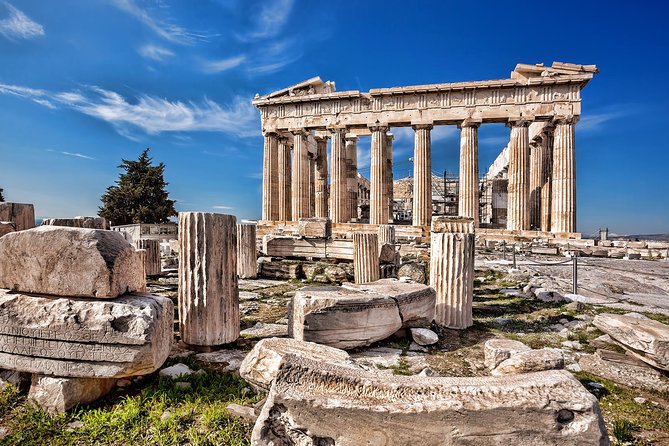
At the top, the Parthenon is the obvious centerpiece. Its scale is impressive even with scaffolding or restoration work that may be present at a given time. The building has endured war, conversion, explosions, weather, removal of sculptures, and centuries of change. Your guide explains what you are seeing rather than leaving you with only the familiar postcard view.
The Erechtheion offers a different experience. It is less massive than the Parthenon, but its unusual design and the Caryatid porch make it one of the most memorable structures on the hill. Because you have already seen the Caryatids in the museum, the building has more meaning when you encounter it outside.
The Acropolis portion is scheduled for about 1 hour and 45 minutes. The description also presents the main walking portion as typically under two hours, so this is not an all-day archaeological march. Still, you should expect steady walking, uphill sections, and time on exposed stone.
The guide allows time for photographs and for simply looking around. That matters. The Acropolis is not a place to rush through while listening to a nonstop speech. You want a few quiet minutes to face Athens, identify the hills and buildings below, and take in the Parthenon at your own pace.
More Walking Tours in Athens
- Athens: Acropolis and Parthenon Guided Walking Tour
★ 4.6 · 5,882 reviews - Greek Food Walking Tour in Athens
★ 5.0 · 4,740 reviews - Acropolis: Acropolis and Parthenon Guided Walking Tour
★ 4.7 · 3,442 reviews - Acropolis monuments & Parthenon Walking Tour with Optional Acropolis Museum
★ 5.0 · 2,678 reviews
Afternoon light, heat, and crowd levels
A 4 pm start is one of the strongest reasons to consider this departure. Athens can be punishing in the middle of the day, especially on pale stone with little shade. An afternoon visit gives the temperature a chance to ease, and several departures were paced around heat and even rain.
Do not treat the timing as a guarantee of an empty Acropolis. The site remains popular, and conditions change by season and day. The benefit is more modest and more useful: you may find the walk more comfortable, the light more attractive, and the approach less frantic than during the busiest hours.
The museum-first sequence also helps with comfort. You spend the hottest opening section indoors, then go outside later. Guides have adjusted the pace for hot conditions, and one group found the easy walking routes especially helpful during a 98-degree day.
The late-day views are a strong bonus. From the Acropolis, Athens spreads out in every direction, and afternoon light can give the city a softer appearance. Bring a phone with room for photographs. Guides have also taken pictures for participants, a thoughtful touch if you are traveling as a couple or family and want everyone in the frame.
Price, tickets, and the real value
The listed tour price is $61.47 per person. Add €30 for the Acropolis and €20 for the Acropolis Museum, both bought in cash from the guide, and your adult cost is effectively the tour price plus €50 in admission fees.
That makes this more expensive than walking up independently, but the comparison is not quite apples to apples. You are paying for a licensed guide, skip-the-line service, a planned route, and an explanation that links the museum displays with the monuments. If you would otherwise hire a guide at one site or spend time trying to understand the layout on your own, the package can be good value.
The entrance tickets are free for people under 18 who present identification at the entrance. The tour information also notes discounted tickets for children aged 17 and under, but confirm the exact booking price for your child before paying. The adult ticket cash requirement remains important, so do not arrive with only a card.
The small group cap improves the value. A group of four, or even a departure that turns into a private tour, is much easier to manage than a large crowd. You can hear explanations, ask about specific sculptures, and keep a sensible pace. The advertised maximum is 10, so do not book on the assumption that every departure will be private.
Meeting point and walking demands
You meet at Makrigianni 4 at 4 pm and finish near Acropoli in Athens. There is public transportation nearby, and the start and finish are within the central Acropolis area. Pick-up and drop-off service are not included, so you make your own way there and away afterward.
One small weakness is worth noting: finding the guide at the starting point may take a little patience. A clear guide sign with participant names would make the first meeting easier, so arrive early enough to look around rather than cutting it close.
The route calls for moderate physical fitness. You do not need to be an athlete, and the walk has been suitable for a 70-year-old participant when paced carefully. But you should be comfortable walking uphill, standing for periods, and crossing uneven or slippery ancient surfaces.
Wear shoes with traction. This is more important than dressing for photographs. The stone can be slick, particularly in rain, and the route is exposed to sun. A hat, water, and sun protection are sensible additions, though the supplied tour details do not promise water or shade.
Who will get the most from this tour
I would choose this experience if you want the Acropolis explained rather than simply photographed. It is especially useful for a first visit, when the names of the buildings and myths can quickly blur together.
Families can benefit from the shorter format, child ticket rules, and the guide’s ability to adjust the pace. The museum offers a calmer way to begin, while the hilltop supplies the big visual moment. Keep in mind that young children still need to manage the walking and marble surfaces.
Older adults may find the route reasonable if they have moderate fitness and use careful footing. Tell the guide if heat, slippery stone, or a slower pace is a concern. The experience has been adjusted for heat and for different walking speeds, but no special mobility service is included.
History fans will get the most from the museum’s sculpture displays and the links between the Caryatids, Parthenon decoration, and surviving buildings. Photographers will appreciate the late-day views, the Temple of Athena Nike, the Odeon, and the broad outlook over Athens.
I would not choose it if you want a private vehicle, hotel pick-up, or a very relaxed sightseeing day with little walking. I would also avoid booking it without allowing enough time to carry €50 in cash per adult for admission.
A clear verdict on the Acropolis afternoon tour
I recommend booking this tour if you value a strong guide and want the museum to make the Acropolis easier to understand. The museum-first plan is the key advantage, and the small group format gives the guide room to answer questions and adjust the pace.
The 4 pm departure is a smart choice during hot weather, though it cannot remove all crowds or guarantee a sunset visit. Add the €50 adult admission cost to your budget, wear grippy shoes, and arrive at the meeting point with cash and a little extra time.
Skip it if you prefer exploring alone and reading at your own speed. For most first-time visitors, though, the combination of museum context, south-slope sights, Parthenon views, and a licensed guide makes the extra cost worthwhile.
FAQ
What time does the tour start?
The tour starts at 4 pm.
Where does the tour meet?
The meeting point is Makrigianni 4, Athens 117 42, Greece.
Where does the tour finish?
The tour ends near Acropoli, Athens 117 42, Greece.
How long does the full experience last?
The total duration is approximately 3 hours and 15 minutes.
How is the time divided between the two main stops?
The Acropolis Museum visit lasts about 1 hour and 30 minutes. The Acropolis visit lasts about 1 hour and 45 minutes.
Is the tour offered in English?
Yes. The tour is offered in English.
Are entrance fees included?
No. Adult entrance fees are €30 for the Acropolis and €20 for the Acropolis Museum. The €50 total is paid in cash to the guide.
Do children pay the entrance fees?
People under 18 are entitled to a free entrance ticket when they present identification at the entrance. The tour also lists discounted tickets for children aged 17 and under, so check the exact booking price for the child.
How many people can join the tour?
The maximum group size is 10 people.
Is hotel pick-up included?
No. Pick-up and drop-off service are not included. You make your own way to the meeting point and from the end point.
Is the tour physically demanding?
You should have a moderate fitness level. The route includes walking on the Acropolis, uphill sections, and ancient marble that may be slippery. Shoes with traction are recommended.
Can I cancel for a full refund?
Yes, if you cancel at least 24 hours before the local start time. Cancellations made less than 24 hours in advance are not refunded, and changes within that period are not accepted.
Recently reviewed around Athens
- Small-Group Women History in Ancient Greece Walking Tour★ 5.0 · 38 reviews
- Ceramic and Pottery Creative Workshop with Two Local Artists★ 4.0 · 57 reviews
- Athens: Wine Workshop Create your Own Wine under the Acropolis★ 5.0 · 77 reviews
- Athens: Greek Wines Tasting with Sommelier and Acropolis Views★ 5.0 · 88 reviews
- Hydra Private Day Trip by Ferry from Athens with Transfers★ 4.0 · 30 reviews
- Small-Group Wine Tour in Athens with Tasting★ 5.0 · 33 reviews
- Wine Trails Private Tour/ Nemea visit 3 wineries from Athens or Nafplion (10 h)★ 5.0 · 44 reviews
- Acropolis of Athens, Parthenon and Acropolis Museum private tour with dinner★ 5.0 · 77 reviews
Acropolis & Acropolis Museum Tours, compared.

Acropolis & up to 5 Archaeological Sites Combo Pass
Read our review →

Acropolis, Parthenon & Acropolis Museum Guided Tour
Read our review →
Acropolis, Parthenon & Acropolis Museum Guided Tour
Read our review →


Acropolis monuments & Parthenon Walking Tour with Optional Acropolis Museum
Read our review →Browse the lists this tour appears in