
Reviewed · ANCIENT CORINTH TOURS
Ancient Sparta Ancient Corinth Private Tour from Athens/ Nafplio
Ancient Sparta is not a grand city of marble columns. That is exactly what makes this 10-hour private tour interesting. You see the modest remains of a military society, the Leonidas monument, a small museum, and then compare Sparta with the far more substantial ruins of Ancient Corinth.
I like the freedom to set your own pace, and I like having round-trip transport for a long Peloponnese day. Drivers including Christos, Takis, Nikolaos, and Philippe have been praised for safe driving, clear English, useful historical commentary, and thoughtful lunch or photo stops.
The main caution is the distance. Sparta takes several hours of driving from Athens, and the archaeological remains are less dramatic than the Acropolis. If you expect a large, fully preserved ancient city, you may feel shortchanged. If you want a broad day of Greek history with no rental car, this makes good sense.
In This Review
- Key points to know before booking
- The real appeal of this long Peloponnese day
- Corinth Canal: a fast look at an immense cut
- Sparta: visit with realistic expectations
- The Archaeological Museum of Sparta
- Acropolis and Ancient Theater: the most striking Spartan remains
- Leonidas Monument and the Molon labe story
- The Olive and Greek Olive Oil Museum
- Ancient Corinth: allow the time Sparta lacks
- What the private vehicle adds
- Driver commentary versus a licensed guide
- Lunch, extra stops, and the daily rhythm
- Who should book this tour?
- Final verdict: book it for breadth and flexibility
- FAQ
- How long does the Ancient Sparta and Corinth tour take?
- Is hotel pickup included?
- Can I start the tour in Nafplio?
- Is transportation private?
- Is the driver an archaeologist guide?
- What vehicles are available?
- Are entrance tickets included?
- Is the Olive and Greek Olive Oil Museum guaranteed?
- Is the Archaeological Museum of Sparta open every day?
- Can I extend the tour?
- Can I cancel for a full refund?
Key points to know before booking

- Sparta is atmospheric but modest: The ancient site has scattered remains, an acropolis, and a large Roman-era theater rather than a complete city.
- Corinth gives you the biggest payoff: Allow your full hour and 40 minutes for the archaeological site and museum if possible.
- The Corinth Canal is a quick photo stop: You get about 15 minutes to walk across a pedestrian bridge and look down from roughly 80 meters.
- Your driver is not an archaeologist guide: You receive books, audio material, and historical information during the drive, but a licensed guide must be arranged separately.
- The schedule can bend: Private transport allows extra stops or a swapped attraction, though additional time costs €30 to €60 per hour depending on the vehicle.
- Check museum days carefully: The Sparta and Olive Oil museums close on Tuesdays, while Ancient Corinth has a winter Tuesday closure.
The real appeal of this long Peloponnese day
This tour links places that are awkward to combine without a car. From Athens, you cross the Corinth Canal, continue south through the Peloponnese to Sparta, then turn back toward Corinth before returning to the capital.
That is a lot of ground. You spend much of the day in the vehicle, but the road itself is part of the experience. One family found the newer Peloponnese road much easier than expected, and several drivers used the journey to explain Greek society, politics, agriculture, and daily life. That helps the hours pass without feeling like dead time.
The private format is important. You are not tied to a large group moving on a fixed whistle-stop schedule. You can ask for a bathroom break, stop at a roadside fruit stand, spend longer at a site, or adjust a lunch stop if time allows.
Still, flexibility has limits. The advertised plan already packs in the canal, several Spartan sights, two museums, Ancient Corinth, and the return drive. A relaxed pace at every stop is not realistic from Athens.
More Ancient Corinth, Mycenae and canal trips:
- From Athens: Mycenae, Epidaurus & Nafplio Full Day Trip
★ 4.8 · 2,438 reviews - From Athens: Mycenae, Epidaurus & Nafplio Full-Day Tour
★ 4.5 · 1,580 reviews - From Athens: Ancient Corinth Day Trip with Canal & VR Guide
★ 4.6 · 1,073 reviews
Corinth Canal: a fast look at an immense cut
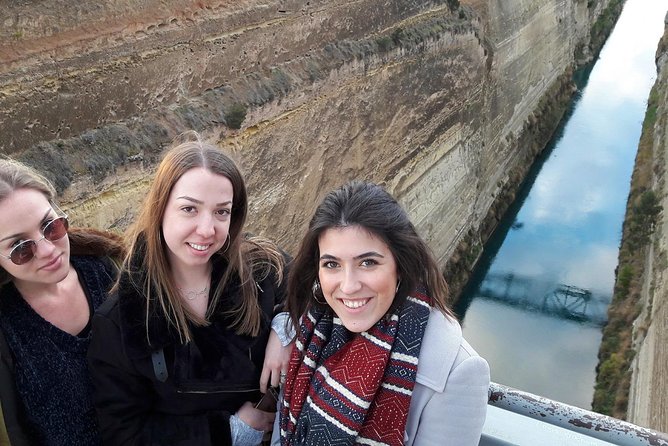
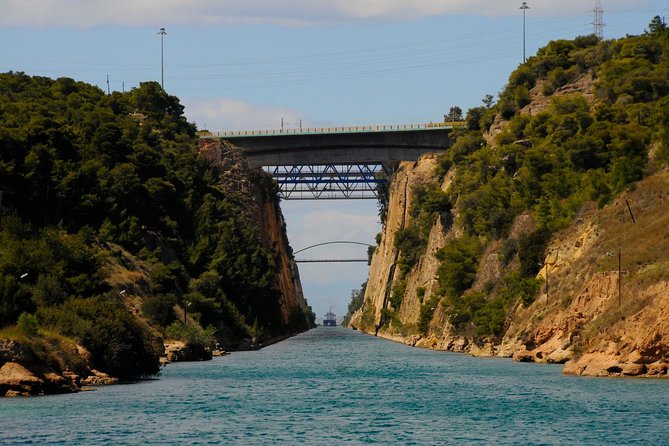
The Corinth Canal is the first stop, and it makes a strong visual opening. Workers spent twelve years, from 1881 to 1893, cutting about 6,400 meters through the land to connect the Aegean and Ionian seas and separate the Peloponnese from central Greece.
You get around 15 minutes here. That is enough to cross a pedestrian bridge, take photographs, and look down into the narrow waterway from a height of about 80 meters. You will not have time for a long walk or a detailed visit.
I would treat this as a sharp introduction rather than a main attraction. The height and straight walls create the drama, while the short stop keeps the day moving toward Sparta. Your driver can also point out the canal’s role in linking two seas and making the Peloponnese a peninsula.
Sparta: visit with realistic expectations
The modern city of Sparta does not wrap its ancient past in a polished tourist center. The remains are spread across open ground, and the site can feel quiet and understated. That matches the ancient city’s character better than a monumental reconstruction would.
Ancient Sparta was built around military strength. Its citizens were divided into groups with different rights and duties, including full Spartan citizens, free residents involved in trade, and helots, an enslaved local population controlled by the state. The system created a disciplined military society, but it also rested on severe inequality.
You only have about 30 minutes for the general Sparta stop before moving to the museum and acropolis area. That is enough to get your bearings, but not enough for a slow archaeological study. If Sparta is your main reason for booking, tell the driver early that you want to protect time here.
The useful question is not whether Sparta has as many visible monuments as Athens. It does not. The useful question is whether you want to see the physical setting of a city whose influence came from its social system and military reputation. If yes, the stop has value.
The Archaeological Museum of Sparta

The Archaeological Museum of Sparta occupies a neoclassical building dating from 1874 to 1876. It is the oldest provincial archaeological museum in Greece, and its compact size suits a packed day better than a huge museum would.
The scheduled visit is about 30 minutes. That gives you a focused look at objects connected with Sparta and the surrounding region, but you will need to keep moving. The general admission price is listed as €10 in summer and €5 in winter.
The museum closes every Tuesday. That is not a small detail. If your date falls on Tuesday, confirm what replaces the stop, since the Olive Oil Museum also closes that day. The tour information specifically warns about these closures, so check before you pay rather than assuming every listed attraction will be open.
More Athens trips worth a second look
- Athens: Acropolis & up to 5 Archaeological Sites Combo Pass
★ 4.4 · 12,619 reviews - Athens: Acropolis Ticket with Optional Audio or Live Guide
★ 4.2 · 11,055 reviews - Athens: Acropolis, Parthenon & Acropolis Museum Guided Tour
★ 4.8 · 9,316 reviews - Athens: Cape Sounion & Poseidon Temple Sunset Half-Day Trip
★ 4.8 · 8,241 reviews
Acropolis and Ancient Theater: the most striking Spartan remains
The acropolis and ancient theater offer the clearest sense of Sparta as a real city rather than just a name from schoolbooks. The theater was built from local white marble during the Roman period, in the late first century BC, and may once have held about 16,000 people.
Its scale is impressive even in a worn state. The theater had a mobile stage and was considered a destination in the ancient world. Later damage during the Byzantine period removed much of the auditorium, while erosion has softened the remaining marble and limestone.
You get about one hour here. That is a better window than the short general Sparta stop, though the site still rewards careful planning. Wear shoes suited to uneven ground, and ask your driver where to meet afterward so you do not waste time finding the vehicle.
The site also helps correct the usual image of Sparta. Ancient writers noted that the city was not built as one dense, showy center filled with grand temples. It looked more like a group of villages. What you see today fits that description: important, spread out, and less theatrical than Athens.
Leonidas Monument and the Molon labe story
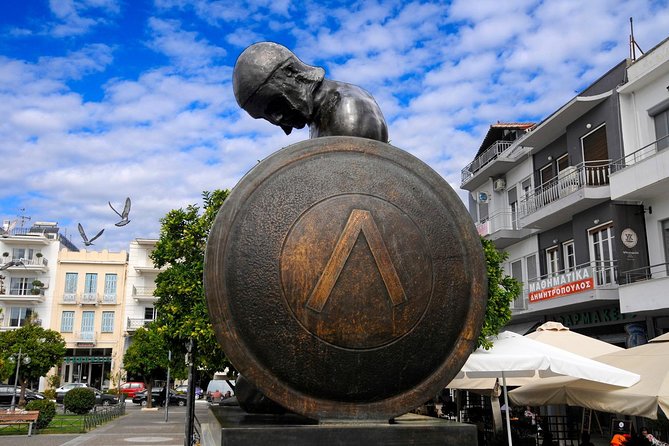
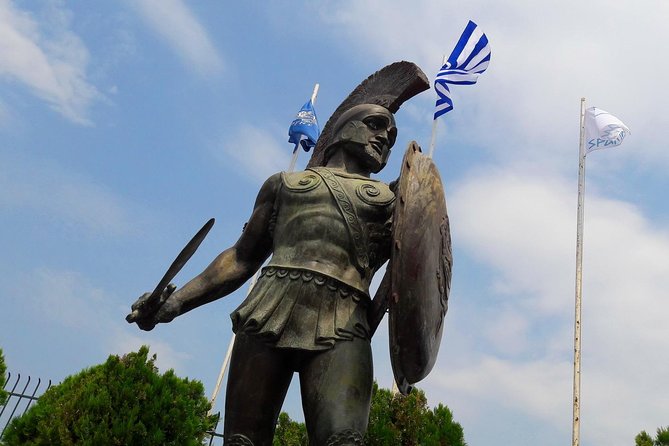
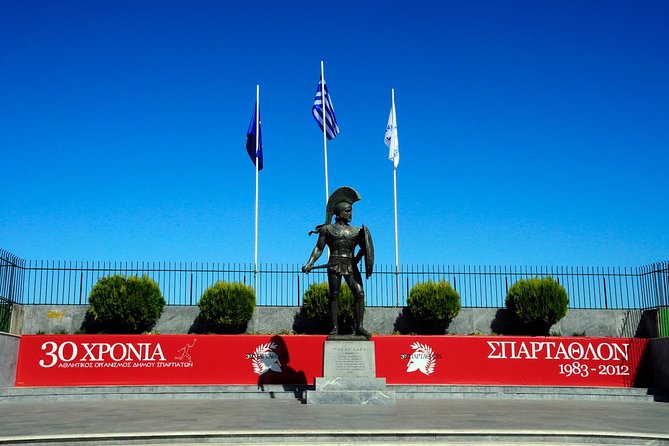
The Leonidas statue provides the tour’s most recognizable Spartan moment. It faces a stadium, with the famous phrase Molon labe, meaning come and get them, associated with Leonidas’ response when the Persians demanded that the Spartans surrender their weapons at Thermopylae.
The stop lasts about 15 minutes. It is brief, but the statue gives you a clear photo and a chance to connect the modern city with the legend of the Spartan king.
Nearby is a fifth-century BC limestone structure that some archaeologists believe was the tomb of Leonidas. Its original use has not been proved. Pausanias wrote that Leonidas’ remains were transferred and buried there after Thermopylae, and the monument is the only preserved structure from the ancient agora.
That uncertainty is worth remembering. You are not being shown a perfectly confirmed tomb. You are seeing a surviving ancient monument with a long-standing identification and a powerful connection to Spartan memory.
The Olive and Greek Olive Oil Museum
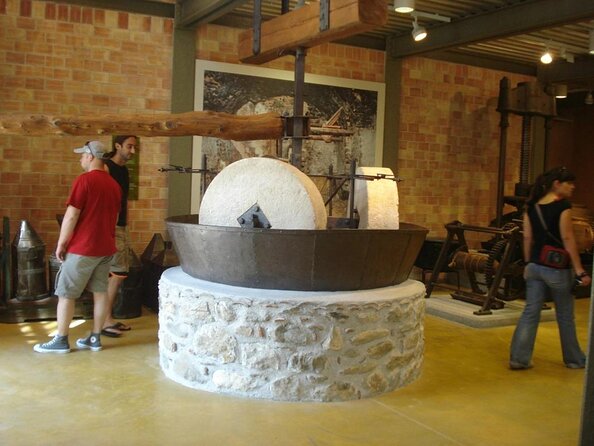
The Olive and Greek Olive Oil Museum is optional and depends on time. It adds a different side of Greece, moving away from kings and battlefields to food, trade, technology, religion, and rural life.
The displays cover olive cultivation and oil production from prehistoric times to the early twentieth century. Particularly unusual material includes fossilized olive leaves from Santorini, dated to roughly 50,000 to 60,000 years ago, and replicas of fourteenth-century BC Linear B tablets that record early written references to olives and olive oil.
You have about 20 minutes here, which is enough for a quick visit but not a slow museum tour. Admission is €5. It closes on Tuesdays.
Past visitors have also had olive oil tastings and met a local host, but you should not assume a tasting is guaranteed. The museum can be a nice change of pace after the ruins, though Ancient Corinth is usually the stronger use of limited time if you must choose between stops.
Ancient Corinth: allow the time Sparta lacks
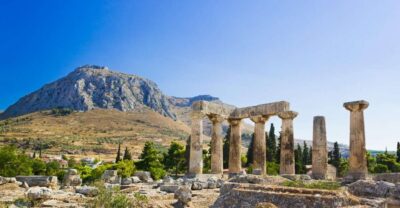
Ancient Corinth is the place where I would protect extra minutes. The archaeological site is larger and more immediately legible than Ancient Sparta, with the remains of one of the major cities of ancient Greece spread around the Temple of Apollo and the old urban center.
You spend about one hour and ten minutes at the site, followed by roughly 30 minutes in the archaeological museum. That is still brisk. One hour and 40 minutes can introduce you to Corinth, but it may leave you wishing for more time, especially if you enjoy inscriptions, sculpture, and architectural details.
Corinth also carries a strong Christian connection. The city is linked with the Apostle Paul’s missionary journeys and with the two New Testament letters known as First and Second Corinthians. That gives the site an extra layer for anyone interested in early Christianity, not just classical Greece.
The combined ticket includes the archaeological site and museum. The listed cost is €15 in summer or €8 in winter. This is separate from the tour price, so keep cash or a payment method ready for admissions.
The museum helps put the scattered ruins into context. Without it, you may see columns and stones but miss how the city worked. If your driver recommends a nearby lunch stop with a view toward the Temple of Apollo, that can be a sensible way to eat without losing the Corinth portion of the day.
What the private vehicle adds
The tour costs $265.50 per person, but the real value depends on your group size and vehicle. It is not simply an entrance ticket with a ride attached. The price covers private transport, fuel, toll roads, parking, hotel or apartment pickup and drop-off within the stated Athens area, and an English-speaking driver for the day.
You can choose among:
- A sedan for up to three adults, or a family of four with two adults and two children
- A minivan for one to seven people
- A minibus for one to fourteen people
Prices vary with group size and vehicle type. Children up to age 12 are listed as free in the stated family arrangements, with limits on the number of children depending on the vehicle.
For two people, this is a costly day compared with a large coach excursion. For a family or group splitting the vehicle cost, the calculation looks better. You avoid car rental, toll decisions, parking worries, and the fatigue of driving a long mountain route. You also gain control over stops.
Pickup is offered from central Athens locations up to seven kilometers from the center. Pickup from places farther out costs an extra €15 each way, and Piraeus has the same additional charge. Airport and Lavrio Port transfers require prior agreement and are not included in that €15 fee.
You can also begin in Nafplio. The price changes because Sparta, Corinth, and the acropolis are closer from there. If Nafplio is your base, this becomes a more efficient day than the Athens version.
Driver commentary versus a licensed guide
Your driver provides historical details while you travel, along with informative books and an audio documentary. That is useful on a long route, and drivers such as Takis and Philippe have been praised for discussing not just monuments but also Greek culture, people, politics, and philosophy.
Do not confuse that service with a guided archaeological tour. The driver does not accompany you through the sites or museums as a licensed archaeologist. If you want detailed interpretation beside the ruins, arrange an archaeological guide in advance. The extra guide costs more and depends on availability.
This distinction matters most at Sparta. The remains are not self-explanatory, and a guide can help you understand the city’s layout, social structure, and surviving monuments. At Corinth, signs and the museum make a self-guided visit easier, though expert commentary would still add depth.
Lunch, extra stops, and the daily rhythm
Lunch is not listed as included, so plan to pay for your own meal. The private format lets you discuss timing with the driver, and the route has included local restaurant and cafe stops. One memorable option described by a family was a small cafe overlooking the Temple of Apollo at Corinth, while another stop involved buying fresh cherries from a roadside farmer on the way to Sparta.
Those details show the best side of a private tour. You are not locked into a bus rest stop. You can ask for a meal that fits your interests, provided the schedule allows it.
The standard day is already full. If you add Mystras, a longer lunch, or several extra roadside stops, something else may need to be shortened. Mystras is not part of the stated itinerary, but it has been substituted or added on some private days when time permitted. It involves a substantial walk and should be requested before departure, not assumed.
Extending the tour costs €30 per hour for a sedan, €45 for a minivan, or €60 for a minibus. Agree on the extra time and price with the driver before the day runs over.
Who should book this tour?
I would recommend it to a family, couple, or small group that wants Sparta and Corinth in one day without renting a car. It also suits anyone who values a flexible schedule more than a formal guided presentation.
You should be comfortable with a long day in a vehicle. The itinerary is intense in a productive way, but it is not a slow country outing. You will walk over uneven archaeological ground, climb or negotiate site paths, and move between several stops.
This is a good match if you want:
- A private vehicle and hotel pickup
- Sparta’s historical setting rather than a grand monument count
- Ancient Corinth and its museum in the same day
- An English-speaking driver with commentary during the ride
- The ability to adjust lunch, photo stops, or the order of the day
Think twice if your priority is a fully guided archaeological experience, extensive museum time, or a relaxed day with only one major site. In those cases, a dedicated Sparta or Corinth tour with a licensed guide would serve you better.
Final verdict: book it for breadth and flexibility
Book this private tour if you want to connect the Corinth Canal, Sparta, Leonidas, olive oil culture, and Ancient Corinth in one ambitious outing. Its strongest features are the private transport, capable drivers, flexible pacing, and the chance to see two very different ancient cities in a single day.
Do not book it expecting Sparta to look like Athens. The remains are scattered, and the museum or theater may matter more to you than the open archaeological ground. Check the Tuesday closures, protect enough time for Corinth, and arrange a licensed guide in advance if site interpretation is important.
Free cancellation is available up to 24 hours before the start time. With those practical points settled, this is a worthwhile choice for a small group that wants a broad, personal look at the Peloponnese rather than a polished, one-site excursion.
FAQ
How long does the Ancient Sparta and Corinth tour take?
The tour lasts approximately 10 hours, including transportation from Athens or Nafplio and the return journey.
Is hotel pickup included?
Pickup and drop-off are included from hotels or apartments in central Athens within seven kilometers of the city center. Other locations may require an extra charge or prior agreement.
Can I start the tour in Nafplio?
Yes. Pickup and drop-off are offered from hotels, apartments, or ports in Nafplio. The price changes because the main attractions are closer from Nafplio.
Is transportation private?
Yes. Only your group participates, and transportation is provided in a private sedan, minivan, or minibus.
Is the driver an archaeologist guide?
No. The English-speaking driver provides historical information, books, and an audio documentary during the journey but does not guide you inside the sites or museums. A licensed archaeological guide can be hired separately.
What vehicles are available?
You can choose a sedan for up to three adults, a minivan for up to seven people, or a minibus for up to fourteen people. Pricing varies by group size and vehicle type.
Are entrance tickets included?
No. Ancient Corinth costs €15 in summer or €8 in winter, and the Archaeological Museum of Sparta costs €10 in summer or €5 in winter. The Olive and Greek Olive Oil Museum costs €5.
Is the Olive and Greek Olive Oil Museum guaranteed?
No. The stop is optional and depends on the available time. It is closed every Tuesday.
Is the Archaeological Museum of Sparta open every day?
No. It is closed every Tuesday. You should also check seasonal admission prices before departure.
Can I extend the tour?
Yes, if you make an arrangement with the driver. Additional time costs €30 per hour for a sedan, €45 for a minivan, or €60 for a minibus.
Can I cancel for a full refund?
You can cancel at least 24 hours before the experience start time for a full refund. Cancellations or changes made less than 24 hours in advance are not accepted for a refund.
Recently reviewed around Athens
- Small-Group Women History in Ancient Greece Walking Tour★ 5.0 · 38 reviews
- Ceramic and Pottery Creative Workshop with Two Local Artists★ 4.0 · 57 reviews
- Athens: Wine Workshop Create your Own Wine under the Acropolis★ 5.0 · 77 reviews
- Athens: Greek Wines Tasting with Sommelier and Acropolis Views★ 5.0 · 88 reviews
- Hydra Private Day Trip by Ferry from Athens with Transfers★ 4.0 · 30 reviews
- Small-Group Wine Tour in Athens with Tasting★ 5.0 · 33 reviews
- Wine Trails Private Tour/ Nemea visit 3 wineries from Athens or Nafplion (10 h)★ 5.0 · 44 reviews
- FLYING DRESS Photoshoot in Athens – Greece★ 5.0 · 47 reviews
Ancient Corinth Tours, compared.
Ancient Corinth Day Trip with Canal & VR Guide
Read our review →
Private Biblical Tour Ancient Corinth & Isthmus Canal from Athens
Read our review →
4-Day Classical Greece Tour: Epidaurus, Mycenae, Olympia, Delphi, Meteora
Read our review →
Ancient Corinth & Nafplio Full Day Trip with Swim
Read our review →
Mycenae and Nafplion Day Trip from Athens with Official guide
Read our review →
Browse the lists this tour appears in