

Reviewed · ACROPOLIS & ACROPOLIS MUSEUM TOURS
Athens: Award-Winning Acropolis Guided e-Scooter Tour
Athens has enough hills, heat, and ancient stones to make sightseeing on foot feel like a full-body workout. This two-hour e-scooter tour gives you a breezy way to cover the Acropolis area, with stops at the Areopagus, Pnyx, National Observatory, Thissio, and Temple of Hephaestus.
I like the careful scooter training and the mostly pedestrian route, which keeps the ride relaxed. I also like the guides’ lively storytelling and practical Athens tips, especially from team members such as Venice, John, Yannis, and Nik. The main catch is simple: you do not enter the Acropolis, and $69 is a fair but not bargain-level price for an outside tour.
In This Review
- Key things to know before you book
- Why an e-scooter works well around the Acropolis
- Starting behind the Acropolis Museum
- Odeon of Herodes Atticus and the Acropolis approach
- Areopagus Hill, Pnyx, and the birthplace of democracy
- National Observatory and a quieter side of Athens
- Thissio, Agia Marina, and the Temple of Hephaestus
- The final sweep of Athens landmarks
- How good is the guiding?
- Is $69 a good value?
- Who should book this ride?
- Should you book the Acropolis e-scooter tour?
- FAQ
- Does the tour enter the Acropolis?
- Where does the tour start?
- Are scooters provided?
- What language is the tour in?
- Do I need to know how to ride a scooter?
- Can I cancel or pay later?
Key things to know before you book

- Mostly car-free riding: The route uses pedestrian areas and low-traffic sections around the Acropolis, rather than sending you into busy Athens traffic.
- A proper practice session: You get instruction before setting off, and the fat-tire scooters are designed to feel stable and comfortable.
- Many famous sights in two hours: You pass the Acropolis, Parthenon, Theatre of Dionysus, Temple of Olympian Zeus, Propylaea, Erechtheion, and Monastiraki.
- History with a local voice: The guides connect the monuments to democracy, philosophy, Greek gods, and everyday Athens.
- A good first-day orientation: You see enough of the central area to decide which sites deserve your own return visit.
- Outside views only: Tickets, museum admission, and an inside Acropolis tour are not included.
Why an e-scooter works well around the Acropolis
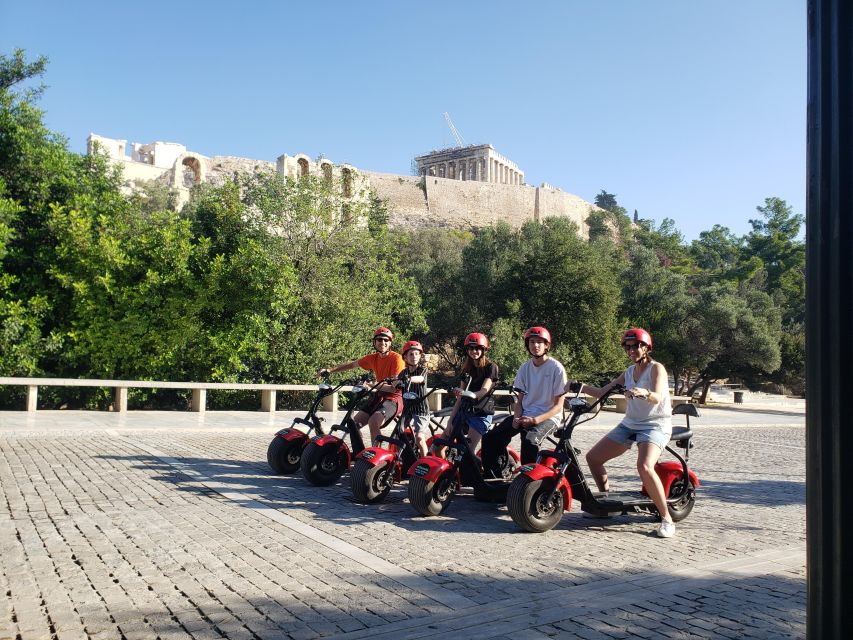
The Acropolis area is compact on a map, but it is not always easy on your feet. Ancient sites sit on hills, paved paths can be uneven, and summer sun turns even a short walk into a warm chore. An electric scooter lets you move between viewpoints without arriving at every stop out of breath.
These are not tiny rental scooters meant for racing through traffic. The tour uses red fat-tire scooters, described as stable and easy to handle once you get moving. The guides keep the pace fairly slow and make sure nobody is left behind. That matters if your group includes teenagers, older adults, or anyone who feels a bit nervous at first.
You should still be able to ride a bike. The activity is not suitable for people who cannot ride, or for people with vertigo, epilepsy, or haemophilia. Wear sports shoes or other comfortable footwear and clothes that let you move freely.
The ride is also a useful compromise for a mixed group. One person can enjoy the fun of riding, another can appreciate the history, and nobody has to choose between a formal walking tour and a fast, impersonal vehicle tour. Some people who are uneasy about driving have chosen to ride as passengers, according to the activity details, though you should confirm how that works for your booking.
More Athens trips worth a second look
- Athens Acropolis Official E-Scooter Guided Tour Fat E-Bike
★ 5.0 · 504 reviews - Athens: City Highlights Guided E-Scooter Tour
★ 5.0 · 277 reviews - Athens: Premium Guided E-Scooter Tour in Acropolis Area
★ 4.9 · 264 reviews
Starting behind the Acropolis Museum
Meet the Wheelz Fat Bike Tours team at Chatzichristou 6A, a short walk behind the Acropolis Museum and about two blocks from the Acropolis Metro Station. Look for the large green Wheelz sign and the red fat-tire scooters.
The location is handy if you are staying near the Acropolis, arriving by metro, or already visiting the museum. Do not confuse the starting point with an Acropolis entrance. You begin at the shop, receive your helmet, and take part in a safety briefing before the sightseeing starts.
The training is one of the strongest parts of the setup. The guides explain how to control the scooter and give you time to practice. That patient start is important because the first few minutes can feel unfamiliar, even if you have used a bicycle or scooter before.
Once the group is ready, the tour moves out at an easy pace. The guides are attentive and encouraging, and on some tours two guides work together: one can remain with the scooters while the other walks with the group and explains a site. That arrangement gives you a better chance to hear the story without trying to balance and listen at the same time.
Odeon of Herodes Atticus and the Acropolis approach
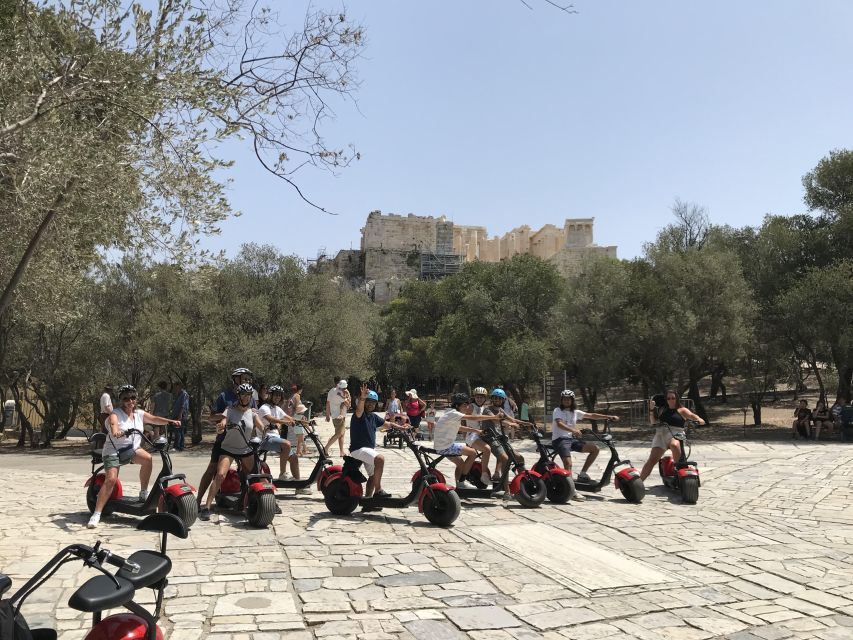
The first major stop is the Odeon of Herodes Atticus, the impressive Roman-era theater built into the southern slope of the Acropolis. You see it from outside and hear about its place in Athens’ long performance tradition.
From here, the route heads toward the front entrance of the Acropolis. This is a useful orientation point, especially if you plan to return later for a timed admission visit. You get a sense of the entrances, the slopes, and the relationship between the Acropolis hill and the streets below.
The tour also passes the Acropolis Museum, Makrygianni, and nearby sections of the Acropolis area. The museum is not included, so treat this as a preview rather than a substitute. I like that arrangement for a first morning because it lets you decide how much time you want to give the indoor collections later.
You will get outside views of the Parthenon, the Propylaea, the Erechtheion, and the Temple of Athena Nike. These brief photo stops are good for orientation and pictures, but they are not detailed visits inside the monuments. If your main goal is to study the Acropolis at length, book a separate entry and allow several hours.
Areopagus Hill, Pnyx, and the birthplace of democracy
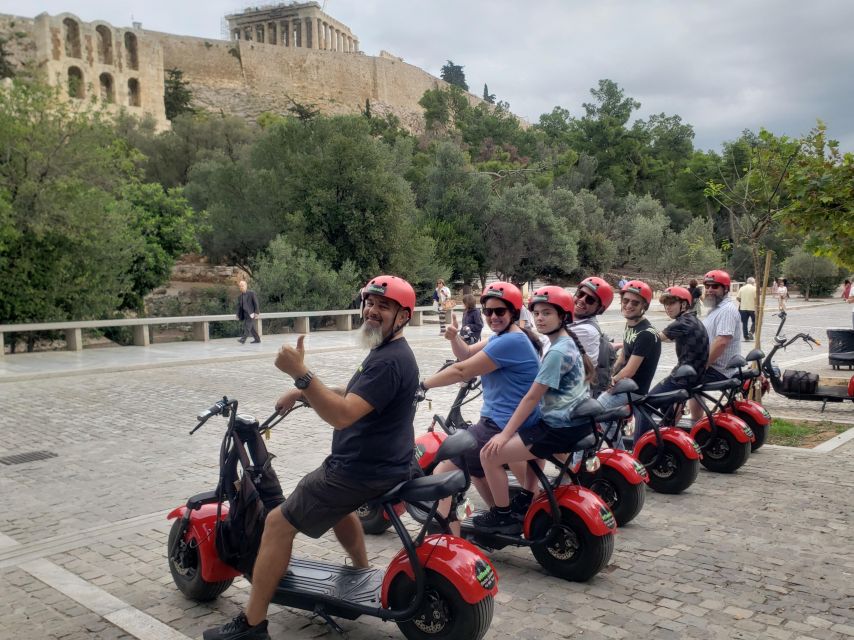
Areopagus Hill is one of the most memorable stops because it gives you a strong view over the city and the Acropolis. It is also tied to ancient law and public life. Your guide uses the place to explain how Athens functioned as a city-state, rather than treating the rock as just another photo platform.
The Pnyx offers an even more direct link to democracy. This is where citizens gathered for political discussion and decisions, and the stop helps turn a familiar schoolbook word into a physical place. You can look across the area and picture public debate taking place outdoors, with the Acropolis nearby.
The guides connect these sites with Socrates, Aristotle, and Plato. The tone is not presented as a lecture. The best part of this tour is the mix of short stops, stories, questions, and time for photographs. Guides such as John and Venice have been singled out for making the ancient material easy to follow, with humor and a clear sense of pride in Athens.
There is one practical point to remember: some stops involve getting off the scooter and walking a short distance. The activity reduces walking, but it does not remove it entirely. Bring shoes with a good grip, especially if the stone surfaces are warm, worn, or uneven.
A different kind of day out, same corner of Greece:
- Athens: Acropolis & up to 5 Archaeological Sites Combo Pass
★ 4.4 · 12,619 reviews - Athens: Acropolis Ticket with Optional Audio or Live Guide
★ 4.2 · 11,055 reviews - Athens: Acropolis, Parthenon & Acropolis Museum Guided Tour
★ 4.8 · 9,316 reviews - Athens: Cape Sounion & Poseidon Temple Sunset Half-Day Trip
★ 4.8 · 8,241 reviews
National Observatory and a quieter side of Athens
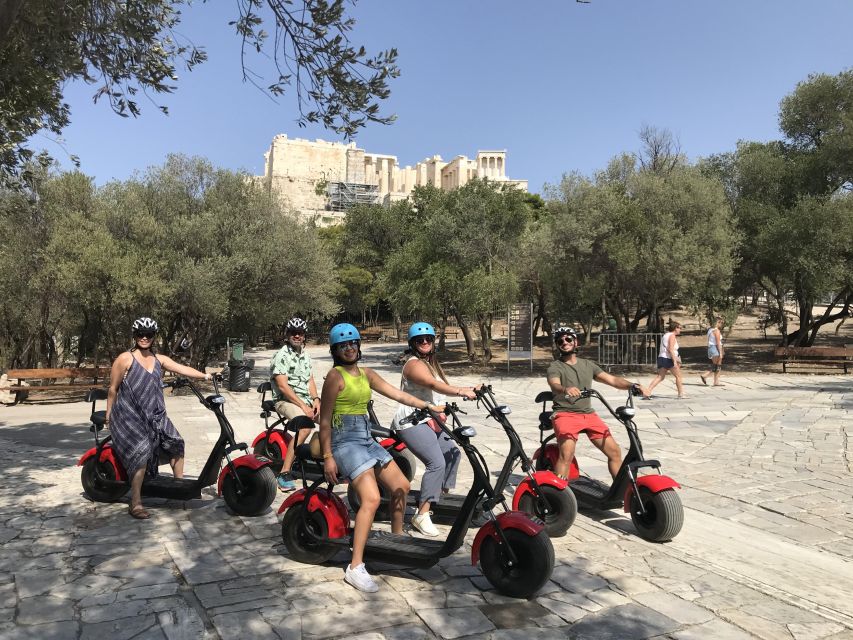
The route continues past the National Observatory of Athens, another good place to pause for city views and a sense of how the old and modern parts of Athens sit together. You are not taking an observatory tour here. It is an outside sightseeing stop, presented as part of the wider Acropolis setting.
A secret stop is also included, though the exact location is not specified in the tour information. That makes it a pleasant bonus rather than something to plan around. Expect a scenic viewpoint or an appealing angle for photos, not a guaranteed major monument.
This section is where the scooter format earns its keep. You can reach several outlooks and historic corners without spending your morning climbing every slope. The route is mostly away from heavy traffic, and guides take care when a short road section is needed.
I would choose an early departure if you can. A 9 a.m. start has been especially useful in hot weather, with cooler air and fewer people around the major sights. Starting early also leaves the rest of your day open for the Acropolis interior, the museum, or a long lunch.
Thissio, Agia Marina, and the Temple of Hephaestus
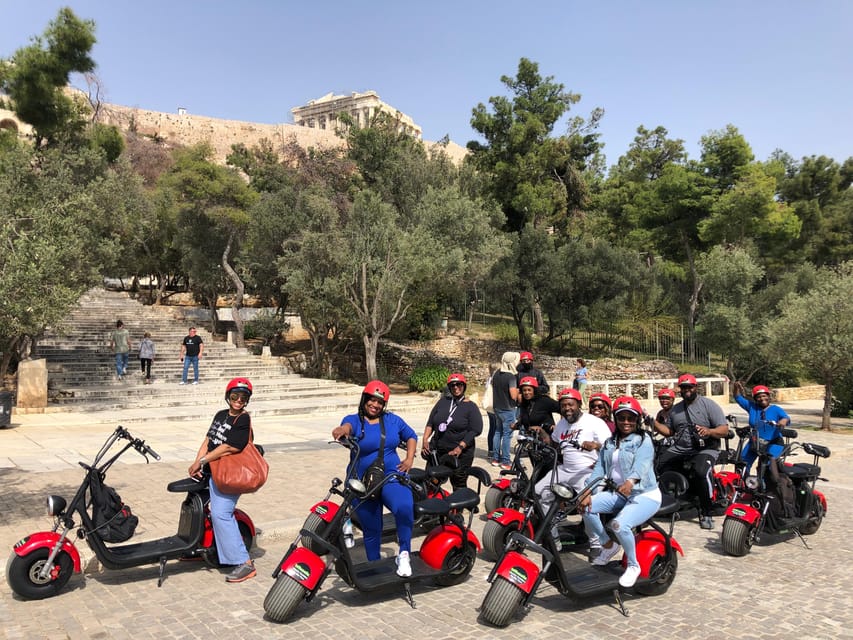
Thissio gives the tour a welcome change of mood. The neoclassical neighborhood has restaurants, cafés, and open areas where you can see how modern Athens lives alongside its ancient monuments. The guides also give recommendations for places to eat, shop, and spend time after the tour.
The Church of Agia Marina is passed rather than explored in detail. That is typical of this experience: the route covers a broad area, then chooses a few places for proper stops. You see more of central Athens, but you should not expect a full visit at every landmark.
The Temple of Hephaestus is the main ancient monument stop away from the Acropolis. It is one of the best-preserved Greek temples in Athens, and its setting in the Ancient Agora area gives you another view of classical architecture. The guide explains what you are seeing, and the tour includes time to pause here.
The Ancient Agora entrance is not included. You see the Temple of Hephaestus from the outside unless you buy a separate ticket. That distinction matters because the tour gives you context and a good look, but it does not replace admission to the archaeological site.
Near the end, there is a break around the Thissio flea market area. Water is included throughout, and a juice is provided near the Temple of Hephaestus or before the return to the shop. In Athens’ heat, these small details are more useful than they sound.
The final sweep of Athens landmarks
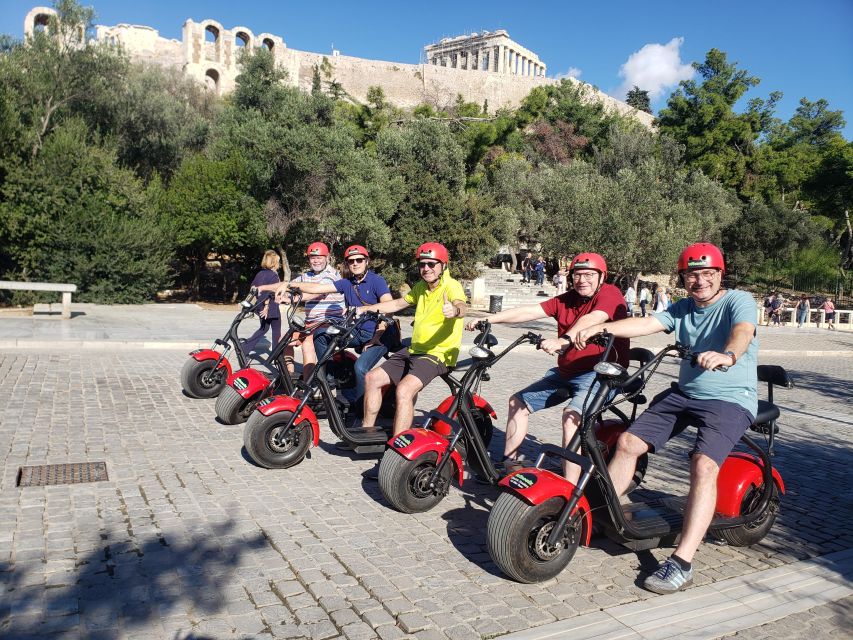
The tour’s final section gathers many familiar names into a broad sightseeing loop. You pass or stop for photographs at the Theatre of Dionysus, Temple of Olympian Zeus, Zappio District, Propylaea, Erechtheion, Monastiraki, and Filopappou.
The Theatre of Dionysus is especially important for anyone interested in drama. It sits below the Acropolis and is linked to the early development of Greek theater. The stop is mainly for photos and an outside explanation, so plan a separate visit if you want to inspect the site closely.
The Temple of Olympian Zeus gives you a sense of scale. Even in its ruined state, the surviving columns show how ambitious ancient building projects could be. The Zappio District adds a more open, leafy part of central Athens before the route returns toward the historic core.
Monastiraki and Filopappou help you understand the city beyond the headline monuments. You see the busy central neighborhood, the hill viewpoints, and the connections between the Acropolis and surrounding districts. The route may feel full because it covers many places quickly, but that is also its purpose: it is a moving introduction rather than a slow archaeological study.
Allow yourself to take photos, but keep your camera ready. Several stops are short, and a one-minute pass by a landmark is not the same as a guided visit. The guide’s spoken explanation is where much of the value lies.
How good is the guiding?

The strongest feature here is the human side of the tour. Guides including Venice, John, Yannis, Nik, Giannis, and others are described as warm, funny, patient, and deeply familiar with the city. Names and staff can change, but the consistent pattern is a personal presentation rather than a recorded script.
The stories cover ancient politics, philosophy, Greek gods, monuments, and local life. The guides answer questions and give restaurant, shopping, and bar suggestions after the ride. That practical local advice can be particularly useful if you take this tour early in your stay.
I also like the two-guide approach when available. One guide can focus on steering and group safety while another explains the site on foot. The group is watched closely, and the pace is designed to keep nervous riders comfortable.
The English guiding is the listed language. If you need another language, this is not the right choice based on the available information.
Is $69 a good value?
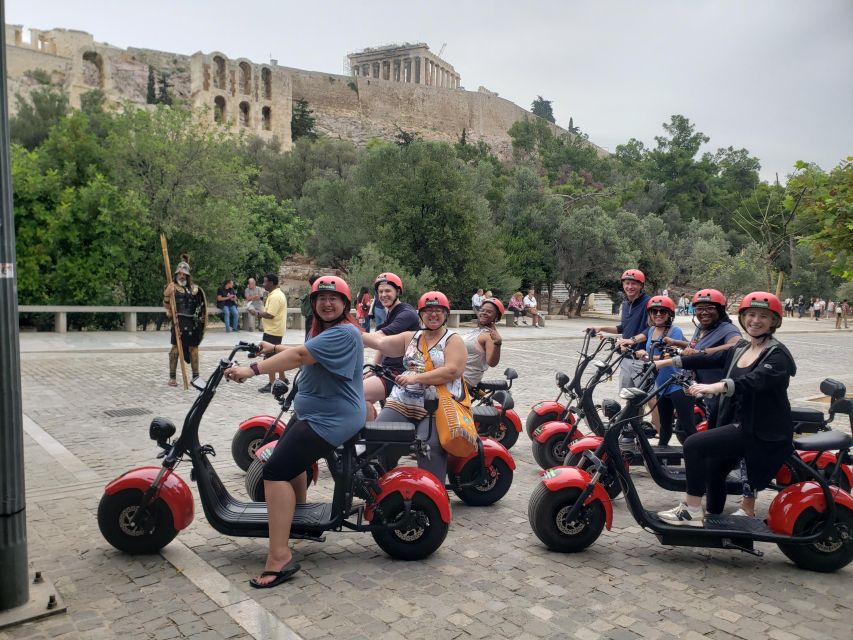
At $69 per person, this is not the cheapest way to see the Acropolis from outside. A self-guided walk costs much less, and a normal city walk may cover some of the same ground.
The price becomes easier to justify if you value three things: reduced walking, a trained guide, and the ability to cover several districts in two hours. You receive the electric scooter, helmet, guide, water, juice, and insurance. The route also saves you from spending time figuring out how to connect the Acropolis, Areopagus, Pnyx, Thissio, and Temple of Hephaestus on your own.
It is particularly good value for a short stay, a layover, or a first day in Athens. You get a clear map in your head, then you can return to the Acropolis or Agora with better context. If your group is mainly interested in entering the monuments and hearing long site explanations, the money may be better spent on admission and a dedicated archaeological guide.
Free cancellation up to 24 hours before the start and reserve-now, pay-later booking make the commitment less risky. Weather can affect any outdoor ride. One tour was postponed because of rain and later went ahead when conditions cleared, so keep your plans a little flexible.
Who should book this ride?
I would recommend it to families with teenagers, couples who want something more active than a bus tour, and anyone who wants to see central Athens without exhausting their legs. It also suits people with limited time who want a quick first look before choosing which monuments to enter.
Older riders can manage it if they are comfortable on a bicycle and can follow the scooter instructions. The stable design helps, but this is still a riding activity, not a seated sightseeing vehicle.
I would be more cautious if you dislike scooters, feel uncomfortable on uneven ground, or want long, quiet time at each archaeological site. People with vertigo, epilepsy, haemophilia, or no ability to ride a bike should not book this activity.
Bring comfortable sports shoes, light clothing suited to the weather, and sun protection. Water is supplied, but you should still arrive ready for outdoor conditions.
Should you book the Acropolis e-scooter tour?
Book it if you want a fun orientation to Athens, less walking, and lively local stories in a short time. The guides’ care, the easy training, and the mostly pedestrian route make it friendlier than the word scooter might suggest.
Do not book it expecting entry to the Acropolis, the Parthenon, the Acropolis Museum, or the Ancient Agora. You will see major sites from outside and receive explanations, then need separate tickets for interior visits.
For most first-time visitors, I would schedule this near the start of an Athens stay, ideally in the morning. It gives you a useful overview, saves energy for the rest of the day, and helps you decide which ancient places deserve a slower return visit.
FAQ
Does the tour enter the Acropolis?
No. The tour sees the Acropolis, Parthenon, Propylaea, Erechtheion, and Temple of Athena Nike from outside. Acropolis admission and an inside guided tour are not included.
Where does the tour start?
It starts at Wheelz Fat Bike Tours, Chatzichristou 6A, behind the Acropolis Museum. The shop is about two blocks from the Acropolis Metro Station and has a large green Wheelz logo.
Are scooters provided?
Yes. An electric scooter is included, along with a helmet, guide, water, juice, and insurance.
What language is the tour in?
The live guided tour is conducted in English.
Do I need to know how to ride a scooter?
You need to be able to ride a bike. The team provides a safety briefing and training before the tour begins, and the scooters are intended to be stable and easy to handle.
Can I cancel or pay later?
You can cancel up to 24 hours in advance for a full refund. The reserve-now, pay-later option lets you hold a place without paying immediately.
Recently reviewed around Athens
- Small-Group Women History in Ancient Greece Walking Tour★ 5.0 · 38 reviews
- Ceramic and Pottery Creative Workshop with Two Local Artists★ 4.0 · 57 reviews
- Athens: Wine Workshop Create your Own Wine under the Acropolis★ 5.0 · 77 reviews
- Athens: Greek Wines Tasting with Sommelier and Acropolis Views★ 5.0 · 88 reviews
- Hydra Private Day Trip by Ferry from Athens with Transfers★ 4.0 · 30 reviews
- Small-Group Wine Tour in Athens with Tasting★ 5.0 · 33 reviews
- Wine Trails Private Tour/ Nemea visit 3 wineries from Athens or Nafplion (10 h)★ 5.0 · 44 reviews
- Private Athens Transfer Airport/Port -Greek Tours-Hourly service★ 5.0 · 88 reviews
Acropolis & Acropolis Museum Tours, compared.

Acropolis & up to 5 Archaeological Sites Combo Pass
Read our review →

Acropolis, Parthenon & Acropolis Museum Guided Tour
Read our review →
Acropolis, Parthenon & Acropolis Museum Guided Tour
Read our review →


Acropolis monuments & Parthenon Walking Tour with Optional Acropolis Museum
Read our review →Browse the lists this tour appears in