Reviewed · GUIDED
Athens: Guided Urban Street-Art Tour
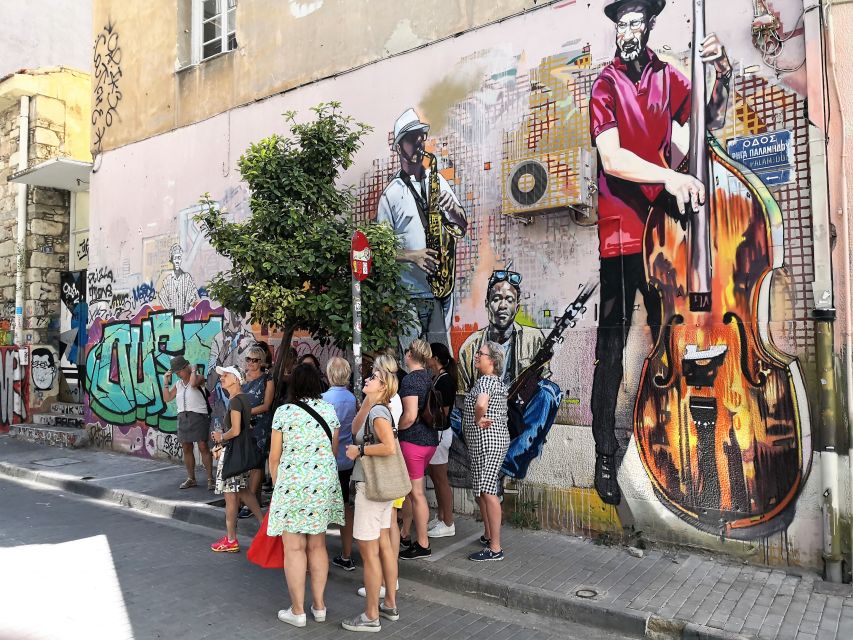
Athens tells its current story on walls. This two-hour street-art walk moves from Monastiraki through Psyrri, Sarri, Omonoia, and Metaxourgeio, using murals and graffiti to explain Greece’s financial crisis, political tensions, social struggles, and changing neighborhoods. Guides such as Penelope, Katerina, Greg, Eleni, and Pascal bring strong knowledge of both the art and the city.
I like two things right away: you see parts of central Athens that many visitors pass by, and you learn how to read the symbols, faces, lettering, and political messages rather than simply stopping for photographs. The main consideration is the amount of walking. The pace can be steady, and summer heat may make the route tiring, especially for young children or anyone who needs frequent breaks.
In This Review
- Key points to know before you book
- Why Athens street art makes such a good walking tour
- Starting beside Monastiraki metro at Lonis
- Monastiraki and Psyrri: the first layers of the city
- Platia Iroon and Sarri: small streets, big messages
- Omonoia: modern Athens without a polish filter
- Metaxourgeio: finishing with a changing neighborhood
- The guides make the difference
- What the $47 price really covers
- Walking conditions, heat, and who will enjoy it
- Why this is not just an Instagram walk
- Should you book the Athens street-art tour?
- FAQ
- Where does the Athens street-art tour start?
- Where does the tour finish?
- How long does the tour last?
- What language is the tour offered in?
- Which Athens neighborhoods does the route visit?
- What is included in the price?
- How much does the tour cost?
- Can I cancel the booking?
Key points to know before you book
- The route crosses six central districts: Begin beside Monastiraki metro and finish at Metaxourgeio Square.
- The art comes with context: Your guide explains artists, techniques, political themes, and the effect of Greece’s financial crisis.
- Guides are the tour’s main strength: Penelope, Katerina, Greg, Eleni, and Pascal are praised for clear English, warmth, and strong knowledge of Athens.
- It is more than a photo walk: You learn to decode images and messages, including work by Greek and international artists.
- Expect a fair amount of walking: The route includes small alleys, courtyards, busy streets, and several neighborhood changes.
- The $47 price buys interpretation: You are paying for a local guide who connects scattered walls to modern Greek society, not simply for access to public art.
Why Athens street art makes such a good walking tour
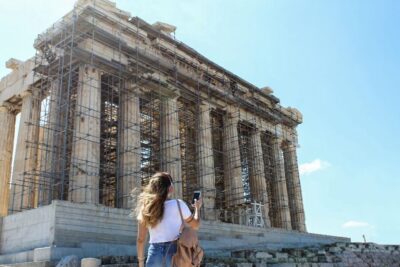
Ancient Athens is easy to understand as a visitor. You see the Acropolis, temples, columns, and museums. Modern Athens takes more work. Its story is spread across apartment blocks, shuttered shops, garages, side streets, and walls covered with layers of paint.
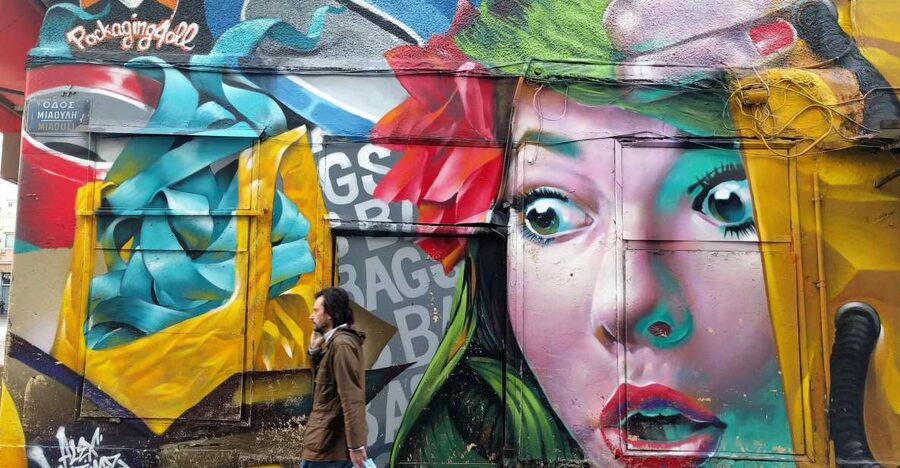
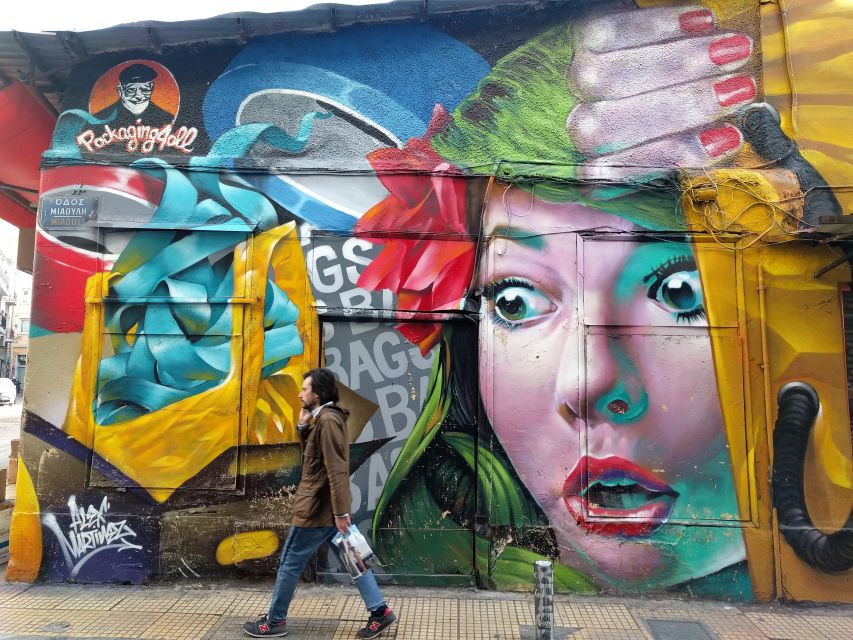
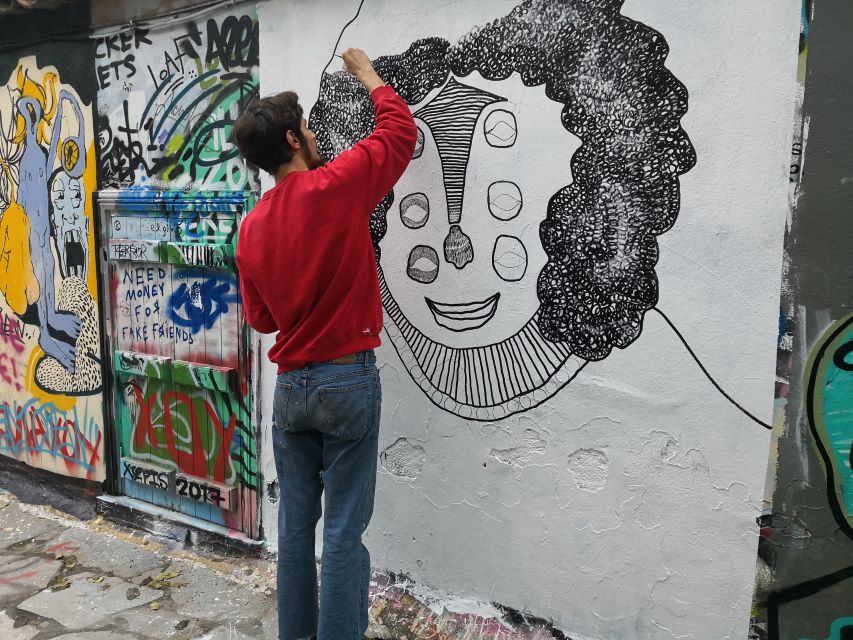
That is where this tour earns its keep. A mural may show a political figure, a distorted face, a mythological reference, or a simple slogan. On your own, you can admire the colors and move on. With a guide, you get the background: who made it, what technique was used, which local issue it reflects, and how the work relates to the mood of the city.
The tour places special focus on the social, political, and financial conditions that shaped Athens street art. Greece’s financial crisis affected artists as well as businesses, families, and public life. The resulting art can be angry, mournful, comic, symbolic, or sharply direct. It often gives you a view of Athens that ancient monuments cannot provide.
I especially like the way this changes your habits for the rest of your stay. After learning to look above shopfronts, around corners, and across large blank walls, you may begin spotting work on your own. The city becomes less like a collection of tourist sights and more like a conversation taking place in public.
More Athens trips worth a second look
- Athens: Acropolis & up to 5 Archaeological Sites Combo Pass
★ 4.4 · 12,619 reviews - Athens: Acropolis Ticket with Optional Audio or Live Guide
★ 4.2 · 11,055 reviews - Athens: Acropolis, Parthenon & Acropolis Museum Guided Tour
★ 4.8 · 9,316 reviews
Starting beside Monastiraki metro at Lonis
The meeting point is in front of Lonis pastry shop at Athinas 7, right beside the Monastiraki metro station exit. If you arrive by metro, use the Athinas Street exit. This is a useful starting place because Monastiraki is easy to reach and familiar to most people staying in central Athens.
Do not expect the tour to begin with a formal gallery or a long introduction indoors. You meet your English-speaking guide on the street and start walking into the city. That keeps the experience practical and immediate, though you should arrive ready to identify the correct pastry shop rather than simply waiting somewhere in the broad Monastiraki area.
The guide may be Penelope, Katerina, Greg, Eleni, Pascal, or another member of the team. The strongest pattern across the guide comments is clear communication and enthusiasm for the subject. Penelope is noted for speaking clearly, maintaining a comfortable pace, offering route choices, and involving everyone. Greg is described as an artist himself, with a particular connection to Psyrri and Athens. Katerina and Eleni are praised for warm, lively explanations.
Monastiraki and Psyrri: the first layers of the city
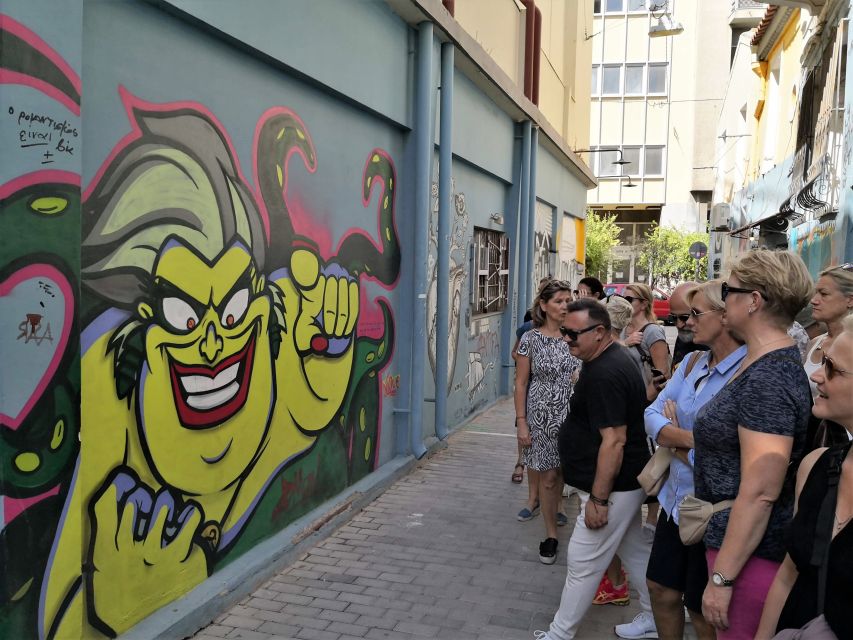
From the meeting point, the walk reaches Monastiraki after about 10 minutes. This first section helps shift your attention away from the postcard Athens around the square. You begin looking at walls, shop shutters, side passages, and the surfaces that locals see every day.
The route then spends about 40 minutes around Psyrri. This is one of the most important parts of the tour, both for the volume of artwork and for the way the neighborhood has changed. The area includes popular restaurants, bars, small businesses, old buildings, and side streets where large commissioned murals can sit close to rougher, unauthorized work.
Your guide explains the difference between a planned mural and a quick graffiti piece. You may learn how artists use stencils, spray paint, lettering, pasted images, or large painted figures. The point is not to rank one form above another. It is to notice intention, skill, placement, and audience.
Psyrri is also where the tour connects art to urban change. A wall can reflect a neighborhood’s older working identity, its later creative reputation, or the pressure brought by new businesses and visitors. You see Athens as a place that keeps changing, sometimes proudly and sometimes uneasily.
Platia Iroon and Sarri: small streets, big messages
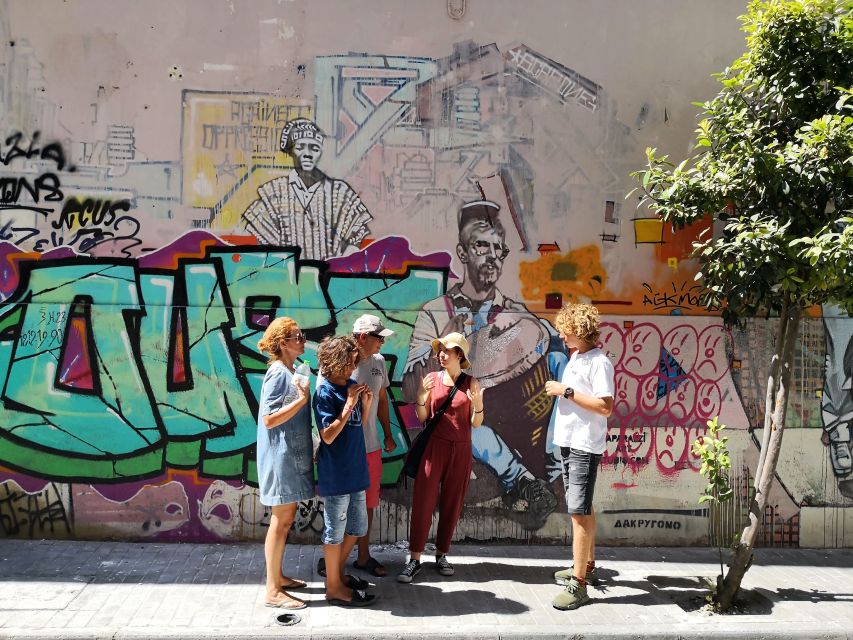
The walk continues to Platia Iroon, or Heroes Square, after about 10 minutes. The route here gives you a chance to pause and take in the work before moving on. Guides are encouraged to make the walk interactive, and the format allows time for questions rather than forcing you to hurry past every image.
From Platia Iroon, it is about 15 minutes toward Sarri. This part of the route uses smaller streets and less formal spaces. The tour description specifically includes narrow alleys and hidden courtyards, so comfortable walking shoes matter more than fashionable ones.
You might find work that is easy to miss from a main road. Some pieces sit high on walls, and one practical lesson repeated by guides is to look up. Athens street art is not confined to eye level. Large murals may occupy upper stories, while tiny tags or pasted images appear around doorways and corners.
This is also a good place to ask questions about meaning. Street art does not always offer one fixed answer. A guide can explain likely references and the artist’s approach, while still allowing you to decide how an image affects you. That balance is useful, since political art can lose its force when it is treated as a simple sightseeing checklist.
A different kind of day out, same corner of Greece:
- Athens: Cape Sounion & Poseidon Temple Sunset Half-Day Trip
★ 4.8 · 8,241 reviews - Athens: Acropolis and Parthenon Guided Walking Tour
★ 4.6 · 5,882 reviews - All Day Cruise -3 Islands to Agistri,Moni, Aegina with lunch and drinks included
★ 5.0 · 4,958 reviews - Athens, Piraeus, and Coastline: Blue Hop-On Hop-Off Bus
★ 3.9 · 4,849 reviews
Omonoia: modern Athens without a polish filter
The route takes about 15 minutes to reach Omonoia. This section may feel less comfortable or tidy than the parts of Athens built for sightseeing. That is part of the point, but it is also a consideration. You are walking through real central neighborhoods, not a controlled museum setting.
Omonoia helps show how street art responds to the city around it. The walls carry traces of economic pressure, public frustration, migration, changing businesses, and the constant repair and repainting of urban space. Your guide places individual pieces into that larger social setting without pretending that every wall has the same message.
This section rewards curiosity. If you want only famous murals with a clean background for photographs, the route may feel too rough around the edges. If you want to understand how art appears in everyday Athens, Omonoia is valuable precisely because it is not polished for visitors.
The guides also bring personal views of the city. Several are artists or closely involved with the local art scene, and they explain how Greek artists work alongside artists from other countries who come to Athens to leave their mark. You get both local and international perspectives rather than a narrow list of Greek names.
Metaxourgeio: finishing with a changing neighborhood
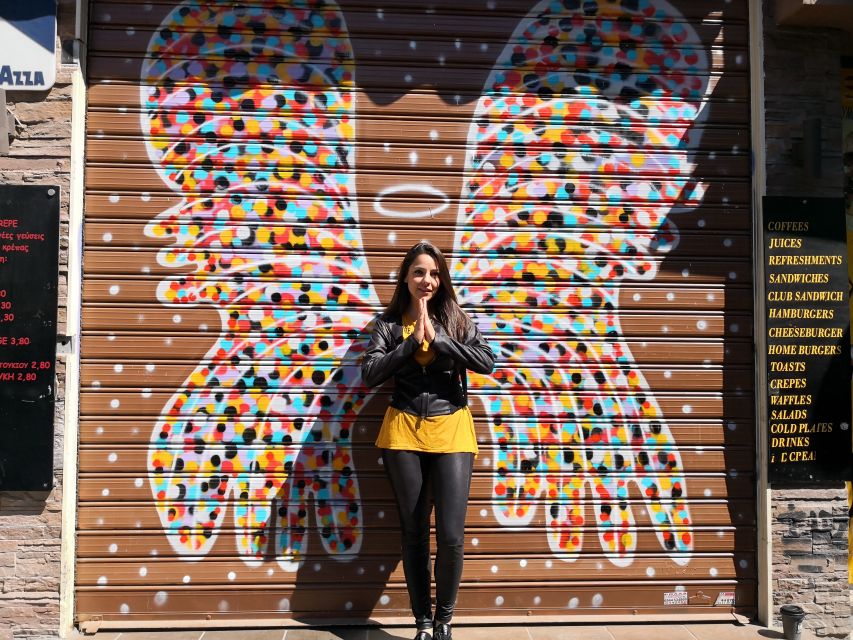
The final stretch takes about 30 minutes and leads to Metaxourgeio Square. This is the longest listed section, so it helps to save some energy. By now, you should have the visual tools to read more of the walls yourself: notice the scale, the materials, the condition of the surface, nearby businesses, and the direction in which an image faces.
Metaxourgeio is a fitting ending because its public art sits within a neighborhood that has seen change and renewed attention. The tour does not present the area as a theme park. Instead, you see how art can mark a place, challenge its image, and comment on what is happening around it.
The final square gives the walk a natural stopping point. Hotel transport is not included, so you will need to make your own way onward after the tour. The finish is useful if you are continuing through central Athens, but you should check your route in advance if your hotel is elsewhere.
The guides make the difference
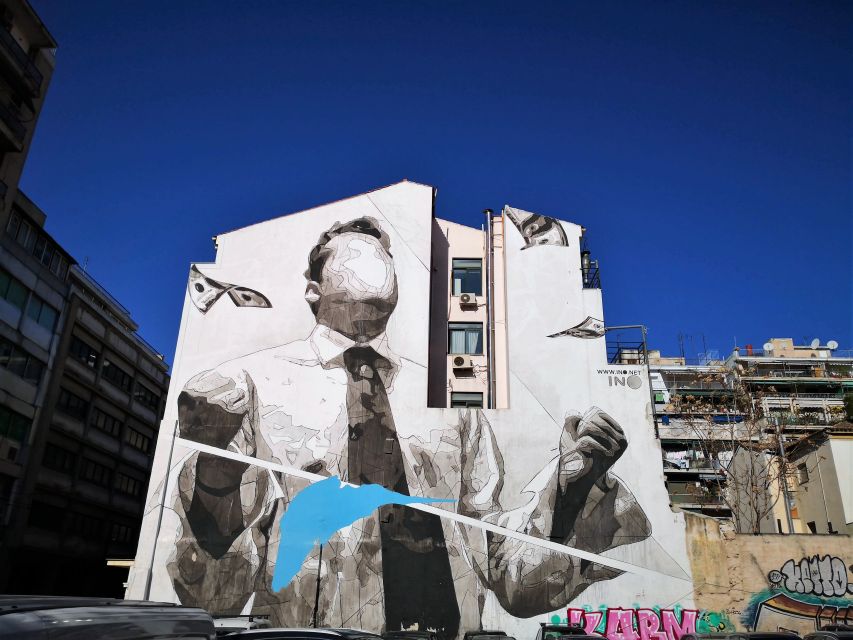
A street-art tour depends heavily on the guide. Public walls do not come with labels, dates, or audio buttons. The person leading you must select worthwhile pieces, explain difficult subjects clearly, keep the group together, and adjust when a wall has been painted over or a street is crowded.
This experience has several guides, and the names that appear most often are Penelope, Greg, Katerina, Eleni, and Pascal. Penelope is praised for detailed explanations, clear speech, patience, and the ability to involve people with different interests. Greg brings a strong sense of Athens and Psyrri, along with personal interest in art. Katerina and Eleni are described as engaging and easy to follow.
The comments about the guides also point to useful practical behavior. The pace can be adjusted, questions are welcomed, and breaks are built into the walk. One guide offered two possible routes and checked that the group was happy with the choice. Another helped visitors learn how to use the metro after the tour.
Private and small-group options are available. A small group is the better choice if you want to ask many questions or discuss the political meaning of a piece. A larger group may feel less personal, but the guide’s job remains the same: help you see more than the surface.
What the $47 price really covers
At $47 per person, this is not the cheapest way to spend two hours in Athens. You can see street art for free by walking through Psyrri and Metaxourgeio on your own. The value comes from the explanation, route planning, and local perspective.
A guide saves you from spending your limited time searching randomly for worthwhile work. More important, the guide explains why a mural matters. You learn about artists, techniques, political imagery, and the connection between public art and Greece’s recent social and financial difficulties.
The price includes an English-speaking guide but not food, drinks, or hotel pickup and drop-off. Some people may stop for coffee during the walk, but that is not an included feature. If you are mainly interested in taking a few attractive mural photographs, $47 may feel high. If you care about modern Greek culture and want a structured introduction to Athens street art, it is a fair price.
The cancellation terms also reduce the risk of booking early. You can cancel up to 24 hours ahead for a full refund, and a reserve-now, pay-later option is available. Starting times vary, so check availability for your date.
Walking conditions, heat, and who will enjoy it
The route is about two hours and covers several districts on foot. One part is listed as a 40-minute walk, another as 30 minutes, with shorter connections between the other areas. The walking itself is not an incidental detail. It is the way you reach the art, and some surfaces and streets will be less smooth than a museum corridor.
Wear comfortable shoes and bring water, especially in warm weather. A summer group ended early because of the heat while traveling with a 13-year-old. That is a useful warning for families: the subject can hold a teenager’s attention, but the sun and steady pace may be the bigger challenge.
Older visitors can still enjoy the route. A guide has accommodated senior citizens, and the format includes time to stop, observe, and ask questions. Still, tell the guide about your pace at the start. The experience is best when you can pay attention to the walls instead of worrying about keeping up.
The tour suits:
- First-time visitors who want a modern side of Athens
- Repeat visitors who have already seen the main ancient sites
- Art lovers interested in murals, graffiti, and public expression
- People curious about Greek society and the financial crisis
- Families with older children who can manage a two-hour city walk
- Visitors who prefer local neighborhoods to a standard sightseeing loop
It may not suit you if you dislike walking, want a quiet indoor activity, or expect every stop to be a famous, perfectly preserved mural. Street art changes. Some pieces may be damaged, painted over, or harder to see than expected.
Why this is not just an Instagram walk
The best reason to book is that the tour treats street art as culture, not decoration. You will certainly have photo opportunities, but the experience asks you to think about the wall as a public statement. Who made it? Who was meant to see it? What event or feeling does it reflect? Why was it placed in that particular neighborhood?
The tour also avoids separating art from daily life. You see work beside businesses, homes, alleys, squares, and ordinary streets. The setting matters. A mural about hardship feels different when you see the buildings and streets around it.
Guides use supporting material on a tablet when useful, and they answer questions about artists and techniques. They can also tailor suggestions to your interests. If you care about political art, local artists, international names, or the history of a district, say so early.
I would book this near the start of an Athens visit if you have room in your schedule. It will sharpen your eye for the rest of the trip. You may notice art on the way to dinner, understand why a neighborhood feels different, or recognize a style that your guide introduced.
Should you book the Athens street-art tour?
Book it if you want to meet modern Athens through its walls. The strongest parts are the guide-led interpretation, the route through Psyrri and other central districts, and the honest look at social and political issues that shaped the city’s art.
Think twice if your group cannot comfortably walk for two hours or if you are visiting during intense heat without a flexible schedule. For everyone else, the $47 fee is justified by the local knowledge and the chance to see Athens beyond ancient monuments.
This is a good choice for curious visitors who want the city to speak in its own voice. Bring water, wear practical shoes, and remember the tour’s simplest lesson: look up.
FAQ
Where does the Athens street-art tour start?
It starts at Athinas 7, Athens, in front of Lonis pastry shop, next to the Monastiraki metro station exit. If you arrive by metro, use the Athinas Street exit.
Where does the tour finish?
The walk finishes at Metaxourgeio Square.
How long does the tour last?
The experience lasts two hours.
What language is the tour offered in?
The tour is conducted in English with a live English-speaking guide.
Which Athens neighborhoods does the route visit?
The route includes Monastiraki, Psyrri, Platia Iroon, Sarri, Omonoia, and Metaxourgeio.
What is included in the price?
The price includes an English-speaking guide. Food, drinks, and hotel pickup and drop-off are not included.
How much does the tour cost?
The listed price is $47 per person.
Can I cancel the booking?
You can cancel up to 24 hours in advance for a full refund. A reserve-now, pay-later option is also available.
Recently reviewed around Athens
- Ceramic and Pottery Creative Workshop with Two Local Artists★ 4.0 · 57 reviews
- Small-Group Women History in Ancient Greece Walking Tour★ 5.0 · 38 reviews
- Athens: Wine Workshop Create your Own Wine under the Acropolis★ 5.0 · 77 reviews
- Athens: Greek Wines Tasting with Sommelier and Acropolis Views★ 5.0 · 88 reviews
- Hydra Private Day Trip by Ferry from Athens with Transfers★ 4.0 · 30 reviews
- Small-Group Wine Tour in Athens with Tasting★ 5.0 · 33 reviews
- Wine Trails Private Tour/ Nemea visit 3 wineries from Athens or Nafplion (10 h)★ 5.0 · 44 reviews
- Private Athens Transfer Airport/Port -Greek Tours-Hourly service★ 5.0 · 88 reviews
Guided, compared.
Acropolis, Parthenon & Acropolis Museum Guided Tour
Read our review →

Cape Sounio & Poseidon Temple Trip with Audio Guide
Read our review →
Mythology of Delphi, Museum and Arachova Guided Tour
Read our review →Acropolis, Parthenon & Acropolis Museum Guided Tour
Read our review →