
Reviewed · ACROPOLIS & ACROPOLIS MUSEUM TOURS
Athens Half-Day Tour: Acropolis, Parthenon & All Major Landmarks
Athens packs a remarkable amount into a small area, and this private tour gives you a fast, comfortable way to connect the Acropolis and Parthenon with the city’s Roman ruins, Olympic stadium, Parliament, neoclassical buildings, and lookout points. Your driver collects you at your hotel, apartment, port, or other stated address, then handles the tricky Athens traffic while you focus on the sights.
I like two things here. First, the private vehicle lets you set the pace instead of waiting for a large group. Second, drivers such as Panos, Petros, and Stavros add useful stories about modern Greek life, not just ancient dates. The air conditioning, bottled water, and door-to-door drop-offs matter greatly in Athens’ summer heat.
The main limitation is clear: this is a driver-led sightseeing tour, not a licensed guide walking inside each monument. Your driver explains the sites before dropping you off, but you explore the Acropolis, museum, or Agora on your own. Admission fees also come extra, so your final cost can rise well above the advertised $145.12.
In This Review
- Key points to know before booking
- A smart first look at Athens
- The Acropolis and Parthenon: the essential stop
- Plaka and the city below the hill
- Hadrian’s Arch and the Temple of Olympian Zeus
- Kallimarmaro and the Olympic story
- Syntagma Square and the Evzones
- The Athenian Trilogy: Academy, University, and Library
- Choose one: Acropolis Museum or Ancient Agora
- Acropolis Museum
- Ancient Agora
- Lycabettus Hill and Athens from above
- What the driver does, and what the driver cannot do
- Price, tickets, and practical value
- Who should book this Athens tour?
- Should you book it?
- FAQ
- How long does the Athens tour last?
- Is hotel pickup included?
- Is the tour private?
- Does the driver enter the Acropolis with the group?
- Are entrance tickets included?
- Can I visit the Acropolis Museum or Ancient Agora?
- What language is the tour offered in?
Key points to know before booking
- Private transport for your group: You ride in an air-conditioned vehicle with WiFi, bottled water, and hotel pickup and drop-off.
- The Acropolis is the centerpiece: You see the citadel and Parthenon, but the €30 Acropolis admission is not included.
- Drivers provide context outside the sites: They are fluent in English and have a strong grasp of Athens history, but they cannot accompany you inside.
- The route covers modern Athens too: Syntagma Square, the Evzones, Kallimarmaro, the Athenian Trilogy, and Lycabettus add variety.
- Optional one-hour additions: Choose the Acropolis Museum or Ancient Agora version when booking, with entrance fees still separate.
- Five hours goes quickly: This works best as a city overview, not as a slow archaeological study.
A smart first look at Athens
The tour’s real strength is its range. In roughly five hours, you can connect the ancient city with the Athens you see today: government buildings, busy central streets, grand avenues, marble monuments, and neighborhoods below the Acropolis.
That makes this a useful first-day plan. You get your bearings, learn how the main districts fit together, and return later to the places that deserve more time. I would not treat it as a substitute for a full day at the Acropolis. I would treat it as a well-planned introduction, especially if you have only a short stay or want to avoid walking between scattered sights in the heat.
Pickup is included from any stated location, and drivers arrive about five minutes before your scheduled start. Airport pickup costs extra. Give the operator the exact hotel or apartment address, ship name for a port pickup, or flight number if relevant. WhatsApp is recommended for easier contact with the driver.
The tour is private, so only your own party participates. Group discounts may apply, and a child seat or booster is available. That private format is especially useful for families, friends, and people carrying luggage. One vehicle described in the feedback had facing bucket seats and a large rear compartment, though the exact vehicle can vary.
More Athens trips worth a second look
- Athens: Cape Sounion & Poseidon Temple Sunset Half-Day Trip
★ 4.8 · 8,241 reviews - Cape Sounion and Temple of Poseidon Half-Day Small-Group Tour from Athens
★ 4.5 · 3,205 reviews - Athens Half-Day Sightseeing Tour with Tickets of Acropolis
★ 4.0 · 1,402 reviews
The Acropolis and Parthenon: the essential stop
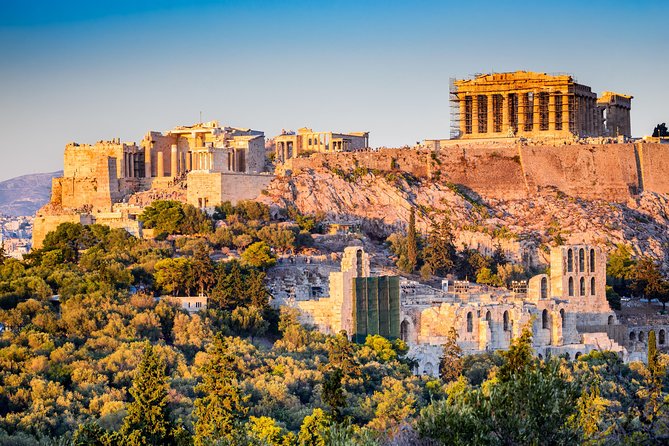
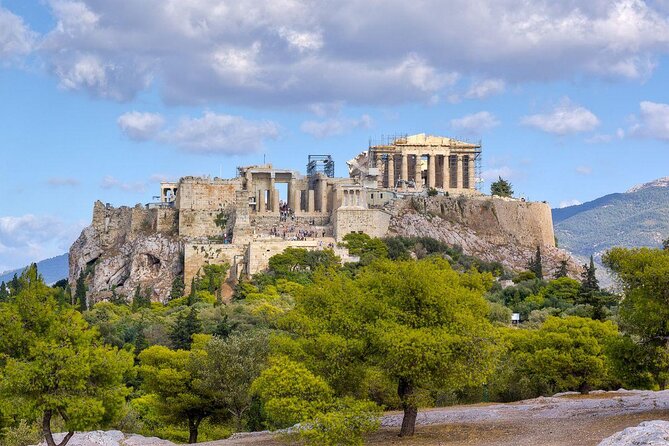
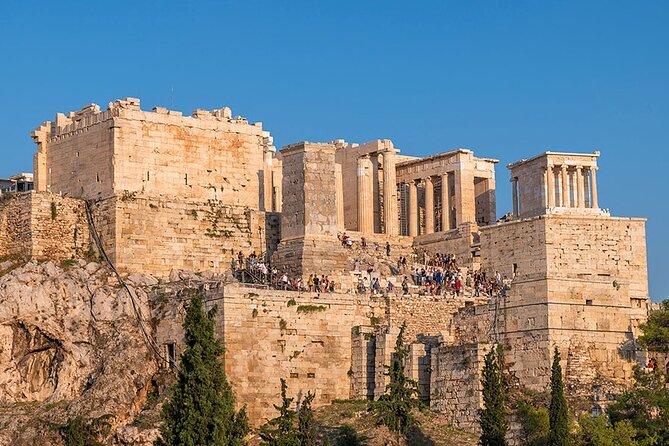
The Acropolis is the reason most people book this outing. Set on a rocky height above Athens, it gathers several of the best-known monuments of Classical Greece in one place. The Propylaea forms the grand entrance, while the Erechtheion and Temple of Athena Nike add their own distinctive details beside the Parthenon.
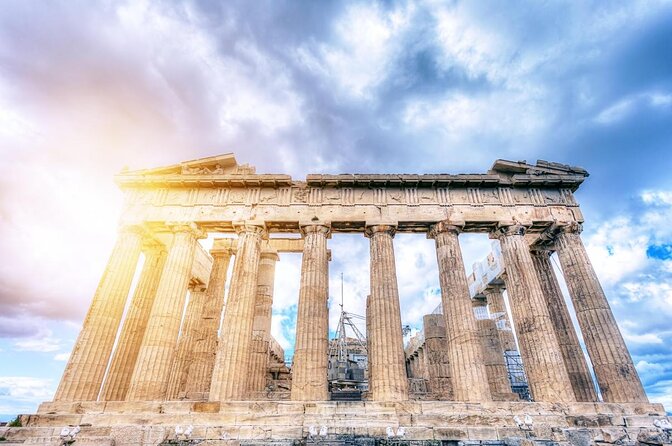
The Parthenon was built between 447 and 432 BCE for Athena, the city’s patron goddess. Its Pentelic marble, Doric columns, sculpted friezes, and carefully controlled proportions explain why it remains such a powerful symbol of ancient Greek architecture, even after war, weather, and centuries of damage.
The listed schedule gives about 30 minutes for the Acropolis and 30 minutes for the Parthenon, but those entries should not be read as a full guided visit inside the complex. The driver takes you to the entrance, gives background, and leaves you to explore. You will need your own ticket, listed at €30 per person, and comfortable shoes are essential.
Plan for queues. One account specifically warns of a long wait at the Acropolis, and Athens heat can make that wait harder than expected. Start early if you can, carry water, and avoid assuming that a five-hour tour means five quiet hours at the monument. The Acropolis alone can consume much of your energy and attention.
The reward is not only the ruins. From the hill, you look across Athens and see the ancient site set against a living capital. That contrast, old marble above a modern city, is one of the tour’s best visual moments.
Plaka and the city below the hill
After the Acropolis, the route includes Plaka, the historic quarter beneath the hill. Its narrow lanes, neoclassical buildings, tavernas, cafés, shops, and scattered ancient remains offer a softer change of pace after the exposed stone of the Acropolis.
Plaka is a good place to notice how Athens layers different eras without neat borders. Ancient fragments appear beside homes and restaurants, while the Acropolis remains visible above the roofs. The stop is also useful if you want a meal suggestion. Several drivers are praised for recommending lunch spots, though the supplied schedule does not promise a meal break or include food.
The driver may also provide a short introduction to Alexander the Great. Born in 356 BCE, he became king of Macedon at 20 and created an empire stretching from Greece through Egypt and Persia. His campaigns spread Greek language and culture while also blending Greek and Persian traditions. This is likely part of the historical commentary or a passing city reference rather than a separate monument stop, so do not expect a dedicated Alexander site visit.
Hadrian’s Arch and the Temple of Olympian Zeus
Hadrian’s Arch is a quick but worthwhile roadside stop. Built in 131 AD to honor Roman Emperor Hadrian, the marble gateway marked the boundary between the older city associated with Theseus and the newer Roman district linked with Hadrian.
Look for the inscriptions on the two sides. One connects the area with Theseus, while the other credits Hadrian. The arch’s Corinthian columns and balanced design show how Roman Athens borrowed from, and added to, the older Greek tradition.
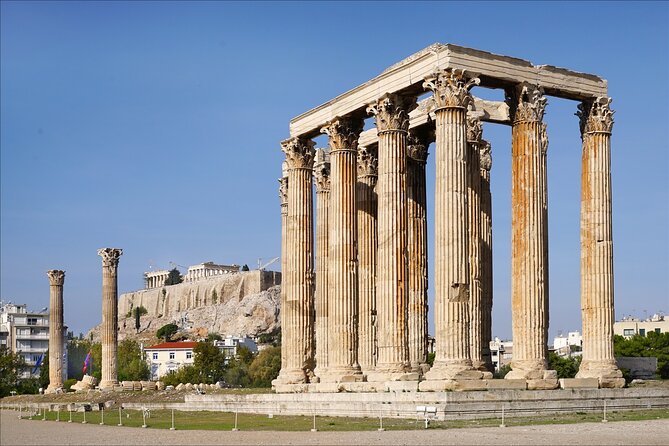
The scheduled stop is about 10 minutes and admission is free. That tells you how to approach it: this is a photo and context stop, not a long archaeological visit. The Temple of Olympian Zeus gets similar treatment. Its construction began in the sixth century BCE and was completed under the Roman emperor Hadrian in the second century CE. The surviving Corinthian columns, some about 17 meters high, give you a sense of the original scale.
Only ruins remain, but the size still surprises. The temple was meant to honor Zeus and reflect Athens’ grand ambitions. Since admission is listed as free for the tour stop, you should confirm with the driver what viewing arrangement applies that day. The experience is primarily an exterior look rather than an extended entry.
A different kind of day out, same corner of Greece:
- Athens: Acropolis & up to 5 Archaeological Sites Combo Pass
★ 4.4 · 12,619 reviews - Athens: Acropolis Ticket with Optional Audio or Live Guide
★ 4.2 · 11,055 reviews - Athens: Acropolis, Parthenon & Acropolis Museum Guided Tour
★ 4.8 · 9,316 reviews - Athens: Acropolis and Parthenon Guided Walking Tour
★ 4.6 · 5,882 reviews
Kallimarmaro and the Olympic story
The Panathenaic Stadium, or Kallimarmaro, is one of Athens’ most memorable modern-classical sights. Built entirely of white marble, it began as a fourth-century BCE stadium for the Panathenaic Games and later took its present form after reconstruction in the second century CE.
Its horseshoe shape is easy to understand from the outside, while the scale hints at its reported capacity of around 50,000. The stadium hosted the first modern Olympic Games in 1896, tying an ancient athletic tradition to the international sporting event we know today.
The tour allows about 15 minutes here, and admission is not included. That is enough for a look, photographs, and a short explanation, but not enough for a slow stadium visit. If Kallimarmaro is high on your list, ask your driver how much time is available and check the current entrance arrangements before you commit to the wider route.
The schedule also includes Dromeas, a 12-meter glass-and-iron sculpture by Costas Varotsos. Created in 1994, the layered figure appears to move through space. Its connection with the marathon story gives the modern artwork a useful link to ancient Greek athletic culture and the legendary run from Marathon to Athens.
This pairing is a nice touch. You are not seeing only temples and broken columns. You are also seeing how Athens continues to use ancient ideas of movement, endurance, and public life in modern art and civic spaces.
Syntagma Square and the Evzones
At Syntagma Square, the Hellenic Parliament occupies a neoclassical building that began life as a royal palace in 1843. It became the seat of Parliament in 1934 and remains one of the city’s key symbols of national government.
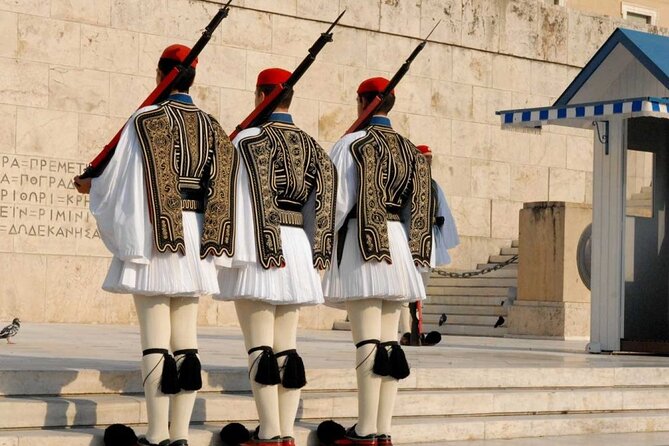
Outside is the Tomb of the Unknown Soldier, completed in 1932. The monument honors Greek soldiers who died in war, with a marble relief, an eternal flame, and the ceremonial guard of the Evzones. Their traditional uniforms and precise movements are a major part of the visual experience.
The schedule allows about 15 minutes for the Parliament and another 15 for the tomb. The changing of the guard is a regular ceremony, but the tour information does not promise that your timing will match the full event. Ask your driver about the schedule on the day. Even without the complete ceremony, this is an important stop because it shows present-day Greek national identity rather than only ancient Greece.
The private format helps here. A driver familiar with central Athens can drop you close to the sights and arrange a pickup point, saving you a hot walk through heavy traffic. One particularly useful detail from the experience is that you can text when ready to move on, though you should confirm the exact arrangement with your driver.
The Athenian Trilogy: Academy, University, and Library
The route passes the three grand neoclassical buildings often grouped as the Athenian Trilogy: the Academy of Athens, the National and Kapodistrian University of Athens, and the National Library of Greece.
The Academy of Athens, founded in 1926, takes inspiration from Plato’s ancient academy. Its exterior features figures associated with Athena and Apollo, and the institution supports research in science, the humanities, and the arts.
The university, founded in 1837, is Greece’s oldest and largest. Its historic main building gives you another view of the country’s nineteenth-century neoclassical revival. The National Library, founded in 1832, holds manuscripts, rare books, and historical documents in a building designed by Theophil Hansen.
Each stop is listed at about 10 minutes and free of charge. In practice, these are best understood as exterior visits and photo opportunities. The driver can explain their purpose and place in Greek public life, but you should not expect an indoor tour or a long scholarly discussion at every building.
I like this section because it broadens the idea of Athens. The city is not only an archaeological site. It is also a national center for education, research, government, and the arts.
Choose one: Acropolis Museum or Ancient Agora
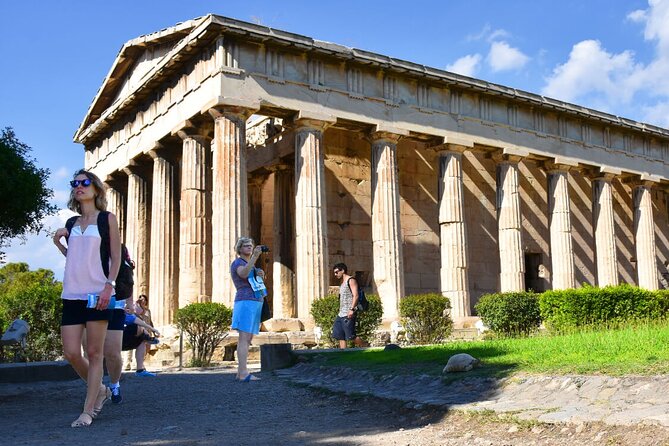
The five-hour option lets you add either the Acropolis Museum or the Ancient Agora, with a one-hour visit to your chosen site. The entrance ticket is extra in both cases.
Acropolis Museum
The Acropolis Museum opened in 2009 at the foot of the hill. Its five floors hold more than 4,000 artifacts from the Archaic, Classical, and Roman periods. The glass-walled Parthenon Gallery gives you a direct view toward the temple, making it easier to connect the sculptures and friezes with the building still visible above.
The Caryatids are another major highlight. The museum holds the original statues from the Erechtheion, protected indoors while reproductions remain at the Acropolis. Glass sections in the floor reveal archaeological remains below the modern structure.
The museum ticket is listed at €20 per person. Choose this option if you want the objects and sculpture explained through displays, rather than seeing only the monuments outdoors. I especially recommend it for first-time visitors who want help understanding what has disappeared from the Acropolis itself.
Ancient Agora
The Ancient Agora was the civic heart of Athens from the sixth century BCE onward. It served as a marketplace, meeting ground, political center, and place for public debate. Socrates is associated with this setting, where ideas about democracy and public life were discussed in ordinary city spaces.
The site includes the restored Stoa of Attalos, the Bouleuterion, temples, and other public structures. The mix of shopping, politics, worship, and conversation gives you a more human picture of ancient Athens than a single monumental temple can provide.
The Agora ticket is listed at €20 per person. Choose it if you want to walk among an ancient city’s public buildings and understand how daily civic life worked. With only one hour, you will need to keep moving, especially if you also spend significant time at the Acropolis.
You may not be able to do both optional sites within the five-hour schedule. The tour offers separate versions, so select the one that fits your priority.
Lycabettus Hill and Athens from above
Lycabettus Hill rises about 300 meters above Athens and provides a broad view over the capital, the surrounding mountains, and the Aegean Sea. A small Chapel of St. George sits at the summit, and Greek legend says Athena dropped a rock there while carrying materials for the Acropolis.
The tour allows about 10 minutes, with no admission fee. That is enough for a quick lookout, not a full hill walk. The ascent is by a winding path, so ask what portion you will cover and wear shoes with a good grip.
This stop works well near the end because it gives you a visual map of the city. From high up, the Acropolis, central Athens, and the dense urban spread make more sense. It is also a welcome pause from formal monuments, though ten minutes may feel brief if views are your main interest.
What the driver does, and what the driver cannot do
This distinction matters more than the word guide in the title. Your English-speaking driver has a deep grasp of Athens history and culture, explains the next stop on the way, and points out places that buses may skip. Drivers praised in the supplied feedback include Panos, Petros, Stavros, Nick, George, Dimitris, and Mapia.
You can expect help with route planning, drop-off points, pickup timing, local recommendations, and basic historical context. Panos is noted for explaining sites in a way that works for children, while Petros is praised for clear English, communication, water, and help with luggage. Stavros is noted for punctuality, city knowledge, and lunch suggestions.
But the driver is not a licensed tour guide and cannot accompany you inside the Acropolis, museum, or other historical sites. If you want detailed explanations beside each column and sculpture, book a licensed guide separately or choose a different type of excursion. If you prefer freedom to explore alone, this arrangement may suit you very well.
Price, tickets, and practical value
The advertised price is $145.12 per person. That is a fair price for private transport, hotel pickup and drop-off, an English-speaking driver, bottled water, and a tailored route through many central sights. The value improves when several people share the vehicle, especially if a group discount applies.
The price does not include entrance fees. The listed costs are:
- Acropolis Hill: €30 per person
- Acropolis Museum: €20 per person
- Ancient Agora: €20 per person
If you add all three listed admissions, that is another €70 per person, making the combined cost $145.12 plus €70, before any currency conversion or airport pickup charge. You may not visit all three, but budget for tickets instead of treating the advertised amount as the full day’s cost.
The operator advises pre-ordering tickets through hhticket.gr a few days before arrival. Check the official site for current availability and prices. The tour itself does not include tickets, and buying them in advance can help you protect the limited five-hour schedule.
Free cancellation is available up to 24 hours before the start time. Changes or cancellations inside that window are not accepted for a refund.
Who should book this Athens tour?
I would choose this experience if you have one day in Athens, are visiting on a cruise stop, are traveling with children, or want to reduce long walks between major sights. It is also a good match for anyone who values a private car, flexible pacing, and local conversation more than a formal lecture at every monument.
It is less suitable if the Acropolis is your main academic interest. The 30-minute entries listed for the Acropolis and Parthenon are short, and the driver cannot enter with you. You may also find the route too rushed if you want to read every display, climb every path, and linger at each viewpoint.
For the best balance, choose one major indoor or archaeological addition. The Acropolis Museum gives the strongest context for the hill itself. The Ancient Agora offers a broader look at public life in ancient Athens. Wear comfortable shoes, carry water, and ask the driver about the exact time available at the Acropolis before setting your expectations.
Should you book it?
Book this tour if you want to cover Athens efficiently in a private vehicle and are happy to explore monuments independently. The combination of hotel pickup, air conditioning, local commentary, flexible movement, and broad city coverage is particularly useful during a hot half-day.
Skip it if you want a licensed guide beside you inside every site. For everyone else, this is a practical first pass through Athens, with enough ancient stone, modern civic life, and city views to help you decide where to spend the rest of your stay.
FAQ
How long does the Athens tour last?
The experience lasts approximately five hours.
Is hotel pickup included?
Yes. Pickup and drop-off are included from any stated location. Airport pickup costs extra.
Is the tour private?
Yes. Only your own group participates.
Does the driver enter the Acropolis with the group?
No. The driver has historical knowledge and provides commentary, but is not licensed to accompany you inside sights.
Are entrance tickets included?
No. The listed entrance fees are separate. The Acropolis is €30 per person, the Acropolis Museum is €20, and the Ancient Agora is €20.
Can I visit the Acropolis Museum or Ancient Agora?
Yes. You can choose a version with a one-hour visit to either the Acropolis Museum or the Ancient Agora. The relevant entrance ticket remains extra.
What language is the tour offered in?
The tour is offered in English with a fluent English-speaking driver.
Recently reviewed around Athens
- Small-Group Women History in Ancient Greece Walking Tour★ 5.0 · 38 reviews
- Ceramic and Pottery Creative Workshop with Two Local Artists★ 4.0 · 57 reviews
- Athens: Wine Workshop Create your Own Wine under the Acropolis★ 5.0 · 77 reviews
- Athens: Greek Wines Tasting with Sommelier and Acropolis Views★ 5.0 · 88 reviews
- Hydra Private Day Trip by Ferry from Athens with Transfers★ 4.0 · 30 reviews
- Small-Group Wine Tour in Athens with Tasting★ 5.0 · 33 reviews
- Wine Trails Private Tour/ Nemea visit 3 wineries from Athens or Nafplion (10 h)★ 5.0 · 44 reviews
- FLYING DRESS Photoshoot in Athens – Greece★ 5.0 · 47 reviews
Acropolis & Acropolis Museum Tours, compared.

Acropolis & up to 5 Archaeological Sites Combo Pass
Read our review →

Acropolis, Parthenon & Acropolis Museum Guided Tour
Read our review →
Acropolis, Parthenon & Acropolis Museum Guided Tour
Read our review →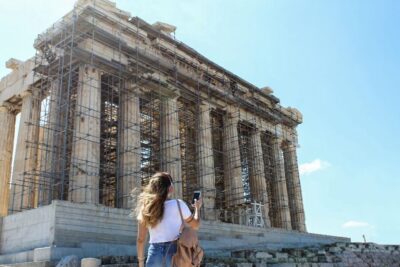


Acropolis monuments & Parthenon Walking Tour with Optional Acropolis Museum
Read our review →Browse the lists this tour appears in