
Reviewed · AUDIO TOURS
Athens: Peloponnese Highlights Day Trip and V.R. Audio Guide
The great draw here is the chance to connect three major Peloponnese sights in one long day: the ruins of Mycenae, the theater at Epidaurus, and the old harbor town of Nafplion. The Corinth Canal adds a quick engineering stop, while the virtual reality device helps you picture places that now survive mainly as stone foundations.
I like the efficient route and the useful mix of ancient sites with free time in Nafplion. I also like that you can listen in your own language instead of relying only on a live guide. Guides including George, Christopher, Angela, Irene, and Nancy have been praised for being friendly, clear, and attentive.
The main drawback is the length. Eleven hours on the road is a serious day out, and Nafplion can feel rushed if you want a relaxed lunch and a proper walk. The archaeological sites also involve uneven ground and walking, so this is not a good choice for anyone with limited mobility.
In This Review
- Key points at a glance
- Why this Peloponnese day trip works from Athens
- The Corinth Canal makes a sharp opening stop
- Mycenae brings the Bronze Age to life
- Nafplion adds a welcome change of pace
- Epidaurus shows why Greek theaters still matter
- The VR and audio format: useful, with limits
- Transport, pace, and what to pack
- Is $33.31 good value?
- Who should book this day trip?
- FAQ
- How long is the Athens to Peloponnese day trip?
- Where can I be picked up in Athens?
- How do I identify the pickup vehicle?
- Which languages are available for the audio guide?
- Is there a live guide?
- Are admission fees included?
- Is food included?
- What should I bring?
- Can I cancel the booking?
- Should you book it?
Key points at a glance
- Mycenae gets the longest visit: You have about two and a half hours for the acropolis, Lion Gate, Cyclopean walls, Tomb of Agamemnon, and optional museum.
- Epidaurus delivers the day’s best small experiment: Test the famous theater acoustics from the center and upper seats.
- Nafplion breaks up the ruins: Use the one and a half hours for alleys, Venetian buildings, harbor cafes, shopping, or a quick swim in summer.
- The Corinth Canal is a short but worthwhile stop: You get about 20 minutes for photos and a look at the waterway linking the Aegean and Ionian seas.
- VR adds visual context: The device reconstructs parts of the ancient world that are now reduced to foundations and walls.
- The price is low for a full day: At $33.31 per person, the transport and guided structure offer strong value, though entry fees depend on the option you choose.
Why this Peloponnese day trip works from Athens

Athens gives you the Acropolis and its museums, but the Peloponnese shows a different side of Greek history. Mycenae takes you into the Bronze Age world of fortified citadels and legendary kings. Epidaurus shows the precision of Classical Greek design. Nafplion adds a graceful seaside town with Venetian and neoclassical buildings.
Doing all three independently in one day would mean arranging transport, checking road connections, and keeping a close eye on time. Here, the route is already set, and the driver handles the long return to Athens. That matters because the final journey back can take about two hours, especially when traffic slows the approach to the city.
The tour uses an air-conditioned coach or minibus and offers pickup at central Athens points. Listed locations include the Monument of the Unknown Soldier near Parliament, the Melina Mercouri Monument in Plaka, Omonia Square, Karaiskaki Square, and 5 Star Taxi Services. At pickup, look for the blue SIGHTS OF ATHENS hop-on, hop-off bus sign.
The exact starting time should be checked when you book. The published pickup times include 7:45 a.m. at the Melina Mercouri Monument, 7:50 at the Greek Parliament, 8:00 at Omonia Square, and 8:05 at Karaiskaki Square. Arrive early. A city pickup is convenient, but several meeting points mean the bus may spend a little time gathering the group.
More Athens trips worth a second look
- Athens: Acropolis Ticket with Optional Audio or Live Guide
★ 4.2 · 11,055 reviews - Athens: Cape Sounio & Poseidon Temple Trip with Audio Guide
★ 4.4 · 4,521 reviews - Athens: Acropolis Ticket with Audio Guide
★ 4.0 · 3,575 reviews
The Corinth Canal makes a sharp opening stop
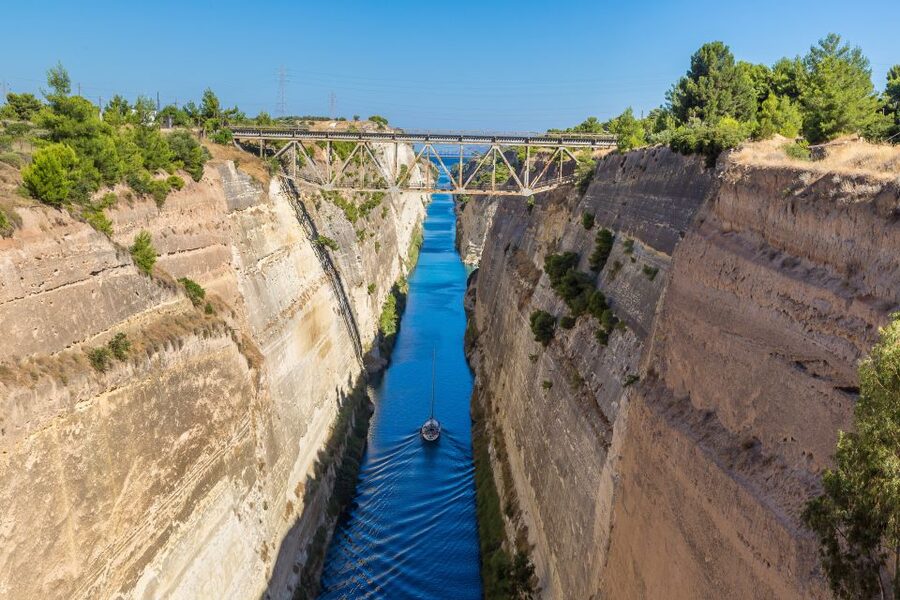
After roughly an hour by road, you reach the Corinth Canal. The stop lasts about 20 minutes, so think of it as a photo break rather than a full visit.
The canal cuts through the narrow Isthmus of Corinth and connects the Aegean and Ionian seas. From the viewing area, the scale is easy to appreciate: steep sides drop toward a narrow ribbon of water, and the channel looks almost too slim for modern ships.
This is a useful first stop because it breaks up the initial drive and gives you a quick piece of modern Greek engineering before the ancient sites begin. You will not have time for a detailed walk or extended exploration, so keep your expectations modest and your camera ready.
Mycenae brings the Bronze Age to life
Mycenae is the core of the day. You get around two and a half hours at the archaeological site, which is enough to see the main remains without racing from one point to the next.
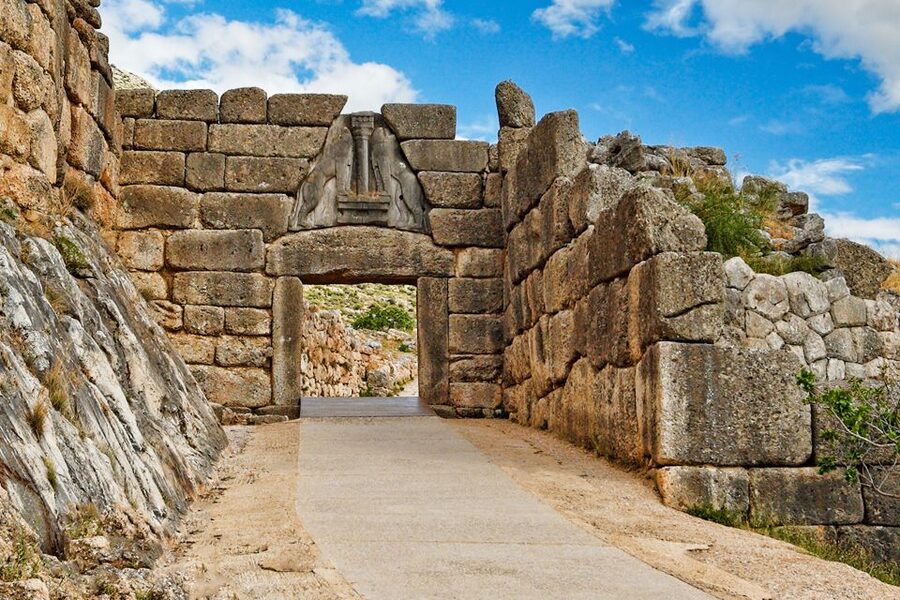
The approach to the acropolis makes the site feel powerful even before you learn the details. Huge stones form the Cyclopean walls, named by later Greeks who thought only the Cyclopes could have moved blocks so large. The walls protected a major Mycenaean center, and their size gives you a clear sense of the city’s defensive purpose.
The Lion Gate is the famous entrance. Its triangular relief of two lions, or lion-like figures, is one of the most recognizable images from ancient Greece. Walk through it slowly. The gate is not just a photo opportunity, it also shows how the builders used massive masonry and carefully planned weight distribution.
You can then explore the acropolis ruins, including foundations of buildings, courtyards, and routes that once connected the fortified center. Much of the site is open and exposed, with uneven paths and little shade. Wear firm shoes and bring a hat, especially in summer.
The Tomb of Agamemnon, also called the Treasury of Atreus, is another major stop. Despite its traditional name, the identification with Agamemnon is not certain. What you can see clearly is the remarkable beehive-shaped chamber, built with carefully placed stone courses that create a high domed interior.
The VR device is most useful here. Mycenae requires some imagination because the surviving walls rarely show the city as it once looked. A reconstruction can help you picture roofs, buildings, people, and activity within the fortress. The technology is not perfect, though. One review noted that the GPS did not always work well, and that is worth bearing in mind if you expect a polished museum-style system.
The audio guide gives you another way to explore. Commentary is offered in English, French, German, Italian, Spanish, Russian, Portuguese, Polish, Chinese, and Japanese. The live tour leader speaks English, but the audio material lets you set your own pace and repeat information when needed.
If you want to visit the Archaeological Museum of Mycenae, the schedule may allow it during this stop. Your priority should be the outdoor acropolis and tomb first. The museum is useful for sculpture, pottery, and smaller objects, but the open-air ruins are the reason to come.
Nafplion adds a welcome change of pace
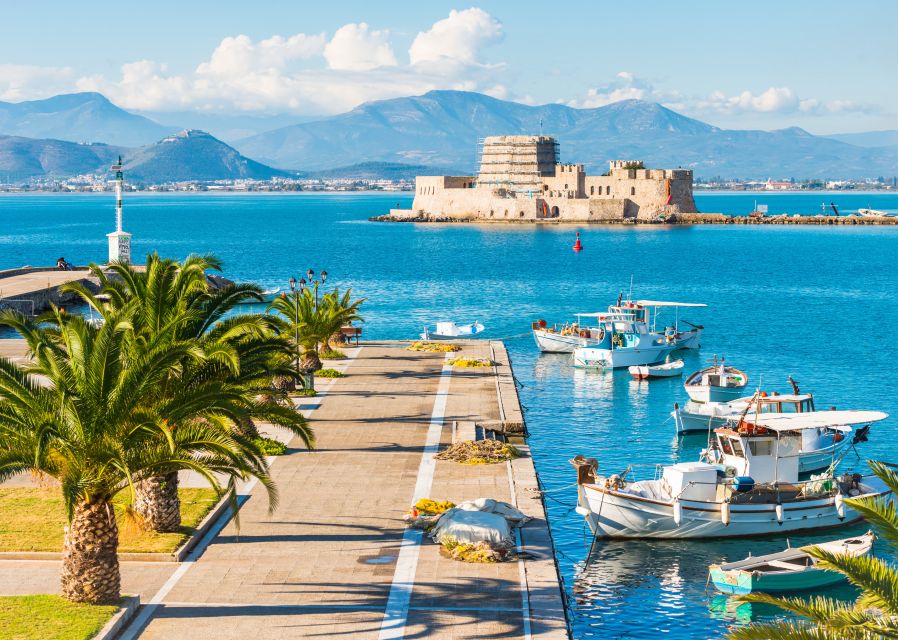
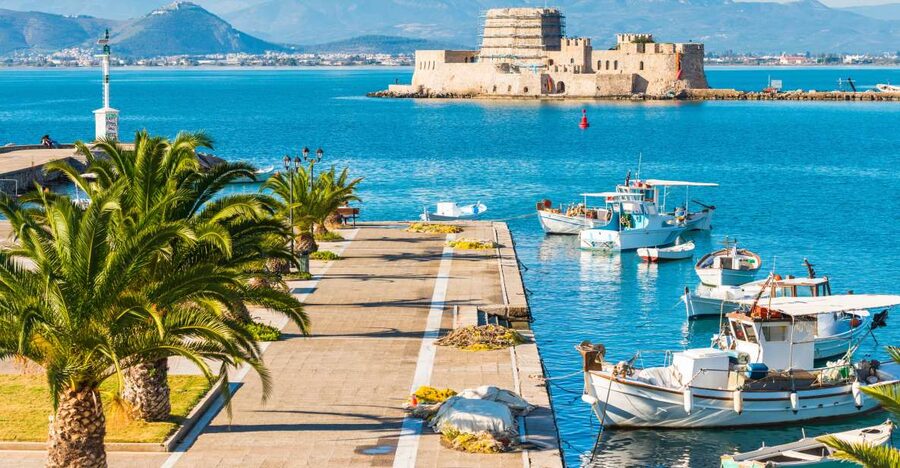
After Mycenae, the route continues to Nafplion, usually written Nafplio in English signs and maps. You have about one and a half hours here, including time for a break, photos, and a walk.
Nafplion was the first capital of independent Greece and has been an important port since the Bronze Age. Its position explains the town’s heavy defenses. Three fortresses watch over the area: the large Palamidi fortress above town, Akronafplia on the peninsula, and Bourtzi, the small water castle on an islet by the harbor.
You probably will not have time to visit all three. For most people, the best use of this stop is a walk through the old town. Look for narrow lanes, Venetian houses, neoclassical mansions, and the long quayside lined with cafes. This is where you can slow down, eat something, and enjoy a setting that feels very different from the bare stones of Mycenae.
The timing calls for a little discipline. A sit-down lunch can take much of the stop, leaving little time for wandering. If Nafplion is a major reason for booking, order quickly or choose a light meal. Some schedules can feel short by roughly 30 minutes, especially if you want lunch, shopping, and a walk.
In warm weather, you can consider Arvanitia Beach, where the water is described as clear enough for a swim. Do not count on having a long beach session. The stop is primarily a town break, and the available time depends on the day’s road conditions and group schedule.
I like this part of the route because it keeps the day from becoming a parade of ruins. Even a short stroll through Nafplion gives you cafes, harbor views, local shops, and a chance to sit down before the final archaeological visit.
A different kind of day out, same corner of Greece:
- Athens: Acropolis & up to 5 Archaeological Sites Combo Pass
★ 4.4 · 12,619 reviews - Athens: Acropolis, Parthenon & Acropolis Museum Guided Tour
★ 4.8 · 9,316 reviews - Athens: Cape Sounion & Poseidon Temple Sunset Half-Day Trip
★ 4.8 · 8,241 reviews - Athens: Acropolis and Parthenon Guided Walking Tour
★ 4.6 · 5,882 reviews
Epidaurus shows why Greek theaters still matter
The final major stop is the Ancient Theater of Epidaurus, reached after about 30 minutes on the road from Nafplion. The visit lasts around two hours.
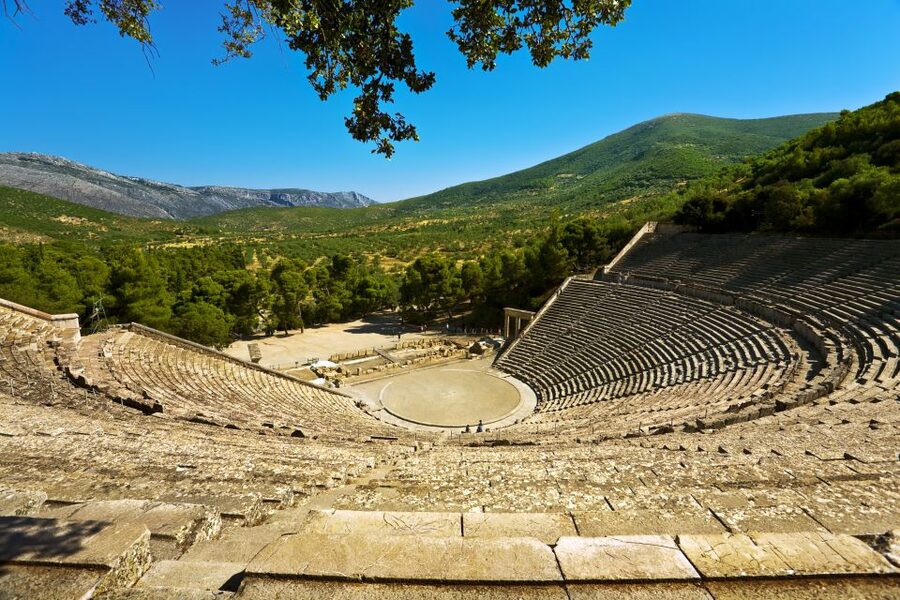
The theater dates from the 4th century BCE and is among the best-preserved Classical Greek structures. It held up to 14,000 people, a reminder that theater in ancient Greece was not a small private pastime. It was a major public event tied to religion, civic life, and performance.
The design is the star. Rows of seats fan out across the hillside, with the circular orchestra at the center. Restored Corinthian pilasters mark the entrance, and the setting remains unusually open and orderly.
You should test the acoustics for yourself. Stand near the center and speak or drop a coin, then ask someone higher up to listen. The effect can be striking, though crowd noise and weather can change what you hear. The point is not a magic trick. The theater’s shape directs sound upward with surprising clarity.
The two-hour visit gives you time to inspect the theater and the surrounding sanctuary area. The tour does not turn Epidaurus into a long specialist lecture, so use the audio guide and your tour leader together. A short explanation from the guide can give you the basic setting, while the audio commentary fills in the details.
Some travelers enjoy Mycenae more because its walls and tomb feel older and more dramatic. I see Epidaurus as the stop that best shows Greek technical skill. Mycenae asks you to imagine a vanished palace center. Epidaurus still lets you experience the logic of a building built for thousands of eyes and ears.
The VR and audio format: useful, with limits
The tour’s unusual feature is the combination of a VR device and an audio guide. That is helpful at Mycenae, where ruins can otherwise look like disconnected stones. It can also give you a better idea of how the main structures related to one another.
The audio guide is available in 10 languages, while the live guide operates in English. This arrangement works well for mixed-language groups. You can listen privately instead of waiting for a full group explanation, and you can pause when you want to look closely at a wall, gate, or tomb.
Do not mistake the tour leader for a full-time lecturer at every stop. The guide’s main job is to keep the group moving, explain the key points, answer questions, and manage the day. Several guides, especially George and Christopher, have been praised for clear information, humor, and careful attention to the group. One useful quality noted about George is that he kept people in good spirits during traffic and bad weather.
The technology may have rough edges. GPS tracking can be imperfect, and the audio guide could use improvement in places. I would treat the VR as a bonus rather than the central reason to book. The sites are strong enough on their own.
Transport, pace, and what to pack
The day includes long road stretches: about one hour from Athens to the Corinth Canal, shorter transfers between the Peloponnese stops, and roughly two hours back to Athens. The air conditioning matters in summer, while the quality of the vehicle can vary. One account described an older bus with no comfort problem, but limited power and no easy way to keep phones charged.
Bring a portable battery if you have one. You will likely take plenty of photos, and the VR device may also use your phone or require electronic power, depending on how the equipment is supplied.
Pack comfortable shoes, a hat, water, snacks, and any personal items you need for a full day. Food and drinks are not included, but you can bring your own. Nafplion provides the main chance to buy coffee or lunch at a place you choose.
The archaeological sites are not suitable for people with mobility impairments. Expect uneven paths, stone surfaces, steps, and exposed areas. The day is manageable for someone comfortable walking outdoors, but it is not a gentle sightseeing ride where you simply step off the bus and view each attraction from a flat platform.
Is $33.31 good value?
At $33.31 per person, this is unusually inexpensive for an 11-hour excursion covering three major destinations and round-trip transport from Athens. The value is strongest if you want to see the Peloponnese without renting a car or arranging several separate buses.
Check the booking option carefully because entry fees are included only when that option is selected. The low headline price may not represent every possible version of the tour.
You are paying mainly for transport, route planning, a driver, a tour leader, and the VR and audio equipment. Food is extra, and Nafplion gives you the freedom to choose your own cafe or restaurant rather than tying you to a group meal.
The tradeoff is time. A private trip could give you longer in Nafplion or more freedom at Mycenae, but it would cost far more. For a first visit with limited time, this group day offers a practical way to cover a large area at a low price.
Who should book this day trip?
I would choose this tour if you have only a few days in Athens and want more than city monuments. It suits history fans, first-time visitors, families who want a simple route, and anyone who prefers a guide and coach over driving unfamiliar roads.
It also works for people who like a little independence. You have an audio guide in your chosen language, free time in Nafplion, and no required shopping stops. You can listen, explore, and rejoin the group at the agreed time.
I would skip it if you dislike long bus days or want a slow visit to Nafplion. It is also a poor fit if you need step-free access. For everyone else, the route makes sense: engineering at Corinth, Bronze Age power at Mycenae, an elegant harbor town, and Classical theater at Epidaurus.
FAQ
How long is the Athens to Peloponnese day trip?
The tour lasts about 11 hours. Starting times vary, so check availability when booking.
Where can I be picked up in Athens?
Pickup points include the Monument of the Unknown Soldier, Platia Karaiskaki, 5 Star Taxi Services, the Melina Mercouri Monument, the Fallen Aviators Monument, the Hellenic Parliament, and Omonia Square. The listed central pickup times include 7:45 a.m. at the Melina Mercouri Monument, 7:50 at Parliament, 8:00 at Omonia Square, and 8:05 at Karaiskaki Square.
How do I identify the pickup vehicle?
Wait near the meeting point by the sign for the blue SIGHTS OF ATHENS hop-on, hop-off buses.
Which languages are available for the audio guide?
Audio commentary is listed in English, French, German, Italian, Spanish, Russian, Portuguese, Polish, Chinese, and Japanese.
Is there a live guide?
Yes. The live tour guide operates in English. The tour leader helps explain the stops, answer questions, and organize the group.
Are admission fees included?
Entry fees are included when the option with entry fees is selected. Check the exact booking choice before paying.
Is food included?
No. Food and drinks are not included. You can bring snacks and food, and you have free time in Nafplion for coffee or lunch.
What should I bring?
Bring comfortable shoes, a hat, your passport or identity card, and personal items for a full day. A copy of your passport or ID card is accepted.
Can I cancel the booking?
You can cancel up to 24 hours in advance for a full refund. A reserve-now, pay-later option is also available.
Should you book it?
Book this Peloponnese day trip if you want maximum historical coverage for a low price and can handle a full day on the road. Mycenae is the emotional high point, Epidaurus is the clever architectural surprise, and Nafplion keeps the schedule from feeling like ruins from dawn to dusk.
Go in with realistic expectations. You will see a lot, but you will not have unlimited time at each place. Wear good shoes, carry water and a phone battery, and keep lunch simple in Nafplion. With those small preparations, this is a strong-value introduction to the Argolis region and one of the easiest ways to fit Mycenae and Epidaurus into an Athens visit.
More 1-Day Tours in Athens
- Athens: Meteora Monasteries Day Trip with Caves and Lunch
★ 4.7 · 2,964 reviews - From Athens: Small-Group Delphi, Museum & Arachova Day Trip
★ 4.8 · 2,476 reviews - From Athens: Mycenae, Epidaurus & Nafplio Full Day Trip
★ 4.8 · 2,438 reviews - Delphi English Day Trip from Athens with Official Guide
★ 4.5 · 2,199 reviews
Recently reviewed around Athens
- Small-Group Women History in Ancient Greece Walking Tour★ 5.0 · 38 reviews
- Ceramic and Pottery Creative Workshop with Two Local Artists★ 4.0 · 57 reviews
- Athens: Wine Workshop Create your Own Wine under the Acropolis★ 5.0 · 77 reviews
- Athens: Greek Wines Tasting with Sommelier and Acropolis Views★ 5.0 · 88 reviews
- Wine Trails Private Tour/ Nemea visit 3 wineries from Athens or Nafplion (10 h)★ 5.0 · 44 reviews
- Hydra Private Day Trip by Ferry from Athens with Transfers★ 4.0 · 30 reviews
- Small-Group Wine Tour in Athens with Tasting★ 5.0 · 33 reviews
- Private Athens Transfer Airport/Port -Greek Tours-Hourly service★ 5.0 · 88 reviews
Audio Tours, compared.
Cape Sounio & Poseidon Temple Trip with Audio Guide
Read our review →
Acropolis Museum Ticket with optional Audio Guide
Read our review →
Acropolis Ticket & Optional Self-Guided Audio Tours
Read our review →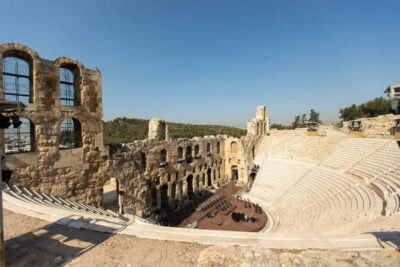
Parthenon & Acropolis Museum with Audio or Live Tour Option
Read our review →
Knossos Palace Entry Ticket with Optional Audio Guide
Read our review →Browse the lists this tour appears in