
Reviewed · AUDIO TOURS
Athens: Roman Agora & Ancient Agora E-ticket & 2 Audio Tours
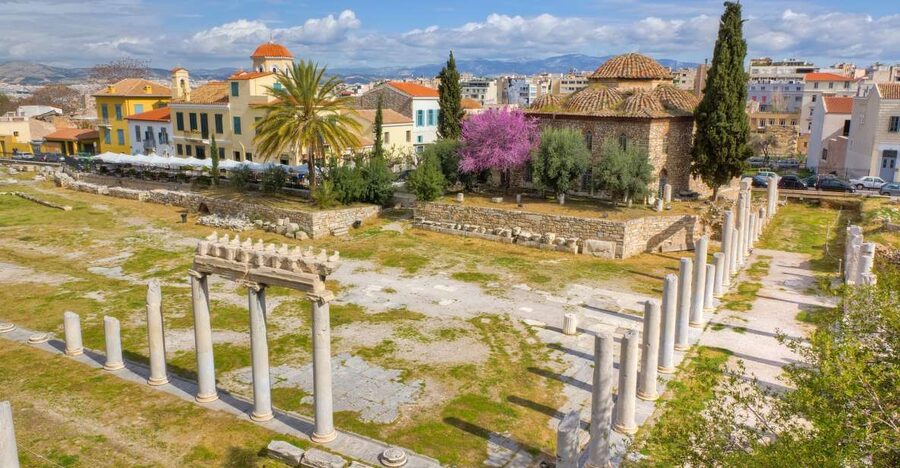
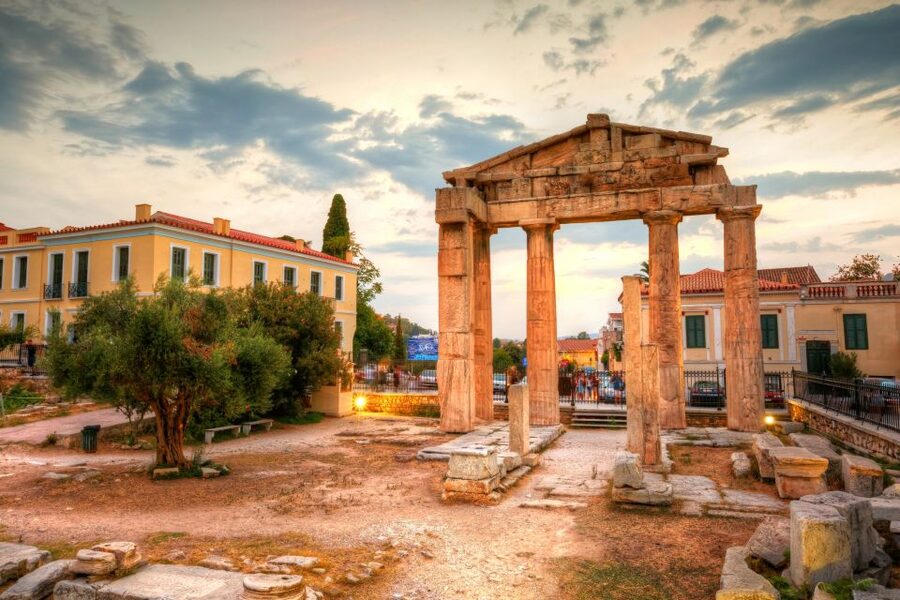
The real appeal here is simple: you get two important Athens archaeological sites on one ticket, then explore them with offline audio tours instead of joining a group. The Roman Agora gives you the Gate of Athena Archegetis and the Tower of the Winds, while the Ancient Agora offers broader ruins, city views, and the museum inside the Stoa of Attalos.
I like the two-hour spacing between the suggested time slots, since it gives you room to walk between sites and pause for photos. I also like that the audio content works without mobile data, which is useful if you are watching roaming costs. The main drawback is that the tours are self-guided, and the audio quality and pronunciation may not suit everyone.
In This Review
- Key points to know before booking
- Two Agoras, two very different Athens experiences
- Starting at the Roman Agora near Monastiraki
- Walking to the Ancient Agora during construction
- The Stoa of Attalos and its museum
- How the smartphone audio tours work
- Timing your day around the two-hour gaps
- What the $51 price means in practice
- Where this experience works best
- The practical verdict on the Roman Agora and Ancient Agora ticket
- FAQ
- How long is the experience valid?
- Which sites are included?
- Is a live guide included?
- Which languages are available?
- Where does the Roman Agora tour begin?
- Where does the Roman Agora tour finish?
- Where should I enter the Ancient Agora?
- How do I reach the Ancient Agora?
- What phone do I need?
- Do I need internet access during the visit?
- How much storage does the app need?
- Are free or reduced tickets available through this booking?
- What should I bring?
- Is the experience refundable?
Key points to know before booking
- Two archaeological sites in one day: Visit the Roman Agora and Ancient Agora with separate timed tickets.
- Start at the Roman Agora: The smaller site makes a sensible first stop and helps you get your bearings.
- Use the temporary Ancient Agora entrance: Construction has closed the main entrance for now.
- Download before leaving: The app needs 200 to 300 MB of storage, a charged phone, and headphones.
- No live guide included: This is an independent visit, not a guided walking tour.
- Check child pricing carefully: Free and reduced tickets are not sold through this booking and must be obtained onsite.
Two Agoras, two very different Athens experiences
Athens is not one single ancient story. The Roman Agora and Ancient Agora sit close together, but they represent different chapters in the city’s past.
The Ancient Agora was the larger civic heart of classical Athens. This was where public life, politics, trade, and debate came together. The site gives you more space to explore and more to look at, including the Stoa of Attalos and its museum.
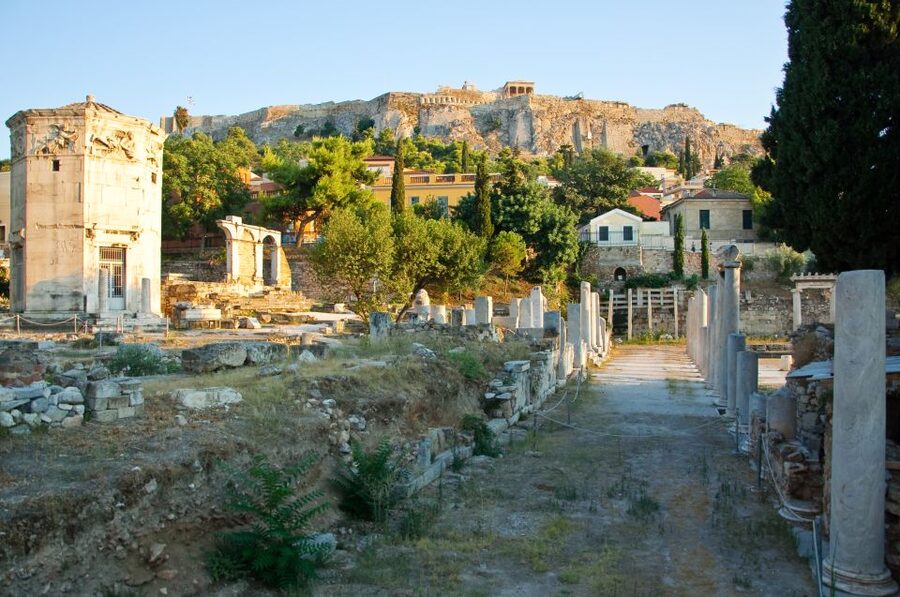
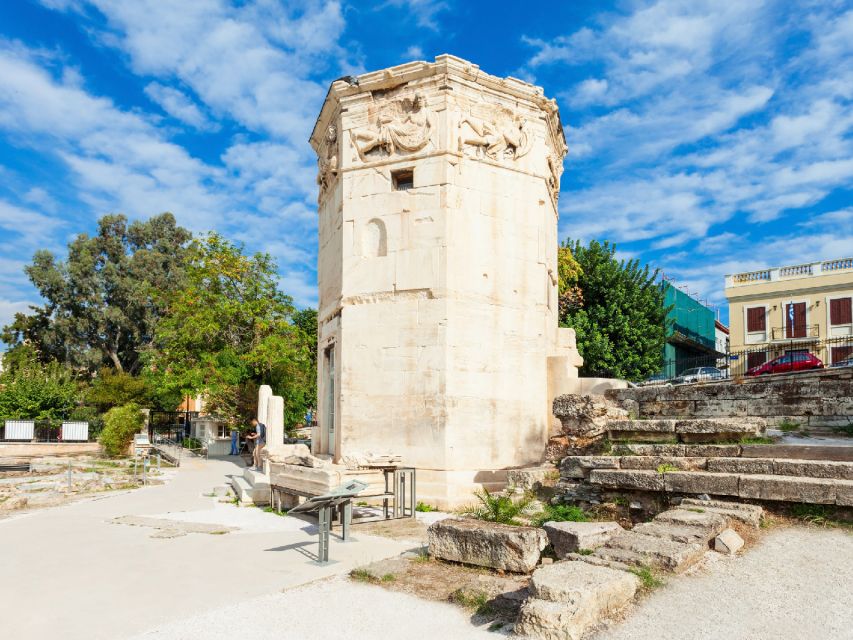
The Roman Agora is smaller and more focused. It reflects the period when Roman power shaped the city. Its best-known features include the Gate of Athena Archegetis and the Tower of the Winds. One useful tip is to visit it first, as the shorter visit helps you get oriented before tackling the larger Ancient Agora.
The combined ticket is designed for one day, with several suggested pairings:
- 8:00 AM Roman Agora, then 10:00 AM Ancient Agora
- 10:00 AM Roman Agora, then 12:00 PM Ancient Agora
- 1:00 PM Roman Agora, then 3:00 PM Ancient Agora
- 2:00 PM Roman Agora, then 4:00 PM Ancient Agora
These times are not just administrative details. They shape your day. The two-hour gap allows time for the first site, the walk to the second, and a little breathing room. You still need to keep an eye on the clock because each ticket is time-slotted.
More Athens trips worth a second look
- Athens: Acropolis Ticket with Optional Audio or Live Guide
★ 4.2 · 11,055 reviews - Athens: Cape Sounio & Poseidon Temple Trip with Audio Guide
★ 4.4 · 4,521 reviews - Athens: Acropolis Ticket with Audio Guide
★ 4.0 · 3,575 reviews
Starting at the Roman Agora near Monastiraki
The Roman Agora entrance is at Epaminonda 6 to 22. The easiest approach is Monastiraki metro station, served by lines 1 and 3. From there, walk along Areos for about 230 meters toward the site.
This is the easier of the two starting points. Monastiraki is a practical transport hub, and the short walk means you do not need a taxi or a complicated route through central Athens.
The audio tour is designed to begin at the Roman Agora entrance. Once inside, you can follow the route toward the Mosque of the Conqueror, where the tour ends within the archaeological site.
The Gate of Athena Archegetis is one of the first features worth noticing. It gives the site a clear sense of arrival and helps explain the Roman-era setting. The Tower of the Winds is another major attraction. Its unusual form and prominent position make it one of the easiest structures here to appreciate, even if you are not an archaeology expert.
The Roman Agora may disappoint you if you expect a large field of ruins. It is more compact than the Ancient Agora, and the visit can feel brief. That is not necessarily a weakness. I would treat it as a focused introduction rather than a full morning outing.
The audio route can add useful context, but you should not expect the flexibility of a live guide. You control the pace, the pauses, and the order in which you look at things. You can also replay the material before or after your visit.
Walking to the Ancient Agora during construction
The Ancient Agora currently has an important access change. The main entrance is temporarily closed because of construction work. You must use the temporary entrance on Apostolou Pavlou Street, at the level of Akamantos Street.
The stated access route is on foot from Thissio station. Build this into your timing. Do not rely on the old entrance shown in an older map or remembered from a previous visit. Construction conditions can change, so follow the signs and site instructions on the day.
The Ancient Agora audio tour ends at the Stoa of Attalos, inside the archaeological site and not far from the entrance. This is useful because the Stoa is both a major sight and a natural finishing point.
Compared with the Roman Agora, the Ancient Agora feels like the main event. You get more room, more historical layers, and a stronger sense of how the city’s public center functioned. The views from parts of the site also give you a chance to pause and photograph Athens from an archaeological setting.
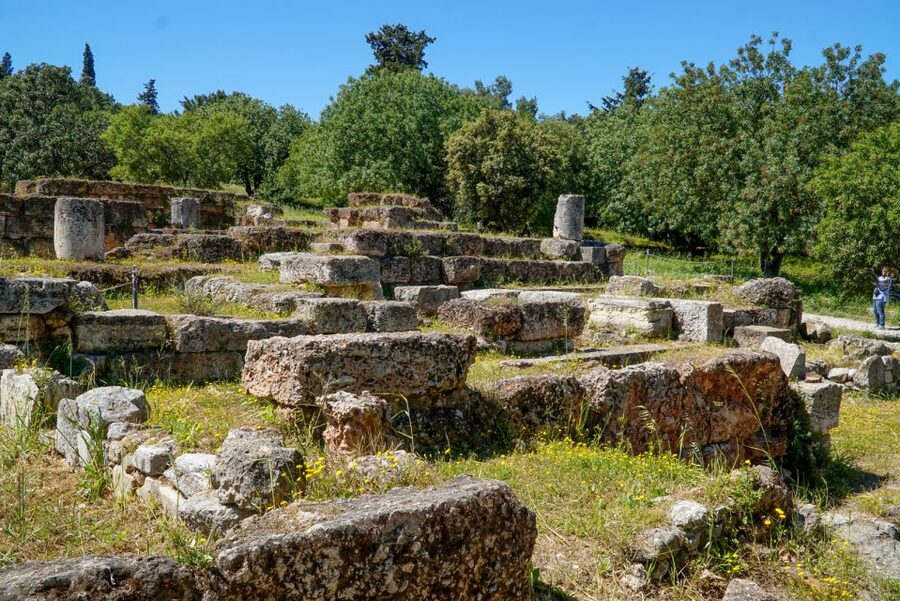
The visit is not simply about looking at broken columns. The audio tour is meant to connect the remains with the city’s civic life and with the Athenian Golden Age. That extra explanation matters here because the site is broad, and some remains can be hard to read without context.
The Stoa of Attalos and its museum
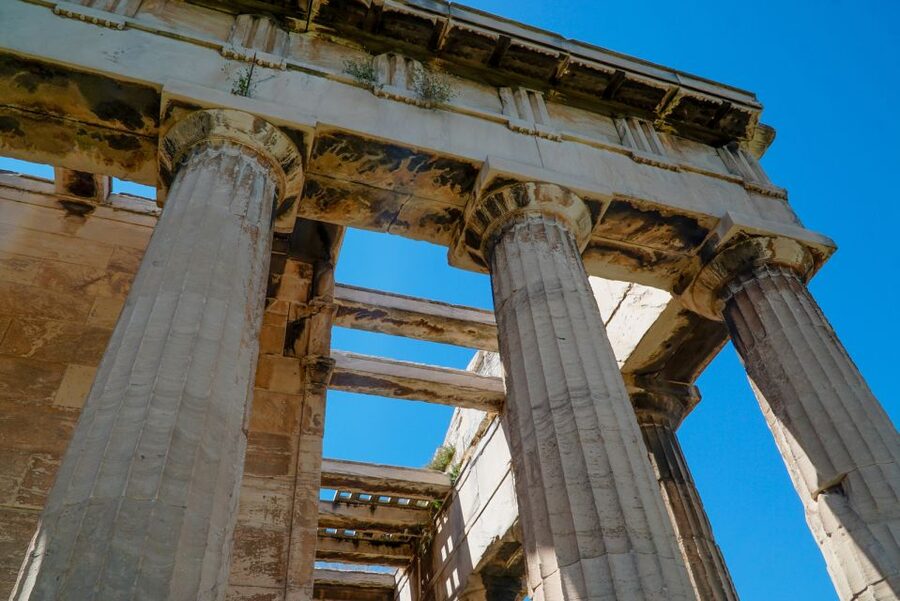
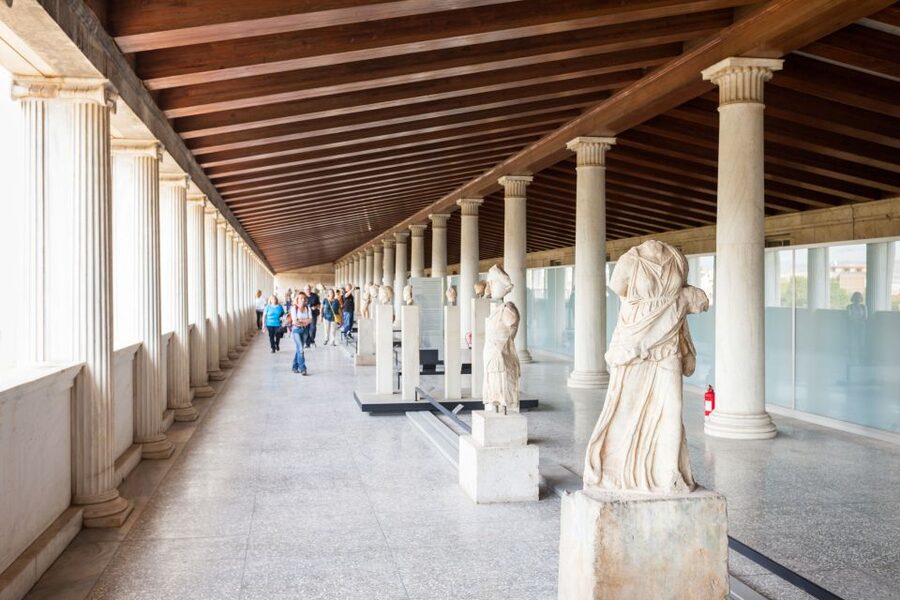
The Stoa of Attalos is among the most useful features of the Ancient Agora. It provides a clear architectural point of reference and houses the site’s historical exhibits.
A stoa was a covered public walkway, and the building helps you picture how ancient public spaces could combine shelter, commerce, and social activity. The museum adds objects and explanations that help make sense of the ruins outside.
I especially value this part of the visit for anyone who finds open archaeological sites difficult to interpret. A museum display can show the size, function, and detail of objects that no longer survive in their original setting.
The audio tour ends here, so allow enough time to look around rather than treating the Stoa as a final waypoint to rush through. If you are visiting in the morning, the Ancient Agora can take up a satisfying portion of your day. If you choose the 3:00 PM or 4:00 PM slot, check the available opening time carefully and keep the schedule tight.
A different kind of day out, same corner of Greece:
- Athens: Acropolis & up to 5 Archaeological Sites Combo Pass
★ 4.4 · 12,619 reviews - Athens: Acropolis, Parthenon & Acropolis Museum Guided Tour
★ 4.8 · 9,316 reviews - Athens: Cape Sounion & Poseidon Temple Sunset Half-Day Trip
★ 4.8 · 8,241 reviews - Athens: Acropolis and Parthenon Guided Walking Tour
★ 4.6 · 5,882 reviews
How the smartphone audio tours work
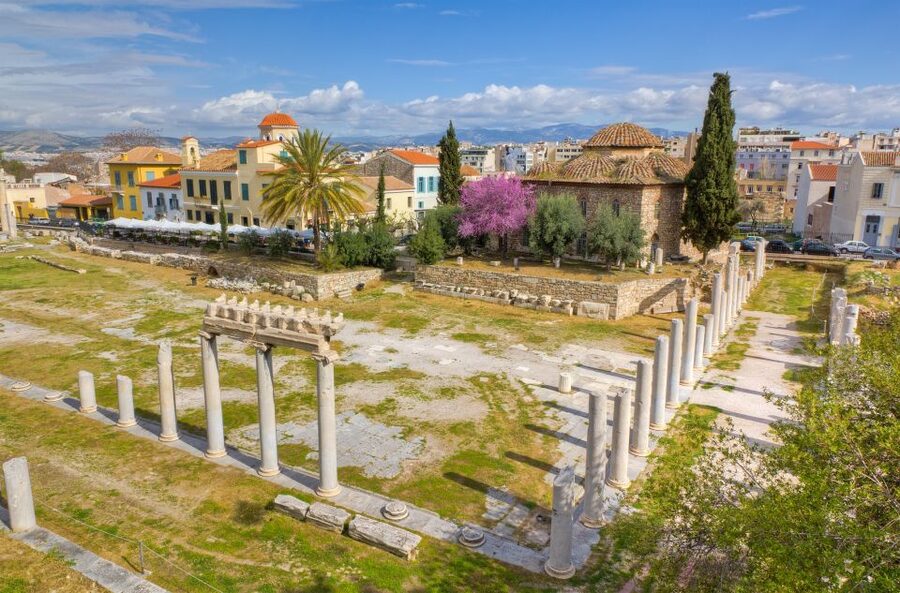
After receiving the tickets by email, you download the app and activate the two audio tours with the supplied link. The content includes audio narration, written information, and maps that can be used offline.
You need:
- An Android phone running version 5.0 or later, or a compatible iPhone
- At least 200 to 300 MB of free storage
- A charged smartphone
- Headphones
- The audio tour downloaded before arriving
The tours are offered in English, Spanish, German, French, and Italian. This makes the product more useful for mixed-language groups, although each person needs to understand how the booking is sold.
The booking is per device, not per participant. If two people want to listen separately, you may need access on two devices. If you are happy to share one phone and one pair of headphones, one device can be enough, but that is less convenient when walking through a large site.
The audio format suits independent visitors who like to stop, replay, and move on when ready. It is less suitable if you want to ask questions or have someone adjust the route when construction changes access.
One piece of feedback was sharply critical of the narration, describing it as machine-like and complaining about pronunciation and a lack of time to move between stops. That is a fair concern to keep in mind. The audio may be useful for structure and background, but you should not expect a polished live performance.
There is also a confusing point worth clearing up. One booking included praise for a guide named Irini, described as helpful and a good photographer. This particular product, however, lists no live guide. If having a person with you is essential, confirm the product type before paying. The name Irini should not lead you to expect her, or any guide, on this self-guided visit.
Timing your day around the two-hour gaps
The schedule works best if you think of it as two separate visits, not one continuous tour.
For the 8:00 AM start, you visit the Roman Agora first and then reach the Ancient Agora for 10:00 AM. This gives you the most daylight and leaves the rest of the day open. It also avoids placing the larger Ancient Agora visit late in the afternoon.
The 10:00 AM and 12:00 PM pairing is a comfortable middle option. You can start at a reasonable hour and still reach the Ancient Agora before the day is too far along.
The 1:00 PM and 3:00 PM pairing works for a later start, while the 2:00 PM and 4:00 PM option suits a compact afternoon plan. These later choices give you less flexibility if you lose time finding the temporary entrance.
I would not plan a long restaurant stop between the sites. The two-hour gap is meant to cover the first visit and the transfer, not a leisurely meal. If you want lunch, plan it before the first slot or after both sites.
Wear comfortable shoes. Ancient surfaces can be uneven, and the visit involves walking. Sunglasses, a sun hat, and sunscreen are sensible in Athens, especially when you are moving through exposed ruins with limited shade.
What the $51 price means in practice
At $51 per person, this is not the cheapest way to see two archaeological sites. You are paying for convenience, reserved entry arrangements, and the two audio tours rather than for a live expert.
The value is strongest when you want a ready-made plan. You do not need to arrange two separate entries, and the audio material gives you a route to follow. The offline maps and narration are also useful if you do not want to spend time researching every monument before arrival.
The value is weaker if you qualify for free or reduced admission. Those tickets cannot be obtained through this booking and must be collected at the onsite ticket booth. One 16-year-old visitor was reportedly entitled to free entry, but the booking did not allow the adults to recover the unused amount. The practical lesson is clear: check age-based and concession rules before booking, and do not buy a full-price ticket for someone who may qualify for free admission.
The non-refundable policy also means you should be certain about your date, your phone compatibility, and the site access arrangements before purchase.
Where this experience works best
I would choose this for a first visit to Athens when you want to cover two central ancient sites without joining a group. It suits independent couples, families with older children, and visitors who prefer listening through headphones to following a guide with a flag.
It is also useful if you like revisiting information. You can replay the audio before or after the visit, which lets you refresh the story later at your hotel.
I would hesitate if you need personal explanations, have limited phone storage, or dislike audio guides. I would also be careful with young children who may become restless during a self-guided archaeological visit.
People with disabilities or reduced mobility should know that the sites are only partially accessible. The access route may also change because of current construction, so check the conditions on arrival and follow staff instructions.
The practical verdict on the Roman Agora and Ancient Agora ticket
This is a useful, well-organized way to visit two important Athens sites, but its strengths are practical rather than luxurious. The timed tickets, offline maps, and two-hour schedule remove some planning work. The Roman Agora is compact and easy to pair with the Ancient Agora, while the Ancient Agora provides the fuller visit, especially with the Stoa of Attalos and its museum.
I would book it if you want independent sightseeing and are comfortable using your own phone. I would skip it if you qualify for reduced admission, want a live guide, or expect highly polished narration. Before paying, confirm the child ticket rules, download requirements, current entrance instructions, and the fact that one device is the basis of the booking.
FAQ
How long is the experience valid?
The ticket is valid for one day. You select time slots for the Roman Agora and Ancient Agora.
Which sites are included?
The package includes timed entry to the Roman Agora and the Ancient Agora in Athens.
Is a live guide included?
No. The experience includes two self-guided audio tours on your smartphone, not a live guide.
Which languages are available?
The audio tours are available in English, Spanish, German, French, and Italian.
Where does the Roman Agora tour begin?
It begins at the Roman Agora entrance at Epaminonda 6 to 22 in Athens. Monastiraki metro station is the easiest transport connection, followed by a walk along Areos.
Where does the Roman Agora tour finish?
The route ends inside the archaeological site at the Mosque of the Conqueror.
Where should I enter the Ancient Agora?
Because of construction, the main entrance is temporarily closed. Use the temporary entrance on Apostolou Pavlou Street, at the level of Akamantos Street.
How do I reach the Ancient Agora?
The stated access route is on foot from Thissio station. Follow the current signs and site instructions because construction may affect access.
What phone do I need?
You need an Android phone running version 5.0 or later or a compatible iOS smartphone. The tour does not support Windows Phones, iPhone 5 or 5C, iPod Touch 5th generation, iPad 4th generation, iPad Mini 1st generation, or older versions.
Do I need internet access during the visit?
The text, audio narration, and maps can be downloaded for offline use. You still need to download and activate the content before your visit.
How much storage does the app need?
Allow approximately 200 to 300 MB of free storage on your phone.
Are free or reduced tickets available through this booking?
No. Free or reduced admission tickets must be obtained at the onsite ticket booth and do not include skip-the-line privileges.
What should I bring?
Bring comfortable shoes, sunglasses, a sun hat, sunscreen, headphones, and a charged smartphone.
Is the experience refundable?
No. The activity is non-refundable.
Recently reviewed around Athens
- Small-Group Women History in Ancient Greece Walking Tour★ 5.0 · 38 reviews
- Ceramic and Pottery Creative Workshop with Two Local Artists★ 4.0 · 57 reviews
- Athens: Wine Workshop Create your Own Wine under the Acropolis★ 5.0 · 77 reviews
- Athens: Greek Wines Tasting with Sommelier and Acropolis Views★ 5.0 · 88 reviews
- Hydra Private Day Trip by Ferry from Athens with Transfers★ 4.0 · 30 reviews
- Small-Group Wine Tour in Athens with Tasting★ 5.0 · 33 reviews
- Wine Trails Private Tour/ Nemea visit 3 wineries from Athens or Nafplion (10 h)★ 5.0 · 44 reviews
- Private Athens Transfer Airport/Port -Greek Tours-Hourly service★ 5.0 · 88 reviews
Audio Tours, compared.


Cape Sounio & Poseidon Temple Trip with Audio Guide
Read our review →
Acropolis Museum Ticket with optional Audio Guide
Read our review →
Acropolis Ticket & Optional Self-Guided Audio Tours
Read our review →
Parthenon & Acropolis Museum with Audio or Live Tour Option
Read our review →
Knossos Palace Entry Ticket with Optional Audio Guide
Read our review →Browse the lists this tour appears in