
Reviewed · AUDIO TOURS
Athens: Roman Agora E-Ticket and Audio Guide
The Roman Agora is a compact site with a surprisingly broad story. In less than an hour, you can move from classical Greek civic life to Roman-era public facilities, Ottoman rule, and one of Athens most recognizable monuments, the Tower of the Winds. The downloadable audio guide adds useful context to stones that can otherwise look like a quick pile of ruins.
I like the convenience of an adult e-ticket and offline audio, especially if you want to avoid a ticket line and explore without joining a group. I also like the audio guides storytelling, which one recent user found strong enough to make the site feel like a trip back through time. The main drawback is value: at $18 for a 45-minute to one-hour visit, the ticket may feel expensive when the site is quiet and tickets are easy to buy on site.
In This Review
- Key points to know before you go
- A small Roman-era site with a big time span
- Arriving with an e-ticket and smartphone audio
- The Gate of Athena Archegetis sets the tone
- The Tower of the Winds is the main reason to linger
- Fountain house, shops, and public facilities
- The Mosque of the Conqueror adds a later chapter
- Acropolis views without the Acropolis crowds
- How the audio guide works in practice
- Is $18 good value for a one-hour visit?
- Who should book this Roman Agora visit?
- Should you book the Roman Agora audio tour?
- FAQ
- How long does the Roman Agora audio tour take?
- What is included in the ticket?
- Is there a live guide?
- Which languages are available?
- Do I need my own phone?
- Do I need headphones?
- Can I use the audio without mobile data?
- How much storage space does the app require?
- Can I use the audio tour more than once?
- Is the Roman Agora fully accessible?
Key points to know before you go

- The Tower of the Winds is the star attraction: This unusual ancient structure helps explain Greek and Roman interest in weather, time, and the eight winds.
- Your phone replaces a live guide: Download the Clio Muse app and audio before arriving, then follow the commentary at your own pace.
- The visit is short and focused: Plan on 45 minutes to an hour, making this a useful stop between larger Athens sights.
- The Acropolis view adds value: The Roman Agora gives you a fine angle toward the Acropolis while you explore.
- Offline content saves mobile data: Text, narration, and maps can be stored on your phone before you enter.
- The audio is available in six languages: Choose English, Spanish, German, French, Italian, or Greek.
A small Roman-era site with a big time span
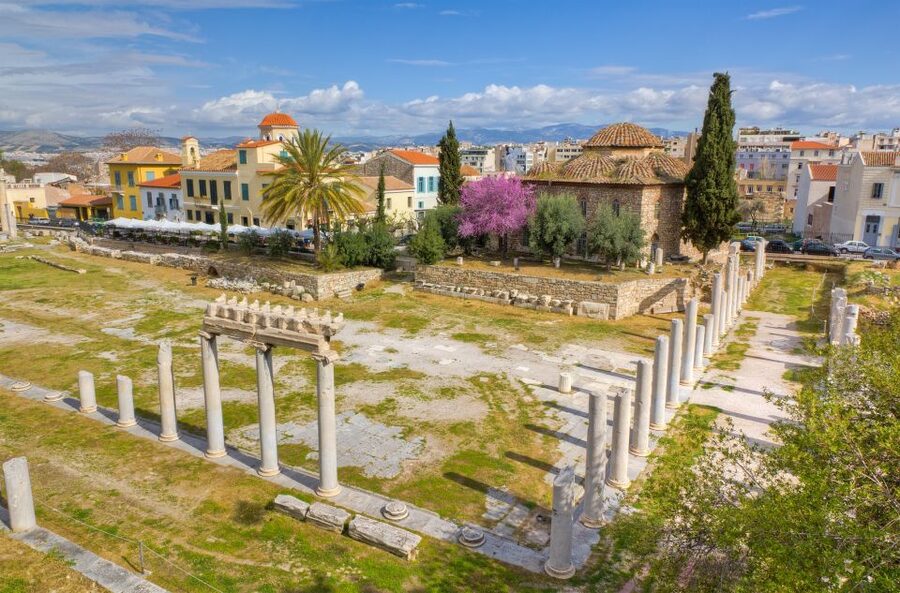
The Roman Agora is not a vast archaeological park. That is part of its appeal. You can see the main remains without spending half a day crossing a large site, yet the setting opens a window onto daily life in Athens across roughly two thousand years.
I find compact ancient sites especially useful early in an Athens visit. You can get a feel for how public space worked, how practical buildings supported city life, and how later rulers reused older monuments. The Roman Agora does not try to overwhelm you with scale. Instead, it gives you a concentrated look at civic and everyday activity.
The audio guide helps turn separate structures into a connected story. You are not simply looking at columns, doorways, and foundations. You are prompted to think about the people who visited the market area, used public facilities, measured time, and adapted the site over later centuries.
The entire visit usually takes 45 minutes to an hour. That makes it easy to pair with other central Athens sights, though you should allow extra time if you like to stop for photographs or listen to every piece of narration.
More Athens trips worth a second look
- Athens: Acropolis Ticket with Optional Audio or Live Guide
★ 4.2 · 11,055 reviews - Athens: Cape Sounio & Poseidon Temple Trip with Audio Guide
★ 4.4 · 4,521 reviews - Athens: Acropolis Ticket with Audio Guide
★ 4.0 · 3,575 reviews
Arriving with an e-ticket and smartphone audio
The basic arrangement is simple. After booking, you receive an email with instructions and an activation link for the audio tour. You then download the app, save the audio content, and bring the entry ticket to the Roman Agora.
Do this before you reach the site. The audio requires about 100 to 150 MB of storage, and you will need a charged Android or iOS phone. Downloading the maps and narration in advance also avoids relying on mobile data while you are walking around Athens.
Bring your own headphones. Neither a smartphone nor headphones are provided, and a phone speaker can be hard to hear outdoors. Comfortable shoes are sensible, though the visit is short. The ground and route may not feel as smooth as a modern museum floor.
The ticket is for an adult entry and includes skip-the-line service. Keep in mind that free and reduced admission tickets must be obtained at the on-site ticket booth and do not receive skip-the-line privileges through this product.
There is no live guide and no standard meeting point. The meeting point can vary by booking option, so read the instructions carefully rather than waiting for a guide or group to appear. This is a self-guided visit from beginning to end.
The Gate of Athena Archegetis sets the tone
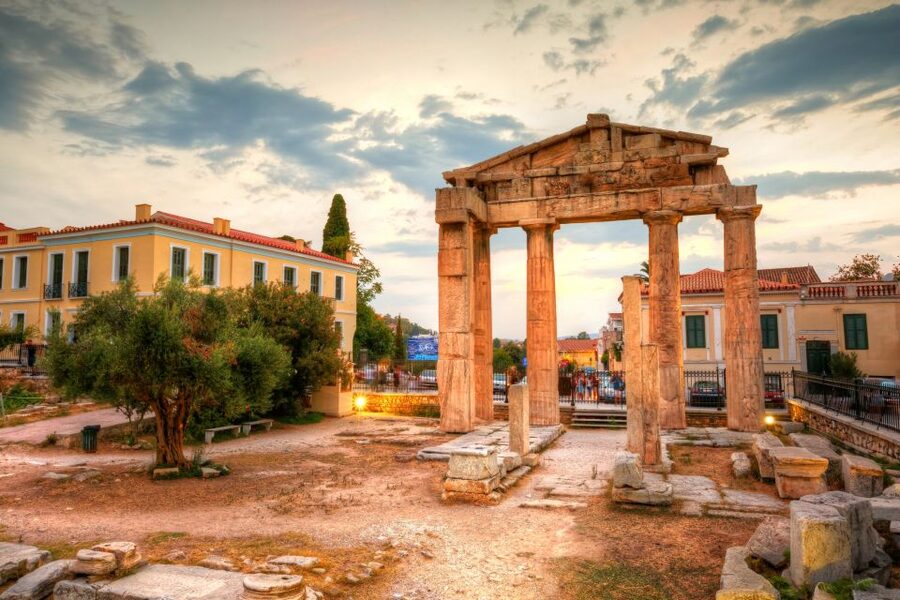
The Gate of Athena Archegetis is one of the first structures to give the site a sense of scale. Its surviving columns and formal design show that this was not just a rough market corner. The gateway marked an important entrance and connected the Roman Agora to the wider urban life of Athens.
This is a good place to begin the audio. Look closely at the proportions and surviving stonework while the narration explains the role of the gate. The point is not only to admire an ancient facade. It is to understand how architecture told people where they were entering and what kind of public space lay beyond.
The gate also frames the surrounding city. Athens is not sealed off from the Roman Agora, and that is useful. You can connect the archaeological remains with the modern streets around them and look toward the Acropolis from within an ancient setting.
If you are moving quickly, the Gate of Athena Archegetis could take only a few minutes. I would give it longer. The audio has a chance to explain details that are easy to miss when you are simply walking past.
The Tower of the Winds is the main reason to linger

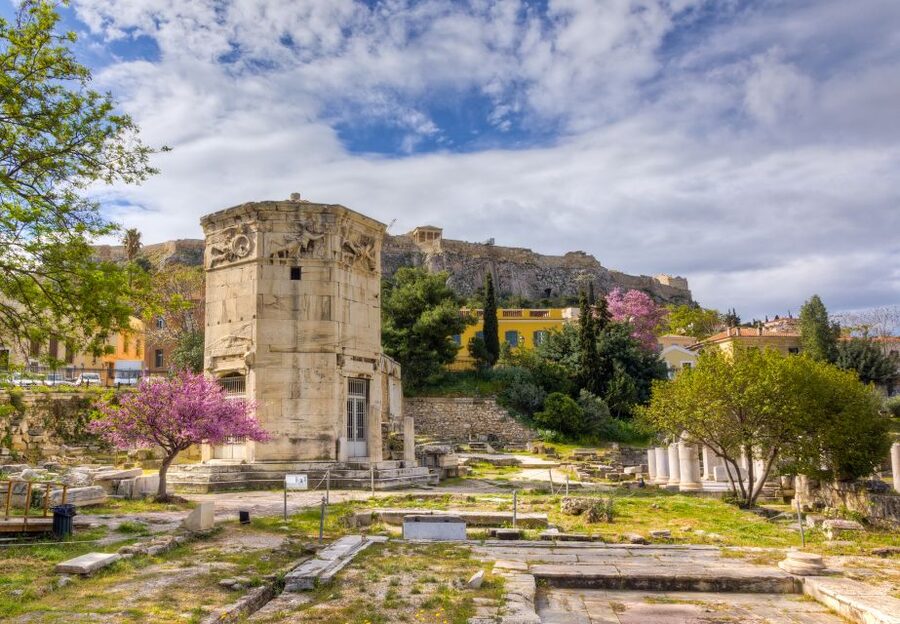
The Tower of the Winds is the most distinctive building in the Roman Agora. It is often described as an ancient weather station and timekeeping structure, and its design reflects Greek interest in the natural world and the winds that shaped daily life.
This is where the audio guide is most useful. A bare description of a stone tower does not tell you why it mattered. The narration points you toward the building’s purpose and the ideas behind its decoration, helping you notice the relationship between architecture, weather, time, and public life.
You get the chance to meet the winds in a playful sense, through the figures and stories associated with the structure. That gives the visit a lighter touch. Ancient sites can feel distant when you only hear dates and names. Stories about weather and daily habits make the monument easier to picture in use.
The Tower of the Winds is also the place where the site feels most memorable. If you have only 45 minutes, make sure you give this structure your full attention. Stop, listen, and look around it rather than treating it as a quick photo stop.
One recent user felt the audio was very good and said it helped bring the past to life. That assessment fits the strongest part of this product: the narration can add meaning to a small number of surviving structures. Still, the app route may not be perfectly clear for everyone. Another user found it difficult to orient themselves, so check the map and listen for directions instead of assuming the next audio point will be obvious.
A different kind of day out, same corner of Greece:
- Athens: Acropolis & up to 5 Archaeological Sites Combo Pass
★ 4.4 · 12,619 reviews - Athens: Acropolis, Parthenon & Acropolis Museum Guided Tour
★ 4.8 · 9,316 reviews - Athens: Cape Sounion & Poseidon Temple Sunset Half-Day Trip
★ 4.8 · 8,241 reviews - Athens: Acropolis and Parthenon Guided Walking Tour
★ 4.6 · 5,882 reviews
Fountain house, shops, and public facilities
The Roman Agora was a working urban area, not simply a place for grand monuments. The remains include a fountain house, shops, and Vespasianae, or public toilets. These features are valuable because they shift your attention from famous rulers and temples to the practical systems that made city life function.
The fountain house points to the importance of water in an ancient city. Shops remind you that commerce took place close to formal public architecture. The Vespasianae offer a more direct glimpse of public sanitation and everyday habits, subjects that are often left out of traditional sightseeing.
I like this part of the site because it makes the Roman Agora feel human. You can think about people stopping for water, buying goods, handling errands, and using public facilities. The remains may be less visually dramatic than the Tower of the Winds, but they answer a more basic question: what did people actually do here?
The audio guide is designed around short original stories rather than one long lecture. That format suits a small archaeological site. You can listen to a section, look at the feature it describes, and continue when you are ready. The content can also be used again before or after your visit, which is useful if you want to review a detail later.
The Mosque of the Conqueror adds a later chapter
The Mosque of the Conqueror, also called the Mosque, reminds you that the Roman Agora continued to matter after the ancient Greek and Roman periods. Its presence adds an Ottoman-era layer to a place that is often presented only through its classical remains.
This is one of the reasons I would not treat the site as a simple Roman stop. Athens changed hands, changed habits, and reused old spaces. Seeing a mosque within the archaeological area gives you a clearer sense of the city as a place with several historical chapters placed close together.
The audio narration helps connect the mosque to the broader story. You do not need to know much about Athenian history before visiting, since the tour supplies background in brief sections. If you already know the Acropolis and classical Athens well, this later layer may be one of the more interesting parts of the visit.
The site is small enough that you can return to the mosque after hearing the audio and examine it with fresh eyes. That ability to pause and repeat sections is a real advantage over a fixed group talk.
Acropolis views without the Acropolis crowds
The Roman Agora offers a splendid view of the Acropolis. It is not a substitute for visiting the Acropolis itself, but it gives you a different way to see the famous hill and connect it to the lower city.
I like this viewpoint because the ancient remains sit in the foreground while the Acropolis rises beyond them. It makes the city feel layered rather than divided into separate attractions. Take a moment to look away from the audio map and absorb the wider setting.
The view also makes the Roman Agora a useful stop for first-time visitors trying to understand central Athens. You can appreciate the relationship between public spaces, monuments, and the hillside above. Since the visit is short, it provides a good change of pace after a larger site.
Do not expect the same number of major structures you would find at the Acropolis. The Roman Agora is a pocket-size archaeological visit. Its value comes from the combination of scale, stories, and setting, not from a long list of intact buildings.
How the audio guide works in practice
The tour is available in English, Spanish, German, French, Italian, and Greek. You choose the language in the app, then listen through your own headphones while moving through the site.
The content includes text, audio narration, and maps for offline use. That is helpful in Athens, where you may already be using your phone for directions, tickets, photos, and restaurant searches. Downloading everything in advance keeps the visit simpler.
The audio can be used repeatedly and at any time, before or after the visit. You could listen to a few sections while planning, use the map on site, and replay the parts that mattered most later. The product also presents a self-guided Athens walking tour on your phone, giving you an additional way to explore the city through short stories.
The main weakness is navigation. Because you are not following a person, you need to match the app’s map and commentary with the structures around you. If you are prone to losing your place, pause at each major feature, confirm the next stop on the map, and keep your phone charged.
There are no named live guides because there is no live guide service. Clio Muse Tours supplies the app-based content instead. That suits independent sightseers, but it will not satisfy you if you want to ask questions or hear spontaneous explanations from a person on site.
Is $18 good value for a one-hour visit?
At $18 per person, this is not the cheapest way to see a small archaeological site. One recent user considered the ticket a little expensive for the length of the visit and noted that buying a ticket on site could be easy when the area was nearly empty.
That is the key value question. You are paying not only for admission but also for the convenience of an advance ticket, skip-the-line service, and the audio content. If the ticket booth has a queue, the package becomes more useful. If the site is quiet and you are comfortable buying entry in person, the price is harder to justify.
The audio guide improves the calculation, particularly if you enjoy historical context but do not want a live group. Its strongest feature is the storytelling around the Tower of the Winds and everyday life. If you would otherwise walk through in 20 minutes without understanding the structures, the narration can make the visit more worthwhile.
I would see this as a convenience purchase rather than a bargain. It makes the most sense when you value advance planning, want commentary in your own language, or prefer not to wait at a ticket counter. It makes less sense if you are already buying several major Athens admissions and are watching every euro.
Who should book this Roman Agora visit?
I would recommend it to independent sightseers who want a short historical stop in central Athens. It is especially suitable for people who enjoy ancient engineering, urban life, and unusual monuments more than large-scale museum collections.
It also works well for:
- You want to visit at your own pace rather than join a group.
- You prefer audio stories in English, Spanish, German, French, Italian, or Greek.
- You want offline maps and narration on your phone.
- You are combining the Roman Agora with other central Athens sights.
- You enjoy seeing how ancient spaces supported ordinary daily life.
- You want an adult skip-the-line ticket arranged in advance.
I would be cautious if you expect a full guided tour, a large archaeological complex, or detailed answers to personal questions. The experience is short, self-guided, and dependent on your own phone. It is also not fully accessible, though it is partially accessible for people with disabilities, so check current conditions before booking if access is important to you.
The booking is non-refundable, so make sure your dates and phone meet the requirements. The app works on Android version 5.0 and later and iOS, but not Windows phones or several older Apple devices, including iPhone 5 and older, iPod Touch 5th generation and older, iPad 4th generation and older, and iPad Mini first generation.
Should you book the Roman Agora audio tour?
Book it if you want a short, independent visit with useful storytelling and you value having your ticket and audio ready before arrival. The Tower of the Winds, Acropolis view, and everyday-life details give the Roman Agora more depth than its compact size suggests.
Skip it if your main aim is the lowest possible admission cost, or if you strongly prefer a live guide. At $18, the package is best for convenience and interpretation, not for the length of the visit alone. Download the content early, bring headphones, check the map as you go, and allow a full hour so the site does not feel rushed.
FAQ
How long does the Roman Agora audio tour take?
The visit lasts approximately 45 minutes to one hour.
What is included in the ticket?
The package includes an adult entry ticket to the Roman Agora, skip-the-line service, and a self-guided audio tour on your smartphone.
Is there a live guide?
No. This is a self-guided audio tour, and no live guide or standard meeting point is provided.
Which languages are available?
The audio guide is available in English, Spanish, German, French, Italian, and Greek.
Do I need my own phone?
Yes. You need your own Android or iOS smartphone to download and use the audio tour.
Do I need headphones?
Yes. Headphones are not provided, so bring your own if you want to listen comfortably.
Can I use the audio without mobile data?
Yes. The tour includes offline text, audio narration, and maps. Download the content before your visit.
How much storage space does the app require?
You need approximately 100 to 150 MB of free storage space on your phone.
Can I use the audio tour more than once?
Yes. The audio tours can be used repeatedly and at any time, including before or after your visit.
Is the Roman Agora fully accessible?
No. The site is partially accessible for people with disabilities. Special restrictions or changes to the route may apply, and you must follow the site guidelines.
Recently reviewed around Athens
- Small-Group Women History in Ancient Greece Walking Tour★ 5.0 · 38 reviews
- Ceramic and Pottery Creative Workshop with Two Local Artists★ 4.0 · 57 reviews
- Athens: Wine Workshop Create your Own Wine under the Acropolis★ 5.0 · 77 reviews
- Athens: Greek Wines Tasting with Sommelier and Acropolis Views★ 5.0 · 88 reviews
- Small-Group Wine Tour in Athens with Tasting★ 5.0 · 33 reviews
- Wine Trails Private Tour/ Nemea visit 3 wineries from Athens or Nafplion (10 h)★ 5.0 · 44 reviews
- Hydra Private Day Trip by Ferry from Athens with Transfers★ 4.0 · 30 reviews
- Private Athens Transfer Airport/Port -Greek Tours-Hourly service★ 5.0 · 88 reviews
Audio Tours, compared.


Cape Sounio & Poseidon Temple Trip with Audio Guide
Read our review →
Acropolis Museum Ticket with optional Audio Guide
Read our review →
Acropolis Ticket & Optional Self-Guided Audio Tours
Read our review →
Parthenon & Acropolis Museum with Audio or Live Tour Option
Read our review →
Knossos Palace Entry Ticket with Optional Audio Guide
Read our review →Browse the lists this tour appears in