Reviewed · GUIDED
Athens: the Great Greek Philosophers Guided Tour in Spanish
Athens makes more sense when you stop looking only at marble temples and start asking what people argued about in the streets below them. This 150-minute walking tour follows the world of Socrates, Plato, and other Greek thinkers through places linked to public debate, civic life, and the birth of Western philosophy.
I like the way the tour turns familiar Athens into a living classroom, especially at the Statue of Plato and the Areopagus. I also like its conversational approach. Guides such as Gregory have used questions, mind games, and everyday examples to make difficult ideas easier to grasp.
The main consideration is language. This is a Spanish-language tour, so it is the right pick only if you can comfortably follow a sustained discussion in Spanish. You should also expect a fair amount of walking, including a visit to the Pnyx hill, and you will need comfortable shoes and water.
In This Review
- Key points at a glance
- Why philosophy changes the way you see Athens
- Starting at Plato’s statue in central Athens
- The Agora and the public life of ideas
- Areopagus and the physical side of the walk
- Socrates’ prison and the cost of questioning
- The Pnyx, democracy, and the power of speech
- Gregory, Sunny, and the guide’s role
- What the $34 price buys you
- Who will enjoy this tour most
- Practical preparation for the 150-minute walk
- Should you book the Great Greek Philosophers tour?
- FAQ
- How much does the tour cost?
- How long does the tour last?
- What language is the tour conducted in?
- Where is the meeting point?
- How early should I arrive?
- Which places are included in the route?
- Are food and drinks included?
- What should I bring?
- Can I cancel the booking?
Key points at a glance
- Philosophy in its original setting: Connect the Agora, Pnyx, Areopagus, and Socrates’ prison with the ideas formed around them.
- A discussion rather than a lecture: The guide invites questions and may use thought exercises to get you thinking.
- Spanish live guiding: The tour is conducted in Spanish, with guides including Gregory and Sunny.
- A useful two-and-a-half-hour route: At $34 per person, the experience gives you focused cultural context without taking up a full day.
- Good for beginners and serious students: The explanations can be adapted to your interests and previous knowledge.
- Simple preparation: Meet at Plato’s statue 10 minutes early, wear comfortable shoes, and bring water.
Why philosophy changes the way you see Athens
Many Athens tours focus on buildings, dates, and rulers. This one follows a different thread: how people began to question accepted ideas, examine their own beliefs, and debate how a city should be run.
That shift matters. The Agora is not just another ancient site to photograph. It was a place tied to public life and discussion, where citizens dealt with civic matters and where philosophical ideas gained an audience. The Pnyx adds another layer, since it is connected with public speaking and democratic participation.
You are not simply being handed a list of famous names. The aim is to connect people, places, and questions. Why should a person examine their own beliefs? What makes a just society? Is wisdom the same as knowing facts? Those questions help the ruins feel less remote.
The tour also gives you a more personal way into Socrates. His story is not treated only as an old lesson from a textbook. The discussion includes his character, his approach to questioning, and the price he paid for refusing to stop challenging accepted beliefs.
That focus is one of the strongest reasons to book. If you enjoy asking why, rather than only asking when, you will get more from this walk than from a standard sightseeing circuit.
More Athens trips worth a second look
- Athens: Acropolis & up to 5 Archaeological Sites Combo Pass
★ 4.4 · 12,619 reviews - Athens: Acropolis Ticket with Optional Audio or Live Guide
★ 4.2 · 11,055 reviews - Athens: Acropolis, Parthenon & Acropolis Museum Guided Tour
★ 4.8 · 9,316 reviews
Starting at Plato’s statue in central Athens
The meeting point is in front of the Statue of Plato. You should arrive 10 minutes before the scheduled start, which gives you time to find the statue and identify the guide without rushing.
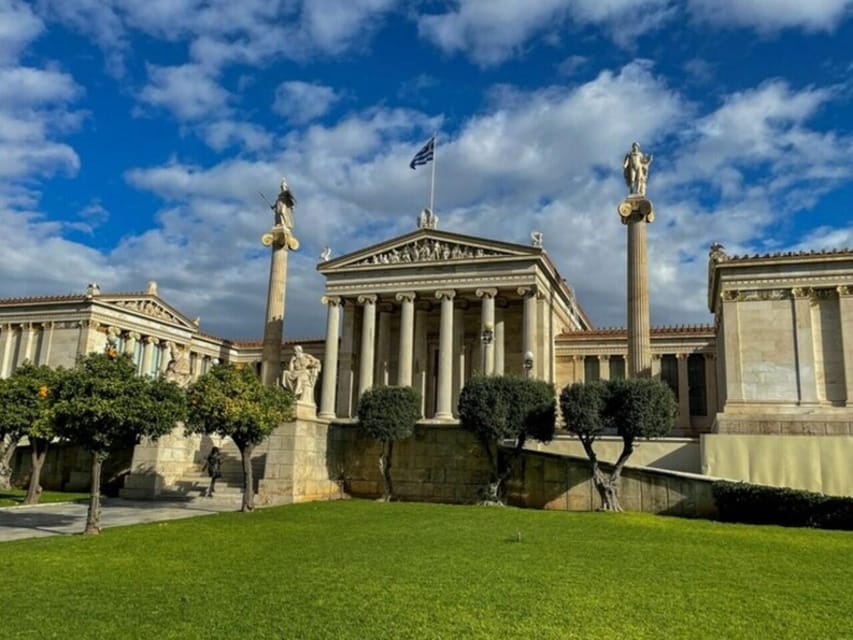
Beginning with Plato is a smart choice. He is one of the easiest figures to recognize in the Greek philosophical tradition, but his importance goes well beyond a familiar name. His work helped preserve and develop the ideas of Socrates, while his own writing shaped later thought about politics, education, knowledge, and the nature of reality.
The statue also gives the guide a clear opening point. From there, the tour can frame the central story: Athens was not only a city of temples and military power. It was also a place where people argued about truth, citizenship, morality, and the best way to live.
The exact order of stops may vary, but the route is built around several important sites in and around the historic center. Because the activity is a walking tour, you should not expect long indoor visits or extended time seated in one place. The value comes from the guide’s explanation at each location and the links between them.
The Agora and the public life of ideas
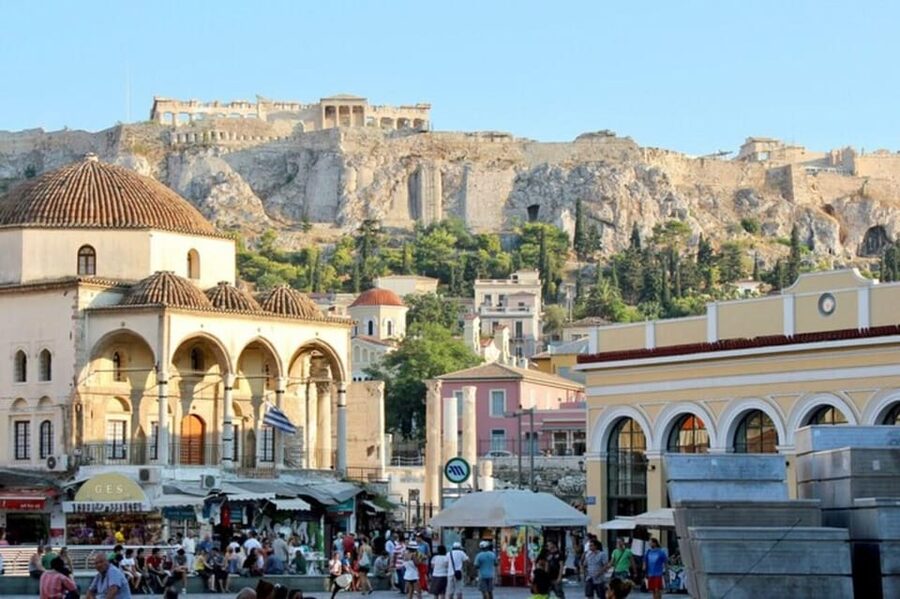
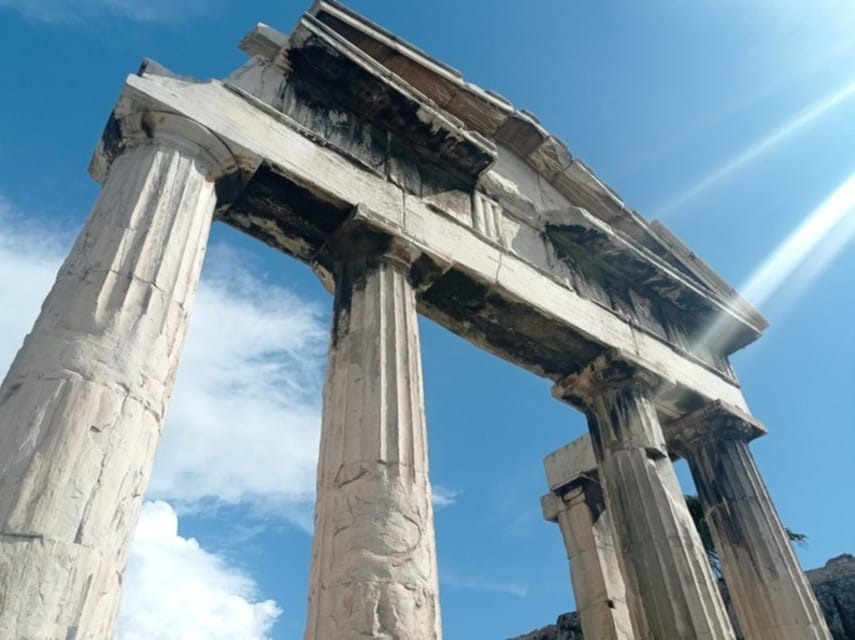
The Greek Agora is one of the most meaningful stops on the route. It helps explain why Athenian philosophy developed in such a public way.
This was not philosophy isolated in a private study. The Agora was part of the city’s social and civic life. People met, traded, discussed public business, and encountered competing views. In that setting, questions could move from one conversation to another.
Your guide uses the site to explain the role of philosophy in ancient Athenian society. That context is useful because many visitors know the names of Socrates, Plato, and Aristotle but have only a thin sense of where their ideas took shape.
The stop may also help you understand Socrates’ unusual method. Rather than presenting himself as a man with every answer, he questioned people and exposed weak assumptions. That approach could be entertaining, irritating, or both. It also explains why Socrates remains such a compelling figure centuries later.
Do not expect every idea to be delivered as a neat historical fact. The strongest part of this experience is the exchange between guide and group. You may be asked to consider a moral problem, compare two ways of thinking, or apply an old argument to ordinary life.
For a beginner, that keeps the tour approachable. For someone who has studied philosophy, it creates room for a more detailed discussion.
Areopagus and the physical side of the walk
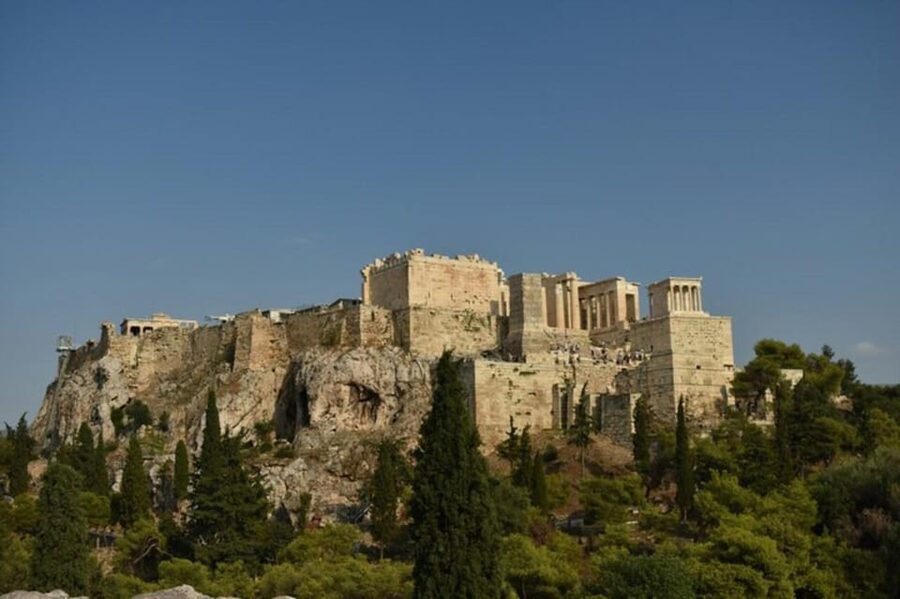
The Areopagus is another major highlight. This rocky hill near the Acropolis is tied to ancient civic and legal life, and it gives the route a strong sense of place.
The stop also comes with a practical issue: uneven stone and changes in elevation. The supplied advice to wear comfortable shoes is not a formality. You should take it seriously, particularly if you are not used to walking on old stone surfaces.
Bring water, too. Athens can be hot, and this is an outdoor activity lasting 150 minutes. Food and drinks are not included, so plan to carry your own water and arrange refreshments before or after the walk.
The Areopagus is valuable because it lets you consider how law, public judgment, and moral questions overlapped in the ancient city. The guide can place philosophical arguments within the wider civic world rather than treating them as abstract theories.
You should also be prepared for a site where the experience depends on listening and imagination. The remains do not recreate ancient Athens for you. The guide’s storytelling fills in the human part, helping you picture debates, accusations, and public decisions in a place that can otherwise seem like a pile of weathered stone.
A different kind of day out, same corner of Greece:
- Athens: Cape Sounion & Poseidon Temple Sunset Half-Day Trip
★ 4.8 · 8,241 reviews - Athens: Acropolis and Parthenon Guided Walking Tour
★ 4.6 · 5,882 reviews - All Day Cruise -3 Islands to Agistri,Moni, Aegina with lunch and drinks included
★ 5.0 · 4,958 reviews - Athens, Piraeus, and Coastline: Blue Hop-On Hop-Off Bus
★ 3.9 · 4,849 reviews
Socrates’ prison and the cost of questioning
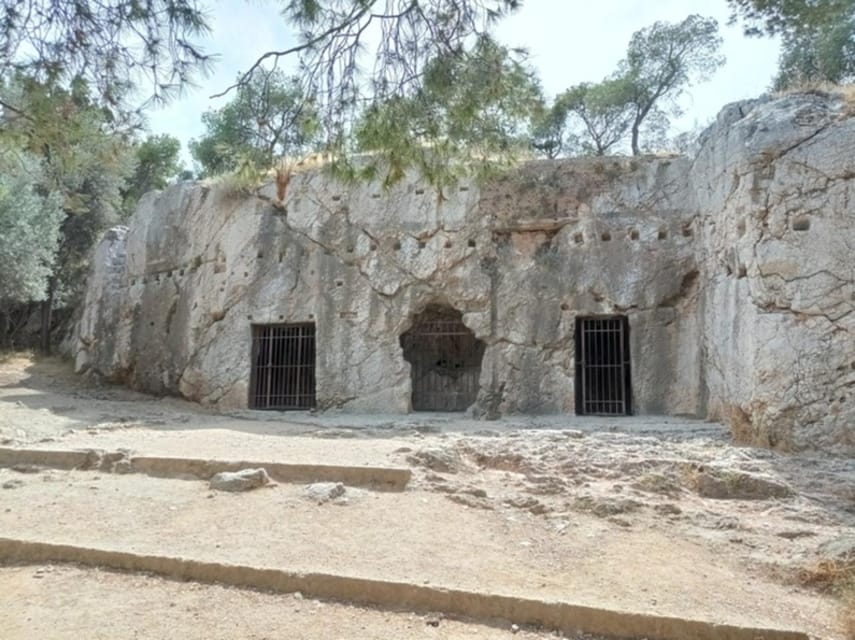
Socrates’ prison is one of the most emotionally charged points on the walk. The site is linked with the final chapter of his life, when his questioning and refusal to abandon his principles had brought him into conflict with the city.
The story is powerful because it joins philosophy with personal risk. Socrates did not treat ideas as decoration. His way of living, questioning, and teaching had consequences, and the tour uses that tension to show why his influence has lasted.
You should keep your expectations measured. The experience is about seeing the place and understanding its connection to Socrates, not about entering a fully preserved prison complex with a museum-style display. Its force comes from the setting, the story, and the guide’s ability to make the episode understandable.
This is also where the tour’s discussion format can work especially well. The guide may ask what you would do if your beliefs placed you in danger, or whether obedience to the law always equals justice. Those questions bring Socrates out of the past and make his story relevant without turning the stop into a solemn history lesson.
Several comments about this experience point to the guide’s use of questions and mental exercises. That style will suit you if you enjoy taking part. If you prefer to stand quietly while a guide speaks without interruption, you may find the approach more demanding.
The Pnyx, democracy, and the power of speech
The route continues toward the hill of Pnyx, a place associated with public speaking and the civic life of ancient Athens. This is an important part of the tour because it broadens the story beyond individual philosophers.
The Pnyx helps you consider the relationship between philosophy and democracy. In a city where public speech mattered, ideas were not merely private possessions. Arguments could influence decisions, reputations, and the direction of the community.
The hill also gives the tour a change of pace. After discussing Socrates and Plato, you can look at the city through the question of participation. Who gets heard? What makes a good argument? How should a society deal with disagreement?
The walk up to the Pnyx is one reason to wear sensible shoes. The tour description does not provide a precise distance or accessibility details, so you should not assume the route will suit every mobility level. If you have concerns, check with the provider before booking.
The reward is a stronger sense of how physical places shaped public life. You are not just hearing about democracy as a modern political term. You are standing in a setting used to discuss the responsibilities and risks of collective decision-making.
Gregory, Sunny, and the guide’s role
The guide makes or breaks a philosophy tour. Here, Gregory is repeatedly described as passionate, engaging, and flexible in his explanations. Sunny is also named as a friendly guide in one recent experience.
You should not assume Gregory will lead every departure, but his approach gives you a useful idea of the style to expect. He has explained philosophy in plain language, welcomed questions, adapted the discussion to the group, and offered suggestions about Athens beyond the tour’s main topic.
His strongest quality appears to be the ability to tell a story rather than recite information. That matters at places such as Socrates’ prison, where a list of dates would feel flat. Storytelling helps you follow the human conflict behind the ideas.
The guide may also tailor examples to the group. One account describes the discussion being adjusted to a participant’s interest in law and society. Another describes the guide using objects nearby and daily life examples to explain difficult concepts.
That flexibility is especially useful if your knowledge of philosophy is limited. You do not need to arrive with a working grasp of every school of thought. You can ask basic questions, and the format is designed to make room for them.
At the same time, the tour is not only for beginners. If you already know the main philosophers, you may appreciate the chance to discuss their ideas, compare schools of thought, and explore questions that a standard sightseeing tour would skip.
What the $34 price buys you
At $34 per person, this is a reasonably priced specialist tour. You are paying for a live official guide and 150 minutes of focused interpretation, not for food, drinks, entrance extras, or a full-day package.
The value depends on how you like to see Athens. If you want a quick photo stop at each famous monument, a general city tour may suit you better. If you want a clear theme and a guide who can connect sites to ideas, this price is attractive.
Two and a half hours is long enough to develop a real subject without consuming your entire day. You can pair it with an Acropolis visit, a museum, or an unplanned wander through central Athens. The tour gives you a framework, then leaves you time to explore on your own.
There is also value in visiting lesser-known places tied to the subject. The guide can show you sites you might not have found by following a standard sightseeing map. Just remember that the tour does not include personal expenses, food, or drinks.
You can reserve now and pay later, which helps if your Athens schedule is still changing. Free cancellation is available up to 24 hours before the activity for a full refund. Check the available starting times when booking, since the duration is fixed but the departure time may vary.
Who will enjoy this tour most
I would recommend this walk to you if you like culture with a human question at its center. It is a particularly good match for:
- First-time Athens visitors who want more context than monument names and dates
- People curious about Socrates, Plato, Aristotle, Pythagoras, or Greek schools of thought
- Students, teachers, and readers who want to connect philosophy with real places
- Couples looking for a thoughtful walk through central Athens
- Independent visitors who want ideas for understanding the city before exploring alone
- Beginners who may have found philosophy intimidating in the past
The tour is also suitable if you do not consider yourself a philosophy fan. The guide’s use of stories, humor, daily examples, and group questions can make the subject approachable.
I would think twice if you want a relaxed, vehicle-based tour or a short route with minimal walking. You should also avoid booking unless you can follow Spanish comfortably, since Spanish is the stated tour language.
Practical preparation for the 150-minute walk
Meet at Plato’s statue 10 minutes before the start. Leave enough time to locate the meeting point, since arriving late could make the group difficult to find once it moves off.
Wear comfortable shoes. The route includes outdoor sites, stone surfaces, and the Pnyx hill. Bring water, and remember that food and drinks are not supplied.
The experience is guided by an official tour guide. Personal expenses are not included, and no meal or refreshment stop is promised. You may want to eat beforehand, especially if you are taking the tour during the warmer part of the day.
Because the activity is outdoors and the information provided does not give an accessibility description, ask the provider about the route if stairs, uneven ground, or hills are a concern.
Should you book the Great Greek Philosophers tour?
Book it if you want Athens to raise questions as well as show you ruins. The strongest parts are the focused theme, the link between famous thinkers and actual places, and the guide-led discussion that makes the ideas easier to follow.
At $34, the tour offers good value for a specialist experience lasting 150 minutes. Gregory’s reported style, along with Sunny’s friendly approach, suggests a warm and flexible presentation, but the exact guide can vary.
Choose something else if you want a broad overview of all Athens sights, a museum-heavy visit, or a tour in English. For a Spanish-speaking visitor who enjoys stories, debate, and the connection between ancient ideas and modern life, this is a smart addition to an Athens itinerary.
FAQ
How much does the tour cost?
The tour costs $34 per person.
How long does the tour last?
The activity lasts 150 minutes, or two and a half hours.
What language is the tour conducted in?
The live tour guide speaks Spanish, and Spanish is the stated activity language.
Where is the meeting point?
You meet in front of the Statue of Plato.
How early should I arrive?
You should arrive at the Statue of Plato 10 minutes before the tour begins.
Which places are included in the route?
The highlights include the Statue of Plato, the Areopagus, and Socrates’ prison. The route also discusses the Greek Agora and the hill of Pnyx.
Are food and drinks included?
No. Food and drinks are not included, and personal expenses are also excluded.
What should I bring?
Bring comfortable shoes and water.
Can I cancel the booking?
Yes. You can cancel up to 24 hours in advance for a full refund. You can also reserve now and pay later.
Recently reviewed around Athens
- Small-Group Women History in Ancient Greece Walking Tour★ 5.0 · 38 reviews
- Ceramic and Pottery Creative Workshop with Two Local Artists★ 4.0 · 57 reviews
- Athens: Wine Workshop Create your Own Wine under the Acropolis★ 5.0 · 77 reviews
- Athens: Greek Wines Tasting with Sommelier and Acropolis Views★ 5.0 · 88 reviews
- Hydra Private Day Trip by Ferry from Athens with Transfers★ 4.0 · 30 reviews
- Small-Group Wine Tour in Athens with Tasting★ 5.0 · 33 reviews
- Wine Trails Private Tour/ Nemea visit 3 wineries from Athens or Nafplion (10 h)★ 5.0 · 44 reviews
- Private Athens Transfer Airport/Port -Greek Tours-Hourly service★ 5.0 · 88 reviews
Guided, compared.


Acropolis, Parthenon & Acropolis Museum Guided Tour
Read our review →

Cape Sounio & Poseidon Temple Trip with Audio Guide
Read our review →
Mythology of Delphi, Museum and Arachova Guided Tour
Read our review →Acropolis, Parthenon & Acropolis Museum Guided Tour
Read our review →