Reviewed · ATHENS TOURS
Biblical Tour Letters ToThe Corinthians St Paul’s Footsteps 6Hour
The most meaningful part of this six-hour journey is the link between places you have read about in the Bible and the actual ground beneath your feet. At Areopagus Hill, you look toward Athens from the rocky setting associated with Paul’s speech about the Unknown God. Later, in Corinth, the Bema and the ancient forum connect directly with his work and his letters to the Corinthians.
I like two things right away: door-to-door pickup from an Athens hotel, apartment, or cruise port, and the comfort of a private vehicle with air-conditioning, Wi-Fi, water, and luggage storage. I also like the human touch reported by guests, including guides such as Chris, Yiannis, Panos, and Alex, who explain the sites with stories and conversation rather than simply pointing out ruins.
The main consideration is pace. The advertised route includes many stops in about six hours and fifteen minutes, and several archaeological sites charge separate entrance fees. Your driver can explain the places outside the sites, but only a licensed guide may accompany you inside, so arrange one in advance if detailed on-site interpretation matters to you.
In This Review
- Key points to know before you book
- From Paul’s Athens speech to the road into Corinth
- Areopagus Hill and the speech about the Unknown God
- Daphni Monastery, a Byzantine pause near Athens
- Corinth Canal and the old problem of moving ships
- Isthmia and the games held beside the isthmus
- The Archaeological Museum of Isthmia
- Ancient Corinth and the Bema linked with Paul
- Kechreai and the harbor where Paul sailed
- The Temple of Apollo and the city’s older roots
- St. Paul’s Church in modern Corinth
- What the $170.50 price really covers
- Who will get the most from this tour
- Practical advice for a smoother day
- Should you book the Footsteps of Paul tour?
- FAQ
- How long does the tour last?
- Where can pickup and drop-off take place?
- Is this a private tour?
- What language is the tour offered in?
- Is a licensed guide included?
- Which entrance fees are extra?
- Are meals included?
- Are cruise passengers able to join?
- What happens if the weather is poor?
Key points to know before you book
- Paul’s Athens and Corinth in one day: Begin at Areopagus Hill, then follow the route toward the Corinthian sites tied to Acts and the letters to the Corinthians.
- Private transport from your door: Pickup and return are offered at Athens hotels, apartments, and the cruise port, with airport service available for an extra fee.
- A small-group feel: The tour is designed for an intimate party, with stated limits ranging from four to six people depending on the booking arrangement.
- The Corinth Canal adds useful context: You see the modern waterway while learning about the much older dream of cutting through the isthmus.
- Archaeology comes with extra costs: Ancient Corinth is listed at €15 per person and Isthmia at €5 per person, while the optional licensed guide costs €160 per booking.
- Strong guide service is central: Chris, Yiannis, Panos, Alex, Christos, and Yanni are praised for clear explanations, warm manners, patience, and careful timing.
From Paul’s Athens speech to the road into Corinth
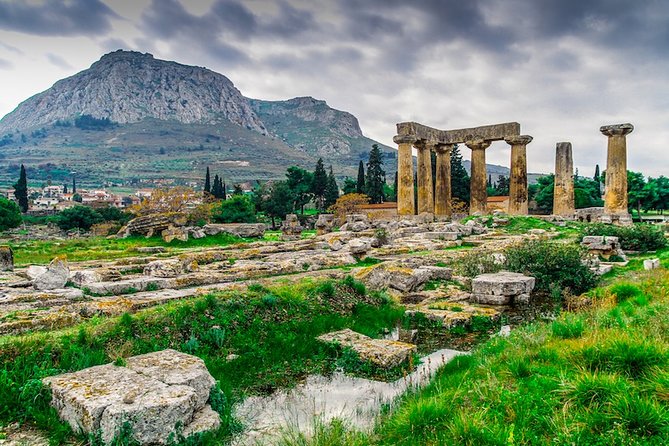
This is not just a drive to a famous ruin. It is a Bible-focused route through western Attica and Corinthia, built around the places connected with Paul’s missionary work.
You begin with pickup at your hotel, apartment, or ship. For a cruise passenger, that arrangement is especially useful. The operator plans the timing around your sailing and returns you to the port, which removes the worry of finding a taxi after a long day outside Athens. For a hotel pickup, the driver waits in the lobby. At an apartment, the meeting point is the building entrance.
The vehicle is a modern private minivan with air-conditioning, bottled water, and Wi-Fi. Luggage can remain in the vehicle during the outing, depending on how much you carry. That can help if you are moving between accommodations or finishing your Athens stay before a cruise.
The drive toward Corinth takes about an hour. This is where the driver’s role matters most. Guides such as Chris and Yannis have been praised for filling the ride with background on Paul, Greek history, local culture, and the places ahead. You can ask questions as you go, and the experience sounds more like an informed conversation than a recorded speech.
More Athens trips worth a second look
- Athens: Acropolis & up to 5 Archaeological Sites Combo Pass
★ 4.4 · 12,619 reviews - Athens: Acropolis Ticket with Optional Audio or Live Guide
★ 4.2 · 11,055 reviews - Athens: Acropolis, Parthenon & Acropolis Museum Guided Tour
★ 4.8 · 9,316 reviews
Areopagus Hill and the speech about the Unknown God
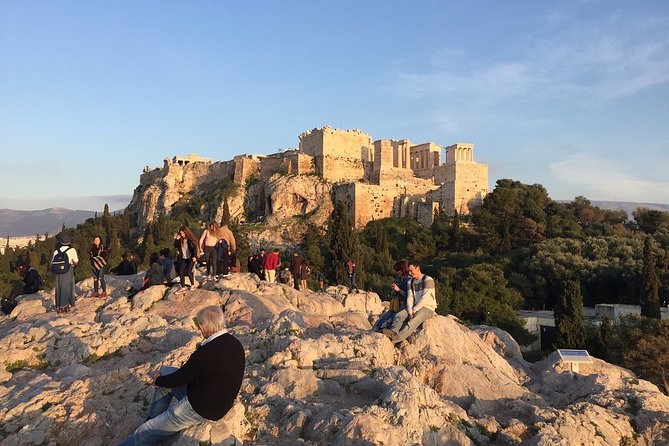
The first stop is Areopagus Hill, the rocky outcrop associated with Paul’s address to the Athenians in Acts 17. The visit is brief, about 15 minutes, but the setting gives the biblical story a physical anchor.
From here, you are near the Acropolis, and the contrast is part of the point. Paul spoke in a city filled with temples, images, and competing schools of thought. His message about the Unknown God addressed an audience deeply accustomed to religious debate.
Do not expect a long Acropolis visit as part of this tour. The planned stop focuses on Areopagus Hill. The rock is uneven, so wear shoes with a firm sole and take care on the climb. If your main goal is a full exploration of the Acropolis, schedule that separately.
Daphni Monastery, a Byzantine pause near Athens
Daphni Monastery offers a change of mood before the long ride west. Located on the slopes of Mount Aigaleo, the monastery occupies the site of an ancient sanctuary connected with Apollo. Its fortified walls and towers give the complex a defensive look, while the interior is known for Byzantine mosaics.
The monastery’s story crosses several periods. Cistercian monks used it during the Frankish era, and it later returned to Orthodox control after the Ottoman conquest. Earthquakes damaged the buildings, and restoration work continues to protect the mosaics and the wider complex.
The planned visit lasts about 20 minutes, so think of Daphni as a short historical and religious stop rather than a full monastery tour. The admission is included, which keeps this part of the day simple. It also broadens the experience beyond Paul and classical Greece by showing how sacred places in Greece were reused and reshaped over many centuries.
Corinth Canal and the old problem of moving ships
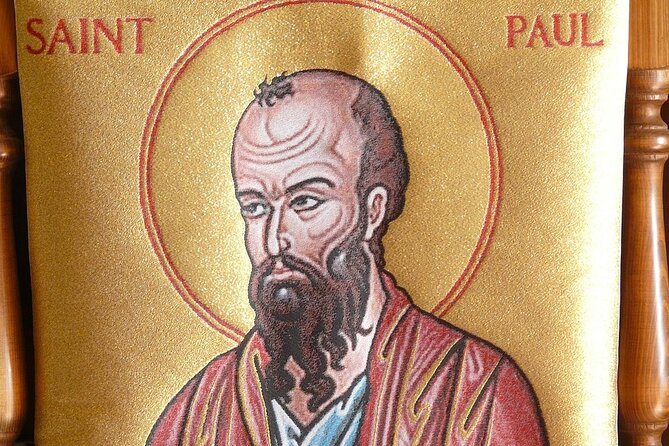
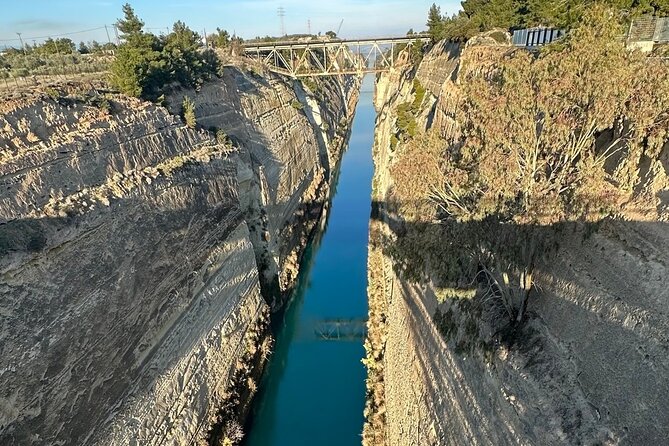
At the Corinth Canal, you pause for about 20 minutes to look into the cut that links the Saronic Gulf with the Gulf of Corinth. The canal separates the Greek mainland from the Peloponnese, creating the geographic effect of an island.
The present canal dates from the late 19th century, but the idea is far older. Periander, the ruler of Corinth in the 7th century BC, is said to have considered cutting through the isthmus. Since ancient engineers could not complete such a project, ships and cargo were moved across the land on the diolkos, a stone transport route.
This is a quick photo and explanation stop, not a boat trip. It works well because it explains why Corinth mattered. The city controlled a narrow land bridge between northern Greece and the Peloponnese, while the nearby ports helped connect sea routes. Once you see the geography, Corinth’s commercial and political importance becomes easier to understand.
A different kind of day out, same corner of Greece:
- Athens: Cape Sounion & Poseidon Temple Sunset Half-Day Trip
★ 4.8 · 8,241 reviews - Athens: Acropolis and Parthenon Guided Walking Tour
★ 4.6 · 5,882 reviews - All Day Cruise -3 Islands to Agistri,Moni, Aegina with lunch and drinks included
★ 5.0 · 4,958 reviews - Athens, Piraeus, and Coastline: Blue Hop-On Hop-Off Bus
★ 3.9 · 4,849 reviews
Isthmia and the games held beside the isthmus
The Isthmia area is one of the most interesting parts of the route for anyone who wants more than the usual Corinth stop. The Isthmian Games were among the most important athletic contests in the ancient Greek world, second only to the Olympic Games in status.
Paul’s connection here is especially appealing for Bible readers. He is traditionally associated with working as a tent maker in the Isthmian area, where athletes and visitors needed temporary accommodation. The location also helps explain the practical side of Paul’s work. He was not only preaching. He was earning a living and meeting people in a busy regional center.
You have about an hour in Isthmia, including the surrounding archaeological attractions. The admission fee for the archaeological site is listed separately at €5 per person. If you want to walk through the remains and understand the athletic complex, allow enough time for uneven ground and outdoor exposure.
The site includes the Temple of Poseidon, a stadium, a theater, and the Sanctuary of Palaimon. The Temple of Poseidon was first built around 690 to 650 BC, then rebuilt after fires and later Roman damage. The stadium preserves an unusual starting mechanism called the ysplex, a device that helped athletes begin races together.
The Sanctuary of Palaimon was devoted to the young Melikertes, also called Palaimon, who was linked with sailors. In Roman times, nighttime ceremonies and bull sacrifices took place here. The theater, built around 400 BC, hosted musical contests and adds another layer to the role of Isthmia as a festival center.
The Archaeological Museum of Isthmia
The small museum helps make sense of the scattered remains outside. Its displays include an Archaic marble pediment from the Temple of Poseidon, a mid-2nd-century BC imperial statue in the form of Zeus, commercial amphorae, weapons, votive offerings, and objects from Mycenaean and Roman cemeteries.
One unusual group of finds is the colored glass from Kechreai. These pieces arrived from Alexandria, Egypt, and were found submerged in the Temple of Isis at the harbor. Their scenes include ships, animals, plants, exotic views, philosophers, and geometric designs. It is a reminder that Corinth’s world reached well beyond mainland Greece.
The museum visit is scheduled for about 20 minutes, and admission is not included. That short time may be enough for a first look, but it will feel tight if you like to read every label. I would ask your driver how the day is running before deciding how long to linger.
Ancient Corinth and the Bema linked with Paul
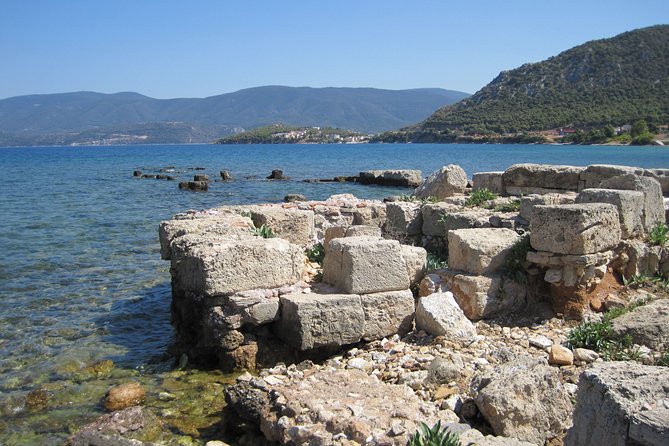
Ancient Corinth is the main event for most people on this tour. The city occupied the narrow isthmus between central Greece and the Peloponnese, roughly between Athens and Sparta. Its location helped make it one of Greece’s major commercial and political centers.
The city you see today reflects several chapters. Rome destroyed Corinth in 146 BC, then rebuilt it in 44 BC. Under Roman rule, it became the provincial capital of Greece. For Christians, the city is closely tied to Acts 18 and Paul’s First and Second Letters to the Corinthians.
The archaeological site includes the Roman forum and the Bema, the raised platform from which city officials addressed the public. Tradition identifies the Bema as the place where Paul was brought before Gallio, the Roman proconsul, after being accused of unlawful teaching.
Gallio refused to treat the matter as a criminal case, viewing it as an internal religious dispute. That small episode is important because it shows Paul operating within the legal and social world of the Roman Empire. The Bema gives the story a clear physical setting, even though the exact details of the ancient hearing remain a matter of historical interpretation.
Ancient Corinth has a listed entrance fee of €15 per person. Your English-speaking driver may explain the site from outside and provide context before you enter, but Greek law does not allow a driver to serve as a guide inside an archaeological site unless that person holds the proper license.
This distinction is easy to miss when booking. If you want detailed explanations beside the monuments, request the optional licensed guide. The listed price is €160 per booking, subject to availability. For a small group, that cost may be reasonable. For one or two people, it changes the overall price considerably.
The best feature of the arrangement is flexibility. Your driver can point out what deserves attention, then allow you to explore at your own speed. Several guests describe guides waiting patiently, adding a stop when time allowed, and helping with practical needs such as umbrellas and rain protection. Do not assume every extra stop is guaranteed, but the service is clearly designed to adapt.
Kechreai and the harbor where Paul sailed
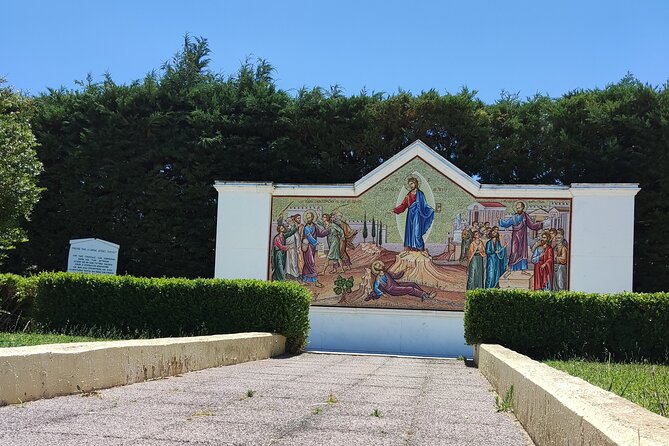
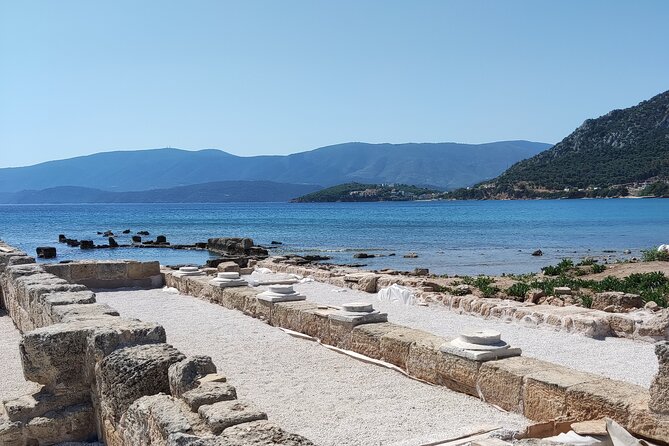
Kechreai, also spelled Cenchreae, was Corinth’s eastern port on the Saronic Gulf. Today, the visit lasts about 30 minutes and admission is free.
The biblical link comes from Acts 18. Paul stopped at Cenchreae during his second missionary journey and had his hair cut after making a vow. In Romans, Paul also mentions Phoebe, associated with the Christian assembly at Cenchreae.
This stop has a different feel from Ancient Corinth. Instead of a large urban forum, you are thinking about ships, harbor traffic, departures, and the movement of people around the eastern Mediterranean. The remains may be less visually dramatic than the main Corinth site, but the setting makes Paul’s journeys feel practical and maritime rather than abstract.
The shoreline can be exposed, so bring sun protection and water even though bottled water is supplied. Your driver’s explanation is useful here because the surviving remains do not always tell the full story on their own.
The Temple of Apollo and the city’s older roots
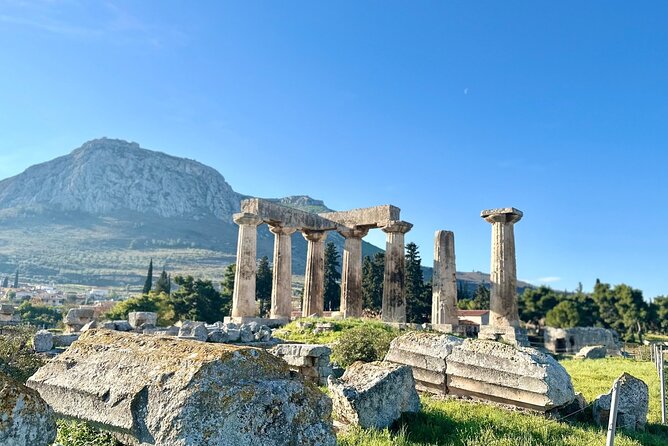
The Temple of Apollo in Ancient Corinth receives a short 10-minute stop. Its construction dates to about 550 BC, and its monolithic Doric columns make it one of the earliest temples of its type in the Peloponnese and mainland Greece.
The temple helps you look past the Roman Corinth associated with Paul. Corinth was already an important Greek city centuries before the Roman rebuilding. The surviving columns are a compact lesson in how the city’s religious and civic identity changed over time.
Because the stop is short, you will not have much room for a slow study of the architecture. It works best when paired with the longer Ancient Corinth visit, where the Temple of Apollo helps frame the broader site.
St. Paul’s Church in modern Corinth
The final listed stop is the Church of St. Paul in Corinth, visited for about 20 minutes. Paul spent roughly a year and a half in Corinth around AD 51 and 52 and founded the local metropolitan church.
This is a useful closing stop because it brings the story into the modern city. After temples, stadiums, forums, and harbor remains, you finish with a living Christian place connected by name and tradition to Paul’s work.
The tour then returns you to your chosen drop-off point. For a cruise passenger, the return timing is the key practical benefit. If traffic or parking forces a change, one stop may need to be shortened or skipped, so tell the operator your ship’s departure time before setting out.
What the $170.50 price really covers
At $170.50 per person, this is not the cheapest way to reach Corinth. It is priced as private or semi-private transport, not as a basic bus excursion.
The value comes from having pickup and return arranged, avoiding a rental car, and seeing several sites in one day. Air-conditioning matters in the Greek heat, and Wi-Fi, water, and luggage storage are small but useful additions. A group of four or six can also spread the vehicle cost across more people.
Budget separately for the €15 Ancient Corinth entrance fee and the €5 Isthmia entrance fee. Meals are not included, although lunch stops are scheduled. Airport pickup costs an additional €60 per booking, and tips are optional.
The licensed guide is the biggest possible extra. Add €160 if you want formal interpretation inside the archaeological sites. For someone who already reads widely and mainly wants transport plus biblical context, the driver’s commentary may be enough. For a first visit to Corinth, or for anyone who wants to understand inscriptions, buildings, and excavation details, the licensed guide is worth considering.
Who will get the most from this tour
I would choose this tour if you care about Paul, Acts, the Corinthian letters, or the meeting point between biblical stories and Greek archaeology. It also suits first-time visitors who want to get beyond Athens without handling a long-distance drive.
It is a good fit for cruise passengers because pickup and return are built around the port. It also works for families or small groups who prefer their own vehicle and a flexible pace. The warm, conversational approach described by guests is useful if you enjoy asking questions instead of listening quietly all day.
I would hesitate if you want a slow archaeological study. The schedule is full, some visits last only 10 or 20 minutes, and the driver cannot guide you inside the sites without a licensed qualification. Someone focused mainly on the Acropolis should book a dedicated Athens tour instead.
The exact group-size information should also be confirmed before payment. The experience is described as private, with intimate groups of two to four, while other details mention a maximum of six and a minivan that can hold up to eight. That may reflect different vehicle or booking arrangements.
Practical advice for a smoother day
Wear sturdy walking shoes. Ancient sites have uneven surfaces, and the route includes outdoor ruins, a hill, and exposed areas near the canal and harbor.
Bring sun protection and a light layer. An umbrella may be available, and water is supplied, but weather can still affect the schedule. The tour requires good weather, with a different date or full refund offered if poor conditions cause cancellation.
Give the operator your exact pickup details. Hotel guests meet in the lobby, apartment pickups take place at the building entrance, and port pickups happen at the gate with a sign bearing your name. For a ship excursion, share the sailing time clearly and leave a sensible margin for the return.
Free cancellation is available up to 24 hours before the start time. Changes or cancellations inside that window are not refunded, and all cutoffs use local Greek time.
Should you book the Footsteps of Paul tour?
Book it if you want an efficient, personal route from Athens to Corinth and care about the biblical connections. The strongest parts are the easy pickup, private vehicle, flexible conversation, and the chance to connect Paul’s speech, work, trial, ports, and churches with real places.
Before booking, budget the entrance fees and decide if you want the €160 licensed guide. If you do, request it early. With that detail settled, this is a practical way to reach Corinth without renting a car, and a meaningful choice for anyone who wants the New Testament brought into its Greek setting.
FAQ
How long does the tour last?
The advertised duration is approximately 6 hours and 15 minutes.
Where can pickup and drop-off take place?
Pickup and return are offered at an Athens hotel, Airbnb apartment, or cruise port. Airport pickup is available for an additional €60 per booking.
Is this a private tour?
Yes. Only your group participates. The experience is described as an intimate small-group tour, with group details listed as two to four people and a maximum of two to six depending on the arrangement.
What language is the tour offered in?
The tour is offered in English and uses an English-speaking driver.
Is a licensed guide included?
No. The driver provides historical and biblical information but cannot guide guests inside archaeological sites unless officially licensed. A licensed guide can be arranged upon request for €160 per booking, subject to availability.
Which entrance fees are extra?
Ancient Corinth costs €15 per person, and the Archaeological Site of Isthmia costs €5 per person. The Daphni Monastery visit is listed with admission included.
Are meals included?
No. Lunch stops are scheduled, but the cost of food is not included.
Are cruise passengers able to join?
Yes. The tour is designed for cruise passengers, with pickup at the port and return arranged to help you reach your ship on time.
What happens if the weather is poor?
The experience requires good weather. If it is canceled because of poor weather, you are offered another date or a full refund. You can also cancel up to 24 hours before the start time for a full refund.
Recently reviewed around Athens
- Small-Group Women History in Ancient Greece Walking Tour★ 5.0 · 38 reviews
- Ceramic and Pottery Creative Workshop with Two Local Artists★ 4.0 · 57 reviews
- Athens: Wine Workshop Create your Own Wine under the Acropolis★ 5.0 · 77 reviews
- Athens: Greek Wines Tasting with Sommelier and Acropolis Views★ 5.0 · 88 reviews
- Hydra Private Day Trip by Ferry from Athens with Transfers★ 4.0 · 30 reviews
- Small-Group Wine Tour in Athens with Tasting★ 5.0 · 33 reviews
- Wine Trails Private Tour/ Nemea visit 3 wineries from Athens or Nafplion (10 h)★ 5.0 · 44 reviews
- Private Athens Transfer Airport/Port -Greek Tours-Hourly service★ 5.0 · 88 reviews
Athens Tours, compared.
Acropolis & up to 5 Archaeological Sites Combo Pass
Read our review →
Acropolis, Parthenon & Acropolis Museum Guided Tour
Read our review →
Cape Sounion & Poseidon Temple Sunset Half-Day Trip
Read our review →
All Day Cruise -3 Islands to Agistri,Moni, Aegina with lunch and drinks included
Read our review →