
Reviewed · MUSEUMS
Megalochori: Lost Atlantis 9D Experience Museum Entry Ticket
Santorini’s Lost Atlantis Museum turns a famous Greek mystery into a hands-on hour of history, technology, and theatrical effects. You’ll question an animated Plato, inspect the world’s largest Atlantis diorama, and watch Santorini’s geological past unfold in holographic form.
I like the clear connection between the Atlantis story and the Minoan settlement at Akrotiri. I also like the lively 9D eruption show, with simulated wind, water, bubbles, smoke, and ash. The main drawback is size: the museum is compact, and you may see everything in 45 minutes rather than a full hour.
In This Review
- Key points
- Atlantis in Santorini: Myth Meets Minoan History
- Plato’s Journey and the Interactive Fresco
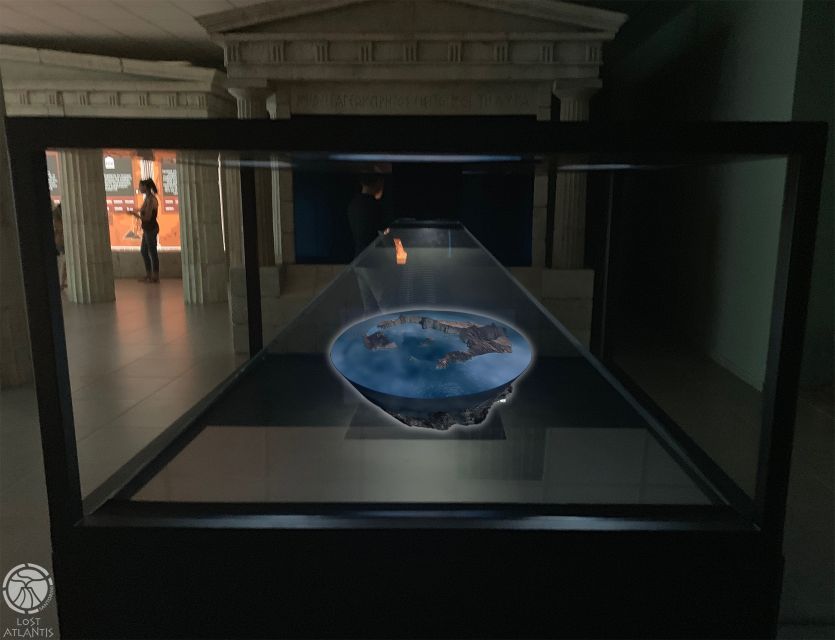
- The Largest Atlantis Diorama
- Virtual Windows Into Daily Life
- Santorini’s Geological Story in Hologram Form
- The 9D Atlantis Destruction Experience
- Dressing Up as an Atlantean
- One Hour in Megalochori
- Is $16 a Fair Price?
- Who Should Visit the Lost Atlantis Museum?
- Should You Book It?
- FAQ
- How long does the Lost Atlantis Museum visit take?
- Where is the Lost Atlantis Museum located?
- Is the museum close to a bus stop?
- What languages are available at the exhibits?
- Is the experience wheelchair accessible?
- Is hotel pickup included?
- Can I cancel my booking?
Key points
- The 9D show brings the disaster to your seat: Feel simulated earthquake movement, wind, water sprays, bubbles, smoke, and ash during the Atlantis destruction sequence.
- Plato becomes an animated guide: Ask him about his philosophy and the idea that Santorini inspired the Atlantis myth.
- A giant Atlantis model rewards close looking: The detailed diorama gives you a visual sense of the city and its daily life.
- Augmented reality adds a playful history lesson: Virtual windows let you look into scenes from everyday life in Atlantis.
- It works well before Akrotiri: The museum gives you a lively introduction to the Minoan world before you visit the archaeological site.
Atlantis in Santorini: Myth Meets Minoan History
The museum’s central idea is simple: Plato’s Atlantis may have been inspired by the volcanic destruction of Santorini, known in ancient times as Thera. The theory is not presented as settled fact. Instead, the exhibits show you the clues that connect Plato’s story with the island’s enormous eruption and the Minoan settlement at Akrotiri.
That distinction matters. You are not visiting a confirmed lost city. You are exploring a fascinating possibility, one built from geography, archaeology, volcanic evidence, and Plato’s written account. The experience works best when you treat Atlantis as a historical puzzle rather than a proven location.
Interactive videos explain the basic case. They help you see why Santorini is part of the discussion: the island has a dramatic volcanic past, and Akrotiri preserves evidence of a sophisticated Bronze Age community that was destroyed and buried by volcanic material.
I would visit this museum before the Akrotiri archaeological site if your schedule allows. The museum supplies the story and the visual drama first. Akrotiri can then give you a more grounded look at the buildings, streets, and objects left behind by the Minoan settlement.
More Santorini museums and collections:
- Athens: Acropolis, Parthenon & Acropolis Museum Guided Tour
★ 4.8 · 9,316 reviews - Athens: Mythology of Delphi, Museum and Arachova Guided Tour
★ 4.6 · 4,008 reviews - Athens: Acropolis, Parthenon & Acropolis Museum Guided Tour
★ 4.8 · 3,579 reviews
Plato’s Journey and the Interactive Fresco
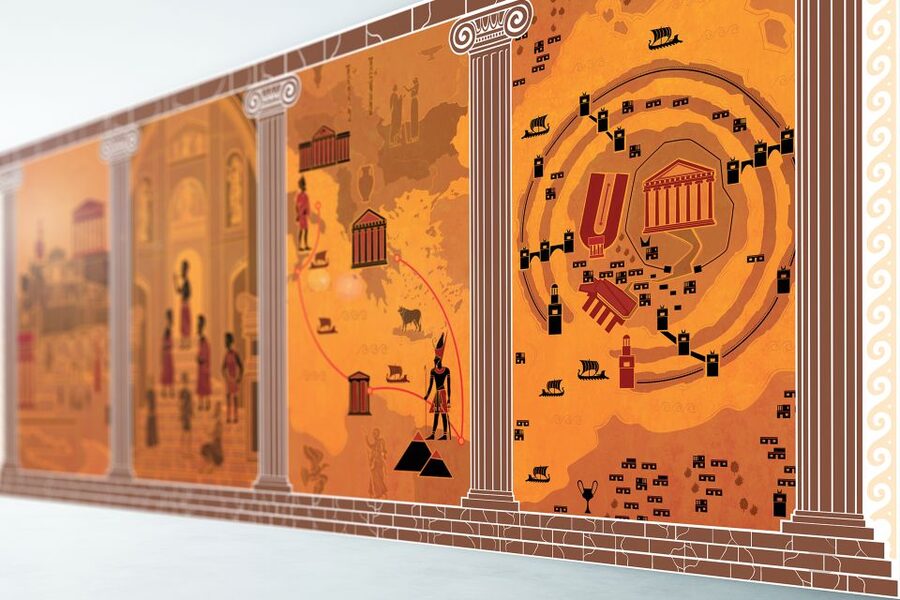
One of the more unusual sections follows Plato’s journey and the ideas that led him to write about an ideal city. An interactive fresco presents this part of the story in a way that is easier to follow than a standard wall of text.
The exhibit does not simply present Plato as a name from a school textbook. It places his philosophy inside the Atlantis question, then lets you consider how much of his account may have been political teaching, moral storytelling, or a memory of a real disaster.
An animated hologram of Plato takes the idea a step further. You can ask him questions about his philosophy and about the theory that Santorini may be the source of the Atlantis myth. It is a clever feature for children and a useful way for adults to pause over the difference between legend and evidence.
The museum lists exhibits in Greek, English, French, German, Italian, Spanish, Turkish, and Chinese. The hosts and greeters speak Greek and English, and guides are available at the exhibits to explain the interactive panels and help you follow the intended order.
The Largest Atlantis Diorama
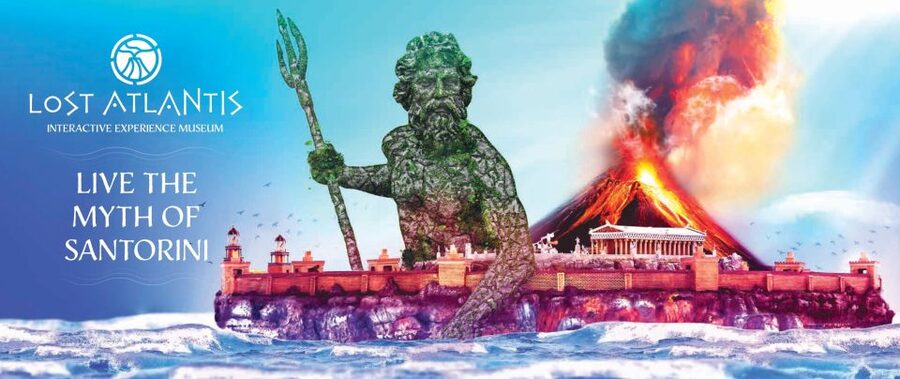
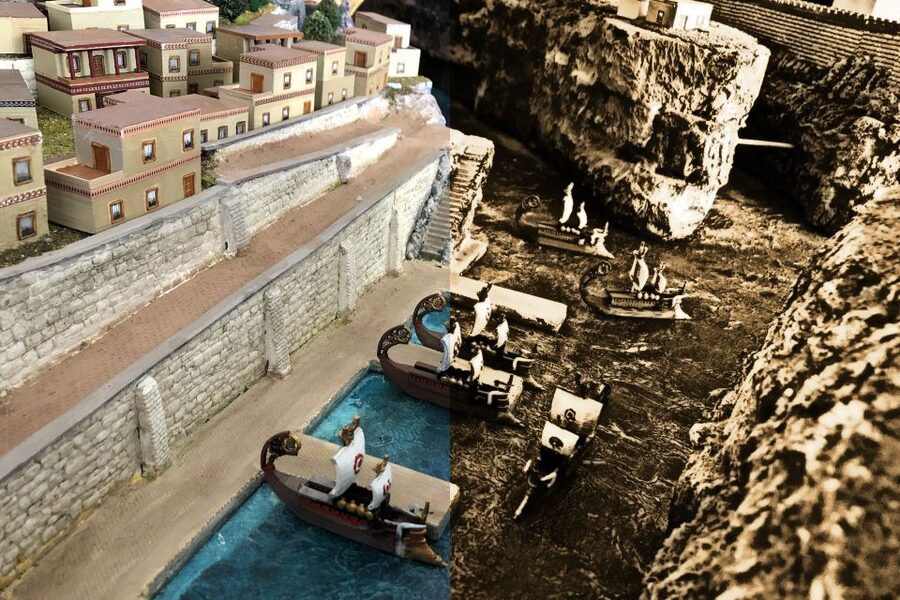
The large Atlantis model is the museum’s main visual anchor. A detailed diorama gives you a sense of the city as a place where people lived, worked, and went about ordinary business before disaster arrived.
A model cannot prove that Atlantis existed, of course. Its value is more practical: it turns an abstract myth into something you can inspect from several angles. You can study the layout, imagine the scale of the city, and better understand what the museum means when it describes Atlantis as an ideal settlement.
Look closely rather than rushing past. The diorama is one of the exhibits that gives the museum substance beyond its special effects. It also helps younger visitors connect the story with physical details instead of trying to remember a long explanation.
The compact setting has a tradeoff. The model is interesting, but the museum is not a vast exhibition hall with dozens of rooms. If you expect a major archaeological museum, you may find the interior small. If you want a focused introduction to one story, the size keeps the visit manageable.
Virtual Windows Into Daily Life
The augmented reality section lets you look through virtual windows into everyday life in Atlantis. This is a smart choice because disasters and legends can feel distant. Seeing ordinary routines gives the story a human scale before the earthquake and eruption take over.
The effect is particularly useful for families. Children aged eight and eleven have found the interactive format more engaging than a conventional history display, and solo visitors can move through the panels at their own pace.
You will not spend hours here. The attraction is designed as a short, guided experience, with staff helping you understand how the panels work and where to go next. That guidance is helpful if you are not used to museum technology or if you arrive with children who want to try every feature at once.
The augmented reality does not replace the archaeological evidence from Akrotiri. Think of it as a bridge between a Bronze Age settlement and the larger Atlantis story. It gives you a feel for the people behind the myth, then prepares you for the destruction sequence.
More Santorini trips worth a second look
- Santorini Classic Catamaran Cruise with BBQ, Drinks and Transfers
★ 5.0 · 3,933 reviews - Half-Day Exclusive Catamaran Cruise in Santorini with Meal and Open Bar
★ 5.0 · 2,975 reviews - Santorini Gold Catamaran Cruise with Snorkel, BBQ & Open Bar
★ 4.8 · 2,822 reviews - Private Santorini Tailor Made – Choice of the Guest!
★ 5.0 · 1,972 reviews
Santorini’s Geological Story in Hologram Form
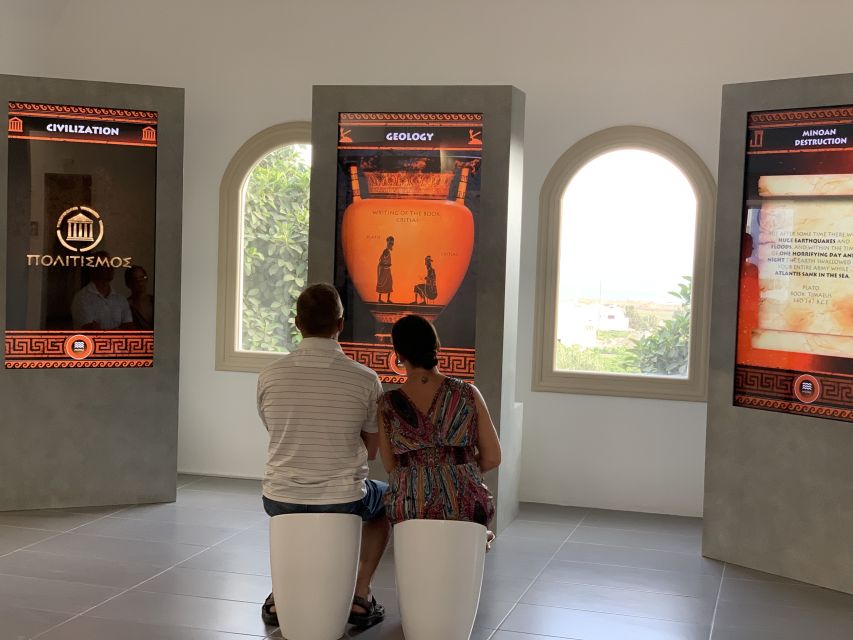
A holographic display shows the geological evolution of Santorini from prehistoric times to the present. This section gives important context for the Atlantis theory because the island’s shape and volcanic character are not fixed features. They are the result of repeated geological change.
The display is useful if you want to understand why the eruption matters. Santorini is not just a scenic island with white villages and blue roofs. Its past includes volcanic activity powerful enough to reshape the island and affect settlements across the Aegean.
The hologram also helps place Akrotiri in time. You can see the island’s story as a long process rather than one isolated event. That makes the later earthquake, tsunami, and eruption sequence easier to understand.
This is still a museum built for a general audience, not a specialist geology lecture. The information is presented through images, motion, and short explanations, so you get a broad picture rather than a detailed scientific study.
The 9D Atlantis Destruction Experience
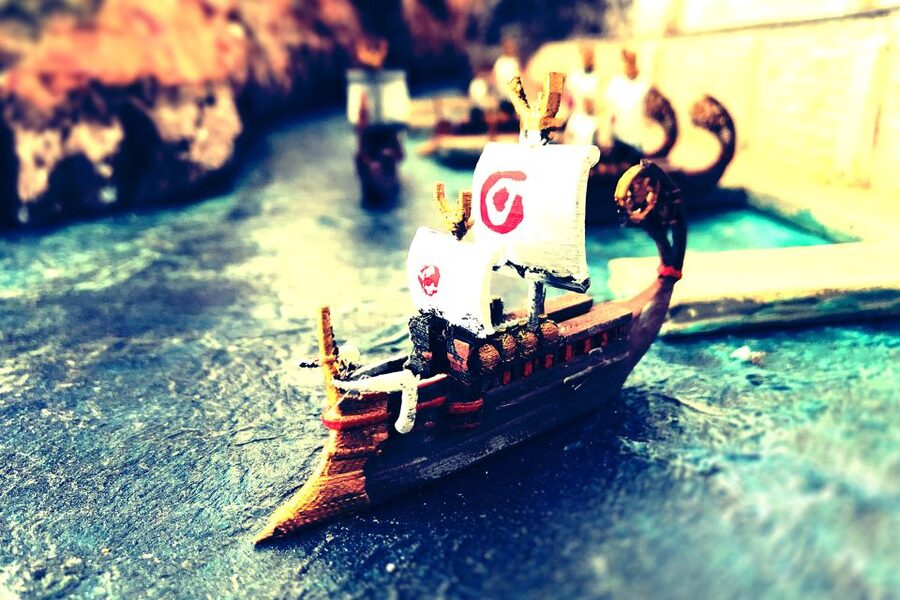
The 9D cinema is the part most likely to decide how much you enjoy the visit. The short film recreates the disaster that destroyed Atlantis, combining moving images with physical effects. Expect simulated shaking, wind, water sprays, bubbles, smoke, and ash.
The aim is not quiet reflection. It is theatrical, noisy, and designed to make you feel present during the earthquake, tsunami, and eruption. You may also walk on simulated lava inside an active volcano as part of the experience.
Calling it 9D is attraction language rather than a scientific category, but the effects give the film more force than a normal cinema presentation. The water, air, smoke, and motion make the story memorable, especially for children and anyone who enjoys rides and special effects.
There is a practical point here: this is not the best part for someone who dislikes simulated motion or sensory effects. The supplied information does not give specific restrictions for the film, so ask the staff if you have concerns before entering. Wheelchair access is available for the attraction as a whole.
The film is short, which keeps the experience from becoming tiring. It also means you should not book the museum expecting a full half-day attraction. The full visit is listed as one hour, and some people finish in about 45 minutes.
Dressing Up as an Atlantean
A smaller playful feature lets you dress up as a citizen of Atlantis and take pictures. This may sound light compared with the volcano story, but it gives families and friends a chance to break up the information-heavy sections.
It also fits the museum’s general approach. You are not only reading about an ancient society. You are using images, sound, virtual scenes, costumes, and physical effects to build a picture of the place.
I would treat this as an optional extra rather than a main reason to buy the ticket. The strongest parts are the 9D film, the diorama, and the interactive explanations. The costume area works best when you have a little time and want a personal souvenir from the visit.
One Hour in Megalochori
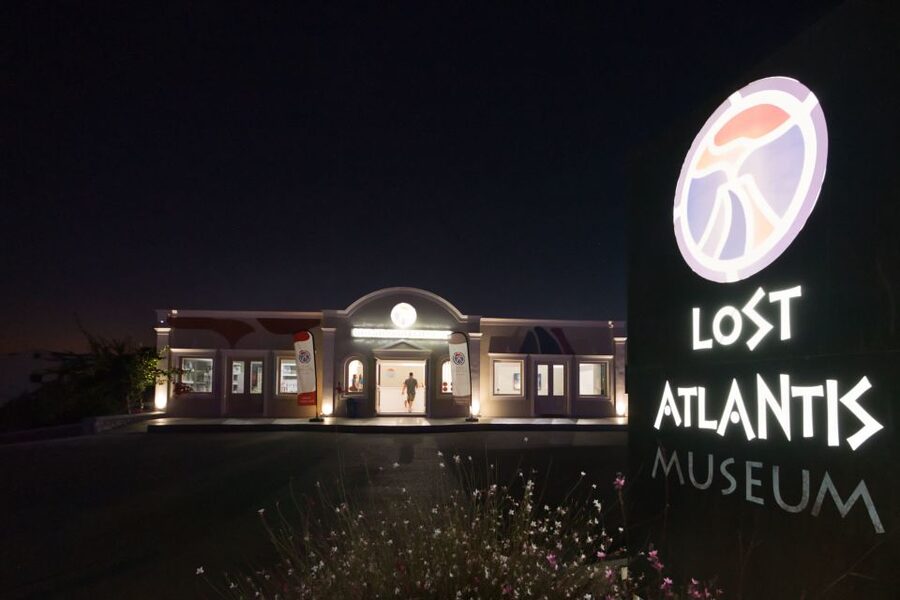
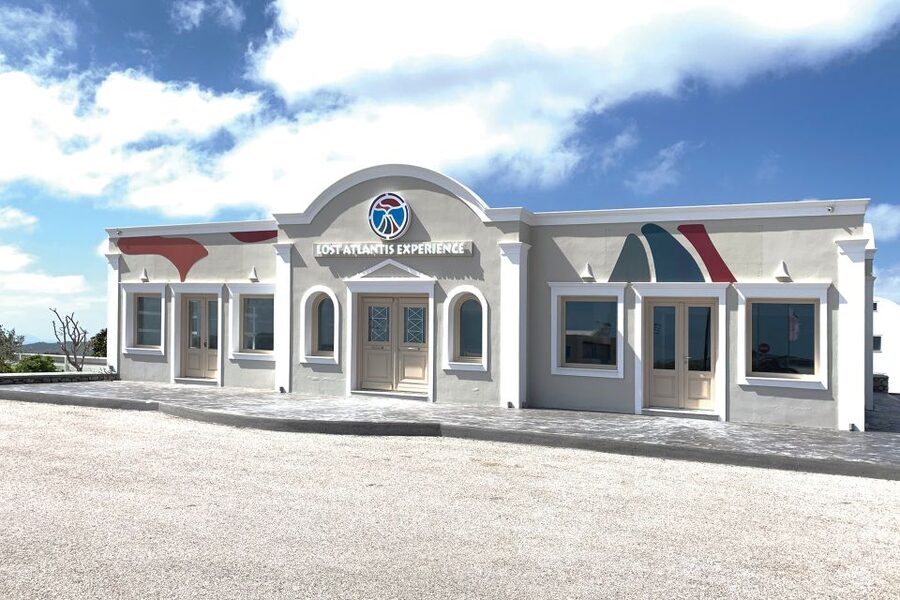
The museum is at Lost Atlantis, Epar.Od. Firon-Ormou Perissis, opposite the large Denaxas supermarket in Megalochori. The local bus stop is about 100 yards away, and staff can give you advice about the next bus.
No hotel pickup or drop-off is included, so you need to make your own way there. Food and drinks are also not included. That is not a serious problem for a one-hour attraction, but you should plan it as one stop in a wider day around southern Santorini.
The visit has a natural flow: begin with the explanation of Plato and the Atlantis theory, move through the diorama and virtual windows, view the geological hologram, then finish with the 9D destruction sequence. Guides are present at all exhibits, which helps you get more from the technology instead of guessing what each screen does.
The museum is wheelchair accessible. Pets and oversized luggage are not allowed. These rules are worth noting if you are visiting directly from a ferry, airport transfer, or a day of sightseeing with large bags.
Is $16 a Fair Price?
At $16 per person, the ticket is reasonably priced for a short attraction with several interactive stations and a special-effects film. I would judge the value by the type of experience you want.
For a family, the price buys an hour of activity that mixes education with fun. Children are more likely to remember an earthquake they felt through a seat, or a virtual window they operated themselves, than a long explanation of volcanic geology.
For an adult mainly interested in archaeology, the value is more limited. The museum does not replace Akrotiri, a proper archaeological visit, or a detailed study of Minoan civilization. It works as an introduction and a way to make the Atlantis theory easier to picture.
The price feels strongest when you combine it with a visit to Akrotiri. Go here first, then visit the ruins with a clearer idea of the volcanic event, the Minoan setting, and the reasons Santorini enters the Atlantis debate.
You can reserve now and pay later, and cancellation is free up to 24 hours before the visit for a full refund. Starting times vary, so check availability when you choose your date.
Who Should Visit the Lost Atlantis Museum?
I would recommend it most strongly to families, first-time visitors to Santorini, and anyone with a spare hour near Megalochori or Akrotiri. The interactive design gives children something to do while adults consider the history and mythology.
It also suits visitors who want a break from viewpoints, churches, and outdoor sightseeing. Santorini can be hot, windy, or crowded at popular sites, while this is a short indoor stop with guides at each exhibit.
You may enjoy it less if you want a serious archaeological museum with original objects and lengthy academic displays. The attraction is built around storytelling, animation, models, and effects. It asks you to enjoy the question of Atlantis, not settle it.
The eight-language exhibit support makes the visit accessible to an international audience. English and Greek-speaking hosts are available, while the displays also cover French, German, Italian, Spanish, Turkish, and Chinese.
Should You Book It?
Book it if you are visiting Akrotiri, have children with you, or enjoy history presented through models, holograms, and special effects. The 9D film is the main draw, while the Plato hologram, geological display, and Atlantis diorama give the hour enough substance to feel worthwhile.
Skip it if your Santorini schedule is packed with archaeological sites and you prefer original ruins to theatrical interpretation. Otherwise, $16 is a fair price for a compact, lively introduction to the island’s volcanic past and the enduring Atlantis mystery.
FAQ
How long does the Lost Atlantis Museum visit take?
The stated duration is one hour. You may finish in about 45 minutes if you move quickly through the exhibits.
Where is the Lost Atlantis Museum located?
It is at Epar.Od. Firon-Ormou Perissis in Santorini, opposite the large Denaxas supermarket.
Is the museum close to a bus stop?
Yes. A local bus stop is about 100 yards from the museum, and staff can advise you about the next bus.
What languages are available at the exhibits?
The exhibits are available in Greek, English, French, German, Italian, Spanish, Turkish, and Chinese. Hosts or greeters speak English and Greek.
Is the experience wheelchair accessible?
Yes, the activity is wheelchair accessible.
Is hotel pickup included?
No. Pickup and drop-off at your accommodation are not included, so you must arrange your own transportation.
Can I cancel my booking?
Yes. You can cancel up to 24 hours in advance for a full refund. You can also reserve now and pay later.
Recently reviewed around Santorini
- Small-Group Tour: Best of Santorini★ 4.7 · 42 reviews
- Santorini: Private Sightseeing Tour with Local Guide★ 4.9 · 105 reviews
- Santorini: Wine Tour with Sunset in Oia★ 4.6 · 199 reviews
- Santorini: Tour of Wineries with Wine Tasting & Food★ 5.0 · 279 reviews
- From Santorini: Volcano Cruise With Oia Sunset★ 4.3 · 97 reviews
- Santorini Wine Roads: Tour of 3 Wineries with a Sommelier★ 4.8 · 79 reviews
- Santorini Volcano, Hot Springs Adventure★ 3.6 · 54 reviews
- Santorini: Small-Group Highlights Tour of Venetian Castles★ 4.9 · 83 reviews
Museums, compared.
Acropolis, Parthenon & Acropolis Museum Guided Tour
Read our review →
Mythology of Delphi, Museum and Arachova Guided Tour
Read our review →Acropolis, Parthenon & Acropolis Museum Guided Tour
Read our review →
Acropolis monuments & Parthenon Walking Tour with Optional Acropolis Museum
Read our review →
Athens All Included: Acropolis and Museum Guided Tour with Ticket
Read our review →
Acropolis Museum Ticket with optional Audio Guide
Read our review →
Small-Group Delphi, Museum & Arachova Day Trip
Read our review →
Parthenon & Acropolis Museum with Audio or Live Tour Option
Read our review →Browse the lists this tour appears in