Reviewed · ATHENS TOURS
Mythology, Philosophy and Democracy Tour
Athens becomes far more legible when you connect its stones to its ideas. This walk follows that path, from mythology and early thought to science, public debate, and democracy, ending on Philopappos Hill with the Acropolis in view.
I like the focus on Kerameikos and the Pnyx, two important places that are easy to miss if you only follow the main sightseeing route. I also like Panos’s teaching style: thoughtful, witty, and willing to connect ancient problems with modern life.
The main consideration is the walking. The route includes hills and exposed outdoor stops, and one review notes that strong summer heat made the tour harder. Wear good shoes, carry water, and consider an evening departure if available.
In This Review
- Key points to know before you book
- A walking lesson in how Athens learned to think
- Kerameikos: pottery, graves, and Pericles’ speech
- The Ancient Agora and the business of public life
- Monastiraki to the Roman Agora
- The Tower of the Winds, an ancient weather station
- Hadrian’s Library and Plaka’s narrow streets
- Pnyx Hill, where public speaking mattered
- Philopappos Hill and the Acropolis finale
- How the three-hour format works
- Heat, hills, and the best time to walk
- Who will get the most from this Athens tour
- Is $50.69 good value?
- Should you book the Mythology, Philosophy and Democracy Tour?
- FAQ
- Where does the tour begin?
- Where does the tour end?
- How long does the tour last?
- What language is the tour offered in?
- How much does the tour cost?
- How many people can join?
- Are admission tickets included?
- Is the tour suitable for most people?
- Is the tour available in poor weather?
- What is the cancellation policy?
Key points to know before you book
- Ideas come first: This is not just a monuments tour. It explains how mythology, philosophy, mathematics, politics, and democracy influenced one another.
- Kerameikos is a major early stop: You visit an old cemetery and pottery district, along with the place linked to Pericles’ famous funeral speech.
- The Pnyx gives the tour its political heart: This hill is presented as the world’s first parliament and offers wide views across Athens.
- Panos leads the walk: His style mixes historical detail, humor, questions, and links between ancient thought and present-day life.
- The group is limited to 12: That makes discussion easier than on a large city tour.
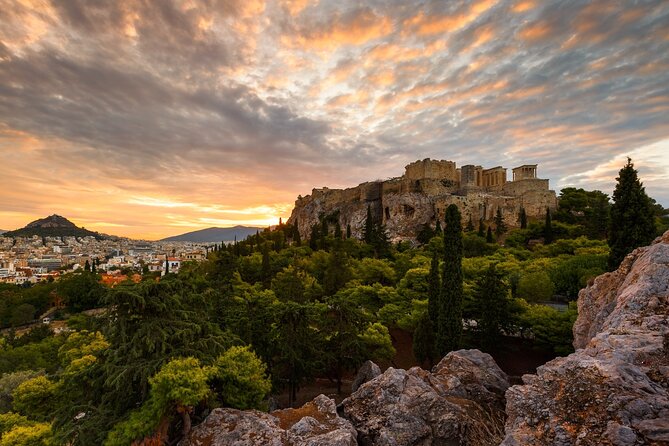
- The finish is scenic: Philopappos Hill offers some of the best views of the Acropolis, including after dark.
A walking lesson in how Athens learned to think
At $50.69 per person, this tour is priced like a modest city walk, but its value depends on what you want from Athens. If you only need dates, names, and quick explanations at famous ruins, a standard orientation walk may be enough.
If you want a connected story, this is a stronger buy. The tour treats Athens as a place where old beliefs slowly met questioning minds. You move through cemeteries, public squares, Roman buildings, neighborhoods, and hills while Panos explains how the city’s ideas developed.
That approach gives the walk a clear purpose. The Acropolis is famous because of its buildings, but this tour asks what kind of society produced them, how citizens argued about public life, and why Greek thought still shapes politics and education.
Panos is the central part of that experience. He is described as witty, warm, and highly informed, but the useful point for you is how he delivers the material. He tells stories rather than reading out a list of facts, and he adapts the conversation to the group’s interests.
That helps with a subject that could sound dry on paper. You may hear about mythology, mathematics, religion, philosophy, and war in the same walk, but the themes are tied together instead of treated as separate school lessons.
More Athens trips worth a second look
- Athens: Acropolis & up to 5 Archaeological Sites Combo Pass
★ 4.4 · 12,619 reviews - Athens: Acropolis Ticket with Optional Audio or Live Guide
★ 4.2 · 11,055 reviews - Athens: Acropolis, Parthenon & Acropolis Museum Guided Tour
★ 4.8 · 9,316 reviews
Kerameikos: pottery, graves, and Pericles’ speech
The tour begins at the Statue of Theseus and moves toward Kerameikos, an area many people pass over while racing to the Acropolis. That is a shame. Kerameikos was both a pottery district and the cemetery of Athens for many centuries.
The name comes from keramos, meaning ceramic. Workshops once operated here, while important Athenians were buried nearby. That combination gives the first stop a useful sense of daily life and public memory. Athens was not only temples and philosophers. It was also a working city with craftspeople, families, funerals, and political ceremony.
The stop takes about 25 minutes and has no admission charge listed. You should expect an outdoor explanation rather than a long museum visit. Panos uses the setting to discuss prominent Athenians and the place associated with Pericles’ funeral speech, known as the Epitaphios.
Pericles gave the speech for the first Athenian casualties of the Peloponnesian War. Its importance here is not just literary. It praised the virtues of democracy and the civic life of Athens, making Kerameikos an ideal place to begin a discussion of public responsibility.
This is one of the tour’s best choices. Starting with Pericles’ speech gives the walk a human angle. Democracy is not introduced as an abstract word. It is linked to citizens who died in war and to a society explaining what it believed it was protecting.
The Ancient Agora and the business of public life
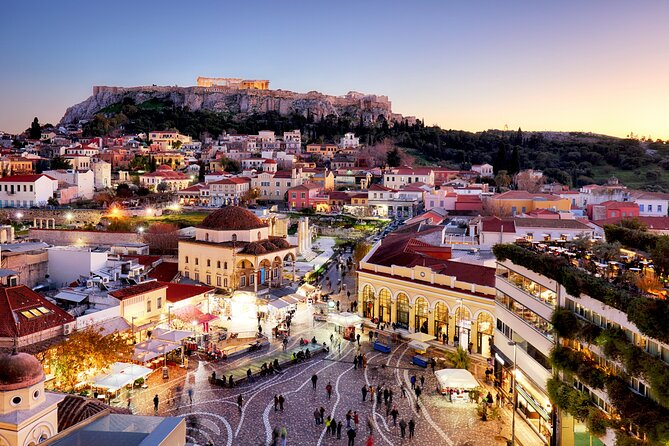
The Ancient Agora was the heart of Athens. This was where citizens walked, met, argued, traded, and discussed the matters that shaped the city.
The names associated with the Agora form an impressive cast: Socrates, Plato, Solon, Themistocles, Pericles, Thucydides, Sophocles, and Aristophanes. The point is not that all of them stood together in one daily debate. Rather, the Agora represents the public world in which politics, drama, philosophy, and civic discussion overlapped.
The listed stop lasts about ten minutes and has no admission charge. That short time means you will not get a full archaeological visit. Instead, the site works as a stage for the larger story.
I like this kind of interpretation because it helps you picture the Agora as a place in use, not merely a field of ruins. You hear about famous thinkers, politicians, writers, and ordinary citizens sharing the same urban setting.
The tour also helps separate Athenian democracy from modern assumptions. The city’s political system was important, but it was not the same as democracy today. The setting lets Panos discuss who took part, how public decisions were debated, and how ideas moved through the community.
Monastiraki to the Roman Agora

From the ancient civic center, the route moves through Monastiraki Square and its flea market. This is the least ancient part of the walk, but it helps you see how old Athens and modern Athens overlap.
The pace is described as easy, and the stop takes about ten minutes. Expect colorful streets, antique shops, and tourist stores. This part is more about atmosphere and orientation than a formal history lesson.
That short modern break is useful. After hearing about philosophers and political leaders, you get a glimpse of present-day street life before returning to archaeological Athens.
The Roman Agora lies north of the Acropolis and east of the Ancient Agora. It was built during the Roman period, when Athens remained an important center but no longer controlled the wider Greek world in the way it had during its classical age.
Again, the listed visit is brief, around ten minutes, with no admission charge stated. You should think of it as a stop for context and exterior discussion, not a full guided archaeological examination.
The route shows Athens changing over time. The city did not stop mattering after its democratic period. Roman rulers added their own buildings, systems, and symbols, leaving later layers beside the places connected to classical Athens.
A different kind of day out, same corner of Greece:
- Athens: Cape Sounion & Poseidon Temple Sunset Half-Day Trip
★ 4.8 · 8,241 reviews - Athens: Acropolis and Parthenon Guided Walking Tour
★ 4.6 · 5,882 reviews - All Day Cruise -3 Islands to Agistri,Moni, Aegina with lunch and drinks included
★ 5.0 · 4,958 reviews - Athens, Piraeus, and Coastline: Blue Hop-On Hop-Off Bus
★ 3.9 · 4,849 reviews
The Tower of the Winds, an ancient weather station
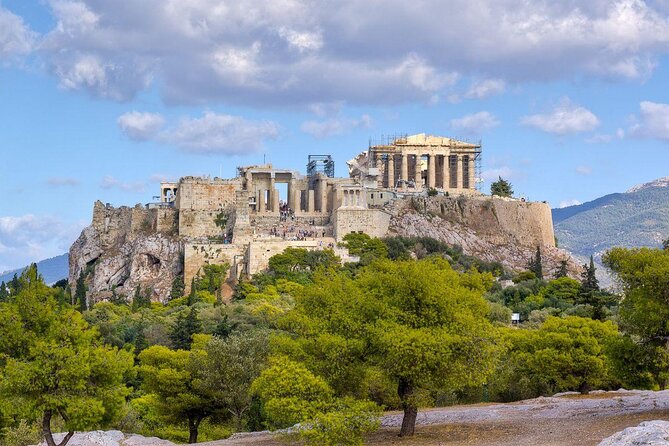
The Tower of the Winds is one of the most unusual stops. This octagonal building was made by Andronicus of Kyrristos in the first century BC.
It served as a wind indicator, a solar clock, and a water-powered timekeeping device. On cloudy days, a hydraulic mechanism could produce a sound every hour. In practical terms, it functioned as both a clock and a weather station.
The comparison with Big Ben is a handy way to understand its civic role. It was a public timepiece and a source of information about weather conditions. It is also described as the first meteorological station.
The stop lasts about ten minutes. That is enough to appreciate the building and hear why it matters, but not enough for a long technical study. If you enjoy old engineering, this may be one of your favorite moments.
It also supports the tour’s main argument. Athens was not only a city of myths and religious belief. It became a place where people observed nature, measured time, asked how the world worked, and tested ideas against evidence.
Hadrian’s Library and Plaka’s narrow streets

Hadrian’s Library was created by the Roman Emperor Hadrian in AD 132 on the north side of the Acropolis. It was said to be the second-largest library in the world at the time.
The stop takes around ten minutes and has no admission charge listed. The value comes from the change in emphasis. After the Agora and the Tower of the Winds, the library brings books, learning, and Roman patronage into the story.
Hadrian admired Greek culture, even as Rome ruled Greece. His library shows how Roman power could also preserve, collect, and display Greek intellectual traditions. This adds another layer to the tour’s account of Athens’ influence.
The walk then continues through Plaka, one of Athens’ most scenic neighborhoods. Small houses and narrow streets make this a pleasant change from open archaeological ground.
Plaka is a short ten-minute stop, so do not treat it as a shopping excursion or a neighborhood tour. Its role is visual and cultural. You see how the modern city surrounds the ancient remains, and you get a slower walk through streets that feel more intimate than the broad avenues near the main sites.
Pnyx Hill, where public speaking mattered

Pnyx Hill is the political center of the tour. It is presented as the first parliament in the world, and its open setting makes the idea of public speech easy to picture.
This was a place where citizens gathered for political discussion and decisions. The hill’s importance is not based on grand architecture. Its power comes from the idea of ordinary citizens meeting in a shared public space to debate the direction of their city.
The stop takes about 25 minutes. You get views across Athens, and the location is especially suited to sunset. There is no admission charge listed.
I would pay close attention here. The Pnyx is the point where the tour’s earlier subjects come together. Mythology shaped how people understood the world. Philosophy encouraged questioning. Public debate gave citizens a way to argue about laws, war, leadership, and the common good.
The hill also makes a good place for reflection. You are not just looking at a ruin. You are standing in a place linked to the practice of speaking, listening, persuading, and disagreeing in public.
Philopappos Hill and the Acropolis finale
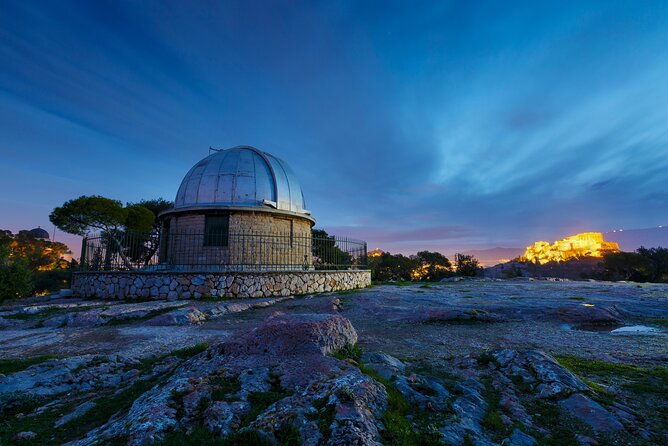
The last stop is Philopappos Hill, also called the Hill of the Muses. The visit is listed at about 45 minutes, making it the longest stop of the walk.
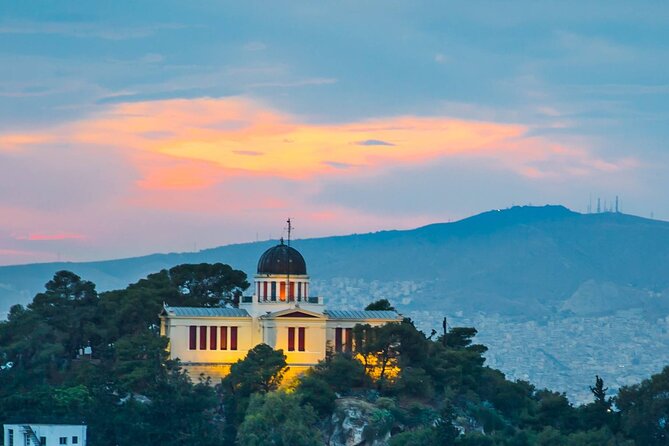
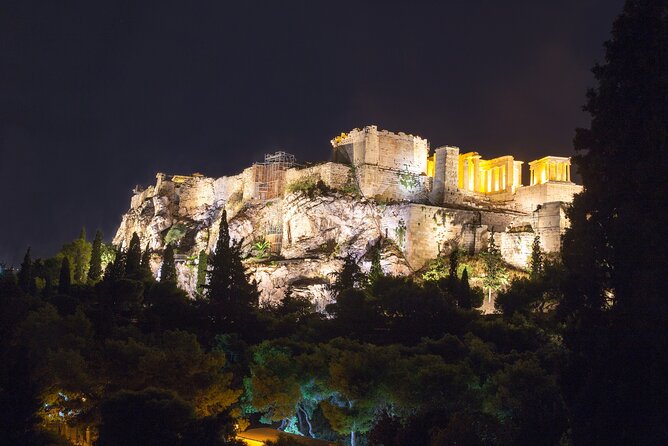
The payoff is the view. From here, you can see the Acropolis and Athens, with especially good sights after dark. If the tour is scheduled in the evening, this final hill can turn the end of the walk into a memorable city panorama.
The hill also gives Panos room for the closing discussion, including an introduction to ancient Greek philosophy and the connections among the tour’s themes. The setting suits that ending. After walking through graves, markets, civic spaces, Roman buildings, and neighborhood streets, you have a broad view of the city and time to consider what you have heard.
The finish point is Philopappos Hill, at Fylis 215 in Athens. You should remember that the walk ends on a hill, not at your hotel or back at the starting point. Plan your onward route before you begin.
How the three-hour format works
The advertised duration is about three hours, though one account describes the walk as lasting four hours. That difference may reflect the pace of the group, questions, or extra discussion.
The listed stop times add up to roughly 155 minutes, before allowing for walking between locations. In practice, you should leave room in your schedule rather than booking a tight meal, museum entry, or departure immediately afterward.
The group has a maximum of 12 people. That is a useful size for a subject built around questions and conversation. You are less likely to feel like a face in a crowd, and Panos can respond to different levels of interest.
The tour is offered in English and includes a mobile ticket. Confirmation is provided at booking. Service animals are allowed, public transportation is nearby, and most people can participate.
All listed stops have free admission. That does not mean every possible activity around the sites is included, so treat this as a guided outdoor walk rather than a package of paid museum entries.
Heat, hills, and the best time to walk
Athens can be extremely hot. One account specifically describes the heat as difficult, even though Panos helped with water and ice cream stops. That is a useful warning, not a minor detail.
The route includes open spaces and hills, especially at Pnyx and Philopappos. I would choose light clothing, sturdy shoes, water, and sun protection. If you have a choice of timing, an evening walk may be more comfortable, and the final views can be better as the city lights come on.
The tour requires good weather. If poor conditions cancel it, you are offered another date or a full refund. A minimum number of participants is also required, so a cancellation for that reason brings the same choice of another date or a refund.
You can cancel for a full refund up to 24 hours before the start time. Changes made within 24 hours are not accepted, and the cut-off follows local Athens time.
Who will get the most from this Athens tour
I would choose this walk if you want more than a quick introduction to ruins. It suits people interested in:
- Greek mythology and ancient religion
- Philosophy and the development of science
- The origins and limits of democracy
- Ancient literature and public speech
- The relationship between Athens and the modern world
- Scenic views reached on foot
It is also a good choice for families with older children and teenagers. The material is serious, but Panos uses humor and conversation to keep it moving. One account specifically notes that children found the educational side worthwhile.
Students and adults with an interest in philosophy should get the most from it. You do not need a university background, but you should enjoy listening and thinking as you walk.
I would be less likely to choose it if your main goal is a detailed examination of every archaeological site. The stop times are short, and the tour covers a wide subject rather than focusing on one monument.
Is $50.69 good value?
The price is $50.69 per person, with group discounts available. Since the route includes a small group, an English-speaking guide, several historical areas, and a final viewpoint, I consider it fair value for a three-hour experience.
The strongest value comes from the interpretation. You can walk past Kerameikos, the Agora, the Tower of the Winds, and the Pnyx on your own, but it is harder to see the relationship between them without a clear guide.
The free-entry format also keeps the cost straightforward. You are paying mainly for Panos’s time, research, storytelling, and route planning rather than a bundle of admission fees.
The trade-off is that the tour will not replace a full Acropolis visit or a museum day. Think of it as a companion experience. It gives you the intellectual and civic background that can make the major monuments easier to understand.
Should you book the Mythology, Philosophy and Democracy Tour?
I would book this tour early in an Athens stay, ideally before visiting the Acropolis. It can give you useful context for the city’s monuments and help you recognize that Athens was built around more than temples.
Book it if you want a thoughtful walk led by Panos, enjoy history told through ideas, and value lesser-known places such as Kerameikos and the Pnyx. The 100 percent recommendation rate and 5 out of 5 score point to a very consistent experience, especially for people who like a guide who explains rather than simply points.
Skip it if you want a short, flat route with little talking, or if intense heat and hill walking would be a problem. For everyone else, this is a smart use of half a day, with the bonus of finishing beside one of Athens’ finest Acropolis views.
FAQ
Where does the tour begin?
The tour begins at the Statue of Theseus in Athens, Greece.
Where does the tour end?
The tour ends at Philopappos Hill, also called the Hill of the Muses.
How long does the tour last?
The advertised duration is approximately three hours. One description of the walk refers to four hours, so you should allow some extra time for questions, walking, and discussion.
What language is the tour offered in?
The tour is offered in English.
How much does the tour cost?
The listed price is $50.69 per person. Group discounts are available.
How many people can join?
The maximum group size is 12 travelers.
Are admission tickets included?
Every listed stop shows no admission ticket charge. The experience is presented as a guided walk through these locations.
Is the tour suitable for most people?
Most travelers can participate. The route includes walking and hills, including Pnyx Hill and Philopappos Hill.
Is the tour available in poor weather?
The experience requires good weather. If it is canceled because of poor weather, you are offered another date or a full refund.
What is the cancellation policy?
You can cancel at least 24 hours before the start time for a full refund. Cancellations or changes made less than 24 hours before the start time are not accepted for a refund.
Recently reviewed around Athens
- Small-Group Women History in Ancient Greece Walking Tour★ 5.0 · 38 reviews
- Ceramic and Pottery Creative Workshop with Two Local Artists★ 4.0 · 57 reviews
- Athens: Wine Workshop Create your Own Wine under the Acropolis★ 5.0 · 77 reviews
- Athens: Greek Wines Tasting with Sommelier and Acropolis Views★ 5.0 · 88 reviews
- Hydra Private Day Trip by Ferry from Athens with Transfers★ 4.0 · 30 reviews
- Small-Group Wine Tour in Athens with Tasting★ 5.0 · 33 reviews
- Wine Trails Private Tour/ Nemea visit 3 wineries from Athens or Nafplion (10 h)★ 5.0 · 44 reviews
- Private Athens Transfer Airport/Port -Greek Tours-Hourly service★ 5.0 · 88 reviews
Athens Tours, compared.

Acropolis & up to 5 Archaeological Sites Combo Pass
Read our review →

Acropolis, Parthenon & Acropolis Museum Guided Tour
Read our review →
Cape Sounion & Poseidon Temple Sunset Half-Day Trip
Read our review →

All Day Cruise -3 Islands to Agistri,Moni, Aegina with lunch and drinks included
Read our review →