Reviewed · ATHENS TOURS
Philosophy and Democracy tour of Athens
Athens becomes far more interesting when you stop treating its ruins as isolated stones and connect them to the arguments, laws, and public debates that took place around them. This walking tour follows that thread from the cemetery at Kerameikos to the Pnyx, where citizens gathered to decide the future of their city.
I like the way the route joins major sites with less obvious ones, and I like that Panos explains difficult ideas in plain language, often with humor and visual examples. The small group, limited to 15 people, also gives you room to ask questions rather than simply follow a flag through the city.
The main consideration is physical: this is a 3.5-hour walk through central Athens, often under a strong sun. Bring water, wear sensible shoes, and remember that admission fees for several archaeological sites are not included in the $50.81 price.
In This Review
- Key points to know before you book
- Why this Athens tour feels different
- Kerameikos: Athens begins with its cemetery
- The Flea Market and the walk between eras
- Hadrian’s Library and the Roman Agora
- The Tower of the Winds and Plaka
- The Ancient Agora: where public life took shape
- A tribute to Socrates
- Pnyx Hill, the clearest lesson in democracy
- What the $50.81 price includes in value
- Timing, comfort, and the meeting point
- Who should book this philosophy and democracy walk?
- Should you book it?
- FAQ
- How much does the Philosophy and Democracy tour of Athens cost?
- How long does the tour last?
- What language is the tour offered in?
- Where does the tour begin and end?
- How large is the tour group?
- Are admission tickets included?
- Can I cancel for a refund?
Key points to know before you book
- Democracy has a real setting: At Pnyx Hill, you see the place linked with the birth of democratic decision-making.
- The route fills in the gaps: Kerameikos, the Agora, Hadrian’s Library, and the Roman Agora add context beyond the Acropolis.
- Panos is the named guide: His approach combines history, political thought, philosophy, humor, and plenty of questions.
- The group stays small: A maximum of 15 people makes conversation easier and helps you hear the guide clearly.
- You pay separately for entry: Several stops list admission tickets as not included, while the Flea Market and Pnyx are free.
- The walk ends near the Acropolis: The final point is on Theorias Street, a useful location for continuing your sightseeing.
Why this Athens tour feels different
Many Athens walking tours focus on monuments and dates. This one uses the city as a classroom for two large ideas: how people reasoned about the good life, and how citizens took part in public decisions.
That gives the route a clear purpose. At the Ancient Agora, you are not only looking at old foundations. You are thinking about the people who met there, argued there, traded there, and shaped public life. At Pnyx, the idea of democracy becomes tied to a physical hill with a view across Athens.
The philosophy side is just as important. Socrates, Plato, and other Greek thinkers are not treated as names to memorize. The guide connects their questions to modern politics, ethics, society, and daily life. One useful feature is the chance to stop and discuss ideas rather than receive a nonstop lecture.
Panos is repeatedly praised for making complex subjects easy to follow. He is also described as funny, patient, clear, and passionate. That matters here, because a tour about ancient political theory could quickly become dry if the guide simply recited definitions.
The tone appears aimed at adults, but the content can work for older children and teenagers too. An 11-year-old and a 15-year-old were reported to have enjoyed it, which suggests that the storytelling and discussion keep the material moving.
More Athens trips worth a second look
- Athens: Acropolis & up to 5 Archaeological Sites Combo Pass
★ 4.4 · 12,619 reviews - Athens: Acropolis Ticket with Optional Audio or Live Guide
★ 4.2 · 11,055 reviews - Athens: Acropolis, Parthenon & Acropolis Museum Guided Tour
★ 4.8 · 9,316 reviews
Kerameikos: Athens begins with its cemetery
The tour starts at the Statue of Theseus and then reaches Kerameikos, one of the most useful stops for understanding Athens beyond the Acropolis.
The name Kerameikos comes from keramos, meaning ceramic. Potters worked in this area, but it also served as Athens’ cemetery for centuries. That combination gives the site an unusually human character. You see a working district and a place of remembrance in the same setting.
The stop lasts about 15 minutes, and admission is not included. That short visit means you should expect an introduction rather than a full archaeological examination. Still, it is a smart first stop because it places the story of Athenian public life alongside ordinary work, family, and death.
The political link is especially important. Pericles delivered his famous funeral speech for the first Athenian casualties of the Peloponnesian War in this wider setting. The speech praised the virtues of Athens and its democratic system, so Kerameikos offers an early connection between war, citizenship, and political ideals.
If you already know the Acropolis, this stop helps widen your view of the city. Athens was not only temples and grand monuments. It was also workshops, graves, public speeches, and citizens negotiating how their community should function.
The Flea Market and the walk between eras
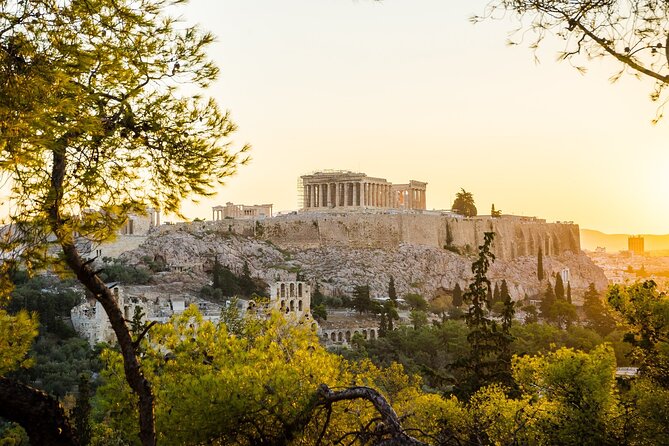
The route includes an easy-paced walk through the Athens Flea Market. This is a brief 15-minute section, with no admission charge.
Its value is less about a formal attraction and more about the change of rhythm. You move from archaeological remains into a living part of the city, with shops, street activity, and the everyday character of central Athens. That contrast supports the tour’s main idea: the ancient city is not sealed off from modern life.
The walk also gives the guide a chance to offer practical suggestions about where to eat, drink, and explore. Those tips are useful early in your stay, especially if this is your first morning in Athens. Do not expect a dedicated shopping session, though. The flea market is a short passage within a larger historical route.
Hadrian’s Library and the Roman Agora
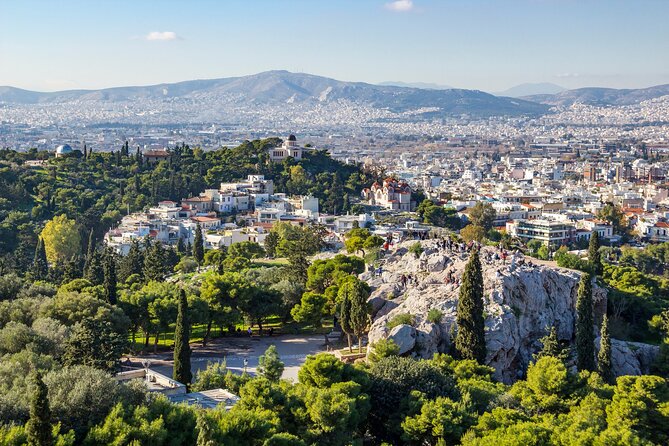
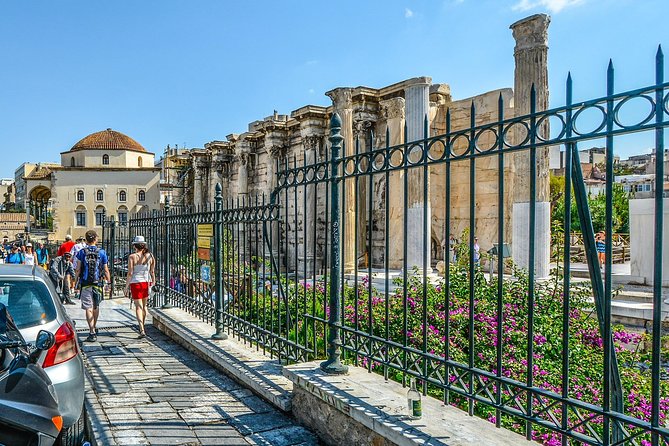
Hadrian’s Library was created by the Roman emperor Hadrian in AD 132 on the north side of the Acropolis. The 15-minute stop is a reminder that Athens continued to matter long after the classical period.
This is one of the tour’s strengths. The story does not freeze Athens at the time of Socrates. It shows how later rulers added their own buildings and ideas to a city already famous for philosophy and civic life.
Admission is not included, so check the cost of any site you plan to enter before the walk. The schedule may leave you with only a short look from outside or a compact explanation at the entrance, rather than time to study every remaining wall.
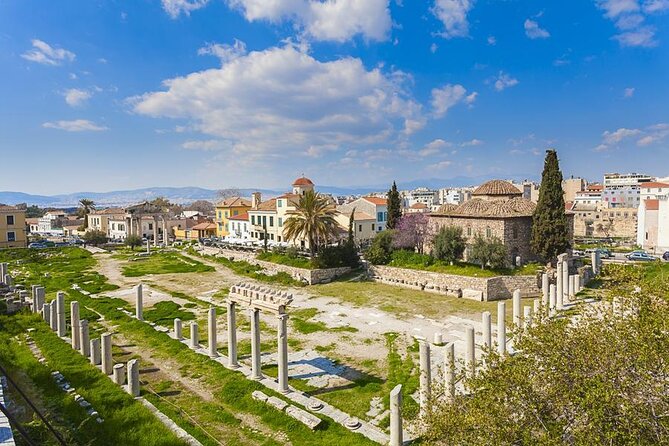
The Roman Agora follows. Located north of the Acropolis and east of the Ancient Agora, it represents another layer of the city’s development. The stop also lasts about 15 minutes and does not include admission.
The contrast between the Ancient Agora and Roman Agora is useful. One is closely tied to the civic life of classical Athens, while the other reflects Roman-era urban planning and administration. You get a better sense of how power and public space changed over time.
A different kind of day out, same corner of Greece:
- Athens: Cape Sounion & Poseidon Temple Sunset Half-Day Trip
★ 4.8 · 8,241 reviews - Athens: Acropolis and Parthenon Guided Walking Tour
★ 4.6 · 5,882 reviews - All Day Cruise -3 Islands to Agistri,Moni, Aegina with lunch and drinks included
★ 5.0 · 4,958 reviews - Athens, Piraeus, and Coastline: Blue Hop-On Hop-Off Bus
★ 3.9 · 4,849 reviews
The Tower of the Winds and Plaka
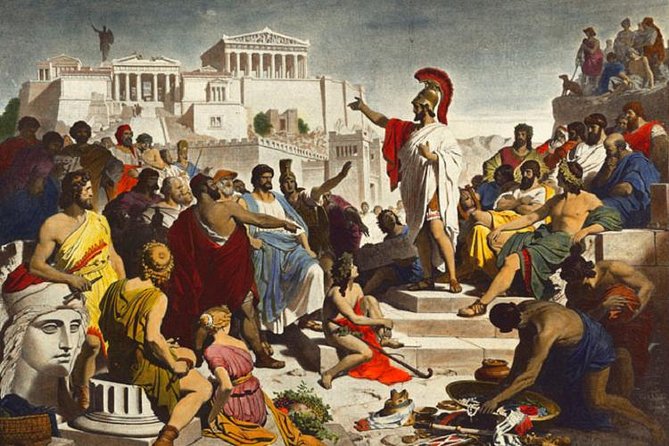
The Tower of the Winds gets only about five minutes, but it may be one of the most memorable explanations on the route.
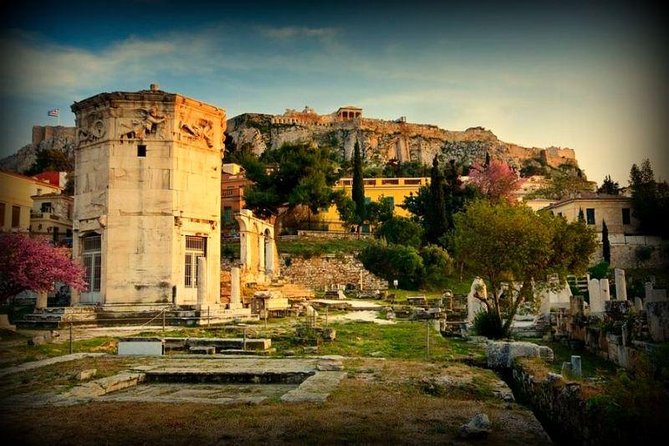
This octagonal building was made by the astronomer Andronicus of Kyrrhos in the first century BC. It functioned as a wind indicator and a clock. The solar clock worked in clear weather, while a hydraulic mechanism could mark the hours on cloudy days.
In practical terms, it was both a timepiece and a weather station. Calling it the Big Ben of Athens gives you a quick mental picture, although the building is much older and much smaller. The guide also explains why it is considered the first meteorological station.
Because the stop is brief, you will not have time for a long visit. Its purpose is to give you a sharp glimpse of ancient scientific thinking before the route continues through Plaka.
Plaka is a scenic neighborhood with small houses and narrow streets. The supplied route does not specify a stop length or admission details here. Treat it as part of the walking connection, not as a separate guided attraction.
That is still valuable. The narrow streets and modest houses provide a human scale after the open archaeological spaces. You also get a better sense of how sightseeing in Athens works: major ruins, local streets, shops, food, and homes all sit close together.
The Ancient Agora: where public life took shape
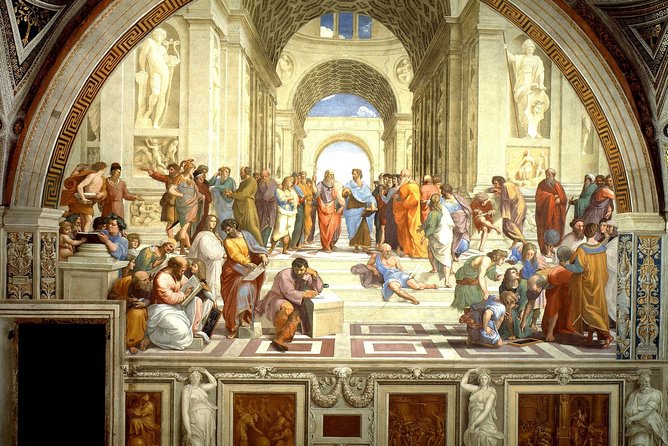
The Ancient Agora is the intellectual and civic center of the tour. You spend about 20 minutes here, and the admission ticket is not included.
This was the heart of Athens. Socrates and Plato walked here, as did politicians such as Solon, Themistocles, and Pericles. The site was not reserved for philosophers. Citizens came to talk, trade, debate, and handle the business of the city.
The guide uses the Agora to connect abstract ideas with real urban space. You can picture arguments taking place among people with different interests and different levels of power. That makes ancient democracy easier to understand, while also showing its limits and complexities.
The names associated with the Agora extend beyond political leaders. Thucydides, Sophocles, and Aristophanes belong to the wider group of Athenians who shaped history, drama, and political thought. The point is not to claim that everyone agreed. It is to show how public life, art, history, and philosophy fed into one another.
The short scheduled visit is a limitation if you want extensive time among the ruins. You may want to return later with an entry ticket and spend longer here. As part of this tour, though, the Agora is the place where the route’s ideas come together most clearly.
A tribute to Socrates
The Prison of Socrates is a brief stop of about 10 minutes, with free admission.
The name carries enormous weight, but the site itself requires careful expectations. You are paying tribute to Socrates at a spot associated with him, rather than taking part in a long museum visit. The guide’s storytelling is what gives this stop its force.
Socrates is central to the tour because he treated questioning as a way of life. His approach also fits the walking format. You are encouraged to think, ask, and test ideas rather than simply accept a polished version of the past.
This stop will appeal most if you enjoy the human side of history. Instead of only hearing about laws and buildings, you consider the fate of an individual who challenged accepted views and paid a heavy price.
Pnyx Hill, the clearest lesson in democracy

Pnyx Hill is the final major historical stop and the place where the tour’s theme becomes most direct. You spend about 30 minutes here, and there is no admission charge.
Pnyx is considered the cradle of democracy because citizens gathered here to make decisions about their future. That does not mean ancient Athens created modern democracy in its present form. The comparison is more useful when you examine both the similarities and the differences.
The guide discusses ancient and modern systems side by side. You can think about participation, public speech, citizenship, power, and who was excluded. The setting encourages this discussion because the hill gives you a broad view of the Acropolis and Athens.
The view is one of the practical rewards of the route. After moving through city streets and archaeological sites, you reach an open position with a clear look toward the Acropolis. Bring water, since this exposed stop can feel warm, especially during the hotter months.
Pnyx is also a strong ending. You leave with a place in mind, not only a collection of names. Democracy happened somewhere. People stood, listened, argued, voted, and accepted the consequences of public decisions.
What the $50.81 price includes in value
At $50.81 per person, this is priced as an affordable small-group walking tour rather than a private guide service. The maximum group size of 15 keeps it more personal than a large city walk, while the 3.5-hour length gives the guide time to build a connected story.
The value depends on what you want. If you only need quick facts about monuments, a shorter general walk may be enough. If you want help understanding why Athens still matters to political and philosophical thought, the price is easier to justify.
Several site admissions are not included, so do not treat the ticket price as a complete archaeological pass. The Flea Market, Prison of Socrates, and Pnyx are listed as free, while Kerameikos, Hadrian’s Library, the Roman Agora, the Tower of the Winds, and Ancient Agora list admission as not included.
Another part of the value is orientation. Panos offers suggestions for food, drinks, and further places to explore. The tour also helps you place other Athens sights in context. One useful piece of advice from the experience is to take it early in your stay, since later visits to the Agora and surrounding monuments can make more sense afterward.
Timing, comfort, and the meeting point
The tour begins at the Statue of Theseus, Athens 105 55, and ends at Theorias 21, Athens 105 58. The finish is near the Acropolis, so you can continue sightseeing from there, though no onward activity is included.
The duration is approximately three hours and 30 minutes. One account of the timing describes a morning start at 9:30 and a finish around 1 p.m., with a break in the middle for refreshments and toilet facilities at a kiosk. Exact start times should be checked when booking.
You should plan for steady walking. One person specifically noted that you need to be prepared for the amount of walking, and another advised bringing a bottle of water. Wear shoes you can use comfortably on uneven historic streets and archaeological ground.
The tour is offered in English and uses a mobile ticket. Service animals are allowed, the route is near public transportation, and most people can participate. The information does not promise full wheelchair access or a completely step-free route, so ask the provider directly if you have specific mobility needs.
Free cancellation is available up to 24 hours before the start time for a full refund. Changes or cancellations inside that window are not accepted and are not refunded. The tour needs good weather and a minimum number of people. If the provider cancels for either reason, you are offered another date or experience, or a full refund.
Who should book this philosophy and democracy walk?
I would choose this tour if you enjoy history, political ideas, or the stories behind famous names. It is especially useful for first-time visitors who want a framework for understanding Athens before visiting more monuments on their own.
It also suits repeat visitors. If you have already seen the Parthenon, this route takes you to other important places and gives them a larger meaning. You will not visit the Parthenon as part of the main itinerary, but the Acropolis remains a constant reference point and appears in the views.
Families with older children and teenagers can also consider it. The material is aimed at adults, yet the lively presentation and discussion format can keep young people involved. Younger children who need constant movement or simple visual attractions may find the philosophy sections demanding.
You should skip it if you want a relaxed ride, a food tour, or a full archaeological-site visit with lots of free time at each stop. This is a walking lesson with ruins along the way. Its strength is the guide’s explanation, not the number of minutes spent inside each monument.
Should you book it?
Book this tour if you want Athens to make sense as a city of ideas, not just a city of ruins. The route links Kerameikos, the Agora, Socrates, Pnyx, and later Roman buildings in a way that gives your sightseeing a clear shape.
The strongest reason to go is Panos’s ability to explain philosophy and democracy with energy, humor, and plain language. The strongest practical reasons are the small group, modest price, central route, and useful local suggestions.
Just budget for separate entry fees, prepare for a long walk, and carry water. If that sounds like a fair trade for a thoughtful look at the forces that shaped Athens and the modern Western world, this is one of the better-value history walks in the city.
FAQ
How much does the Philosophy and Democracy tour of Athens cost?
The listed price is $50.81 per person. Admission tickets for several archaeological sites are not included.
How long does the tour last?
The tour lasts approximately three hours and 30 minutes. A morning schedule has been described as starting at 9:30 a.m. and ending around 1 p.m., including a break.
What language is the tour offered in?
The tour is offered in English.
Where does the tour begin and end?
It begins at the Statue of Theseus in Athens 105 55, Greece, and ends at Theorias 21 in Athens 105 58, Greece.
How large is the tour group?
The maximum group size is 15 people.
Are admission tickets included?
No. Admission is not included for Kerameikos, Hadrian’s Library, the Roman Agora, the Tower of the Winds, and the Ancient Agora. The Flea Market, Prison of Socrates, and Pnyx are listed as free.
Can I cancel for a refund?
Yes. You can cancel at least 24 hours before the start time for a full refund. Cancellations or changes made less than 24 hours before the start are not accepted or refunded. If poor weather or an insufficient number of participants cancels the tour, you are offered another date or a full refund.
Recently reviewed around Athens
- Small-Group Women History in Ancient Greece Walking Tour★ 5.0 · 38 reviews
- Ceramic and Pottery Creative Workshop with Two Local Artists★ 4.0 · 57 reviews
- Athens: Wine Workshop Create your Own Wine under the Acropolis★ 5.0 · 77 reviews
- Athens: Greek Wines Tasting with Sommelier and Acropolis Views★ 5.0 · 88 reviews
- Hydra Private Day Trip by Ferry from Athens with Transfers★ 4.0 · 30 reviews
- Small-Group Wine Tour in Athens with Tasting★ 5.0 · 33 reviews
- Wine Trails Private Tour/ Nemea visit 3 wineries from Athens or Nafplion (10 h)★ 5.0 · 44 reviews
- Private Athens Transfer Airport/Port -Greek Tours-Hourly service★ 5.0 · 88 reviews
Athens Tours, compared.

Acropolis & up to 5 Archaeological Sites Combo Pass
Read our review →

Acropolis, Parthenon & Acropolis Museum Guided Tour
Read our review →
Cape Sounion & Poseidon Temple Sunset Half-Day Trip
Read our review →

All Day Cruise -3 Islands to Agistri,Moni, Aegina with lunch and drinks included
Read our review →