
Reviewed · WORKSHOPS
Philosophy Experiential Workshop at Plato’s Academy Park -Athens
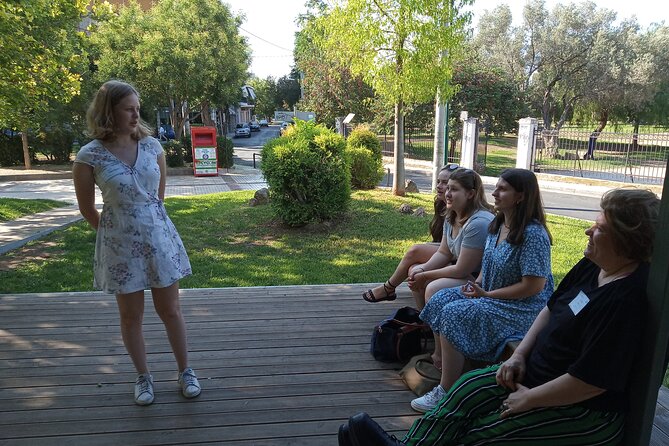
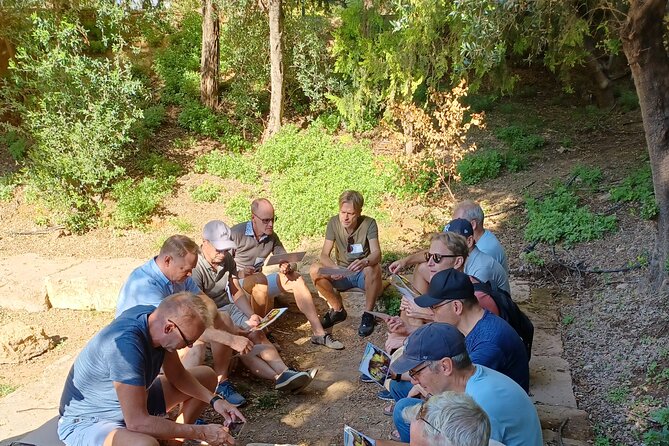
Plato’s Academy Park is not just a place to take a photo beside a few stones. Here, you use the setting to think through Plato’s ideas, read short ancient texts, and argue a case under the rules of a real water-timer. The discussion is the main event, not a long list of dates and names.
I like the free museum visit, which gives you a clear visual introduction before you walk into the park. I also like the small group limit of 10, since a Socratic discussion works best when you have time to speak, question, and listen. The main thing to consider is that this is an outdoor workshop, so poor weather can cancel it, and the museum may be closed without notice.
In This Review
- Key points at Plato’s Academy Park
- Why this is different from a normal Athens tour
- Starting at the Plato Digital Museum
- Reading ancient Greek ideas in plain English
- Walking to the ancient Gymnasium ruins
- Plato’s Allegory of the Cave, discussed outdoors
- The water-timer debate
- Adding the Aristotle philosophy hour
- Price, group size, and overall value
- Weather and practical planning
- Who should book this workshop
- Should you book the Plato Academy workshop?
- FAQ
- Where does the workshop begin?
- How long does the main workshop last?
- What language is the workshop offered in?
- Is the Plato Digital Museum included?
- What happens if the museum is closed?
- Is this a guided tour?
- What age group can participate?
- What happens if the weather is poor?
- Can I book a private session?
- Can I cancel for a full refund?
Key points at Plato’s Academy Park
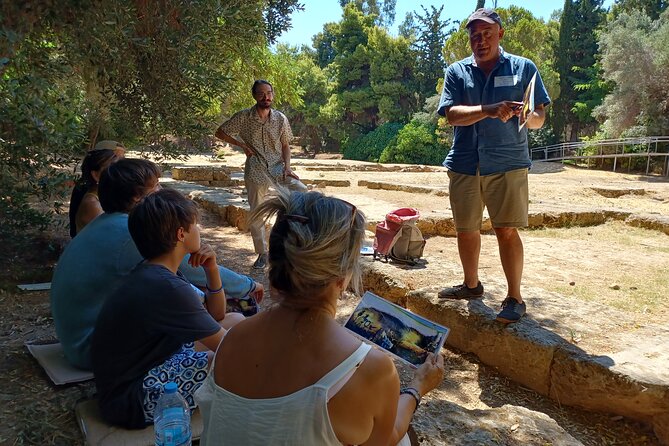
- Plato’s Allegory of the Cave: Discuss one of philosophy’s best-known ideas through questions rather than a standard lecture.
- A free digital museum visit: See a concise introduction to Plato and the Academy when the museum is open Tuesday through Friday, 10:00 AM to 4:00 PM.
- An ancient Gymnasium setting: Connect Socrates, Plato, and Aristotle while standing near the remains of the place where philosophical education took shape.
- A water-timer debate: Use a replica of an ancient timing device to practise structured debate in the spirit of classical Athens.
- Plain English and no prior study: The facilitator explains ideas without difficult terminology, making the workshop suitable for adults and teenagers aged 14 and over.
- Optional Aristotle extension: Add an hour focused on virtue, choice, and Aristotle’s philosophy if you want more than the basic two-hour session.
Why this is different from a normal Athens tour
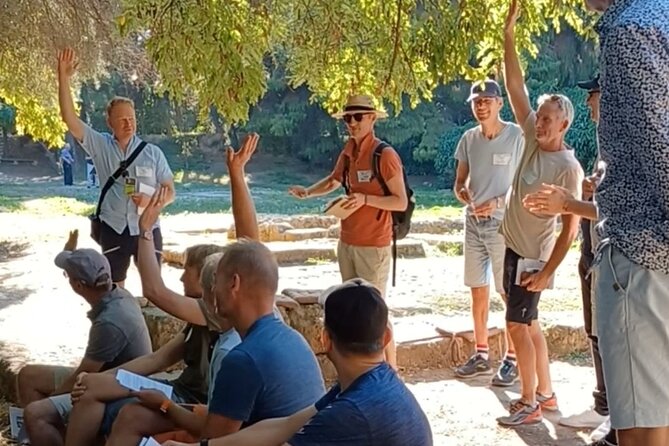
Many Athens tours move from monument to monument. You hear the date, take the picture, and continue to the next stop. This workshop takes a slower and more active route. You are asked to form an opinion, explain it, and respond to other people.
That change matters. Plato’s ideas can feel remote when they appear in a textbook. They become easier to grasp when you use them to talk about what people believe, how they learn, and how they decide what is true.
The setting does much of the work. Plato’s Academy Park is tied to the place where Plato taught, while the nearby Gymnasium ruins help you picture education in the ancient world. You are not entering a fully rebuilt school or a large archaeological complex. The remains are limited, and the park is open-air. The value comes from combining the physical place with guided questions.
I would choose this activity if you enjoy history best when you can take part. If you mainly want a detailed walk through Athens’ major ruins, this will not replace the Acropolis, the Ancient Agora, or a conventional archaeological tour. It is a focused workshop with a historical setting, not a broad sightseeing circuit.
More Athens trips worth a second look
- Athens: Classic Cooking Class with Market Visit and Wine
★ 5.0 · 1,101 reviews - Athens: Food Market Visit and Cooking Class with Wine
★ 4.9 · 1,087 reviews - Greek Cooking Class in Athens Including Rooftop Dinner with Acropolis View
★ 5.0 · 826 reviews
Starting at the Plato Digital Museum
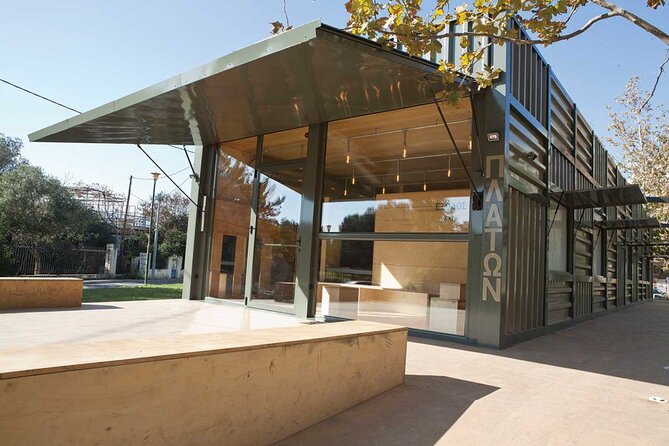
The meeting point is Plato’s Academy Digital Museum at Alkmeonos 1, Athens 104 42. The first part is a short visit to the museum, which has free admission. Its purpose is to give you the basic story before the outdoor discussion begins.
The museum is small, so do not expect a full morning of galleries. That is also part of its appeal. You can get your bearings without spending much time indoors, then move into the park where the main activity takes place. The museum helps connect Plato’s name with the Academy, rather than leaving you to approach the ruins with no context.
There is one practical catch. The museum is open Tuesday through Friday from 10:00 AM to 4:00 PM, but its hours and operating days can change. It may also close without advance notice. When it is unavailable, the facilitator replaces the visit with a discussion covering the same key ideas.
That backup plan protects the content of the workshop, but it changes the feel of the first few minutes. If seeing the museum matters to you, check its status before booking or contact the provider close to your date. You should not assume that the museum will be open simply because your workshop is scheduled.
Reading ancient Greek ideas in plain English
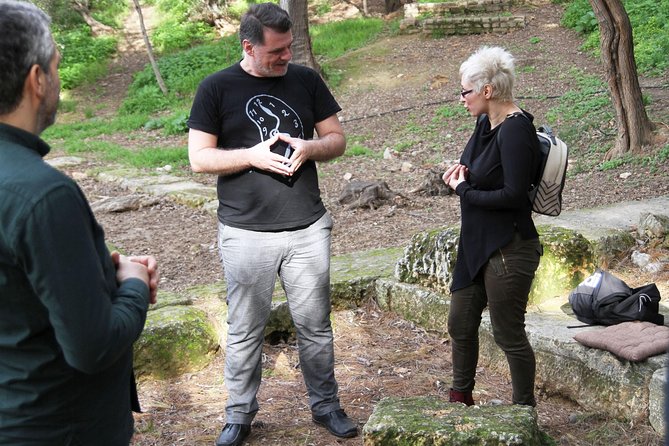
After the museum, you take part in a philosophical warm-up. The facilitator gives you short ancient Greek texts to read and interpret. You do not need previous study, and the material is presented in plain English.
This opening exercise is useful because it gets everyone speaking early. You are not expected to deliver a polished academic answer. You are there to notice a point, ask a question, or offer another reading. That low-pressure start helps teenagers and adults join in at the same level.
The workshop is designed for people aged 14 and over. A teenager under 18 cannot book alone and must attend with an adult who is responsible for supervision. The session is suitable for people without a background in philosophy, which makes it a reasonable choice for a family group with older children.
I would still think about personality and attention span before booking. A curious 14-year-old who likes discussion may enjoy this far more than a younger child who needs constant movement. The activity lasts about two hours, and much of that time involves listening, speaking, and thinking rather than walking from one sight to another.
Walking to the ancient Gymnasium ruins
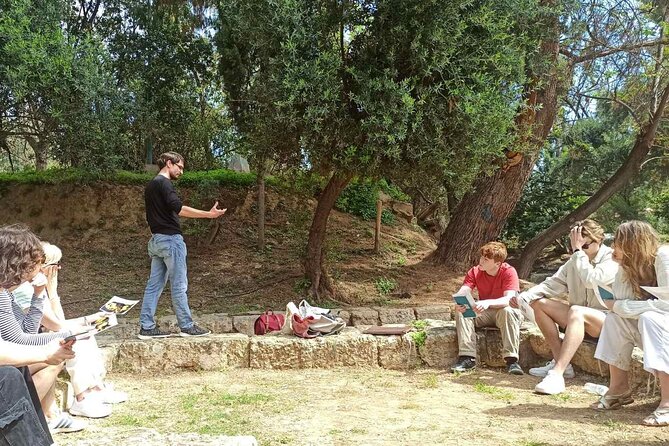
The group then moves through Plato’s Academy Park to the ancient Gymnasium ruins. This is a short park walk within the activity, not a major archaeological trek. The facilitator uses the remains to explain the setting and builds a timeline linking Socrates, Plato, and Aristotle.
That timeline is one of the most useful parts for anyone who knows the names but not the connections. Socrates shaped the questioning tradition associated with philosophy. Plato developed that tradition through his teaching at the Academy. Aristotle, Plato’s student, later formed his own approach to ethics, knowledge, and the natural world.
You see these figures as part of a continuing conversation rather than as three unrelated statues in a history lesson. The location gives the explanation a physical anchor. You can discuss education beside the remains of an ancient educational site.
Keep your expectations realistic. Plato’s Academy Park is not presented as a fully preserved campus. There is a small chance archaeological excavation will be underway during your visit. If that happens, you may view the Gymnasium ruins from a short distance and hold the discussion at another spot in the park.
That possibility does not remove the historical value, but it can limit how close you get to the remains. I would treat the ruins as a setting for the workshop, not as the sole reason to book it.
A different kind of day out, same corner of Greece:
- Athens: Acropolis & up to 5 Archaeological Sites Combo Pass
★ 4.4 · 12,619 reviews - Athens: Acropolis Ticket with Optional Audio or Live Guide
★ 4.2 · 11,055 reviews - Athens: Acropolis, Parthenon & Acropolis Museum Guided Tour
★ 4.8 · 9,316 reviews - Athens: Cape Sounion & Poseidon Temple Sunset Half-Day Trip
★ 4.8 · 8,241 reviews
Plato’s Allegory of the Cave, discussed outdoors
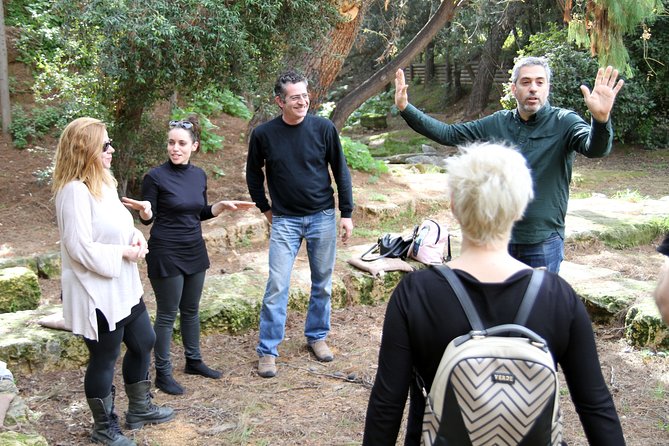
The central discussion focuses on Plato’s Allegory of the Cave. The facilitator uses the Socratic method, asking questions that guide you toward your own interpretation instead of simply explaining what Plato meant.
The allegory raises basic but difficult questions. How do we know what is real? What happens when someone sees beyond familiar beliefs? Why might people resist a new way of understanding the world? You do not need to arrive with answers. The point is to test ideas together.
This format received the strongest praise in the available feedback. People valued the question-and-answer structure because it made the history and concepts easier to follow than a standard talk. One participant described the conversation as a way to consider the place of philosophy in modern life, not just ancient Athens.
That is the workshop’s best feature. The discussion links a text written long ago with choices and assumptions you recognize today. It also gives you a reason to remember the Academy after you leave. You are likely to recall an idea you argued about more clearly than a list of dates.
The style depends on your willingness to take part. You can listen, but the session is designed around participation. If you prefer a quiet audio guide or a guide who does all the talking, you may find the Socratic format demanding. If you enjoy testing a point and hearing another view, it should feel lively without becoming a classroom lecture.
The water-timer debate
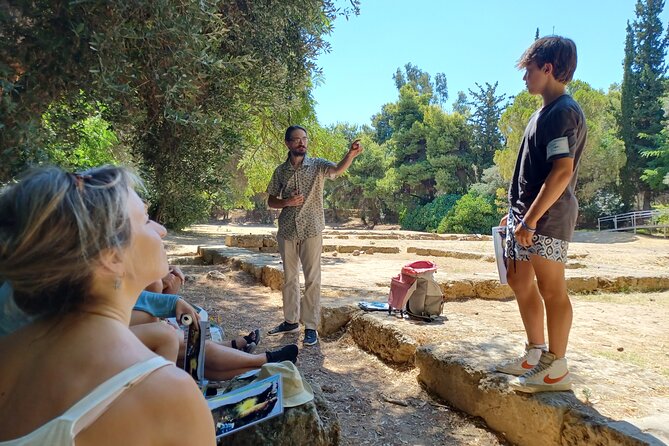
The final activity is a role-play debate using a replica of an ancient water-timer. The device gives the discussion a time limit, echoing the way speakers in ancient Athens had to manage their turns.
This is more than a prop for a photograph. A timed debate changes how you speak. You must make your point clearly, avoid wandering too far, and give the other side room to respond. It turns the idea of ancient public discussion into something you can practise yourself.
You do not need public-speaking experience. The aim is not to produce a perfect argument or win a contest. It is to experience the structure of a debate and see how rules affect the way people exchange ideas.
The role-play also adds a lighter finish after the more concentrated conversation about the Allegory of the Cave. The workshop moves from reading, to interpretation, to discussion, then action. That progression helps the two hours feel varied.
Photos or video may be taken in the public space during the activity, including possible future publication by the provider or other participants. You can withdraw your consent by contacting the provider in writing, but the provider is not responsible for images taken and used by other people. If privacy matters to you, ask about this at the start and be aware of the public setting.
Adding the Aristotle philosophy hour
You can request an extra hour focused on Aristotle. This extension includes a game about virtue and choice, giving the session a second philosophical theme.
The added hour makes sense if you want more than Plato’s Academy and prefer a longer, more varied workshop. Aristotle’s ideas about virtue can be approached through decisions and behavior, so the game offers a different style from the text discussion and Socratic questioning.
The basic experience lasts about two hours. Adding another hour makes it a larger block of your Athens day, so consider your energy and plans afterward. The supplied information does not give a separate price for the Aristotle option, so ask the provider for the current cost and availability before booking.
A private version is also available on request. That may suit a family, school-style group, or friends who want a more tailored conversation, though you should confirm the private group details directly.
Price, group size, and overall value
The listed price is $53.92 per person. For two hours, that is more than you would pay for a simple self-guided visit to a park, but you are paying for an expert facilitator, the interactive format, liability insurance, and local VAT of 24 percent. The museum itself is free, so the charge is for the teaching and organized experience rather than admission fees.
I see the best value here for a small group that will actively participate. With a maximum of 10 people, the facilitator has a reasonable chance to include different voices. That matters in a discussion-based activity. In a group of 30, a Socratic debate would quickly become a few people speaking while everyone else watches.
You should also compare this price with what you want from Athens. If you want a conventional guide to explain several ancient monuments, spend the money elsewhere. If you want to understand one major Platonic idea, practise debate, and connect philosophy with a real historical place, the price is easier to justify.
The activity is booked an average of 34 days ahead, so advance planning is sensible. That does not guarantee that every date sells out, but it suggests that you should not leave a preferred time until the last minute.
Weather and practical planning
This is an outdoor experience, and good weather is required. If conditions force a cancellation, you should be notified at least three hours before the start. You can then choose another date, a similar workshop, or a full refund.
Bring the right attitude toward an open-air historical site. Dress for the weather, keep your clothing respectful, and be ready to walk through a park. The conduct rules also cover cleanliness, sobriety, loudness, photography, video, and general respect for the place and other people.
The facilitator may end your participation without a refund if your behavior is disrespectful. That is a firm policy, but it is reasonable for a workshop held at a heritage site. Treat the Academy as a cultural place, not as a backdrop for loud entertainment.
The meeting point is near public transportation, and service animals are allowed. Most people can participate. The activity ends back at the meeting point, which makes it easier to plan another Athens stop afterward.
Free cancellation is available until 24 hours before the start time. Canceling or changing the booking less than 24 hours ahead does not qualify for a refund, except when the provider cancels because of poor weather.
Who should book this workshop
I would recommend it to adults and teenagers over 14 who like asking questions, hearing different opinions, and connecting ancient ideas with present-day life. It is especially good for a small family group with older children, since the discussion gives everyone a role.
It also suits a repeat visitor to Athens who has already seen the major monuments and wants a quieter, more thoughtful activity. The park setting and the link between Socrates, Plato, and Aristotle offer something different from another standard city walk.
You may not enjoy it if your main goal is extensive archaeology, a large museum, or a fast overview of Athens. The Digital Museum is small, the ruins may be viewed from a distance if excavation is underway, and the facilitator is there to lead an educational workshop, not provide a full guided tour of the city.
Should you book the Plato Academy workshop?
Book it if you want to do more than look at ancient stones. The combination of the free museum, Gymnasium ruins, Allegory of the Cave discussion, and water-timer debate gives you a clear two-hour experience with a real point of view.
I especially recommend it for curious families, older teenagers, and adults who enjoy learning through conversation. Just check the museum schedule, plan for good weather, and understand that participation is part of the deal.
Skip it if you want a passive sightseeing stop or a detailed tour of many archaeological remains. At $53.92, the value depends on your interest in philosophy and your willingness to speak up. For the right person, Plato’s Academy becomes less a ruin to photograph and more a place to think.
FAQ
Where does the workshop begin?
It begins at Plato’s Academy Digital Museum, at Alkmeonos 1, Athens 104 42, Greece.
How long does the main workshop last?
The main experience lasts approximately two hours.
What language is the workshop offered in?
It is offered in English, using plain language suitable for people without previous knowledge of philosophy.
Is the Plato Digital Museum included?
The brief museum visit is included, and the museum has free entrance. Its opening days and hours can change, and it may sometimes be closed without notice.
What happens if the museum is closed?
The facilitator replaces the museum visit with a discussion covering the same key insights.
Is this a guided tour?
No. It is an educational, interactive workshop led by an expert facilitator.
What age group can participate?
The workshop is suitable for adults and teenagers aged 14 and over. Underage participants cannot book alone and must attend with an adult who supervises them.
What happens if the weather is poor?
The outdoor activity may be canceled. You should be notified at least three hours before the start and offered another date, a similar workshop, or a full refund.
Can I book a private session?
A private option is available on request. Confirm the details with the experience provider.
Can I cancel for a full refund?
You can cancel up to 24 hours before the start time for a full refund. Cancellations or changes made less than 24 hours before the activity are not accepted for a refund.
Recently reviewed around Athens
- Small-Group Women History in Ancient Greece Walking Tour★ 5.0 · 38 reviews
- Ceramic and Pottery Creative Workshop with Two Local Artists★ 4.0 · 57 reviews
- Athens: Wine Workshop Create your Own Wine under the Acropolis★ 5.0 · 77 reviews
- Athens: Greek Wines Tasting with Sommelier and Acropolis Views★ 5.0 · 88 reviews
- Hydra Private Day Trip by Ferry from Athens with Transfers★ 4.0 · 30 reviews
- Small-Group Wine Tour in Athens with Tasting★ 5.0 · 33 reviews
- Wine Trails Private Tour/ Nemea visit 3 wineries from Athens or Nafplion (10 h)★ 5.0 · 44 reviews
- Private Athens Transfer Airport/Port -Greek Tours-Hourly service★ 5.0 · 88 reviews
Workshops, compared.

Classic Cooking Class with Market Visit and Wine
Read our review →
Food Market Visit and Cooking Class with Wine
Read our review →
Greek Cuisine Cooking Class in Santorini with Recipes and Wine
Read our review →
Half-Day Cooking Class at Basiliko Family Tavern
Read our review →
Greek Cooking Class in Athens Including Rooftop Dinner with Acropolis View
Read our review →
Greek Small-Group Athens Cooking Class & Dinner
Read our review →
Authentic Cooking Class in the White Mountains
Read our review →
Browse the lists this tour appears in