
Reviewed · ANCIENT CORINTH TOURS
Private Biblical Ancient Corinth Tour from Athens
The most striking part of this day is how many layers of Corinth you reach in one trip: a modern canal, an ancient shipway, ports linked with St. Paul, a fortress on a huge rock, and the ruins of a major Roman-era city. You travel in a private, air-conditioned vehicle from Athens, with hotel, apartment, or cruise-port pickup.
I like the freedom to slow down at places such as Kechries and Acrocorinth, and I like that drivers including Alex, George, Bill, and Chris have helped guests connect the sites with Paul’s time in Corinth. The main drawback is the steep, rocky climb at Acrocorinth, plus the fact that your driver is not a licensed guide and will not enter the archaeological sites with you.
In This Review
- Key points to know before booking
- Why Corinth makes a strong day trip from Athens
- Looking down into the Corinth Canal
- The Diolkos and Corinth’s ancient shortcut
- Kechries, Paul, and the eastern sea route
- The hard climb to Acrocorinth
- Inside the Archaeological Museum of Ancient Corinth
- Ancient Corinth and the places linked with Paul
- Lunch, local shops, and the practical rhythm of the day
- What private transport adds to the price
- Who should book this Corinth day trip?
- Should you book the Private Biblical Ancient Corinth Tour?
- FAQ
- How long does the Private Biblical Ancient Corinth Tour last?
- Where can pickup take place?
- Is admission to the archaeological sites included?
- Is the driver a licensed tour guide?
- Is the Acrocorinth walk difficult?
- What happens if bad weather cancels the tour?
Key points to know before booking
- The Corinth Canal gives you the quickest visual payoff, with steep limestone walls and boats moving far below.
- Kechries adds a strong biblical link, since Acts places Paul there during his second missionary journey.
- Acrocorinth requires real effort, with a rough, steep route that may not suit every visitor.
- Ancient Corinth and its museum are the heart of the day, but the €15 admission fee is extra.
- Private transport lets you shape the pace, though the driver provides commentary rather than guided tours inside the ruins.
- Lunch is flexible, with time for a local taverna and shops in Corinth, but the schedule can stretch late.
Why Corinth makes a strong day trip from Athens
Corinth sits roughly halfway between Athens and Sparta, on the narrow Isthmus of Corinth. That position made it a natural crossroads. Goods moved between the mainland and the Peloponnese here, while ships used the nearby ports to reach the Aegean, Ionian Sea, Italy, and the eastern Mediterranean.
That geography is the key to understanding the tour. You are not simply visiting a pile of Greek ruins. You are following the reason Corinth became powerful in the first place: control of land, ships, trade, and the road between two seas.
The drive from Athens takes about an hour each way, according to the planned schedule. With roughly eight hours total, this is a full day, but the private vehicle makes it far easier than arranging several separate connections. WiFi and bottled water are included, although one past booking had poor WiFi and weak air-conditioning in the back of an older replacement vehicle. That appears to have been an unusual vehicle problem, but it is worth keeping in mind if you are booking for a large group.
More Ancient Corinth, Mycenae and canal trips:
- From Athens: Mycenae, Epidaurus & Nafplio Full Day Trip
★ 4.8 · 2,438 reviews - From Athens: Mycenae, Epidaurus & Nafplio Full-Day Tour
★ 4.5 · 1,580 reviews - From Athens: Ancient Corinth Day Trip with Canal & VR Guide
★ 4.6 · 1,073 reviews
Looking down into the Corinth Canal
The first major stop is the Corinth Canal, a dramatic cut through the Isthmus. It runs about 6.4 kilometers and is only 21.4 meters wide at its base. That narrow channel is too tight for many modern ships, but smaller vessels still pass below the viewing points.
From above, the canal is easy to understand in one glance. The steep limestone walls drop toward the water, and the canal slices the land so neatly that the Peloponnese can seem almost like an island. I find this stop useful because it explains the whole region before you reach the ancient sites.
You spend about 30 minutes here. That is enough for photographs and a look at passing boats, but not a long walk or extended visit. The stop is free, and there is no need to budget for a ticket.
The Diolkos and Corinth’s ancient shortcut
Near the canal, you see the Diolkos, an ancient paved trackway used to move boats overland across the isthmus. Before modern engineering cut through the rock, this route offered ships and cargo a way to avoid sailing around the Peloponnese, a long and hazardous journey.
The idea sounds astonishing today. Ancient workers moved vessels over land, combining the basic principle of a railway with overland shipping. The Diolkos also had military value, since naval forces could be shifted more quickly during wartime.
The planned visit lasts about 30 minutes. Do not expect a grand monument rising intact from the ground. The value is in understanding the system and the scale of Corinth’s commercial power. Your driver can explain the setting, but you should remember that this is not a formal archaeological lecture with a licensed guide.
Kechries, Paul, and the eastern sea route
Kechries was Corinth’s eastern port, serving ships arriving through the Saronic Gulf. Its counterpart, Lechaion, handled routes west toward Italy and the rest of Europe. Together, the two ports helped Corinth profit from traffic moving between different parts of the Greek world.
Kechries also gives the tour its clearest biblical connection. Acts 18:18 places the Apostle Paul there during his second missionary journey, when he stopped to have his hair cut in fulfillment of a vow. Paul later mentions the local Christian community and Phoebe in Romans 16:1.
You have about 30 minutes at the site. The setting helps connect the ancient text to a real place where ships arrived and departed. If your interest is mainly biblical, this is one of the most meaningful stops, along with Ancient Corinth itself.
The tour information also describes time at the Church of Saint Paul on some outings. Since the exact sequence can vary, ask your driver at the start of the day which stops are planned for your booking.
More Athens trips worth a second look
- Athens: Acropolis & up to 5 Archaeological Sites Combo Pass
★ 4.4 · 12,619 reviews - Athens: Acropolis Ticket with Optional Audio or Live Guide
★ 4.2 · 11,055 reviews - Athens: Acropolis, Parthenon & Acropolis Museum Guided Tour
★ 4.8 · 9,316 reviews - Athens: Cape Sounion & Poseidon Temple Sunset Half-Day Trip
★ 4.8 · 8,241 reviews
The hard climb to Acrocorinth
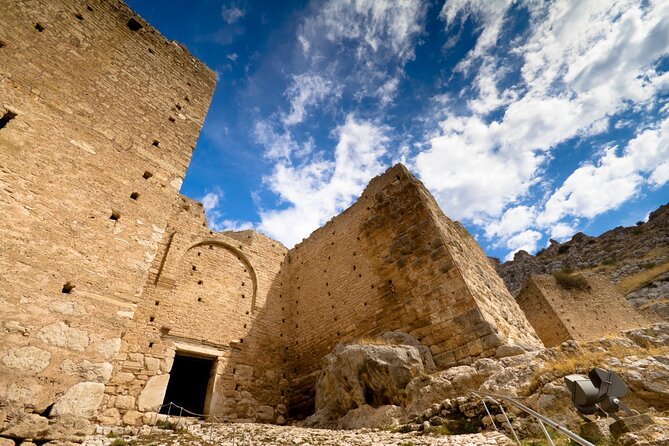
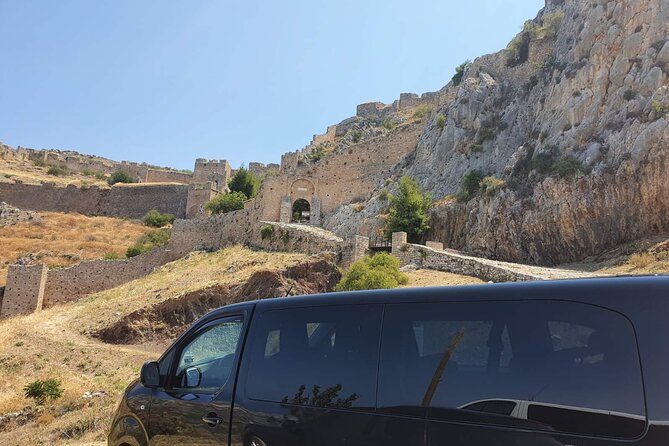
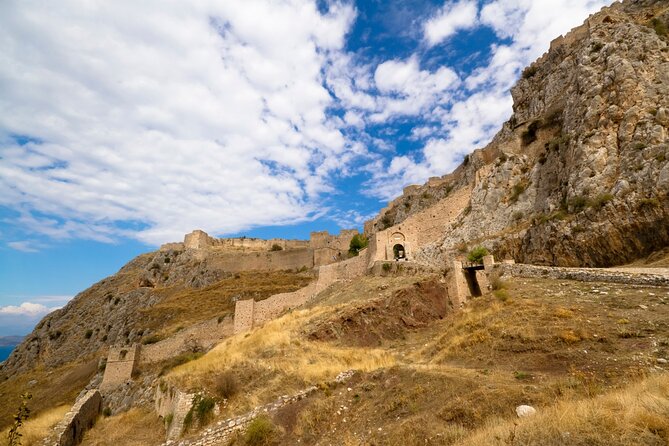
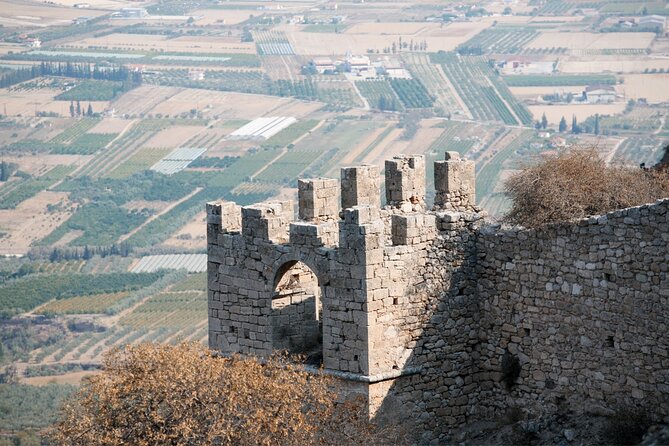
Acrocorinth is the old upper citadel, built on a massive rock above Ancient Corinth. Its height gave defenders control over the isthmus and the route into the Peloponnese. A dependable water supply helped make it a defensive stronghold for centuries.
The views are the reward. From high up, you can look over the plain, the ancient city, and the narrow land bridge that made Corinth so important. This is the stop that gives the day its grandest sense of place.
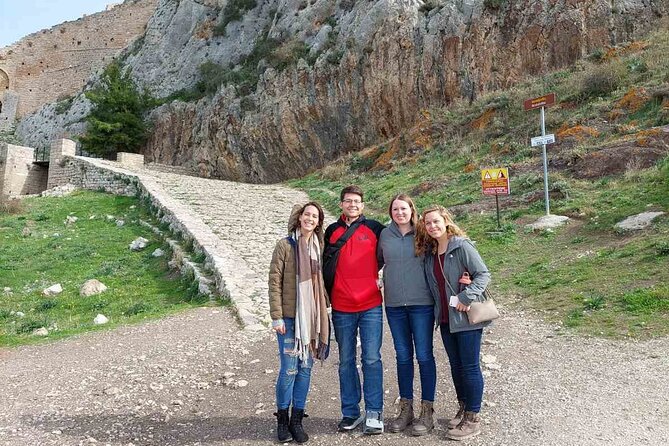
It is also the stop you should assess honestly. The route can be steep, rocky, and slippery, and reaching the top takes effort. One group found that no one made it all the way up before closing time. The planned stop is one hour, so time and fitness matter.
If you have knee problems, poor balance, or limited walking ability, you may prefer to spend less time climbing and more time at the lower sites. The private format helps here, since you can discuss the pace with your driver instead of being tied to a large group schedule. Still, private transport does not remove the physical challenge of the hill.
Inside the Archaeological Museum of Ancient Corinth
The Archaeological Museum of Ancient Corinth was built in 1932 to hold objects found during excavations. It was created by the American School of Classical Studies with funding from Ada Small Moore, and its design centers on two atriums. A west wing was added in 1951.
The museum gives needed context to the open-air ruins. After seeing columns, streets, and foundations under the sun, you can look at the objects recovered from the city and better understand how people lived, worshipped, traded, and governed.
Plan on about an hour. The museum and archaeological site admission costs €15 per person and is not included in the tour price. That extra fee is easy to overlook when comparing options, so add it to the advertised $204.81 per-person cost.
Your driver can explain the museum’s importance before you enter, but drivers do not accompany you inside the archaeological sites. If you want sustained interpretation among the exhibits and ruins, you will need to arrange a licensed guide separately.
Ancient Corinth and the places linked with Paul
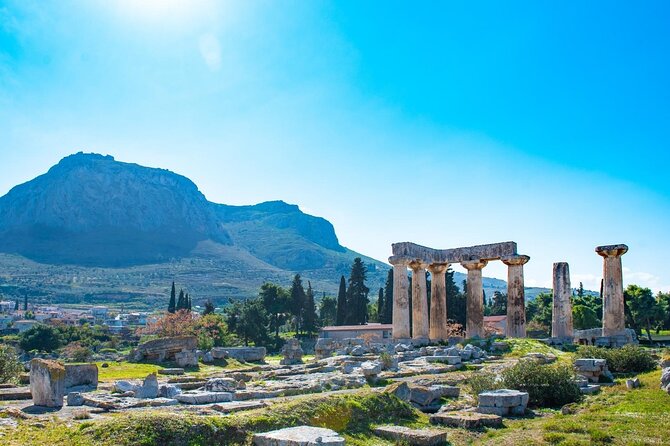
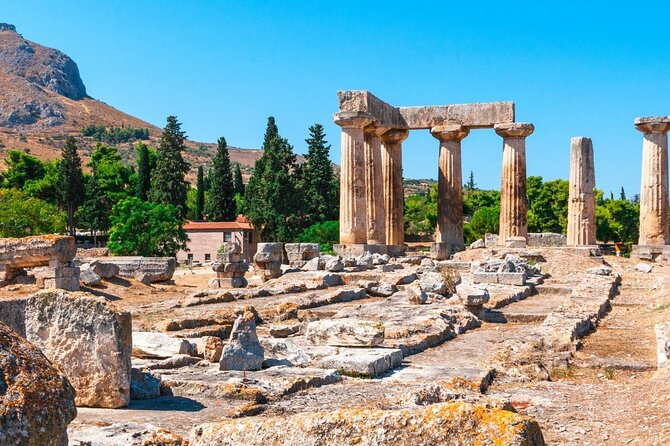
Ancient Corinth is the main event. In 400 BC, the city had a population of about 90,000, making it one of the largest and most important cities in Greece. Its position brought wealth, but it also brought outside influence, political pressure, and constant movement.
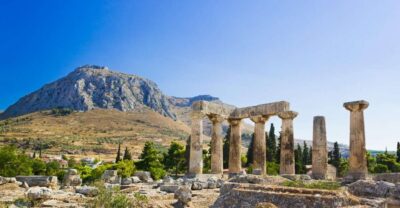
For Christian visitors, Corinth carries special weight because of First and Second Corinthians, along with the account of Paul’s missionary work in Acts. On site, you can see the Bema, the platform associated with public judgment, the Roman marketplace, and the Temple of Apollo. The stone connected with Paul’s preaching is another point of interest for people following the New Testament story.
Give yourself the full hour planned for the ruins, and use your free time wisely. The site is easier to appreciate if you pause to picture Corinth as a working city rather than treating each remaining column as an isolated object.
The tour description lists Ancient Corinth admission separately from transport, and the €15 charge covers the archaeological site and museum. Confirm the current arrangement when booking, since the ticket wording may not spell out every site in the day.
Lunch, local shops, and the practical rhythm of the day
You get about two hours for a break in Corinth, including time to browse village shops and eat at a local taverna. This pause keeps the day from becoming a nonstop march through ruins.
Several drivers have suggested family-run or seaside restaurants, and one lunch stop was described as having a good view and local food. Another group found the meal authentic but not suited to its taste, so restaurant choice is personal rather than guaranteed. Ask for options if you have strong preferences.
Timing can be the weak point. One group did not eat until 4 p.m., which is late for many people. I would carry a small snack, especially if you are traveling with children or plan to spend time climbing Acrocorinth.
What private transport adds to the price
At $204.81 per person, this is not the cheapest way to see Corinth. The price makes more sense when you divide it among a private group and consider the Athens pickup, return transport, air-conditioning, bottled water, WiFi, and the ability to adjust the pace.
You are paying for convenience and control, not a traditional guided tour. Your driver picks you up at your Athens hotel or apartment, or at Piraeus Port after disembarkation, then returns you to the same place. That is especially useful after a cruise, when arranging independent transport can eat into your day.
The tradeoff is important: your driver is not an official guide. Drivers such as Alex, George, Bill, Chris, Petros, and Dimitirous have provided English commentary and answered questions, but they do not enter the archaeological sites with you. The quality of the day can depend heavily on the individual driver’s communication style and subject knowledge.
Past experiences have been especially strong with Alex, George, and Bill, who helped with biblical context, timing, restaurant choices, and general questions about Athens. That does not guarantee a particular driver, but you can request one if the company allows it.
Who should book this Corinth day trip?
I would choose this tour if you want to cover several Corinth sites in one day without renting a car or joining a large bus group. It suits couples, families, and private groups who value door-to-door transport and flexibility.
It is particularly good for:
- People interested in Paul’s journeys and early Christianity
- Visitors who want both ancient and modern engineering in one day
- Cruise passengers with pickup from Piraeus Port
- Small private groups willing to split the per-person cost
- Active visitors who are comfortable with the Acrocorinth climb
I would think twice if you need step-free sightseeing, want a full guided explanation inside every site, or dislike long days on the road. The tour is also less appealing if your main goal is a slow, museum-heavy visit, since the schedule spreads time across many stops.
Free cancellation is available up to 24 hours before the start time. The experience requires good weather, with a different date or full refund offered if poor weather forces cancellation.
Should you book the Private Biblical Ancient Corinth Tour?
Book it if you want a broad, personal day that connects the Corinth Canal, ancient transport, Paul’s ports, the upper fortress, museum collections, and the Roman city. The private vehicle and flexible pace are the real advantages, while the strongest drivers add useful historical and biblical context.
Before paying, confirm the €15 site and museum fee, ask about the day’s exact stop order, and be clear about your walking ability at Acrocorinth. If you want expert interpretation inside the ruins, arrange a licensed guide. If you are comfortable exploring some sites independently, this is a practical and memorable way to reach Corinth from Athens.
FAQ
How long does the Private Biblical Ancient Corinth Tour last?
The tour lasts approximately eight hours, including about one hour of driving each way between Athens and Corinth.
Where can pickup take place?
Pickup is available from Athens hotels, apartments, and Piraeus Port. At a hotel, the driver waits in the lobby. At an apartment, the driver waits at the building entrance. At Piraeus, the driver waits in the disembarkation area.
Is admission to the archaeological sites included?
No. Admission to the Archaeological Site and Museum costs €15 per person and is not included in the tour price.
Is the driver a licensed tour guide?
No. Drivers are not official licensed guides and do not enter archaeological sites with you. They provide English commentary and can answer questions about the places you visit.
Is the Acrocorinth walk difficult?
The route to Acrocorinth can be steep, rocky, slippery, and long. The stop lasts about one hour, and the climb may not suit people with limited mobility or those uncomfortable on uneven ground.
What happens if bad weather cancels the tour?
If poor weather causes cancellation, you can receive a different date or a full refund. You can also cancel for a full refund if you do so at least 24 hours before the experience begins.
Recently reviewed around Athens
- Small-Group Women History in Ancient Greece Walking Tour★ 5.0 · 38 reviews
- Ceramic and Pottery Creative Workshop with Two Local Artists★ 4.0 · 57 reviews
- Athens: Wine Workshop Create your Own Wine under the Acropolis★ 5.0 · 77 reviews
- Athens: Greek Wines Tasting with Sommelier and Acropolis Views★ 5.0 · 88 reviews
- Hydra Private Day Trip by Ferry from Athens with Transfers★ 4.0 · 30 reviews
- Small-Group Wine Tour in Athens with Tasting★ 5.0 · 33 reviews
- Wine Trails Private Tour/ Nemea visit 3 wineries from Athens or Nafplion (10 h)★ 5.0 · 44 reviews
- Acropolis of Athens, Parthenon and Acropolis Museum private tour with dinner★ 5.0 · 77 reviews
Ancient Corinth Tours, compared.
Ancient Corinth Day Trip with Canal & VR Guide
Read our review →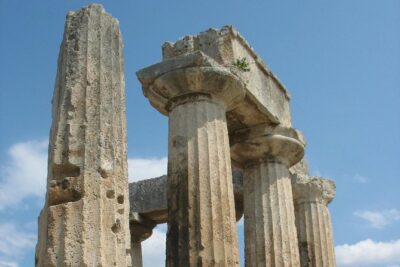
Private Biblical Tour Ancient Corinth & Isthmus Canal from Athens
Read our review →
4-Day Classical Greece Tour: Epidaurus, Mycenae, Olympia, Delphi, Meteora
Read our review →
Ancient Corinth & Nafplio Full Day Trip with Swim
Read our review →
Mycenae and Nafplion Day Trip from Athens with Official guide
Read our review →
Browse the lists this tour appears in