
Reviewed · ANCIENT CORINTH TOURS
Private Tour of Apostle Paul’s Footsteps in Ancient Corinth
The most meaningful part of this private Corinth tour is the chance to connect places named in the New Testament with the actual ground beneath your feet. You visit Kenchreai, where Paul arrived by sea, the Agora where he faced the Roman authorities, and the streets of Corinth where his work and friendships took shape.
I like two things right away. First, the route covers far more than the main ruins, including the Corinth Canal, ancient Diolkos, Kenchreai, and Acrocorinth. Second, a private car lets you set a comfortable pace. Guides such as Giannis, Nick, Ruslan, George, and Fotis are often praised for their patience, safe driving, history knowledge, and care with older family members.
The main consideration is that this is a driver-led tour, not a private licensed guide-led tour inside the archaeological sites. You also pay the €15 entrance cost separately, and the 5 to 6 hours includes driving time from Athens.
In This Review
- Key points to know before booking
- Why Corinth matters to Paul’s story
- The Corinth Canal: a sharp opening view
- Diolkos and the ancient shortcut across Greece
- Kenchreai, Paul’s eastern gateway
- Ancient Corinth, from the Agora to the Bema
- The Museum of Ancient Corinth fills in the details
- Acrocorinth, the fortress above the city
- Saint Paul Church brings the route into the present
- What the private format adds
- Price, timing, and practical value
- Food and extra local advice
- Who should book this Corinth tour?
- Should you book it?
- FAQ
- How long does the tour take?
- Is hotel or port pickup included?
- Is airport pickup included?
- Are archaeological entrance fees included?
- Is this a private tour?
- Is the tour conducted in English?
- Can I cancel for a full refund?
Key points to know before booking
- Paul’s Corinth comes to life at the Bema and Agora: These are the tour’s central biblical sites, tied to Paul’s preaching and trial before the Roman proconsul.
- Acrocorinth is the visual high point: The old fortress offers broad views and layers of Greek, Byzantine, Frankish, Venetian, and Ottoman history.
- The route includes two ancient ports: Kenchreai connects directly with Paul’s journeys, while Diolkos reveals how ancient ships crossed the isthmus.
- Your driver matters: Giannis, Nick, Ruslan, George, Dennis, Johnny, and Fotis are among the drivers praised for warmth, flexibility, and helpful explanations.
- Entry fees are extra: Allow €15 per person for the archaeological sites and museum.
- It suits small private groups: Groups of one to four use a sedan, while larger parties receive a suitable vehicle.
Why Corinth matters to Paul’s story
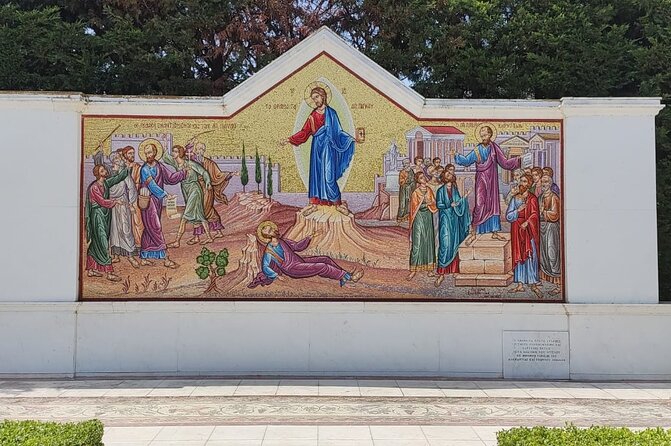
Corinth was not a minor stop on Paul’s travels. It was a major commercial city linking mainland Greece with the Peloponnese, and its position gave it money, movement, and a mix of cultures and religions.
Paul spent about 18 months with the Corinthians around 50 to 51 AD. The city became important enough to receive two New Testament letters, and its early Christian community included people such as Aquila, Priscilla, and Phoebe. The tour helps you place those names in a real setting instead of treating Corinth as a distant biblical reference.
You should know what this experience is, and what it is not. It is a historical tour with a strong Christian focus. The driver explains the biblical connections, local history, and ancient remains, but the company does not provide a licensed guide to accompany you into the archaeological sites. For many people, this works well because you can explore independently after receiving background from your driver. If you want a formal theological lecture at every ruin, you may find the format too light.
More Ancient Corinth, Mycenae and canal trips:
- From Athens: Mycenae, Epidaurus & Nafplio Full Day Trip
★ 4.8 · 2,438 reviews - From Athens: Mycenae, Epidaurus & Nafplio Full-Day Tour
★ 4.5 · 1,580 reviews - From Athens: Ancient Corinth Day Trip with Canal & VR Guide
★ 4.6 · 1,073 reviews
The Corinth Canal: a sharp opening view
The first stop is the Corinth Canal, cut through the 6.3-kilometer-wide Isthmus of Corinth in 1893. The canal transformed the Peloponnese into an island and created a direct water route between the Gulf of Corinth and the Saronic Gulf.
You have about 20 minutes here, which is enough for photographs and a quick look at the steep limestone walls. The water below can look surprisingly calm, but the scale of the cut gives the place its force. This is a good first stop because it explains why Corinth mattered long before Paul arrived. Control of this narrow crossing meant control of movement between two parts of Greece.
The canal is a modern engineering project, but the idea behind it is ancient. Greek and Roman leaders understood the value of shortening sea journeys around the Peloponnese. The next stop shows how earlier societies tried to solve the same problem.
Diolkos and the ancient shortcut across Greece
At Diolkos, you see the remains of a stone-paved trackway used to haul ships overland across the isthmus. It predates the canal by more than two thousand years.
The stop lasts about 10 minutes, so it is brief. Still, it gives you a useful picture of ancient practical thinking. Instead of sending ships around the dangerous southern tip of the Peloponnese, crews could move them across land along this route. It was a demanding task, but it saved time and reduced risk for trade and naval travel.
This is not a grand ruin with columns and statues. It is valuable because it shows how infrastructure shaped Corinth’s success. Ask your driver to explain how Diolkos fits into the story of the isthmus, since the physical remains can be easy to miss without context.
Kenchreai, Paul’s eastern gateway
Kenchreai, also spelled Cenchreae or Kechrees, was Corinth’s eastern port. Paul is associated with this place during his first visit to Corinth around 51 AD, and he later sailed from here toward Ephesus.
The site has only modest remains, but its connection with Paul gives it unusual weight. This is where the tour shifts from broad regional history to the personal movements recorded in the New Testament. The port also connects with Phoebe, a prominent Christian woman from the local church who is traditionally linked with carrying Paul’s letter to the Romans.
You spend about 20 minutes here. Do not expect a fully restored harbor. Come for the setting and the association, not for a large collection of visible ruins. The stop works best when your driver explains what the port meant in Corinth’s trade network and how it fits Paul’s route by sea.
More Athens trips worth a second look
- Athens: Acropolis & up to 5 Archaeological Sites Combo Pass
★ 4.4 · 12,619 reviews - Athens: Acropolis Ticket with Optional Audio or Live Guide
★ 4.2 · 11,055 reviews - Athens: Acropolis, Parthenon & Acropolis Museum Guided Tour
★ 4.8 · 9,316 reviews - Athens: Cape Sounion & Poseidon Temple Sunset Half-Day Trip
★ 4.8 · 8,241 reviews
Ancient Corinth, from the Agora to the Bema
Ancient Corinth is the heart of the experience. This is where you spend time with the physical remains of the city Paul knew, including the Agora, the Bema, the Temple of Apollo, streets, shops, and civic buildings.
The Bema was a raised platform in the center of the city. Paul is believed to have stood here during his appearance before the Roman proconsul. Even if you approach the site as a history enthusiast rather than a Christian pilgrim, the setting helps you understand how Roman authority operated in a busy public center.
The Agora was the city’s marketplace and public core. Paul’s work took place amid commerce, politics, religion, and ordinary daily life, not in an isolated religious setting. Nearby shops are associated with the sort of working world shared by Paul, Aquila, and Priscilla, who made and sold tents.
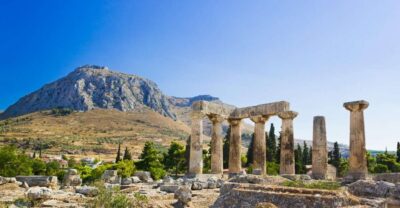
The Temple of Apollo is another major sight. Its surviving columns belong to a much older pagan tradition and remind you that Christianity entered a city with established gods, rituals, and civic cults. That contrast is one of the strongest parts of the tour. You can picture the early Christian message taking root beside temples and public customs that had shaped Corinth for centuries.
The planned visit here lasts about 40 minutes, though the private format may allow some flexibility. Entrance is not included. The total archaeological and museum admission is listed as €15 per person, so add that to the advertised tour price.
The Museum of Ancient Corinth fills in the details
The Museum of Ancient Corinth takes about 45 minutes and gives you a needed indoor counterpoint to the open-air ruins. Built in 1932, it holds objects found during excavations at Corinth.
The galleries cover a long span, including prehistoric finds and material from the Sanctuary of Asklepios. You see the city through everyday objects, religious pieces, and works of art rather than only through monumental ruins.
I find museums like this especially useful after walking through an archaeological site. The Agora can leave you with a general sense of scale, while the museum helps explain how people lived, worshipped, traded, and decorated their world. It also reinforces the fact that Corinth was not only a biblical backdrop. It was a functioning city with a long life before and after Paul.
Museum admission is also part of the €15 site fee. If you are short on time, do not confuse the museum with a quick gift-shop stop. The 45-minute visit is a substantial part of the tour and adds real context.
Acrocorinth, the fortress above the city
Acrocorinth is the most dramatic stop. The fortified acropolis rises above Ancient Corinth and carries layers from Greek, Byzantine, Frankish, Venetian, and Ottoman rule. Its walls, towers, and bastions show how useful this high position remained across many centuries.
The site is not just a Christian or classical stop. It tells the larger story of power in Corinth. Whoever held Acrocorinth could watch and help protect the city below, as well as the routes through the isthmus.
The ruins also include the location associated with the Temple of Aphrodite. Ancient accounts connect the sanctuary with a large community of priestesses, sometimes described as numbering up to 1,000. This detail provides a sharp contrast with the Christian community Paul served and helps explain the different religious worlds present in Corinth.
You have about 40 minutes here. Wear sturdy, comfortable shoes, since the ground is uneven and the site includes uphill walking. The fortress is rewarding, but it may be the most physically demanding portion of the day. Ask about the walking conditions if someone in your group has difficulty with slopes or rough surfaces.
The reward is the view. From Acrocorinth, the relationship between the high fortress, the ancient city, and the surrounding plain becomes clear. This is the place where I would allow extra photo time if your schedule permits.
Saint Paul Church brings the route into the present
The final stop is the modern Apostolos Pavlos Church in the center of Ancient Corinth. Inside, a mosaic by Pastorutti and Tsotsonis depicts Paul’s journey and mission in the city.
After the older ruins and pagan sanctuaries, the church offers a quieter way to finish. It links the ancient Christian community with modern Greek religious life and gives the tour a reflective ending.
You spend about 20 minutes here. The church is not an archaeological site, so it serves a different purpose. It is a place to consider Paul’s lasting influence rather than another set of ancient remains.
What the private format adds
The tour includes hotel and port pickup and drop-off, bottled water, WiFi, and an air-conditioned vehicle. For one to four people, the company uses a sedan. Airport pickup is possible for an additional €50 per booking.
The private setup is useful in several ways. You can ask questions about Paul, Greek history, churches, food, or places you pass along the route. You can also request a slower pace, more photo time, or comfort stops. Nick is praised for making sure his group had restroom breaks and places to refill water bottles, while Dennis is noted for helping an older passenger in and out of the car.
Several drivers are singled out for personal service. Giannis is repeatedly described as patient, warm, and well informed about Paul and the sites. Nick is praised for an easy manner, safe driving, and a clean vehicle. Ruslan is noted for punctual communication and for handling pickup from Piraeus and drop-off at the airport. George is praised for assisting an older mother, carrying water, and adjusting the pace. Fotis and Johnny also receive strong marks for safe driving and extra explanations.
The important point is that the driver assigned to you may shape the day. The company provides English-speaking professional tour drivers with strong history knowledge, but this is not the same as guaranteed access to one particular person. If you have mobility concerns or want a specific religious focus, explain that when booking.
Price, timing, and practical value
At $169.03 per person, the price is reasonable for a private 5 to 6-hour excursion from Athens if you are splitting the cost among two or more people. You are paying for private transport, pickup and drop-off, an English-speaking driver, water, and the ability to avoid organizing several separate connections.
The value is less obvious for a solo visitor, especially after adding the €15 entrance fee. A larger group can make better use of the private vehicle and personal attention, while a couple gains comfort and flexibility compared with a crowded group excursion.
Travel time is included in the tour duration. That matters. You should not expect five or six full hours walking among the ruins. The listed stops add up to roughly three hours and 15 minutes, with the remaining time used for driving between Athens and Corinth and between the sites.
Pickup is available from hotels, apartments, and ports. At a hotel or apartment, the driver waits at the entrance. At the port, the driver waits at the gate with a sign bearing your name. Airport pickup and drop-off cost extra, which some people find useful when connecting a flight with a hotel or cruise.
Bring comfortable shoes, a hat, and sunscreen. Greek sun can be strong, and Acrocorinth adds uneven ground and uphill walking. Child seats are available by request, and most people can take part, but the route is not described as fully accessible.
Food and extra local advice
Lunch is not included, but the private format can make it easy to ask for a restaurant suggestion. George recommended a local Mediterranean meal of lamb chops, Greek salad, and dessert, while another driver suggested a memorable gyro.
Do not treat lunch as guaranteed. It depends on your timing and your driver, and it is paid separately. Still, this is one advantage of a private day. You can ask for a meal stop instead of being tied to a fixed coach schedule.
Drivers also offer practical advice about Greece beyond the formal route. That can be useful when Corinth is one day in a larger Athens or cruise itinerary.
Who should book this Corinth tour?
I would recommend it most strongly to:
- Christian visitors who want to connect Acts and Paul’s letters with real places
- Couples and families who prefer a private car to a large group
- Cruise passengers seeking a port pickup and a flexible day trip
- History fans interested in Greek, Roman, Byzantine, Frankish, Venetian, and Ottoman periods
- Families traveling with older relatives who may need help and a gentler pace
- Visitors who want Ancient Corinth and Acrocorinth without arranging transport themselves
I would be more cautious if your main goal is a formal biblical study tour led by a licensed archaeologist or theologian. The experience is driven by a history-focused English speaker, and the site visits are not accompanied by a licensed guide. One disappointed customer expected a more explicitly biblical program. That is a fair warning: Paul is the thread running through the day, but the tour also covers engineering, archaeology, pagan religion, military history, and modern Greece.
Should you book it?
Book this tour if you want a well-rounded private day trip that places Paul’s Corinth inside its wider setting. The strongest moments are the Bema, Agora, Kenchreai, Acrocorinth, and the contrast between the Temple of Apollo, the Temple of Aphrodite, and the modern Saint Paul Church.
The main tradeoff is cost versus depth. You receive comfortable private transport and flexible attention, but you pay site fees separately and do not have a licensed guide inside the ruins. For a couple, family, or port group that values convenience and personal care, the price can make good sense. For a solo visitor seeking the cheapest option, a group excursion may be better.
The cancellation policy is generous if your plans change: cancel at least 24 hours before the start for a full refund. Poor weather can also lead to a new date or full refund. With comfortable shoes, sun protection, and realistic expectations about the driver-led format, this is a strong way to see Corinth from Athens.
FAQ
How long does the tour take?
The tour lasts approximately 5 to 6 hours, including travel time between Athens, Corinth, and the individual stops.
Is hotel or port pickup included?
Yes. Hotel, apartment, and port pickup and drop-off are included. At a hotel or apartment, the driver waits at the entrance. At a port, the driver waits at the gate with a sign bearing your name.
Is airport pickup included?
Airport pickup and drop-off are optional and cost an additional €50 per booking.
Are archaeological entrance fees included?
No. Entrance fees for the archaeological sites and museum are not included. The listed cost is €15 per person.
Is this a private tour?
Yes. Only your group participates. Groups of one to four people use a sedan vehicle.
Is the tour conducted in English?
Yes. The tour is offered in English and includes an English-speaking professional tour driver.
Can I cancel for a full refund?
Yes, if you cancel at least 24 hours before the experience start time. Cancellations made less than 24 hours before the start are not refunded. If poor weather causes the company to cancel, you are offered another date or a full refund.
Recently reviewed around Athens
- Small-Group Women History in Ancient Greece Walking Tour★ 5.0 · 38 reviews
- Ceramic and Pottery Creative Workshop with Two Local Artists★ 4.0 · 57 reviews
- Athens: Wine Workshop Create your Own Wine under the Acropolis★ 5.0 · 77 reviews
- Athens: Greek Wines Tasting with Sommelier and Acropolis Views★ 5.0 · 88 reviews
- Hydra Private Day Trip by Ferry from Athens with Transfers★ 4.0 · 30 reviews
- Small-Group Wine Tour in Athens with Tasting★ 5.0 · 33 reviews
- Wine Trails Private Tour/ Nemea visit 3 wineries from Athens or Nafplion (10 h)★ 5.0 · 44 reviews
- Acropolis of Athens, Parthenon and Acropolis Museum private tour with dinner★ 5.0 · 77 reviews
Ancient Corinth Tours, compared.
Ancient Corinth Day Trip with Canal & VR Guide
Read our review →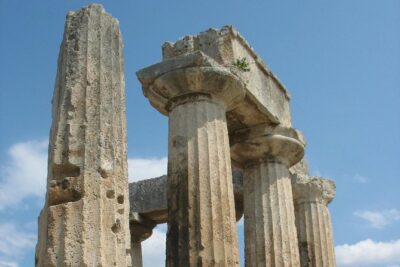
Private Biblical Tour Ancient Corinth & Isthmus Canal from Athens
Read our review →
4-Day Classical Greece Tour: Epidaurus, Mycenae, Olympia, Delphi, Meteora
Read our review →
Ancient Corinth & Nafplio Full Day Trip with Swim
Read our review →
Mycenae and Nafplion Day Trip from Athens with Official guide
Read our review →
Browse the lists this tour appears in