Reviewed · ATHENS TOURS
Unexpected Athens Orientation Tour
Athens reveals itself in layers on this four-hour walk. You move from the polished grandeur of Syntagma and Kolonaki through the more restless streets of Exarcheia, then into Psiri and Monastiraki, where Ottoman-era traces, markets, old tombs, and modern city life meet. I like the way this tour explains how Athens became a European capital, rather than treating the city as a collection of ancient ruins. I also like its focus on places you might pass without understanding, including old rivers, 19th-century buildings, and a WWII prison that is closed Mondays and Tuesdays. The main consideration is pace: four hours on foot covers a lot of ground, so comfortable shoes are essential.
The guides are a major part of the experience. Andreas is praised for his clear, friendly approach, while Simos is noted for attentive pacing. Antigoni has also been singled out for connecting city history with present-day Greek life. At $62 per person, the tour is not the cheapest way to walk around Athens, but it offers a useful citywide framework and can save you hours of trying to piece the story together alone.
In This Review
- Key points to know before booking
- Why this Athens walk feels different
- Syntagma Square and the making of a capital
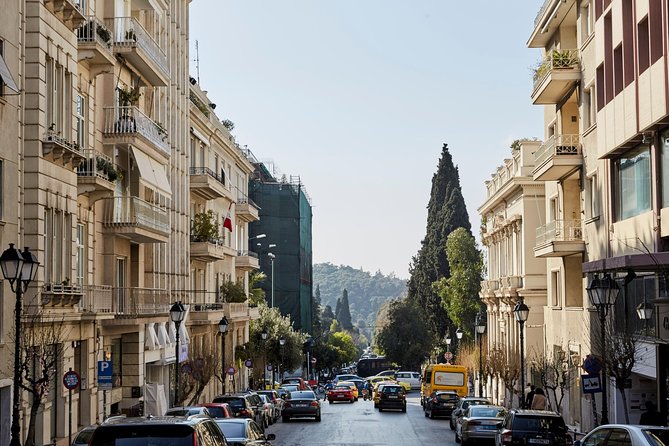
- Kolonaki and the polished side of Athens
- Exarcheia and the city’s harder questions
- Psiri and the Ottoman imprint
- Monastiraki and the final half hour
- The city map adds real value
- Guides, group size, and the pace of the walk
- Is $62 a fair price?
- Who should book this Athens tour?
- Should you book Unexpected Athens Orientation Tour?
- FAQ
- How long does the Unexpected Athens Orientation Tour last?
- Where does the tour start and finish?
- Which languages are available?
- Is the tour available as a private experience?
- Is the WWII prison open every day?
- What should I bring?
- Are food, drinks, and gratuities included?
Key points to know before booking
- Four neighborhoods, one connected story: Walk from Syntagma through Kolonaki, Exarcheia, Psiri, and Monastiraki rather than staying around the Acropolis.
- A strong introduction to modern Athens: See the Parliament, Academy, University, National Library, central markets, and major squares.
- History beyond classical Greece: The route covers Ottoman neighborhoods, royal Athens, industrial-era buildings, WWII history, old rivers, and ancient tombs.
- Expect a serious walking tour: The four-hour route has guided visits lasting about one hour each in Kolonaki, Exarcheia, and Psiri, followed by 30 minutes in Monastiraki.
- French and English are available: You can choose a live guide in either language, and private groups are available.
- Check the prison stop carefully: The WWII prison is closed on Mondays and Tuesdays, so the exact experience can vary by day.
Why this Athens walk feels different
Many first visits to Athens revolve around the Acropolis, the Ancient Agora, and the Roman Forum. Those places deserve your time, but they do not explain the whole city. Athens is also a modern capital shaped by royal rule, Ottoman memory, industrial growth, political change, migration, and daily commerce.
This tour is built around that broader view. It begins at Syntagma Square, the symbolic center of contemporary Athens, then moves through districts with very different moods and architectural styles. You get a clearer sense of the city’s transition from old settlement to European capital.
I especially like this approach if you have already seen the major ancient monuments. The walk gives you another way to read Athens. A grand neoclassical building is not just attractive stonework. A market is not merely a place to buy food. A neighborhood name can point to a period of political and cultural change.
The tour also seems well suited to first-time visitors who want help getting their bearings. Several past bookings describe it as a useful introduction, while people who had already visited Athens found new streets and fresh context. That range is important. This is not simply a beginner’s walk, but it is accessible enough to serve as one.
More Athens trips worth a second look
- Athens: Acropolis & up to 5 Archaeological Sites Combo Pass
★ 4.4 · 12,619 reviews - Athens: Acropolis Ticket with Optional Audio or Live Guide
★ 4.2 · 11,055 reviews - Athens: Acropolis, Parthenon & Acropolis Museum Guided Tour
★ 4.8 · 9,316 reviews
Syntagma Square and the making of a capital
Your starting point is Syntagma, or Constitution, Square. The meeting point may vary according to the option you book, so check the final instructions before setting out.
Syntagma is the right place to begin because it represents the political heart of modern Greece. From here, the guide places Athens in the 19th century, when the city was being shaped as the capital of a new European state. The tour highlights royal palaces and other landmarks tied to that period, helping you see how the city’s public face was constructed.
The route includes the Parliament, the Academy, the University, and the National Library. These buildings are among the clearest examples of Athens looking westward in its architecture and civic ideals. Their columns and formal facades can seem familiar at first glance, but the point of the tour is to explain why they were built and what role they played in creating a modern capital.
You will likely get more from these buildings with a guide than you would from a quick photograph. The value is not just architectural detail. It is the connection between political power, education, national identity, and the physical shape of the city.
Kolonaki and the polished side of Athens

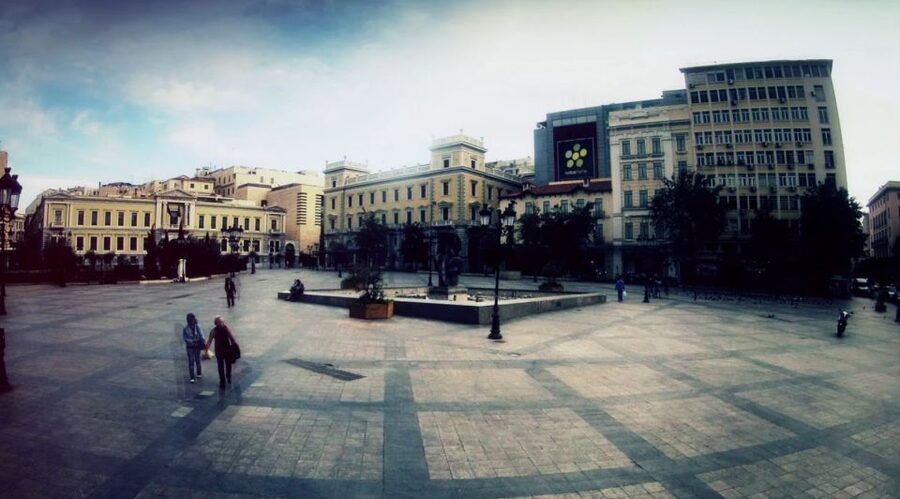
The first major neighborhood stop is Kolonaki, with about an hour of guided touring. This district gives you a different view of Athens from the market lanes and older residential quarters later in the walk.
Kolonaki is associated with central Athens at its most formal and refined. Here, the guide can help you notice the relationship between government buildings, grand residences, public institutions, and the city’s 19th-century development. The tour description also points to landmarks linked to the industrial revolution and royal Athens, so this section broadens the story beyond ancient Greece.
The strength of spending a full hour here is that you are not simply passing through. You have time to understand how one district reflects the ambitions of a growing capital. The drawback is that some visitors may find this portion less immediately dramatic than the later streets of Psiri or Monastiraki. It rewards attention to architecture and civic history more than quick visual thrills.
I would not book this tour expecting a museum-style route with long interior visits. It is primarily a walking experience. The buildings and streets are the material, and the guide provides the explanation that ties them together.
Exarcheia and the city’s harder questions
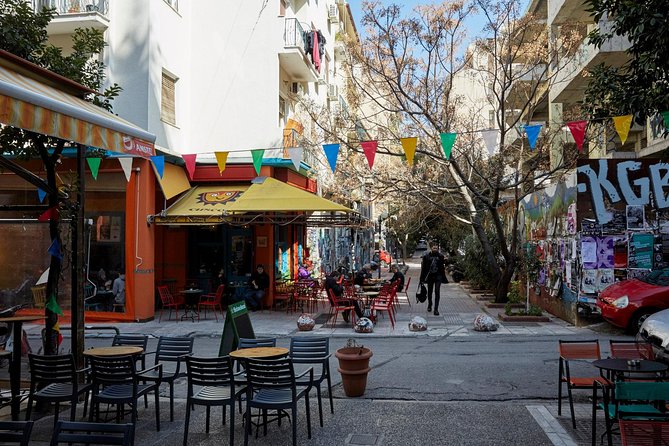
The tour then reaches Exarcheia, again with about an hour of guided time. This is one of the most useful parts for anyone who wants to understand Athens as a living city rather than a historical display.
Exarcheia allows the discussion to move from national monuments to social and political life. The exact points covered depend on the guide and the day, but the overall purpose is clear: you see a district that helps explain the tensions and challenges of contemporary Athens.
The walk also includes a descent to a notorious WWII prison. This is a powerful historical element, but it comes with a practical catch. The prison is closed Mondays and Tuesdays, so do not assume this part will be available on those days. If that site matters to you, check the operating schedule before booking.
This stop may feel heavier than the architectural sections. That is part of its value. Athens is not only a postcard city of ancient temples and sunny squares. Its 20th-century story includes occupation, imprisonment, hardship, and political conflict. A good guide can put those events into a human scale.
The route may also point out ancient rivers that still flow and tombs from an earlier era. These details are easy to miss because modern streets have covered or redirected much of the old city. You might walk past water or stonework without realizing how far back its story reaches. That contrast, old traces under a modern capital, is one of the tour’s best ideas.
A different kind of day out, same corner of Greece:
- Athens: Cape Sounion & Poseidon Temple Sunset Half-Day Trip
★ 4.8 · 8,241 reviews - Athens: Acropolis and Parthenon Guided Walking Tour
★ 4.6 · 5,882 reviews - All Day Cruise -3 Islands to Agistri,Moni, Aegina with lunch and drinks included
★ 5.0 · 4,958 reviews - Athens, Piraeus, and Coastline: Blue Hop-On Hop-Off Bus
★ 3.9 · 4,849 reviews
Psiri and the Ottoman imprint
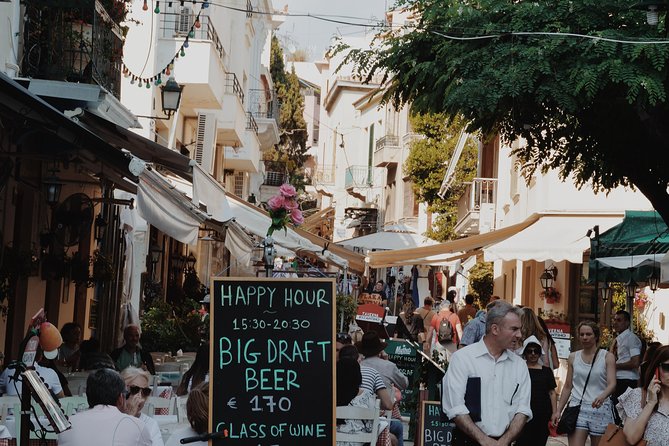
Psiri receives about an hour, making it one of the central parts of the experience. This is where the tour examines the ways Athens changed under Ottoman rule and how older traditions interacted with Western European ideas.
The neighborhood helps correct a common misunderstanding about Athens. The city did not move directly from classical glory to modern European capital. Centuries of Ottoman rule and local customs shaped its streets, buildings, food traditions, and social life. Some elements were preserved, some were altered, and others were pushed aside as the new capital was planned.
The guide’s job here is to point out that mixture without reducing it to a simple before-and-after story. You will walk through streets where older forms and newer ambitions sit close together. The preserved Ottoman neighborhoods are valuable precisely because they show a side of Athens that is often overlooked by visitors focused on the Acropolis.
This is also a good place to ask questions. If you want recommendations for a traditional taverna or Greek coffee, the guides have provided that kind of local advice in the past. Keep in mind that food and drinks are not included, so any stop for a meal or coffee is at your own cost.
Monastiraki and the final half hour
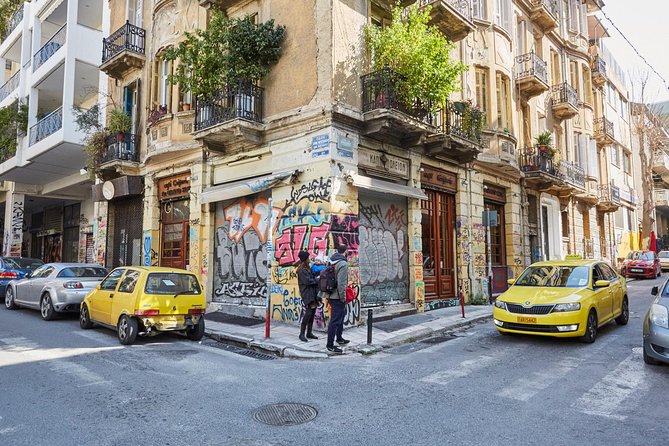
The last neighborhood is Monastiraki, with about 30 minutes of guided touring, and the walk ends at Monastiraki Square.
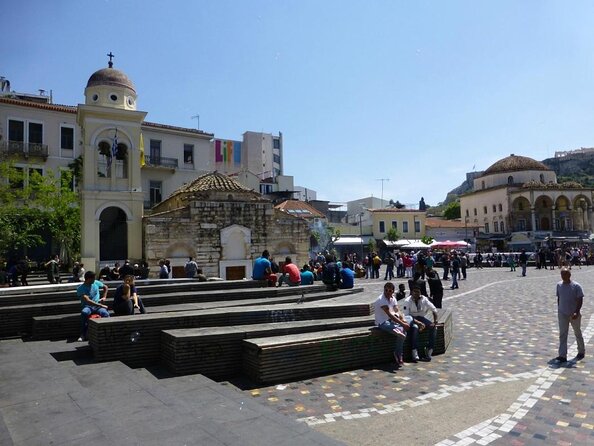
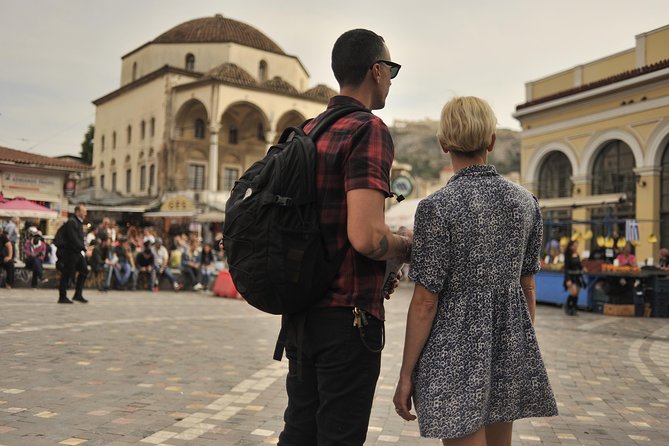
Monastiraki is an effective finish because so many periods of Athens meet here. Ancient remains, Ottoman traces, commercial streets, and present-day city life are all close together. After the quieter explanations in Kolonaki and Exarcheia, the final section gives you a more energetic urban setting.
The central markets and surrounding streets help make sense of Athens as a working city. You are not looking only at monuments preserved for public viewing. You are seeing the commercial routes and public spaces that keep the old center in use.
The shorter time here makes sense, but it also means you should not expect a long market visit. Think of Monastiraki as the closing chapter and a useful place to continue exploring on your own afterward. Since the walk finishes at Monastiraki Square, you can use your map and the guide’s suggestions to plan lunch, coffee, shopping, or another nearby sight.
The city map adds real value

The included map highlights changes across 2,500 years. That may sound like a small extra, but it helps with the central challenge of understanding Athens: the city’s past is often hidden beneath its present form.
Use the map during the walk, then keep it afterward. It can help you remember which areas belong to the royal capital, which streets reflect Ottoman influence, and where the modern city has covered older features.
The map is especially useful if you plan to explore independently after the tour. The guide gives you a framework, and the map helps you keep that framework in place. I would treat it as a practical planning tool, not just a souvenir.
Guides, group size, and the pace of the walk
The experience is available in English or French. Past bookings have praised several guides by name, including Andreas, Simos, and Antigoni. The recurring strengths are clear explanations, a friendly manner, attention to the group, and a well-managed pace.
That last point matters. Four hours is a long time to be walking and listening, particularly in warm weather. Simos has been praised for pacing the route carefully, which is reassuring because this tour covers four districts rather than concentrating on one small area.
A private group option is available if you want a more personal format. The standard experience can also be a good choice if you like meeting a small group and hearing questions you might not think to ask yourself. One past booking specifically appreciated being part of a small group, though the exact group size is not stated.
Bring comfortable shoes. This is not optional advice. The route includes several neighborhoods, city squares, older streets, and a possible descent to the prison site. Food, drinks, and gratuity are not included.
Is $62 a fair price?

At $62 per person, this tour costs more than simply walking from Syntagma to Monastiraki with a guidebook. The question is what you are paying for.
You are paying for four hours of interpretation across several parts of Athens, not for entry to a single headline attraction. The value is strongest if you want to understand why the city looks the way it does, how Ottoman and Western influences met, and how ancient features survive inside a modern capital.
It is also good value for a first day in Athens if the tour helps you choose where to return later. You can mark the central markets, Psiri, Exarcheia, or the Ottoman streets for a longer visit. A guide’s restaurant and coffee suggestions may also help you avoid spending every meal in the most tourist-focused places.
The value is weaker if your main goal is the Acropolis or other major archaeological sites. This walk does not replace a dedicated ancient Athens tour, and the supplied information does not include entrance tickets to monuments or museums. It is best viewed as a companion to those visits.
Flexible booking terms add some practical value. You can cancel up to 24 hours ahead for a full refund, and the reserve-now, pay-later option lets you hold a place without paying immediately. Still, check the starting time and meeting point for your chosen option, since those details can vary.
Who should book this Athens tour?
I would recommend it to first-time visitors who want a clear introduction to Athens beyond the headline monuments. It is also a strong choice for returning visitors, especially if you have already seen the Acropolis and want neighborhoods, architecture, and modern social context.
History fans will appreciate the range. You get royal Athens, the 19th-century capital, Ottoman streets, WWII history, old watercourses, tombs, and markets in one route. Architecture fans will enjoy the Academy, University, National Library, Parliament, and other buildings of international interest.
The tour may be less suitable if you dislike long walks, prefer a slow museum visit, or want a food-focused experience. It also may not meet your expectations if you are looking for extensive time inside ancient sites. The prison section is unavailable Mondays and Tuesdays, so those dates deserve special attention.
Should you book Unexpected Athens Orientation Tour?
Book this tour if you want to understand Athens as more than the setting for ancient ruins. Its best feature is the range of the story: royal palaces and neoclassical institutions, Ottoman neighborhoods, WWII memory, old rivers, city markets, and modern streets all fit into one guided walk.
I would choose it early in an Athens visit, then use the rest of your time to return to the places that caught your attention. Choose a comfortable pair of shoes, check the prison schedule, and allow for four hours of steady walking.
At $62, it is a considered purchase rather than a casual stroll. For a guide-led introduction to the city’s many eras, with English or French service and the option of a private group, the price is reasonable. If you only want the ancient highlights, spend your money elsewhere. If you want the story between the monuments, this is the better choice.
FAQ
How long does the Unexpected Athens Orientation Tour last?
The tour lasts four hours. The listed route includes about one hour in Kolonaki, one hour in Exarcheia, one hour in Psiri, and 30 minutes in Monastiraki.
Where does the tour start and finish?
The tour starts at Syntagma, or Constitution, Square. The listed finishing point is Monastiraki Square. The exact meeting point may vary according to the option booked.
Which languages are available?
You can take the tour with a live English-speaking or French-speaking guide.
Is the tour available as a private experience?
Yes. A private group option is available.
Is the WWII prison open every day?
No. The prison is closed on Mondays and Tuesdays. Check the schedule if visiting this site is important to you.
What should I bring?
Bring comfortable shoes. The experience is a four-hour walking tour through several central Athens neighborhoods.
Are food, drinks, and gratuities included?
No. Food and drinks are not included. Gratuity is optional and is also not included.
Recently reviewed around Athens
- Small-Group Women History in Ancient Greece Walking Tour★ 5.0 · 38 reviews
- Ceramic and Pottery Creative Workshop with Two Local Artists★ 4.0 · 57 reviews
- Athens: Wine Workshop Create your Own Wine under the Acropolis★ 5.0 · 77 reviews
- Athens: Greek Wines Tasting with Sommelier and Acropolis Views★ 5.0 · 88 reviews
- Hydra Private Day Trip by Ferry from Athens with Transfers★ 4.0 · 30 reviews
- Small-Group Wine Tour in Athens with Tasting★ 5.0 · 33 reviews
- Wine Trails Private Tour/ Nemea visit 3 wineries from Athens or Nafplion (10 h)★ 5.0 · 44 reviews
- Private Athens Transfer Airport/Port -Greek Tours-Hourly service★ 5.0 · 88 reviews
Athens Tours, compared.
Acropolis & up to 5 Archaeological Sites Combo Pass
Read our review →
Acropolis, Parthenon & Acropolis Museum Guided Tour
Read our review →
Cape Sounion & Poseidon Temple Sunset Half-Day Trip
Read our review →

All Day Cruise -3 Islands to Agistri,Moni, Aegina with lunch and drinks included
Read our review →