
Reviewed · ACROPOLIS & ACROPOLIS MUSEUM TOURS
Acropolis and Acropolis Museum Private Tour with Licensed Expert
The most useful part of this Athens experience is the pairing of the Acropolis and Acropolis Museum. You first see the monuments in their hilltop setting, then examine original sculpture and architectural details in an air-conditioned museum nearby. That order turns a pile of famous stones into a story you can follow.
I like the private format for two reasons. You can set the pace, and you can stop to ask why a temple was built, how a myth fits the site, or what you are seeing in the museum. I also like that the guides are licensed experts, with names such as Betty, Vicki, Lydia, Eva, Nicole, and Catherine repeatedly praised for clear storytelling and strong command of Greek history.
The main consideration is price. The tour costs $188.65 per person, and entrance fees are extra: €30 for the Acropolis and €20 for the museum. Add the walking, hot sun, rough stone, and summer crowds, and you will want to choose your time carefully.
In This Review
- Key points to know before booking
- Meeting your guide by the Acropoli Metro Station
- Walking through the Theater of Dionysus
- Entering through the Propylaea
- Seeing the Temple of Athena Nike
- Taking time at the Parthenon
- Studying the Erechtheion and Caryatid figures
- Looking down at the Odeon of Herodes Atticus
- Connecting the hilltop to the Acropolis Museum
- Choosing the Agora or five-hour city version
- Guides, group size, and communication
- Is $188.65 per person a fair price?
- Practical advice for a smoother visit
- Who should book this Acropolis tour?
- Should you book it?
- FAQ
- How long does the Acropolis and museum tour last?
- Are Acropolis and Acropolis Museum tickets included?
- Where do I meet the guide?
- Is this a private tour?
- Is the tour offered in English?
- Can I choose a version that includes the Ancient Agora?
- What happens if bad weather cancels the tour?
Key points to know before booking
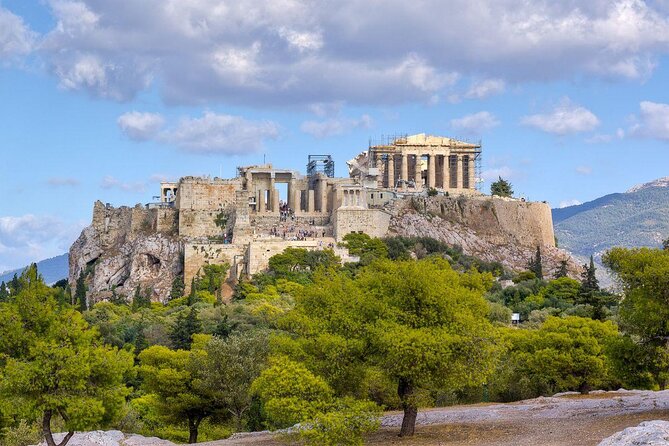
- About 80 minutes on the Acropolis: See the Theater of Dionysus, Propylaea, Temple of Athena Nike, Parthenon, Erechtheion, and Odeon of Herodes Atticus.
- About 80 minutes in the museum: Study original Acropolis sculptures, models, videos, and interactive displays with your guide.
- Private means flexible: Your group sets the pace and gets direct time with the guide rather than following a large bus group.
- Tickets cost extra: Budget €50 per person for the Acropolis and museum, unless prices or ticket arrangements change.
- Early starts help: Summer mornings are cooler and less crowded. By late morning, the hill can feel hot and packed.
- Several versions are available: Choose the Acropolis and museum, Acropolis only, Acropolis and Ancient Agora, or a five-hour city tour by luxury vehicle.
Meeting your guide by the Acropoli Metro Station
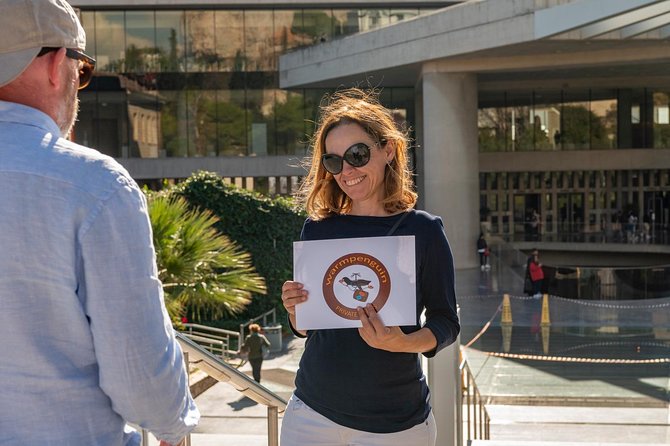
Your guide meets you at street level outside the Acropoli Metro Station, at 7 Makrygianni Street. This is close to the Acropolis Museum and gives you a useful first view of the ancient defensive wall around the hill.
That meeting point is more than a place to exchange names. Your guide can use the wall and surrounding streets to explain the Acropolis as a center of worship, civic life, and Athenian identity. You get your bearings before tackling the climb, which is helpful in a district where it is easy to focus only on the Parthenon and miss the larger setting.
The standard tour is private, so only your group participates. That matters if you have children, older family members, or people who want to linger over architecture. It also means you can ask the same question twice without holding up a large group.
If you choose the city tour by vehicle, pickup and return transfers are included from a central Athens hotel, cruise ship terminal, or another stated address. The regular walking options do not include vehicle transfers.
More Museum Tours in Athens
- Athens: Acropolis, Parthenon & Acropolis Museum Guided Tour
★ 4.8 · 9,316 reviews - Athens: Mythology of Delphi, Museum and Arachova Guided Tour
★ 4.6 · 4,008 reviews - Athens: Acropolis, Parthenon & Acropolis Museum Guided Tour
★ 4.8 · 3,579 reviews
Walking through the Theater of Dionysus
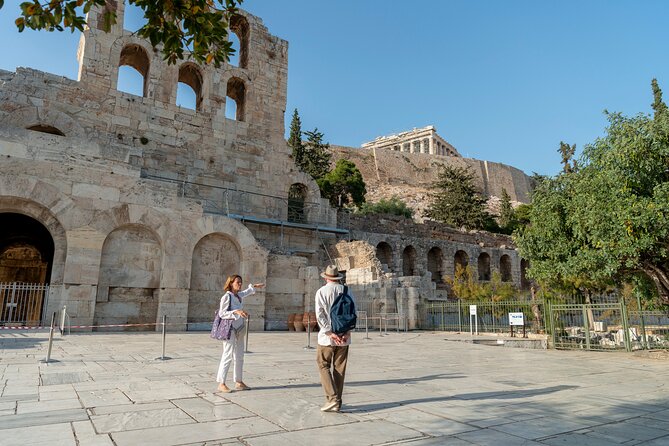
The Acropolis visit generally begins on the southern slope, where you see the Theater of Dionysus. Built in the fourth and fifth centuries BC, it occupies a natural amphitheater and is regarded as the world’s oldest theater.
This is a fine opening stop because it shifts your attention from temples to performance. Ancient Greek drama was not a side activity for a few artists. This theater could hold about 25,000 people, and major plays were first presented here before becoming part of the literary tradition you know today.
The stone seating and curved form are easy to understand when you have a guide pointing out how the theater uses the hillside. On your own, you may simply photograph the rows and move on. A licensed guide can explain why the place mattered and connect it to the religious festivals held in honor of Dionysus.
The walking is not difficult for everyone, but it is not a flat museum stroll. Expect an uphill route, uneven surfaces, and exposed sun. Wear shoes with a firm grip, and keep water handy, especially from late spring through early autumn.
Entering through the Propylaea
From the theater, you ascend toward the Propylaea, the monumental gateway to the Acropolis. This is the point where the hilltop monuments begin to feel like a carefully planned sacred precinct rather than a group of isolated ruins.
The approach also offers a useful glimpse into ancient visual drama. The original Acropolis was filled with painted details, metalwork, and sculpture. As the temples come into view, your guide can explain the huge bronze statue of Athena that once greeted people arriving at the sanctuary. Ancient accounts say the tip of Athena’s raised spear could catch the sunlight and be seen by ships approaching Athens.
That kind of detail is where a private guide earns the fee. You are not just told that the Acropolis was important. You learn how the site worked as a symbol visible from far away, and how mythology, religion, politics, and architecture met on the hill.
The Propylaea itself is also a practical bottleneck. Crowds gather here, so a guide who knows how to move a small group through the site is useful. One highly praised guide, Vicki, was singled out for handling the crowded, complicated setting while keeping attention on the monuments. That is a real advantage at a place where noise and tour groups can easily break your concentration.
Seeing the Temple of Athena Nike
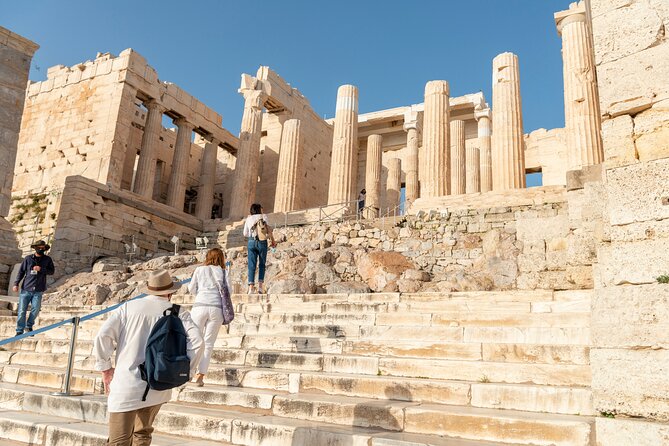
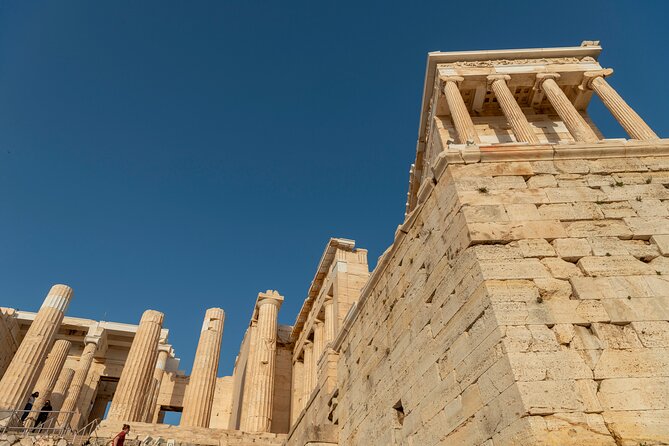
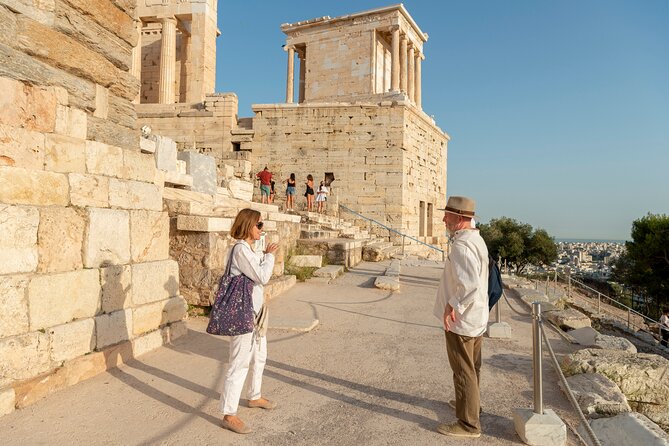
Near the entrance is the Temple of Athena Nike, a small Ionic temple built around 420 BC. Its position overlooking Athens gives it more visual power than its size might suggest.
The temple was dedicated to Athena in her role as Nike, or victory. Your guide can explain the Ionic design and the temple’s place near the entry route. You also get a sense of how carefully the Athenians used the hilltop’s edges, placing a compact but elegant building where it could be seen from the city below.
The structure has been restored, so this is one of the easier monuments to read. Even here, though, restoration can make it tempting to mistake a modern reconstruction for untouched antiquity. Ask your guide which parts are ancient, which were rebuilt, and how archaeologists make those decisions.
More Athens museums and collections:
- Acropolis monuments & Parthenon Walking Tour with Optional Acropolis Museum
★ 5.0 · 2,678 reviews - Athens All Included: Acropolis and Museum Guided Tour with Ticket
★ 4.5 · 2,673 reviews - Athens: Acropolis Museum Ticket with optional Audio Guide
★ 4.4 · 2,652 reviews - From Athens: Small-Group Delphi, Museum & Arachova Day Trip
★ 4.8 · 2,476 reviews
Taking time at the Parthenon
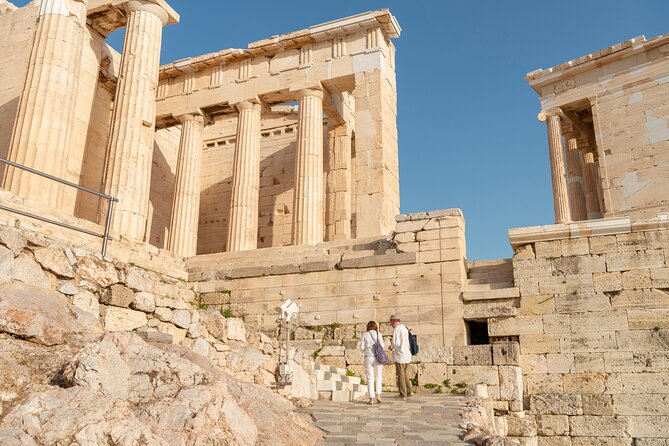
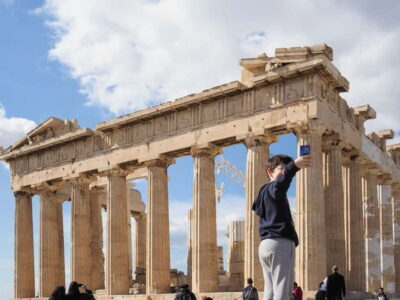
The Parthenon is the main event, but the best visit is not simply a quick walk around it for photographs. Your guide spends time on its construction, religious role, mythology, and place in the so-called Golden Age of Classical Greece.
Built as a temple to Athena, the Parthenon was both a religious center and a powerful statement about Athens. Its design is famous for visual refinements that make the building appear balanced and alive rather than rigid. The tour is most useful when your guide points out how art, engineering, worship, and civic pride fit together.
You will not enter the Parthenon itself. The experience is about viewing the exterior, understanding the structure, and seeing how it relates to the other monuments and the city below. Admission to the Acropolis is not included, and the stated fee is €30 per person.
The timing makes a major difference. A summer visit at 8 a.m. can still be pleasant, while conditions may be hotter and more crowded by 10 a.m. If the booking system offers you a choice, an early start is the sensible pick for comfort. For the Acropolis-only option, an afternoon visit can offer softer golden light and honey-colored tones on the stone, although you should still expect heat depending on the season.
Studying the Erechtheion and Caryatid figures
The Erechtheion is the second-largest temple on the Acropolis and one of the most visually distinctive. Its unusual plan reflects the complicated religious traditions attached to the hill, and it was dedicated to more than one divine figure.
Your guide explains the myths connected with Athena, Zeus, and the ancient kings associated with the site. The building is especially valuable as a reminder that Greek sanctuaries were not designed around one simple story. Different cults, legends, and sacred places could share the same hill.
The porch with female figures is one of the most memorable sights. The original Caryatids are not all on the building today. Several are displayed in the Acropolis Museum, where you can examine them at close range and compare the museum pieces with the figures still visible on the hill.
That link between the hill and the museum is one of the strongest reasons to book the combined experience. You see the architecture first, then meet the sculpture in a controlled setting where details such as folds in clothing, hair, and posture are easier to study.
Looking down at the Odeon of Herodes Atticus
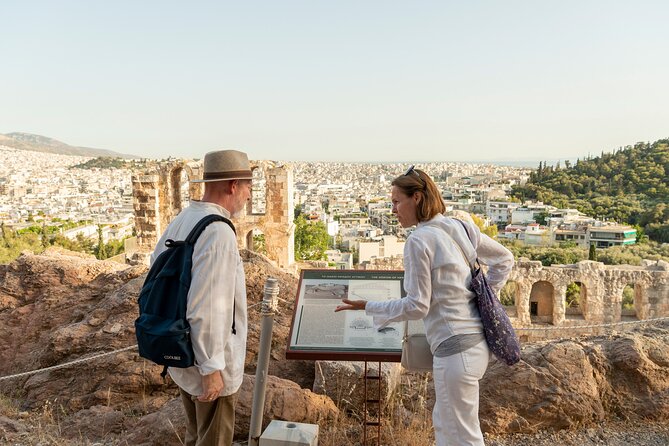
The Odeon of Herodes Atticus sits on the southern slope below the Acropolis. Herodes Atticus built it in AD 161 in memory of his wife, and its marble auditorium remains a working theater.
You generally view it rather than enter it during this tour. Still, the scale and surviving stonework make it an important stop. Unlike many ancient buildings that survive only as foundations, the Odeon still communicates its original purpose as a performance space.
Your guide can also help you separate the monuments by age. The Acropolis is not one single moment frozen in time. The Theater of Dionysus belongs to the classical world, while the Odeon was built centuries later under Roman rule. Seeing both makes the hill’s long use easier to grasp.
Connecting the hilltop to the Acropolis Museum
After roughly 80 minutes at the Acropolis and its associated buildings, you continue to the New Acropolis Museum, a short distance away. The museum visit lasts about 80 minutes, though the overall tour includes time for moving between sites.
The museum contains original masterpieces, architectural fragments, models, videos, and interactive displays. It is a cool and welcome change after the exposed hilltop, particularly on a hot day. More important, it lets you examine objects that are difficult or impossible to appreciate from a distance outdoors.
A guide can point out how museum pieces relate to the Parthenon, Erechtheion, and other structures you have just seen. The Caryatid figures are a key example. On the Acropolis, you see the porch and its setting. In the museum, you can study the original sculpture much more closely.
There is also value in seeing the museum before the Acropolis, as guide Lisa recommended to one group. That order gives you visual clues before you reach the hill. The more common order, Acropolis first and museum second, has its own strength because you move from the real setting to the surviving works. Ask about the best sequence when you meet your guide, especially if heat or crowd levels are a concern.
The museum ticket is listed at €20 per person and is not included in the tour price. Allow enough energy for both sites. The walk and standing add up, and one group described the experience as a lot of walking even while enjoying it.
Choosing the Agora or five-hour city version
The Acropolis and Ancient Agora option keeps the focus on ancient Athens but replaces the museum with the Agora. This is a three-hour version, and the tour ends at the Agora.
The Agora was the center of public life in ancient Athens, so it complements the Acropolis well. One guide, Nicole, was praised for bringing the Parthenon, Areopagus, and Agora into a single story involving gods, philosophers, and Paul’s sermon. The available information notes rough cobbles and some walking distance between the Acropolis and Agora, making this option a poor fit if you have limited mobility.
The luxury vehicle option expands the experience to five hours. It includes the Acropolis, Acropolis Museum, Temple of Olympian Zeus, Hadrian’s Arch, Olympic Stadium, Athens Trilogy, Syntagma Square, and the guards. Return transfers are included, and a licensed guide accompanies you at the Acropolis and museum.
This version makes sense if you are arriving by cruise ship, have limited time in Athens, or want an overview beyond the ancient hill. It is less focused than the three-hour walking tour, so choose it for coverage and transport rather than long, detailed attention at every monument.
Guides, group size, and communication
The guide is the heart of this experience. The guide team includes Betty, Vicki, Lydia, Eva, Nicole, Catherine, Lisa, Maria, Natalia, Effy, Valia, and others. You cannot assume a particular person unless the operator confirms it, but the strongest pattern in the feedback is clear: visitors valued guides who could explain complex history in an engaging, human way.
Betty was repeatedly praised for warmth, storytelling, and her ability to work well with children. Vicki received strong marks for handling crowds and explaining the site. Lydia was noted for architectural and historical detail, while Catherine was identified as an archaeologist. Nicole was praised for fluent English and vivid storytelling.
Private guiding also removes the need for group headphones in a small party. For groups of six or more, a whisper communication system is included. That helps with the background noise, though one honest account noted that Greek-accented English became harder to follow amid heavy crowd noise. If clear communication is important to your group, tell the operator when booking and confirm what can be arranged.
The tour is offered in English. Guides have also been described as flexible when groups were delayed, and one guide extended the time so a late-arriving party could receive the full experience. Do not count on that every day, but it is worth contacting the operator promptly if transport problems threaten your meeting time.
Is $188.65 per person a fair price?
At $188.65 per person, this is not a budget visit. You still need to add the listed admission fees, €30 for the Acropolis and €20 for the museum, for a stated total of €50 per person. Currency exchange rates also affect the final cost.
The value comes from the private licensed guide, not from admission. If you are happy reading signs, using an audio guide, and moving at your own pace, the price may be hard to justify. If you want context, direct questions, help with crowd flow, and a guide who can connect the outdoor ruins with museum objects, the fee buys a more focused visit.
The value improves for a family or small group because the guide serves your party rather than a large crowd. Group discounts may also be available, so check the total rather than judging only the per-person price.
The experience carries a 4.9 rating from 445 reviews, with 98 percent of customers recommending it. Those figures do not remove the practical drawbacks, but they match the consistent strengths: guide quality, personal attention, and strong explanations.
Practical advice for a smoother visit
Book early if your Athens dates are fixed. This experience is booked an average of 63 days ahead, which suggests that popular morning slots can disappear during busy periods.
Wear sturdy walking shoes. The Acropolis and Agora include uneven surfaces, and the Agora route has rough cobbles. Bring water, sun protection, and a hat in warm weather. The hill has limited shade, and the climb can feel demanding even if you are generally active.
Check the ticket arrangement after booking. The operator may contact you about purchasing skip-the-line tickets. If you do not reply, the guide assumes you have bought the required tickets for the correct time slots, and delays caused by missing or mistimed admission are not their responsibility.
The meeting point is near public transportation, and service animals are allowed. Most people can participate, but the Agora version is specifically not recommended for anyone with limited mobility. The tour requires good weather. If poor weather cancels it, you are offered another date or a full refund.
Cancellation is free up to 24 hours before the start time. Changes or cancellations inside that window are not accepted for a refund.
Who should book this Acropolis tour?
I would choose the three-hour Acropolis and museum version if you are visiting Athens for the first time and want the city’s essential ancient sites explained well. It suits families, history fans, cruise passengers who can reach the meeting point, and anyone who dislikes being herded through a large group.
Choose the Acropolis-only option if your budget is tighter or you mainly want time on the hill. It lasts about 90 minutes, ends inside the Acropolis, and leaves you free to take photographs and enjoy the views on your own.
Choose the Agora option if public life, philosophy, and the civic side of ancient Athens interest you more than sculpture. Choose the vehicle option if you need hotel or cruise pickup and want to add major city sights in one day.
Should you book it?
Book this tour if you want the Parthenon explained by a licensed guide rather than simply photographed. The best part is the connection between the Acropolis monuments and the original works in the museum, supported by the freedom to ask questions and adjust the pace.
Skip it if you prefer independent sightseeing, dislike a fixed three-hour schedule, or are trying to keep total costs low. In that case, admission tickets alone are easier to manage.
For most first visits, I would book the combined Acropolis and museum option, request an early start in summer, confirm the ticket plan, and allow extra energy for the walking. The guide can turn the visit from a hot climb around famous ruins into a clear, memorable introduction to Athens.
FAQ
How long does the Acropolis and museum tour last?
The standard Acropolis and Acropolis Museum experience lasts approximately three hours, with about 80 minutes at the Acropolis and about 80 minutes in the museum.
Are Acropolis and Acropolis Museum tickets included?
No. Admission is listed separately at €30 per person for the Acropolis and €20 per person for the Acropolis Museum. The stated total is €50 per person.
Where do I meet the guide?
The meeting point is at street level outside the Acropoli Metro Station, at 7 Makrygianni Street in Athens, near the Acropolis Museum.
Is this a private tour?
Yes. Only your group participates, allowing you to set the pace and ask the guide questions directly.
Is the tour offered in English?
Yes. The experience is offered in English.
Can I choose a version that includes the Ancient Agora?
Yes. The Acropolis and Ancient Agora option lasts three hours and ends at the Agora. The route includes walking over rough cobbles and is not recommended for anyone with limited mobility.
What happens if bad weather cancels the tour?
If poor weather causes cancellation, you are offered a different date or a full refund. You can also cancel up to 24 hours before the start time for a full refund.
Recently reviewed around Athens
- Small-Group Women History in Ancient Greece Walking Tour★ 5.0 · 38 reviews
- Ceramic and Pottery Creative Workshop with Two Local Artists★ 4.0 · 57 reviews
- Athens: Greek Wines Tasting with Sommelier and Acropolis Views★ 5.0 · 88 reviews
- Athens: Wine Workshop Create your Own Wine under the Acropolis★ 5.0 · 77 reviews
- Hydra Private Day Trip by Ferry from Athens with Transfers★ 4.0 · 30 reviews
- Small-Group Wine Tour in Athens with Tasting★ 5.0 · 33 reviews
- Wine Trails Private Tour/ Nemea visit 3 wineries from Athens or Nafplion (10 h)★ 5.0 · 44 reviews
- Private Athens Transfer Airport/Port -Greek Tours-Hourly service★ 5.0 · 88 reviews
Acropolis & Acropolis Museum Tours, compared.
Acropolis & up to 5 Archaeological Sites Combo Pass
Read our review →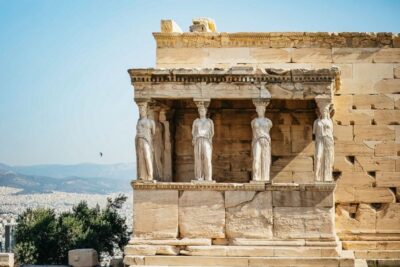
Acropolis, Parthenon & Acropolis Museum Guided Tour
Read our review →
Acropolis, Parthenon & Acropolis Museum Guided Tour
Read our review →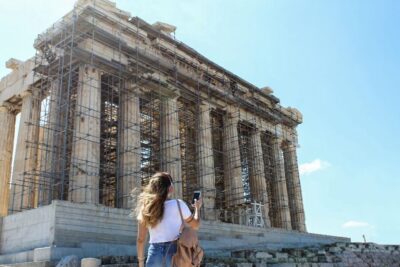


Acropolis monuments & Parthenon Walking Tour with Optional Acropolis Museum
Read our review →Browse the lists this tour appears in