
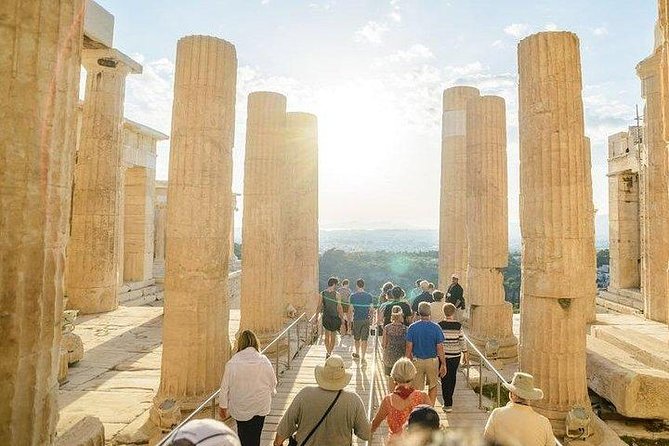
Reviewed · ACROPOLIS & ACROPOLIS MUSEUM TOURS
Ancient Athens tour: Acropolis, Parthenon and Acropolis Museum
The best part of this Athens tour is the link between the Acropolis monuments and the Acropolis Museum. You first see the Parthenon, Caryatids, and ancient theaters in their original setting, then examine surviving sculptures and decoration indoors, where the details are easier to understand.
I like the early 9 a.m. start, which helps you face less heat and, often, thinner crowds. I also like the small maximum of 20 people, plus the use of listening devices so you can hear guides such as Alexia, Lydia, Giannas, and John the archaeologist without standing shoulder to shoulder.
The main catch is the ticket setup. The advertised $72.59 price does not automatically include entry unless you choose the ticket option, so confirm your booking carefully. The uphill walk also crosses smooth, slippery stone, and Athens sun is no joke.
In This Review
- Key points to know before you book
- Why this four-hour Athens visit works
- Meeting at Porinou Street at 9 a.m.
- Walking up the Acropolis for the first view
- The Parthenon, about 10 minutes of focused attention
- Theater of Dionysus and the world of Greek drama
- Odeon of Herodes Atticus and the Propylaea
- The Erechtheion and the famous Caryatids
- The Acropolis Museum brings the stones to life
- The guides make the difference
- What the $72.59 price really means
- Heat, crowds, and what to pack
- Who should book this Acropolis tour?
- Should you book it?
- FAQ
- How long does the tour last?
- What time does the tour begin?
- Where does the tour meet?
- Where does the tour end?
- Is the tour offered in English?
- Are Acropolis and museum tickets included?
- Is a guide included?
- How large can the group be?
- What level of fitness is needed?
Key points to know before you book
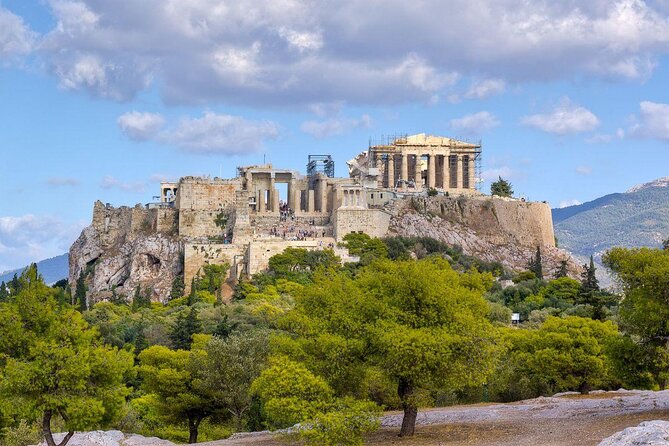
- The museum completes the Acropolis visit: You see ancient sculpture and architectural pieces indoors after seeing the ruins outdoors.
- A 9 a.m. start matters: The Acropolis can become very hot and crowded later in the day.
- A licensed guide adds real value: Mythology, building methods, political life, and small artistic details are explained on site.
- The route is physically moderate: Expect uphill walking, uneven ground, and slick rock near the summit.
- Tickets may cost extra: Acropolis entry is listed at €30 and museum entry at €20 unless your selected option includes them.
- You have some freedom at the end: The museum visit includes guided time, and you may be encouraged to remain longer on your own.
Why this four-hour Athens visit works
The Acropolis is easy to admire and surprisingly easy to misunderstand. From a distance, the Parthenon can look like a single famous temple on a hill. Up close, you are seeing a whole sacred precinct, with entrances, theaters, temples, statues, and layers of repair from different periods.
That is why I think a guide earns the fee here. The stones do not explain themselves. A good guide shows you where to look, gives you the myth behind a figure, and connects a damaged column to the larger story of Athens.
This experience is built around two major pieces: about two hours at the Acropolis and about one hour in the museum. The remaining time is used for the individual monuments and movement between them. It is a brisk visit, but the pace is meant to leave room for photographs and short pauses.
The group can include up to 20 people. That is not a private tour, but it is still more manageable than a large coach group. Listening devices are supplied, and several guides have been praised for finding places where the group can gather and hear clearly. One review advised bringing wired headphones, since sound could be difficult in some areas, so I would pack a pair if you have them.
More Museum Tours in Athens
- Athens: Acropolis, Parthenon & Acropolis Museum Guided Tour
★ 4.8 · 9,316 reviews - Athens: Mythology of Delphi, Museum and Arachova Guided Tour
★ 4.6 · 4,008 reviews - Athens: Acropolis, Parthenon & Acropolis Museum Guided Tour
★ 4.8 · 3,579 reviews
Meeting at Porinou Street at 9 a.m.
You meet at Porinou 5 in Athens at 9 a.m., near public transportation. The tour returns to the same meeting point at the end, making it easier to plan lunch or an afternoon visit nearby.
Arrive ready to walk. There is no separate bus ride described for the tour, and the central experience is on foot. Water is provided, but I would still bring sunscreen, a hat, and extra water if you normally drink a lot in warm weather.
The early start is one of the smartest parts of the schedule. The Acropolis has little shade, and the stone underfoot can hold the morning heat as the day progresses. Starting early also gives your guide a better chance of stopping in useful places before the hill becomes packed.
At the meeting point, check whether your booking includes entrance tickets. If not, the Acropolis ticket is listed at €30 per person and the museum ticket at €20. The supplied information says you can buy tickets in cash from the guide at the meeting point, unless you already purchased them or selected the inclusive option.
People under 25 should carry a physical passport or identity card to confirm eligibility for a reduced price. Do not rely only on a photograph or digital copy if you are counting on that discount.
Walking up the Acropolis for the first view
The Acropolis section lasts about two hours, and this is where your guide’s timing and crowd control matter most. The route includes the hilltop monuments, the entrance gates, the theaters below, and the major temples.
The walk is rated as requiring moderate physical fitness. You do not need to be an athlete, but you should be comfortable walking uphill on uneven stone. Some parts can be slippery, especially around the worn rock surfaces. Shoes with a secure sole make much more sense than smooth dress shoes.
The reward is the setting itself. The Acropolis is not just a museum display with a roof overhead. You see the buildings against the Attic sky, with Athens spreading below and the ancient structures occupying the rocky summit.
Your guide may pause at different points to avoid blocking pathways or to find a quieter spot for an explanation. This is useful because the site can be crowded even outside the main summer months. One visitor found the pace comfortable and felt there was enough time for photographs, while another wished for more time alone at the monuments. That is the fair tradeoff of a guided four-hour visit: you gain context and direction, but you do not have unlimited wandering time.
The Parthenon, about 10 minutes of focused attention
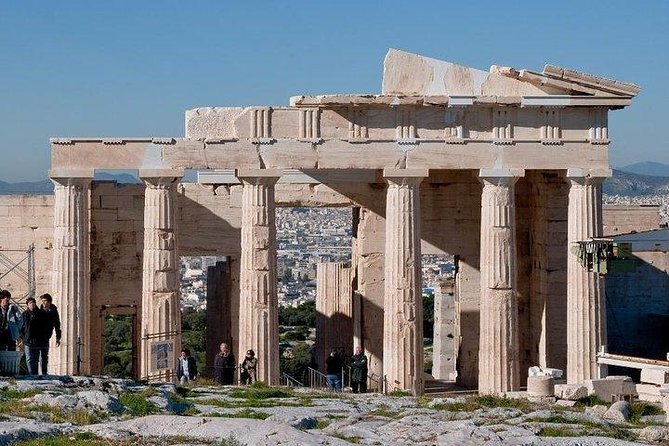
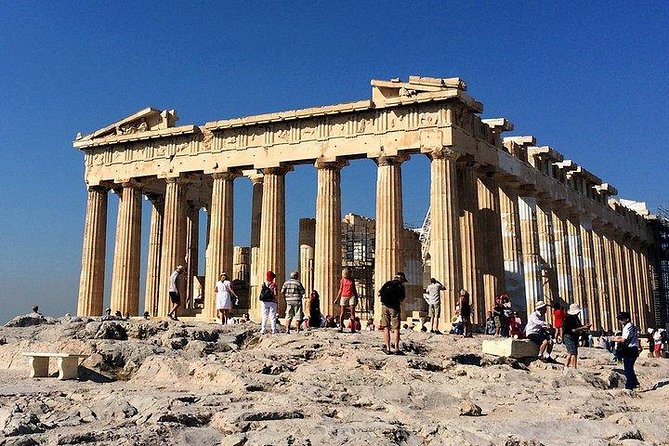
The Parthenon is the headline stop, but the building rewards close looking. It was dedicated to Athena, the city’s patron goddess, and its scale makes more sense when your guide points out its position at the top of the Acropolis and explains what its sculptural decoration once did.
The scheduled focus here is about 10 minutes, though the wider Acropolis visit gives you more time around the monument. Do not expect a long private inspection with no interruptions. You will share the space with other groups, and your guide will need to keep everyone together.
Still, a short explanation can change what you see. Instead of only photographing columns, you can learn how the temple fit into the sacred center of Athens and why the surviving decoration matters. Several guides have been praised for explaining not only the buildings but also the people who commissioned and built them.
The Parthenon is also the place where you will feel the weather most strongly. Bring water, use sunscreen, and take shade breaks when your guide offers them.
More Athens museums and collections:
- Acropolis monuments & Parthenon Walking Tour with Optional Acropolis Museum
★ 5.0 · 2,678 reviews - Athens All Included: Acropolis and Museum Guided Tour with Ticket
★ 4.5 · 2,673 reviews - Athens: Acropolis Museum Ticket with optional Audio Guide
★ 4.4 · 2,652 reviews - From Athens: Small-Group Delphi, Museum & Arachova Day Trip
★ 4.8 · 2,476 reviews
Theater of Dionysus and the world of Greek drama
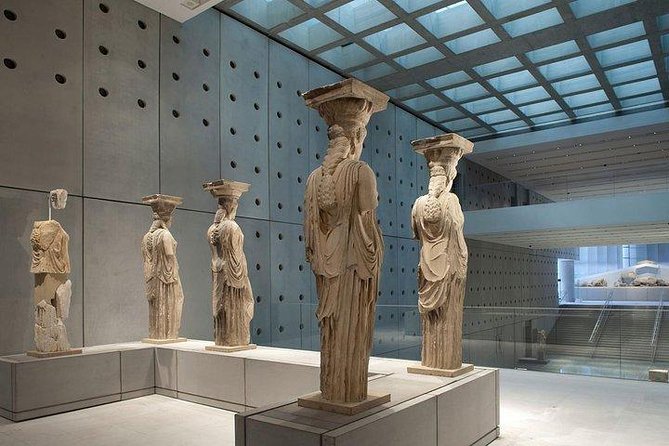
The Theater of Dionysus receives about 10 minutes, but its importance is far larger than that short stop suggests. It is described as one of the most important ancient theaters in the world, and it helps you picture Athens as a city where drama, religion, politics, and public life overlapped.
The theater is a useful counterpoint to the Parthenon. The temple represents sacred architecture on the summit, while the theater shows how large public gatherings shaped daily life below it. Your guide can give the site a human scale by explaining how performances fit into Athenian society.
The itinerary lists the Theater of Dionysus twice, but you should think of it as one part of the Acropolis route rather than two separate attractions.
Odeon of Herodes Atticus and the Propylaea
The Herod Atticus Odeon is another short stop, listed at about 10 minutes. This Greek-Roman venue still operates, a detail that helps bridge ancient construction and modern Athens. It is not merely a pile of old stone. Its form remains tied to performance.
The Propylaea, also given about 10 minutes, served as the grand gateway to the Acropolis. This is where the approach to the summit becomes especially meaningful. Rather than arriving at the temples by accident, you pass through a monumental entrance designed to shape the visitor’s experience.
A guide is especially helpful here because the Propylaea can be overshadowed by the Parthenon. It is easy to hurry through while aiming for the famous temple, but its scale and role tell you that the whole approach was carefully planned.
The Erechtheion and the famous Caryatids
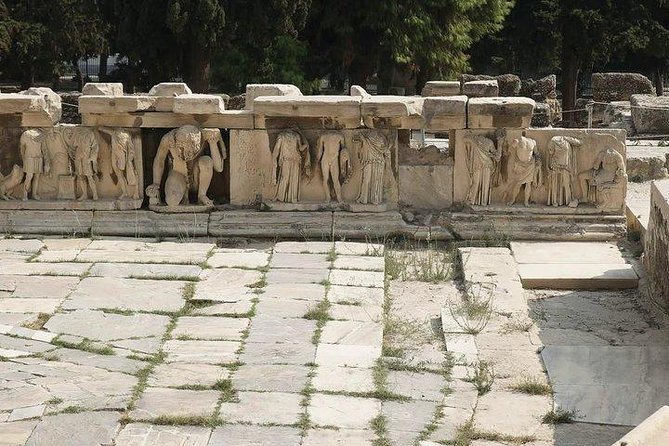
The Erechtheion is best known for its Caryatids, the female figures used as architectural supports. The stop lasts about 10 minutes, yet it often becomes one of the most memorable parts of the visit because the statues are so easy to recognize.
Your guide can help you separate the original ancient pieces from later copies and explain why the building has an unusual design. The Caryatids are not simply decorative figures placed beside a temple. They are part of the building’s structure and visual message.
This is also a good place to pay attention to details rather than only taking the standard photograph. Look at posture, clothing, hair, and the way the figures carry the weight above them. The museum visit later gives you a better chance to study related work at close range.
The Acropolis Museum brings the stones to life
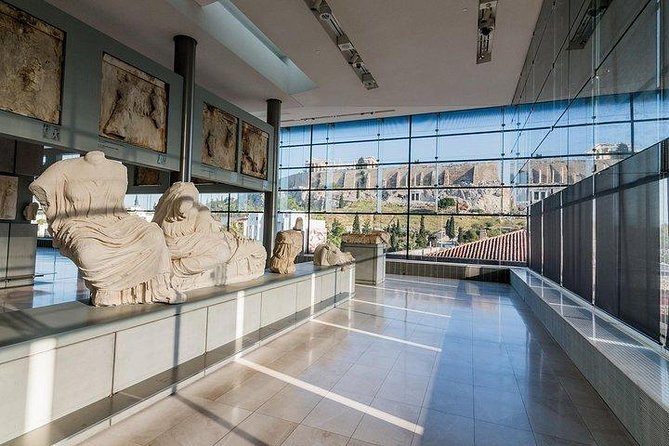
The museum visit lasts about one hour and is included only when you select the appropriate ticket option. If you are deciding whether to add it, I would choose the full Acropolis and museum experience. Seeing the ruins first gives the museum displays a clear purpose.
The Acropolis Museum focuses on finds from the Acropolis and its surrounding slopes. Its collection reaches from the Greek Bronze Age through Roman and Byzantine Athens. The building also sits over the remains of Roman and early Byzantine parts of the city, so the museum itself connects archaeology, architecture, and the modern street plan.
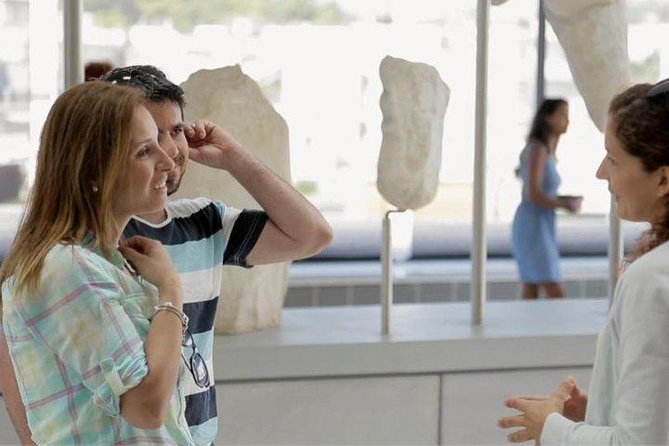
Inside, your guide can point out sculptural details and architectural decoration that are hard to study outdoors. Weather, distance, barriers, and crowds make close observation difficult on the hill. In the museum, preserved pieces are displayed at eye level and in a setting where you can take your time.
Guided museum time is usually about an hour, after which you may be encouraged to stay longer on your own. That arrangement suits me. You get a clear introduction, then have the option to revisit the objects that interest you instead of being rushed from case to case.
The museum is also the best answer to the common question of why an entry ticket is worth paying for after seeing the Acropolis itself. The hill gives you the place and scale. The museum gives you surviving fragments, decoration, and close detail.
The guides make the difference
The experience includes a licensed English-speaking guide, and the guide is the main reason to choose this format over an audio guide. The strongest guiding style described in the feedback combines archaeology, mythology, humor, and practical care.
Named guides have included Giannas, Selena, Afrofithi, Alexia Kolia, Bernardos, Efie, Aphrodite, Lydia, Zeta, George, Demos, Simon, Fey, Michael G, and John the archaeologist. Your guide will depend on the date, but the pattern is clear: the tour is designed around live explanation rather than a fixed recording.
Alexia was praised for making the group excited about Athens, while Lydia was noted for keeping people comfortable with shade and water breaks. John the archaeologist was singled out for his teaching style and careful pacing. Bernardos used humor and storytelling to make museum objects easier to remember.
These details matter because the Acropolis can overwhelm you. There are many monuments, many groups, and plenty of information competing for your attention. A patient guide who knows when to stop, when to move, and where the group can hear is worth more than a long speech delivered in the wrong place.
What the $72.59 price really means
At $72.59 per person, this is not a cheap walk, but the price needs to be judged against what you receive. A licensed guide covers the Acropolis and museum in one four-hour session, with a group capped at 20 people and bottled water provided.
The value is strongest if you want structure and explanation. You will not need to work out which monument you are looking at, find every major stop, or read a guidebook while trying to keep up with a group. You also gain a planned transition from the open-air site to the museum.
The price is less attractive if you already know the Acropolis well or want several hours to explore independently. One person specifically wanted more free time at the hill, and that is a reasonable concern. The tour covers many places in a short period, so the schedule favors broad coverage over long, quiet stops.
Remember the admission costs. Unless your selected package includes tickets, the Acropolis entry is €30 and the museum entry is €20. That can change the final cost by €50 per person, so compare the full amount rather than the headline tour price.
Heat, crowds, and what to pack
The practical advice here is simple:
- Wear shoes with a reliable grip.
- Bring sunscreen and water.
- Carry a hat or another way to protect yourself from the sun.
- Bring wired headphones if you have them, in case the supplied listening setup is hard to hear in a crowded area.
- Carry a physical passport or ID if you are under 25 and seeking a reduced ticket.
- Leave room in your schedule if you want to remain in the museum after the guided hour.
Crowds are part of the experience. Even in September, the Acropolis can be busy. The guide may find better gathering points and photo locations, but no tour can make the hill empty.
The route is not presented as wheelchair-friendly or suitable for people with limited mobility. The stated expectation is moderate physical fitness, so ask the provider directly if you have concerns about uphill walking or slippery stone.
Who should book this Acropolis tour?
I would choose this tour if you are visiting Athens for the first time, want the major monuments in one morning, and prefer a person to explain what you are seeing. It also suits cruise-port visitors who need a defined four-hour plan and families who benefit from a guide who can keep the material lively.
The museum option is especially worthwhile for anyone interested in sculpture, ancient building decoration, or archaeology. It also helps if the Acropolis feels visually confusing. The outdoor site gives you the drama, while the museum lets you slow down.
I would hesitate if you want a private experience, dislike group pacing, or plan to spend half a day photographing one monument. A self-guided visit gives you more freedom, but you will need to supply the background and route planning yourself.
Free cancellation is available up to 24 hours before the local start time. Changes or cancellations inside that window are not accepted for a refund.
Should you book it?
Yes, if you want the Acropolis and museum explained together rather than treated as two unrelated stops. The early start, licensed guide, listening devices, water, and manageable group limit make the format practical, while the museum adds the close-up detail the ruins cannot provide.
Before paying, confirm whether your chosen option includes the €30 Acropolis ticket and €20 museum ticket. Then arrive at Porinou 5 prepared for sun, uphill walking, and a full morning of ancient Athens.
FAQ
How long does the tour last?
The experience lasts approximately four hours.
What time does the tour begin?
The tour begins at 9 a.m.
Where does the tour meet?
The meeting point is Porinou 5, Athina 117 42, Greece.
Where does the tour end?
The activity ends back at the meeting point.
Is the tour offered in English?
Yes. The tour is offered in English.
Are Acropolis and museum tickets included?
Tickets are excluded unless you select the option that includes entrance tickets. The listed prices are €30 per person for the Acropolis and €20 per person for the museum.
Is a guide included?
Yes. A licensed tour guide is included.
How large can the group be?
The tour has a maximum of 20 people.
What level of fitness is needed?
A moderate level of physical fitness is recommended because the visit involves walking on the Acropolis, including uphill sections and potentially slippery rocks.
Recently reviewed around Athens
- Ceramic and Pottery Creative Workshop with Two Local Artists★ 4.0 · 57 reviews
- Small-Group Women History in Ancient Greece Walking Tour★ 5.0 · 38 reviews
- Athens: Wine Workshop Create your Own Wine under the Acropolis★ 5.0 · 77 reviews
- Athens: Greek Wines Tasting with Sommelier and Acropolis Views★ 5.0 · 88 reviews
- Hydra Private Day Trip by Ferry from Athens with Transfers★ 4.0 · 30 reviews
- Small-Group Wine Tour in Athens with Tasting★ 5.0 · 33 reviews
- Wine Trails Private Tour/ Nemea visit 3 wineries from Athens or Nafplion (10 h)★ 5.0 · 44 reviews
- Private Athens Transfer Airport/Port -Greek Tours-Hourly service★ 5.0 · 88 reviews
Acropolis & Acropolis Museum Tours, compared.

Acropolis & up to 5 Archaeological Sites Combo Pass
Read our review →

Acropolis, Parthenon & Acropolis Museum Guided Tour
Read our review →
Acropolis, Parthenon & Acropolis Museum Guided Tour
Read our review →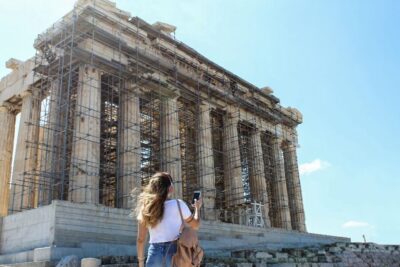


Acropolis monuments & Parthenon Walking Tour with Optional Acropolis Museum
Read our review →Browse the lists this tour appears in