
Reviewed · MUSEUMS
Athens: Kotsanas Museum of Ancient Greek Technology Ticket
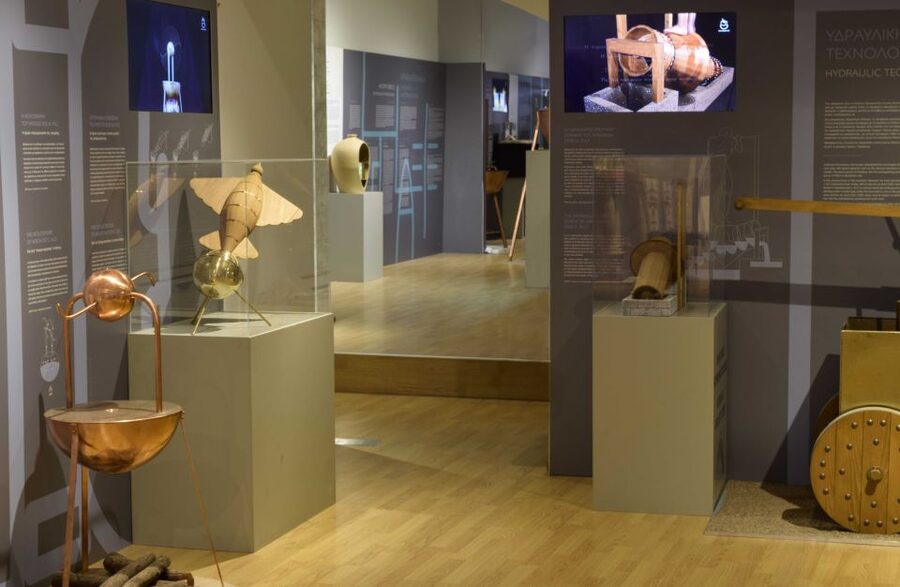
Ancient Greece gave the world more than temples, statues, and philosophy. At the Kotsanas Museum, you can see working models of machines that look surprisingly close to modern technology, including the Antikythera calculating mechanism, often described as the oldest analog computer in the world. It is a small museum, but the ideas inside are big.
I like the hands-on displays, since you are not limited to staring at objects behind glass. I also like the setting: a 700-square-meter Art Nouveau building just five minutes from Syntagma Metro Station. The main drawback is that your ticket does not include a guided tour, so visitors who prefer a live explanation may need to rely on the English labels, audio-visual material, and videos.
In This Review
- Key points to know before you go
- Why ancient technology feels unexpectedly modern
- Entering the 700-square-meter Art Nouveau museum
- The opening exhibits: machines that move, count, and respond
- Philon, Heron, and the ancient art of automation
- The hydraulic clock of Ktesibios
- The Antikythera mechanism, the museum’s main draw
- How the audio-visual displays improve the visit
- How much time should you allow?
- Is the $7.90 ticket good value?
- Who will enjoy this museum most?
- Should you book the Kotsanas Museum?
- FAQ
- Where is the Kotsanas Museum of Ancient Greek Technology?
- What does the ticket include?
- Is a guided tour included?
- How many exhibits are inside?
- Is the Antikythera mechanism displayed?
- Are the exhibits interactive?
- Is information available in English?
- Is the museum wheelchair accessible?
Key points to know before you go
- About 100 working models: See machines linked to ancient Greek engineers, including Heron, Philon, Ktesibios, and the makers of the Antikythera device.
- Hands-on mechanisms: Several exhibits let you operate the machinery yourself, making the visit more active than a standard display museum.
- Near Syntagma Square: The museum is at Pindarou 6, about a five-minute walk from Syntagma Metro Station.
- English support: Explanatory labels, audio-visual material, videos, and animations are available in English, with material also presented in Greek.
- Self-guided visit: Your entry ticket includes museum admission, not a guided tour.
- Good value at $7.90: The ticket is reasonably priced for a central Athens attraction, especially if you take time with the displays.
Why ancient technology feels unexpectedly modern
The Kotsanas Museum is built around a useful surprise: ancient Greek technology was not limited to simple tools, stone construction, and sailing. Greek inventors developed clocks, automatic devices, calculating instruments, theatrical machines, and systems driven by water, air, weights, and gears.
That is what makes this museum more interesting than a basic collection of old objects. You are shown how mechanisms worked, not just what they looked like. A model can make a complicated idea much easier to grasp than a paragraph in a history book.
The strongest example is the Antikythera calculating mechanism. Its original fragments were recovered from a shipwreck, but the museum presents a working model to show how the device may have used gears to calculate astronomical cycles. You do not need an engineering background to appreciate the point. Ancient craftsmen were building compact mechanical systems capable of handling information in a way that feels startlingly advanced.
The museum also helps you connect old inventions with familiar modern machines. Some devices use automated movement, timed sequences, sound, images, or mechanical figures. The resemblance is not always exact, but it gives you a better sense of how old ideas can reappear in new forms.
More Museum Tours in Athens
- Athens: Acropolis, Parthenon & Acropolis Museum Guided Tour
★ 4.8 · 9,316 reviews - Athens: Mythology of Delphi, Museum and Arachova Guided Tour
★ 4.6 · 4,008 reviews - Athens: Acropolis, Parthenon & Acropolis Museum Guided Tour
★ 4.8 · 3,579 reviews
Entering the 700-square-meter Art Nouveau museum
The museum is located at Pindarou 6 in central Athens, roughly five minutes on foot from Syntagma Metro Station. That makes it easy to fit into a day of sightseeing around Syntagma Square, the National Garden, Plaka, or the Acropolis area.
The building itself adds a pleasant change of pace. Instead of entering a large modern museum complex, you visit a historic Art Nouveau building with a total area of about 700 square meters. The setting feels more intimate, and the compact scale helps keep the collection manageable.
Your ticket is valid for one day, with the available starting time selected when you book. This is not a long coach excursion or a fixed route through Athens. You arrive at the museum, enter, and set your own pace. The activity ends at the same location, so there is no transport arrangement to manage afterward.
Plan to leave food and drinks outside, since they are not allowed in the museum. The venue is wheelchair accessible, which is useful for visitors who need step-free access, though you may still want to confirm any particular access needs before arrival.
The opening exhibits: machines that move, count, and respond
The exhibition, titled The Hi-Tech Inventions of Ancient Greeks, includes about 100 selected models. The collection is arranged to show different kinds of mechanical thinking, rather than presenting a random group of artifacts.
Expect to see devices connected with motion, timekeeping, calculation, automation, theater, and practical engineering. The models are accompanied by diagrams, photographs, explanatory labels, and bibliographical references. This matters because the machines can look puzzling at first. The supporting material gives you the basic story: what the device was designed to do, which forces powered it, and how its parts worked together.
Several exhibits are interactive. You might turn, pull, or activate a mechanism with your own hands. That small action changes the visit. Instead of simply reading that an ancient device used water pressure or gears, you can watch the result unfold in front of you.
The displays are especially useful for families and older children who may lose interest in a conventional museum of statues. The mechanisms give them something to test. Adults who enjoy mathematics, engineering, theater, or the history of science will also find plenty to examine.
Philon, Heron, and the ancient art of automation
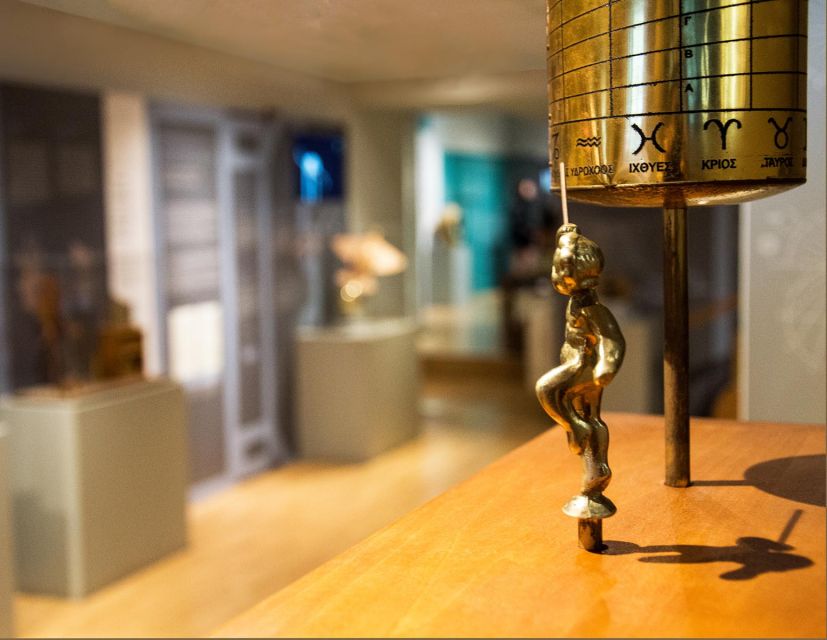
Two of the most memorable parts of the collection are linked to Philon and Heron. The displays include a robot-servant and Philon’s cinema, along with Heron’s automotive-puppet show.
These names refer to ancient inventors whose work explored automatic movement and mechanical entertainment. The robot-servant model demonstrates how a machine could perform a repeated service through a system of containers, valves, and controlled flow. The exact workings are easier to understand when you can see a model operate.
Philon’s cinema points to another side of ancient engineering: the use of mechanical motion to create changing images or scenes. It is a reminder that technology was not only used for farming, warfare, construction, or astronomy. Ancient inventors also made devices for wonder and amusement.
Heron’s automotive-puppet show carries that idea further. The model presents a sequence of automated movements, showing how timing and mechanical control could produce a small performance. It is a clever bridge between engineering and theater.
These displays are valuable because they make ancient technology feel less dry. You can see that mechanical skill was used to entertain an audience as well as solve practical problems. If you are short on time, give these moving exhibits more than a passing glance.
More Athens museums and collections:
- Acropolis monuments & Parthenon Walking Tour with Optional Acropolis Museum
★ 5.0 · 2,678 reviews - Athens All Included: Acropolis and Museum Guided Tour with Ticket
★ 4.5 · 2,673 reviews - Athens: Acropolis Museum Ticket with optional Audio Guide
★ 4.4 · 2,652 reviews - From Athens: Small-Group Delphi, Museum & Arachova Day Trip
★ 4.8 · 2,476 reviews
The hydraulic clock of Ktesibios
Timekeeping is another major theme. The museum includes a model of the hydraulic clock associated with Ktesibios, an ancient engineer known for work with water-powered devices.
A hydraulic clock uses the controlled movement of water to mark the passage of time. That may sound simple, but keeping the flow steady requires careful design. The model lets you consider the practical problems involved: how water enters, how its level changes, and how that change is translated into a visible indication of time.
This is a good example of why the museum’s models matter. A written description can tell you that ancient engineers used water clocks. A working reconstruction shows the chain of cause and effect. You can follow the movement and understand the design as a machine, not just as a historical fact.
The clock also puts modern timekeeping in perspective. We now use electronic displays and phones, but the basic challenge remains familiar: create a dependable way to measure something invisible. The Kotsanas Museum is strongest when it makes that link without pretending ancient and modern technology are identical.
The Antikythera mechanism, the museum’s main draw
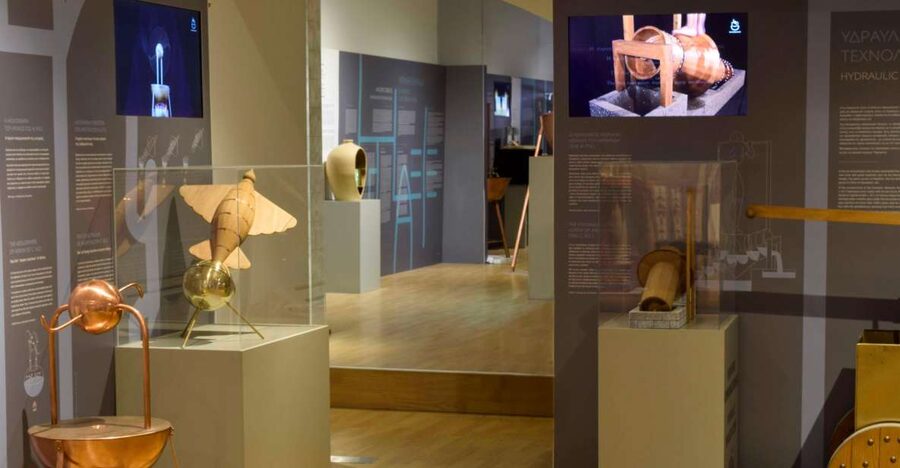
If you visit only one section carefully, make it the Antikythera calculating mechanism. The museum presents a model of the famous device, which used an intricate arrangement of gears to calculate astronomical cycles.
The original mechanism is one of the best-known examples of ancient Greek mechanical engineering. Its survival is remarkable, but the real value of the museum model is practical. You can see how the gears fit into a system and what the system was intended to calculate.
The device is sometimes described as an ancient analog computer. That label helps modern audiences understand its purpose, though it should not lead you to expect a laptop-sized machine with a screen. Its power came from carefully arranged mechanical parts, each contributing to a calculation.
Take your time here. Read the diagrams, watch any related animation, and look at the model from more than one angle. The mechanism can be hard to understand in a quick glance. The museum’s explanatory material is there to help you follow the design step by step.
For anyone interested in astronomy, mathematics, ancient science, or the history of computers, this exhibit alone gives the admission price a strong argument. It is also a useful stop for visitors who want to see something beyond the usual Athens highlights.
How the audio-visual displays improve the visit
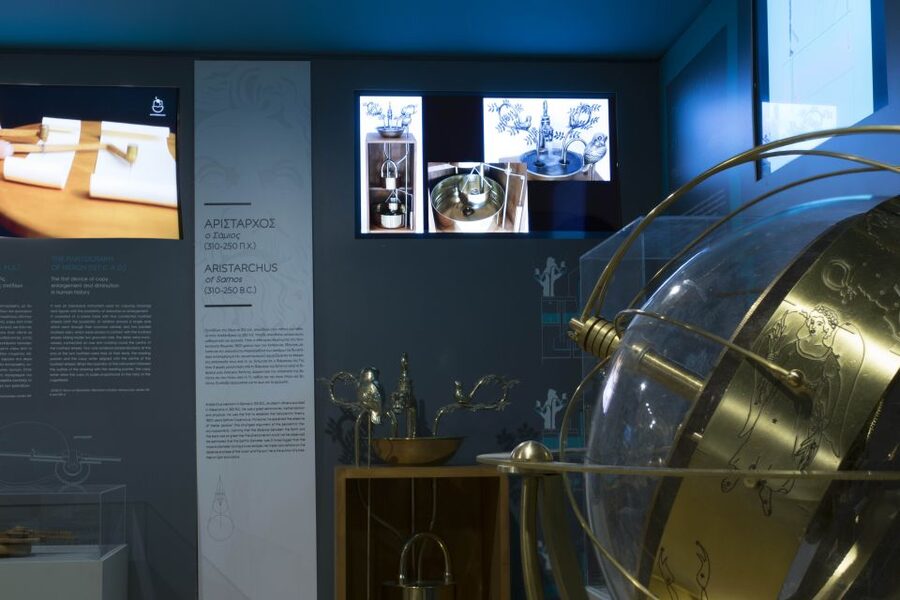
The museum does not expect every visitor to understand each machine immediately. Exhibits are supported by audio-visual material, large posters, diagrams, photos, video, animation, and documentaries in which the exhibitor explains how the mechanisms functioned and how they were used.
English material is available, and Greek material is also included. The English support makes the museum practical for international visitors, especially since no guided tour is included with the ticket.
The videos and animations are particularly helpful for machines with hidden internal parts. A model may show the outside of a device, while an animation can reveal the gears, pipes, or chambers inside. This allows you to understand the design without needing a technical education.
You should still expect to do some reading and watching. This is not a performance where an interpreter walks you through every station. The visit rewards curiosity and a willingness to pause. If you rush from one model to the next, you will miss much of what makes the collection worthwhile.
How much time should you allow?
The ticket is valid for one day, but no fixed visit duration is provided. That gives you freedom to choose a short stop or a more careful museum visit.
You can make the museum work as a quick Athens break if you focus on the Antikythera mechanism, the clocks, and the animated devices. That approach suits a busy sightseeing day. If you enjoy technical displays, plan to spend longer reading the diagrams and trying the interactive mechanisms.
Because the museum is near Syntagma Metro Station, it is easy to visit between other activities. You do not need to dedicate an entire day to it. The compact location also makes it a sensible choice in hot weather or during a short pause from outdoor sightseeing.
The best pace is unhurried but selective. Give the most complex models time, then move on when a display feels less relevant to your interests.
Is the $7.90 ticket good value?
At $7.90 per person, this is one of the easier Athens admissions to justify. The price is modest compared with major archaeological sites, and the museum offers more than a static room of replicas. You receive access to about 100 operating models, interactive displays, and English explanatory material in a central location.
The value depends on how you visit. If you spend only a few minutes inside, the ticket may feel less worthwhile. If you test the mechanisms, watch the animations, and study the Antikythera model, you get a focused lesson in ancient engineering for a reasonable cost.
The absence of a guided tour is the main limitation. A guide could connect the inventions and answer questions as you go. On the other hand, a self-guided visit lets you skip topics that do not interest you and spend more time with the devices you find most engaging.
The high rating of 4.9 from 26 reviews supports the museum’s appeal, especially for people who want an unusual cultural stop. Since no detailed guide service is included, I would choose it for the working models and interactive format rather than for personal storytelling.
Who will enjoy this museum most?
I would recommend the Kotsanas Museum to you if you like science, machines, astronomy, ancient history, or unusual museums. It is also a strong choice for families because the operating models give children something concrete to watch and use.
It works well for first-time visitors who want a break from temples and sculpture. Athens has plenty of major archaeological sights, but this museum shows a less familiar side of Greek culture: invention, calculation, automation, and mechanical entertainment.
You may enjoy it less if you want a large collection of original antiquities or a traditional guided tour. Much of the appeal comes from reconstructed models and explanatory displays. The experience is about understanding how the machines worked, not seeing priceless original objects.
The museum is also a good fit for a rainy or very hot day. It gives you an indoor activity near central Athens without requiring a long journey.
Should you book the Kotsanas Museum?
Book this ticket if you want a short, central, affordable museum visit with working models and hands-on displays. The Antikythera mechanism, Heron’s automated theater, Philon’s devices, and Ktesibios’s hydraulic clock offer plenty of material for a thoughtful visit.
Skip it if your Athens schedule is already packed with major archaeological sites and you are not interested in technology. Also keep in mind that no guided tour is included, so you will need to use the English labels, videos, diagrams, and interactive displays on your own.
For most curious visitors, the $7.90 price makes the choice easy. Give it enough time to see the machines operate, and the museum can turn a familiar Athens trip into a look at the ancient world’s inventive side.
FAQ
Where is the Kotsanas Museum of Ancient Greek Technology?
The museum is at Pindarou 6, Athina 106 71, Greece. It is about a five-minute walk from Syntagma Metro Station.
What does the ticket include?
The ticket includes entry to the Kotsanas Museum of Ancient Greek Technology.
Is a guided tour included?
No. A guided tour is not included with the entry ticket. You can use the museum’s labels, diagrams, audio-visual displays, videos, animations, and documentaries.
How many exhibits are inside?
The exhibition includes approximately 100 selected operating models of ancient Greek inventions.
Is the Antikythera mechanism displayed?
Yes. The museum includes a model of the Antikythera calculating mechanism, described as the oldest analog computer in the world.
Are the exhibits interactive?
Yes. Many exhibits are interactive, and you can operate some of the mechanisms with your own hands.
Is information available in English?
Yes. Audio-visual material is available in Greek and English, and English is listed among the available languages.
Is the museum wheelchair accessible?
Yes. The activity information states that the museum is wheelchair accessible.
Recently reviewed around Athens
- Small-Group Women History in Ancient Greece Walking Tour★ 5.0 · 38 reviews
- Ceramic and Pottery Creative Workshop with Two Local Artists★ 4.0 · 57 reviews
- Athens: Wine Workshop Create your Own Wine under the Acropolis★ 5.0 · 77 reviews
- Athens: Greek Wines Tasting with Sommelier and Acropolis Views★ 5.0 · 88 reviews
- Hydra Private Day Trip by Ferry from Athens with Transfers★ 4.0 · 30 reviews
- Small-Group Wine Tour in Athens with Tasting★ 5.0 · 33 reviews
- Wine Trails Private Tour/ Nemea visit 3 wineries from Athens or Nafplion (10 h)★ 5.0 · 44 reviews
- Private Athens Transfer Airport/Port -Greek Tours-Hourly service★ 5.0 · 88 reviews
Museums, compared.

Acropolis, Parthenon & Acropolis Museum Guided Tour
Read our review →
Mythology of Delphi, Museum and Arachova Guided Tour
Read our review →Acropolis, Parthenon & Acropolis Museum Guided Tour
Read our review →
Acropolis monuments & Parthenon Walking Tour with Optional Acropolis Museum
Read our review →
Athens All Included: Acropolis and Museum Guided Tour with Ticket
Read our review →
Acropolis Museum Ticket with optional Audio Guide
Read our review →
Small-Group Delphi, Museum & Arachova Day Trip
Read our review →
Parthenon & Acropolis Museum with Audio or Live Tour Option
Read our review →Browse the lists this tour appears in