

Reviewed · ACROPOLIS & ACROPOLIS MUSEUM TOURS
Athens: The Acropolis Museum Guided Tour
The Acropolis Museum does something few museums can: it lets you look at ancient objects while seeing the monument they once belonged to through the glass atrium. A guide helps connect the statues, offerings, ruins, and temples, turning a fine collection into a readable story about Athens in the 5th century BC.
I like the clear route through the museum and the way a good guide puts Greek religion, art, science, and city life into context. I also like that the 75-minute format keeps the visit focused, with guides such as Dimitris, Natasha, Niobe, Margherita, and Annie praised for explaining difficult material with humor and energy. The main drawback is that 75 minutes is tight, and some departures have been delayed when this museum visit follows a longer Acropolis tour.
In This Review
- Key points to know before booking
- Why the Acropolis Museum deserves its own visit
- Meeting the guide near Dionysiou Areopagitou Street
- The opening galleries and the Archaic sculptures
- Votive offerings and the human side of Athena’s sanctuary
- Caryatids, architecture, and the museum’s modern design
- Looking through the glass floor at ancient Athens
- The upper level and views toward the Parthenon
- How the 75-minute schedule works
- Is $41 plus admission a fair price?
- Who should book this Acropolis Museum tour?
- Should you book it?
- FAQ
- How long is the Acropolis Museum guided tour?
- What language is the tour offered in?
- Is the museum entrance included in the $41 price?
- Where is the meeting point?
- Is the tour wheelchair accessible?
- What should I bring?
- Can I bring luggage or large bags?
Key points to know before booking
- The museum sits below the Acropolis, so the glass atrium gives you a direct visual link to the Parthenon and surrounding ruins.
- The route includes more than famous statues, with ancient Athenian neighborhood remains visible below the floor.
- The Archaic Gallery uses natural light to show early Greek sculpture at its best.
- The guide matters here, since the collection is large and the important details are not always obvious at first glance.
- The advertised price is $41, but museum admission, about €20 per adult, is extra.
- The meeting point is a short walk from the museum, and large bags are not allowed on the tour.
Why the Acropolis Museum deserves its own visit

Many people treat the museum as a side dish after climbing the Acropolis. That is a mistake. The hilltop ruins show you the buildings, but the museum explains the people, beliefs, craft, and political confidence behind them.
The collection includes more than 4,000 objects from the Acropolis and its surrounding area. You see offerings left for Athena, sculpted figures, architectural pieces, and traces of earlier buildings. The museum also helps you picture ancient Athens as a working city rather than a collection of lonely marble ruins.
I especially like the way the building places modern Athens and ancient Athens in the same frame. The upper glass atrium is aligned with the Parthenon, and the view gives you a useful sense of scale and position. You are not simply looking at an isolated temple. You are looking back toward the place where many of these objects once had a role.
A guide adds the missing links. Without one, you can admire the polish of a statue or the expression on a carved face, but you may not know why the piece mattered. With a strong guide, a votive offering becomes evidence of personal faith, a Caryatid becomes part of a larger architectural problem, and an excavation below your feet becomes a record of ordinary Athenian life.
More Museum Tours in Athens
- Athens: Acropolis, Parthenon & Acropolis Museum Guided Tour
★ 4.8 · 9,316 reviews - Athens: Mythology of Delphi, Museum and Arachova Guided Tour
★ 4.6 · 4,008 reviews - Athens: Acropolis, Parthenon & Acropolis Museum Guided Tour
★ 4.8 · 3,579 reviews
Meeting the guide near Dionysiou Areopagitou Street
The meeting point is at 3 Dionysiou Areopagitou Street, outside the Lukumades and Pilino stores. Staff carry an orange Athens Walking Tours sign. The location is at the beginning of the pedestrian walkway running from Hadrian’s Arch and Syngrou Avenue toward the Acropolis.
This is not directly at the museum entrance, so allow time to find the staff before the start. One useful feature is that the staff can help reunite you with the group if you have trouble locating the tour. That matters in the busy Acropolis area, where several walking tours gather and the pedestrian route can feel confusing at first.
The meeting point is practical if you are already visiting Hadrian’s Arch, the Plaka area, or the Acropolis. It is less convenient if you are standing at the museum entrance expecting to meet there. Check the street address carefully rather than relying only on a map pin.
The tour is offered in English with a live licensed guide. You should bring a passport or identity card, wear comfortable shoes, and leave luggage or large bags behind. The museum is wheelchair accessible. Tours operate in rain or shine, so the museum works well as a dependable plan even when Athens weather changes.
The opening galleries and the Archaic sculptures

The tour normally begins by giving you the broad story of the Acropolis and the museum itself. That introduction helps you understand why the building is so modern and open, rather than designed like a dark traditional museum.
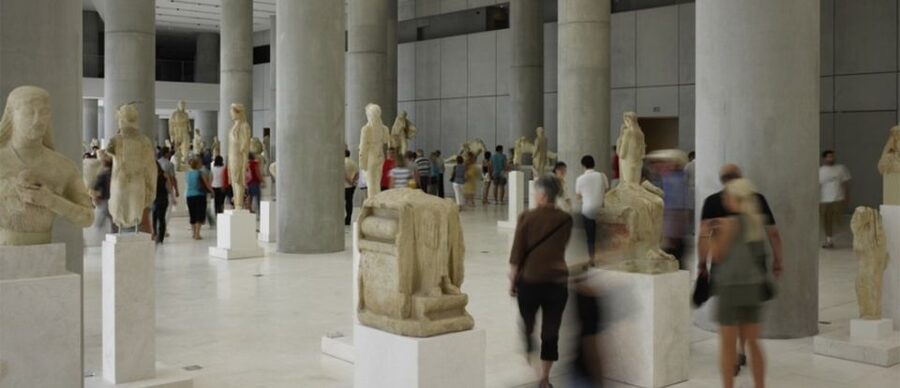
The first-floor Archaic Gallery is one of the most rewarding parts of the visit. Natural light reaches the sculptures, making it easier to see surface details, traces of color, and the structure of the figures. The early statues can look stiff at first, but a guide can show you the gradual shift toward more natural poses and more convincing human form.
This is where the tour’s educational value becomes clear. The museum is not just displaying beautiful marble. It is showing how Greek artists experimented over time. A guide such as Natasha has been praised for explaining both the objects and the building, while other guides have been credited with keeping the amount of information manageable.
You may hear stories from Greek mythology and explanations of the religious role of the Acropolis. The best part is the connection between myth and daily life. Ancient people did not separate art, worship, politics, theater, science, and public identity in the same way modern visitors often do. The objects make more sense once you see those subjects as connected.
The pace is generally brisk but not frantic. A guide has a planned set of highlights, which is useful in a museum with thousands of objects. The tradeoff is that you will not study every case or linger wherever you like. If you enjoy reading labels slowly, plan to return after the guided portion.
Votive offerings and the human side of Athena’s sanctuary

The votive offerings to Athena are among the most revealing objects on the route. These were gifts connected to worship, gratitude, requests, and personal devotion. They show that the Acropolis was not only a setting for grand public monuments. It was also a place where individuals approached a powerful goddess with private hopes and thanks.
A guide can give these objects a human scale. You begin to see the Acropolis as a religious center filled with acts of devotion, not simply as a scenic hill topped by the Parthenon. This is one reason I recommend taking the museum tour before visiting the ruins if your schedule permits.
The guides who receive the strongest praise tend to explain why an object is important rather than simply naming it. Niobe, for example, has been praised for selecting key pieces and explaining their importance without overwhelming the group. That sort of structure suits visitors who want a firm foundation in Greek history without taking a university course on the subject.
Families can benefit from this approach, too. Annie was praised for drawing a seven-year-old into the conversation, helping the child feel included rather than expected to stand quietly through an adult lecture. The experience is still built around ancient art, but a lively guide can make the stories accessible to younger listeners.
More Athens museums and collections:
- Acropolis monuments & Parthenon Walking Tour with Optional Acropolis Museum
★ 5.0 · 2,678 reviews - Athens All Included: Acropolis and Museum Guided Tour with Ticket
★ 4.5 · 2,673 reviews - Athens: Acropolis Museum Ticket with optional Audio Guide
★ 4.4 · 2,652 reviews - From Athens: Small-Group Delphi, Museum & Arachova Day Trip
★ 4.8 · 2,476 reviews
Caryatids, architecture, and the museum’s modern design
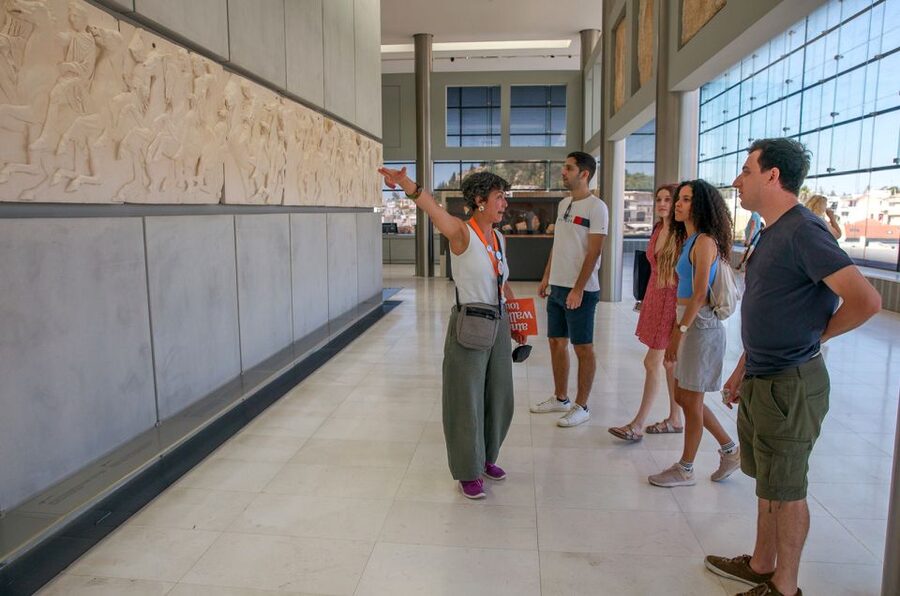
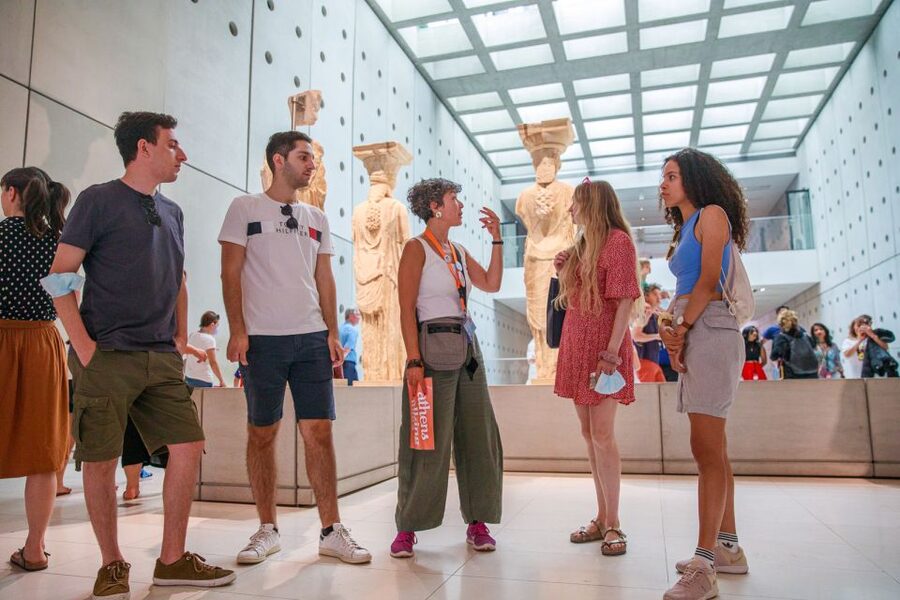
The Caryatids are an obvious highlight, and the museum gives them the space they deserve. These sculpted female figures served as architectural supports, blending human form and building structure. Seeing them inside the museum helps you study details that can be hard to notice when you are outdoors on the Acropolis.
The collection also includes architectural elements that show how the ancient buildings were assembled and decorated. A guide can point out the difference between a free-standing statue and a sculpture designed as part of a temple. That distinction is easy to miss when you are moving quickly through the galleries on your own.
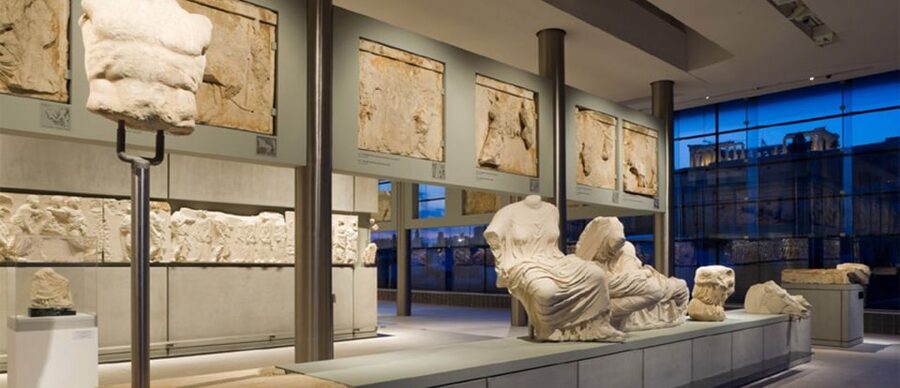
The building by Bernard Tschumi and Michael Photiadis is part of the experience, not just a container for the exhibits. Its clean Modernist lines, broad glass surfaces, and carefully controlled views create a conversation between old and new Athens. The glass atrium lines up with the Parthenon, while glass floors bring the ancient ground below into view.
I like this design because it avoids pretending that the past exists separately from the present. You see excavated remains beneath a contemporary building, then look through the structure toward the Acropolis. The effect is especially useful for first-time visitors who need help orienting themselves.
The modern architecture can also be a mild distraction. Some visitors come mainly for the ancient objects and may find the building’s geometry competing for attention. In practice, the guide usually helps explain why the layout matters, including how the museum’s position and alignment relate to the hill above.
Looking through the glass floor at ancient Athens
One of the most memorable parts of the route is the view through the plexiglass floor to the remains of an ancient Athenian neighborhood. Instead of seeing only temples and elite monuments, you get a glimpse of streets and buildings connected to everyday urban life.
This section changes the way you picture ancient Athens. The Acropolis was a sacred and political center, but it existed within a lived-in city. The excavated neighborhood beneath the museum gives you that missing setting.
Three-dimensional displays add another layer by helping reconstruct what the area may have looked like in earlier periods. You should not expect a full archaeological site visit beneath the museum, but the visible remains are far more than a decorative floor feature. They show that the city’s past is layered, with one period built over another.
If you dislike looking down through glass or prefer to move slowly around archaeological remains, the group pace may feel quick. The guide has to keep everyone together and continue through the planned route. You can return to this area afterward if you want a closer look.
The upper level and views toward the Parthenon
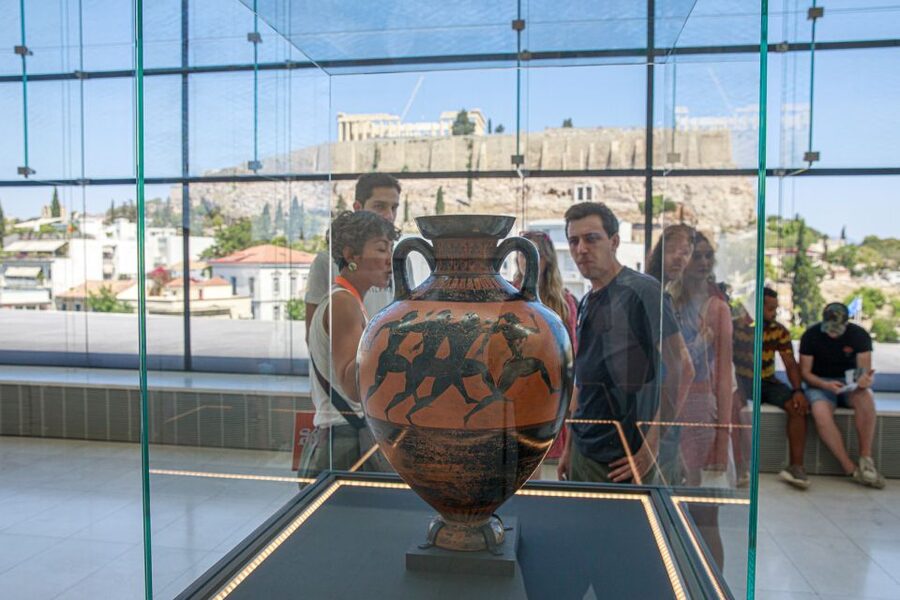
The upper level brings the museum’s central idea into focus. The glass atrium is built in alignment with the Parthenon, providing a panoramic view of the Acropolis ruins. This is where the objects and the monument outside finally meet.
Look beyond the display cases for a moment. The view helps you understand where the sculptures and architectural fragments belonged. It also reminds you that the Parthenon is not just a famous photograph. It was part of a larger sanctuary filled with sculpture, ritual activity, and carefully planned visual statements.
A good guide will connect the upper gallery to what you will see on the hill. Several visitors have found the museum particularly useful as preparation for the Acropolis itself. That order makes sense: first learn what the buildings and sculptures meant, then see the surviving structures outdoors.
If you have already visited the Acropolis, the museum still fills important gaps. You may recognize the names and shapes of objects from the hill, but the indoor displays provide closer views and more context. If you only have time for one short guided experience, this museum visit gives you a concentrated introduction, though it cannot replace seeing the Acropolis in person.
How the 75-minute schedule works
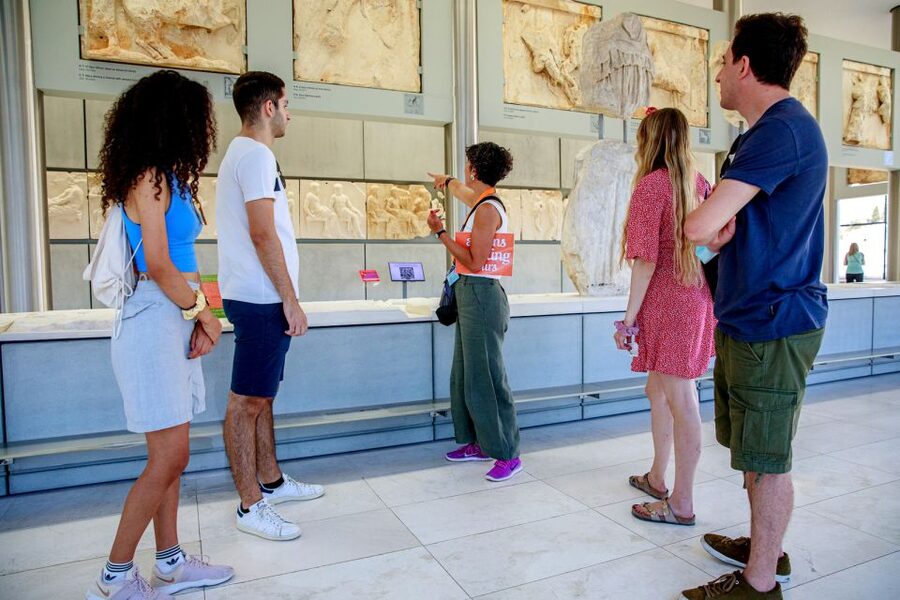
Seventy-five minutes is enough for a purposeful highlights tour. You should expect a guided route through the major galleries, with time devoted to the Archaic sculptures, votive offerings, Caryatids, ancient neighborhood remains, museum design, and the Acropolis views.
It is not enough for an unhurried museum afternoon. Some guides finish close to the advertised time, while the amount of detail can vary. One guide was praised for giving a full overview without overloading the group. Another was described as spending too much time on individual people and details when the visitor wanted more general Acropolis context.
That difference comes with any live tour. The guide’s personality shapes the visit. Dimitris has been praised for combining humor with a strong account of the Acropolis, while guides including Jordan, Apollo, Margherita, and Kimon have been singled out for making mythology and ancient culture easier to follow.
The group can be fairly large. One visitor found the size disappointing, though the guide managed the movement well. A larger group may mean you need to stand where you can see the object and hear clearly. If you want a private, slow-paced study of individual pieces, this is not the right format.
There is also a timing issue for people booking only the museum portion. The museum visit can be the second part of a longer Acropolis tour. If the earlier portion runs late, your start may be delayed by 30 to 45 minutes. That has caused problems for people with lunch plans or another afternoon activity.
For that reason, I would not schedule a tight connection after this tour. Keep the rest of the day flexible, especially in high season.
Is $41 plus admission a fair price?
The listed price is $41 per person, and entrance is not included. Admission is approximately €20 per adult, so your total cost is notably higher than the headline amount.
The value depends on how much help you want inside the museum. If you are comfortable reading labels, using a guidebook, and building the story yourself, you can save money by visiting independently. The building is easy to appreciate on your own, and you can set your own pace.
I think the guided option earns its cost for first-time visitors, families, and anyone who wants the Acropolis explained rather than simply photographed. The collection is large, the themes overlap, and the objects come from several periods. A well-organized guide lets you spend 75 minutes on the pieces that matter most.
The skip-the-ticket-line service can also save time, but it does not remove the need to pay the entrance fee. Confirm the exact admission arrangement when booking so you know what is covered and what is not.
Who should book this Acropolis Museum tour?
Book it if you want a short, structured introduction before visiting the Acropolis. It is particularly useful if Greek mythology and ancient art are new to you, or if you find museums difficult to interpret without help.
Families may like the steady pace and storytelling, though younger children will respond best to an engaging guide. The accessible building and English-language format also make this a practical choice for many visitors with mobility needs.
I would be cautious if you have a strict afternoon schedule. The 75-minute tour itself is short, but a late start can happen when your group joins an ongoing tour from the Acropolis. I would also skip it if you prefer to spend long stretches at individual objects.
Book early if you want a morning departure in summer. One visitor specifically found an early start worthwhile in the heat, and the museum offers welcome shelter from the sun. Comfortable shoes remain a good idea, especially because the meeting point is reached on foot and the tour may involve standing.
Should you book it?
I would book this tour if you plan to see the Acropolis and want the monuments to make sense. The best guides turn the museum into a preparation course for the hill, explaining how religion, art, public life, and architecture fit together.
Choose it for the expert storytelling, the Caryatids, the Archaic Gallery, the visible ancient neighborhood, and the view toward the Parthenon. Skip it if you need a perfectly timed schedule or want a long, self-directed museum visit.
The smart plan is to take the museum tour before the Acropolis, leave extra time afterward, and treat the guided 75 minutes as an introduction rather than your entire museum visit.
FAQ
How long is the Acropolis Museum guided tour?
The guided tour lasts 75 minutes.
What language is the tour offered in?
The tour is conducted in English with a live licensed guide.
Is the museum entrance included in the $41 price?
No. Entrance fees are not included and cost approximately €20 per adult.
Where is the meeting point?
Meet at 3 Dionysiou Areopagitou Street, outside the Lukumades and Pilino stores. Staff will be holding an orange Athens Walking Tours sign.
Is the tour wheelchair accessible?
Yes, the activity is wheelchair accessible.
What should I bring?
Bring a passport or identity card and wear comfortable shoes.
Can I bring luggage or large bags?
No. Luggage and large bags are not allowed on the tour.
Recently reviewed around Athens
- Small-Group Women History in Ancient Greece Walking Tour★ 5.0 · 38 reviews
- Ceramic and Pottery Creative Workshop with Two Local Artists★ 4.0 · 57 reviews
- Athens: Wine Workshop Create your Own Wine under the Acropolis★ 5.0 · 77 reviews
- Athens: Greek Wines Tasting with Sommelier and Acropolis Views★ 5.0 · 88 reviews
- Hydra Private Day Trip by Ferry from Athens with Transfers★ 4.0 · 30 reviews
- Small-Group Wine Tour in Athens with Tasting★ 5.0 · 33 reviews
- Wine Trails Private Tour/ Nemea visit 3 wineries from Athens or Nafplion (10 h)★ 5.0 · 44 reviews
- Private Athens Transfer Airport/Port -Greek Tours-Hourly service★ 5.0 · 88 reviews
Acropolis & Acropolis Museum Tours, compared.

Acropolis & up to 5 Archaeological Sites Combo Pass
Read our review →

Acropolis, Parthenon & Acropolis Museum Guided Tour
Read our review →
Acropolis, Parthenon & Acropolis Museum Guided Tour
Read our review →


Acropolis monuments & Parthenon Walking Tour with Optional Acropolis Museum
Read our review →Browse the lists this tour appears in