
Reviewed · ACROPOLIS & ACROPOLIS MUSEUM TOURS
Private Guided Tour: Athens, Acropolis and Acropolis Museum
Athens makes more sense when you connect its monuments instead of seeing them as isolated ruins. This private five-and-a-half-hour walking tour links Syntagma Square, the National Garden, Roman temples, the Acropolis, and the Acropolis Museum in one carefully ordered route.
I especially like the private format, which lets you ask questions, pause for photos, and set a pace that works for your group. I also like the route up the Acropolis from the south slope, where you see the Dionysus Theater before reaching the main monuments and may avoid some of the worst crowding.
The main drawback is cost: $318 per person is a serious splurge, and Acropolis and museum tickets are not included. This is also a demanding walk with stairs, uneven ground, sun, and little shelter on the hill.
In This Review
- Key points at a glance
- Why a private Athens tour can be worth the splurge
- Starting at Syntagma Square and Parliament
- The National Garden, Zappeion, and modern Olympic Athens
- Zeus, Hadrian, and the walk toward the Acropolis
- Entering the Acropolis through the Dionysus Theater
- The Parthenon and the monuments of the Acropolis
- The Acropolis Museum and its glass-floor archaeology
- Walking demands, weather, and entry rules
- Who gets the best value from this tour?
- Should you book the Athens Acropolis private tour?
- FAQ
- How long does the tour last?
- What language is the tour offered in?
- Is this a private tour?
- Where do I meet the guide?
- Are entrance tickets included?
- Is hotel pickup included?
- Does the tour include food or drinks?
- Can I bring a stroller or large bag?
- Is the tour suitable for wheelchair users?
- What should I bring?
Key points at a glance
- Syntagma Square starting point: Meet your licensed English-speaking guide inside the metro station, near the ticket machines and the large central clock.
- A full Athens introduction: See Parliament, the Evzones, the National Garden, Zappeion Hall, Hadrian’s Arch, and the Temple of Zeus before reaching the Acropolis.
- South-slope Acropolis route: Enter by the Dionysus Theater and continue past the Odeon of Herodes Atticus, Philopappos Hill, and the main hilltop monuments.
- Private attention: Guides including Annie, Margarita, Tina, and Theodora have been praised for clear explanations, warmth, humor, and good pacing.
- Museum visit included: Finish among about 4,000 artifacts, with archaeological excavations visible beneath glass floors.
- Plan for a long walk: Wear firm, comfortable shoes, carry water and cash, and bring a hat and weather-appropriate clothing.
Why a private Athens tour can be worth the splurge
At $318 per person, this is not a budget sightseeing walk. You pay for a private licensed guide rather than transportation, meals, or admission, so the value depends heavily on how much you want historical explanation and how many people are in your party.
For a first visit, I can see the appeal. Athens has layers from classical Greece, Roman rule, the modern Greek state, and the revival of the Olympic Games. A good guide helps you connect those layers while you move through the city. You are not just looking at columns. You learn why a site matters, what changed over time, and how each place fits into Athens as a whole.
The private setup also works well for families and mixed-age groups. A guide can explain mythology to children, discuss archaeology with adults, and slow down for photos without holding up a large group. One family found that their four-year-old remembered stories about Athena and the Parthenon afterward. Another guide, Efie, adjusted her explanations to keep teenagers interested.
That flexibility is one of the strongest reasons to book this version instead of visiting independently. Guides such as Annie, Margarita, Tina, Vicky, Panagiota, and Theodora have been praised for making complicated material easy to follow. Several visitors also singled out guides who handled both adults and children well.
Still, a private guide cannot change the basic conditions of the Acropolis. It can be hot, exposed, crowded, and physically tiring. One couple logged roughly 12 miles during their day in Athens, while another counted about 20,000 steps. Those figures include more than the formal route, but they give you a useful warning: this is not a gentle stroll.
More Museum Tours in Athens
- Athens: Acropolis, Parthenon & Acropolis Museum Guided Tour
★ 4.8 · 9,316 reviews - Athens: Mythology of Delphi, Museum and Arachova Guided Tour
★ 4.6 · 4,008 reviews - Athens: Acropolis, Parthenon & Acropolis Museum Guided Tour
★ 4.8 · 3,579 reviews
Starting at Syntagma Square and Parliament
The meeting point is inside Syntagma metro station, one level below street level. Look for the orange Athens Walking Tours sign by the ticket-validating machines beneath the large hanging clock. This detail matters because Syntagma Square is busy, and waiting outside without a clear landmark could waste precious time.
The first stop is a small collection of archaeological finds discovered during excavations in the area. It offers a quick reminder that modern Athens often sits directly above older layers. This is a modest beginning, but it gives your guide a chance to explain how the city’s past turns up in ordinary construction projects.
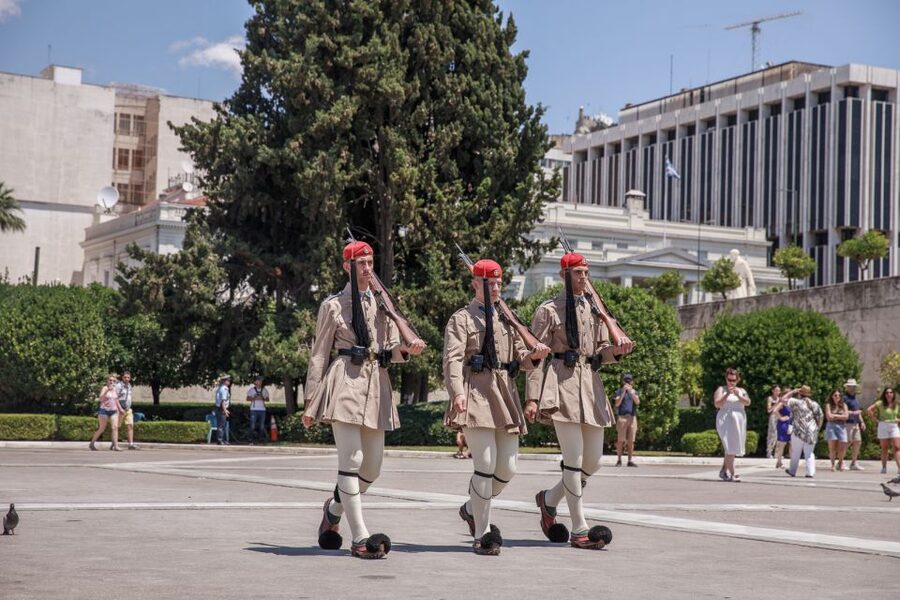
From there, you walk to the House of Parliament and the Tomb of the Unknown Soldier. If the timing works, you can watch the Change of Guards performed by the Evzones. The ceremony is a memorable piece of modern Greek tradition, and it gives the morning a useful contrast: Athens is not only an ancient city, but also the capital of a modern nation.
The timing of the guard change is important, but the supplied schedule does not promise a particular ceremony time. Ask your guide at the start if seeing it is a priority.
The National Garden, Zappeion, and modern Olympic Athens
The route continues through the National Garden, once Queen Amalia’s private garden. The shade is welcome, especially during the hot months, and this section provides a break from Athens’s hard stone streets and traffic.
You then reach Zappeion Hall, an elegant neoclassical building tied to the city’s modern public life. Your guide discusses the first modern Olympic Games and people who shaped Athens in more recent times. This part is easy to rush past on your own, but it helps explain how the city developed after the ancient period.
I like this sequence because it prevents Athens from becoming a parade of famous ancient names. You see a government building, a formal garden, a neoclassical hall, and Olympic landmarks before arriving at the Acropolis. The city begins to feel like a living capital rather than an open-air archaeology park.
Zeus, Hadrian, and the walk toward the Acropolis
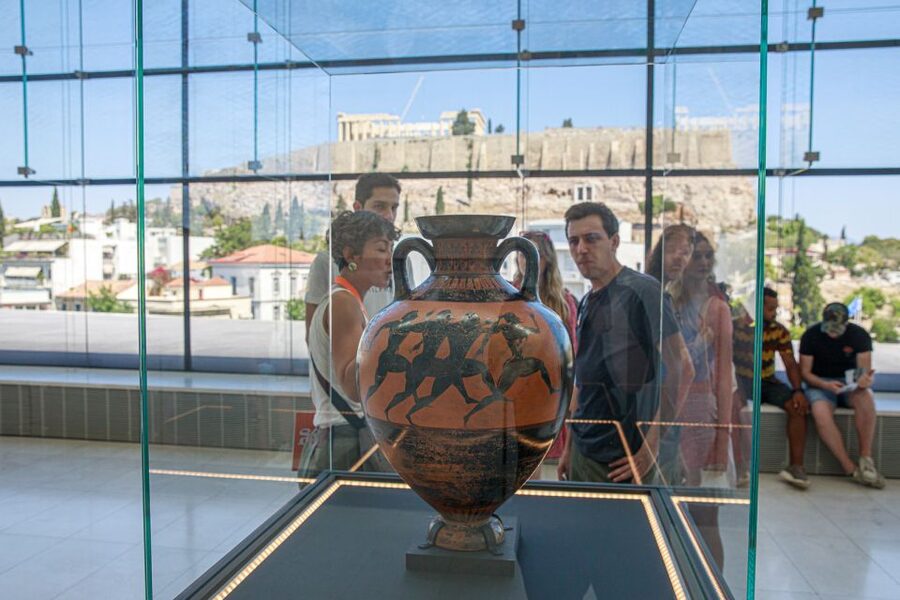
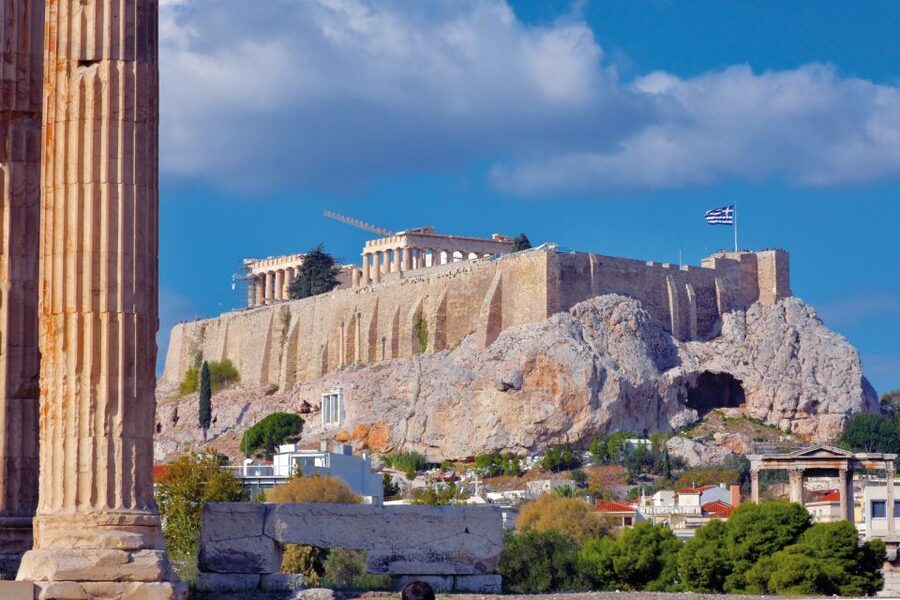
The Temple of Zeus and Hadrian’s Arch bring you into the Roman chapter of Athens. The Temple of Zeus was a huge undertaking, and its remaining columns convey the scale of the original project even without a complete structure. Hadrian’s Arch is a compact but useful marker of the boundary between older Athens and the Roman expansion.
From here, you follow the Dionysiou Areopagitou walkway toward the Acropolis. The route is attractive and gives you time to shift from city sightseeing to the ancient sanctuary ahead. It also allows your guide to place the Acropolis in relation to nearby sites rather than presenting it as a solitary hill.
The tour uses the south entrance and begins with the Dionysus Theater, described as the first theater of antiquity. This is a smart approach for two reasons. You see an important site that many independent visitors hurry past, and the southern slope can provide a more orderly way toward the Acropolis monuments than the main approach.
Do not read avoid the crowds as a guarantee of an empty site. Athens can be crowded at any entrance, and all visitors pass through airport-style security. In peak season, waits can exceed 30 minutes.
More Athens museums and collections:
- Acropolis monuments & Parthenon Walking Tour with Optional Acropolis Museum
★ 5.0 · 2,678 reviews - Athens All Included: Acropolis and Museum Guided Tour with Ticket
★ 4.5 · 2,673 reviews - Athens: Acropolis Museum Ticket with optional Audio Guide
★ 4.4 · 2,652 reviews - From Athens: Small-Group Delphi, Museum & Arachova Day Trip
★ 4.8 · 2,476 reviews
Entering the Acropolis through the Dionysus Theater
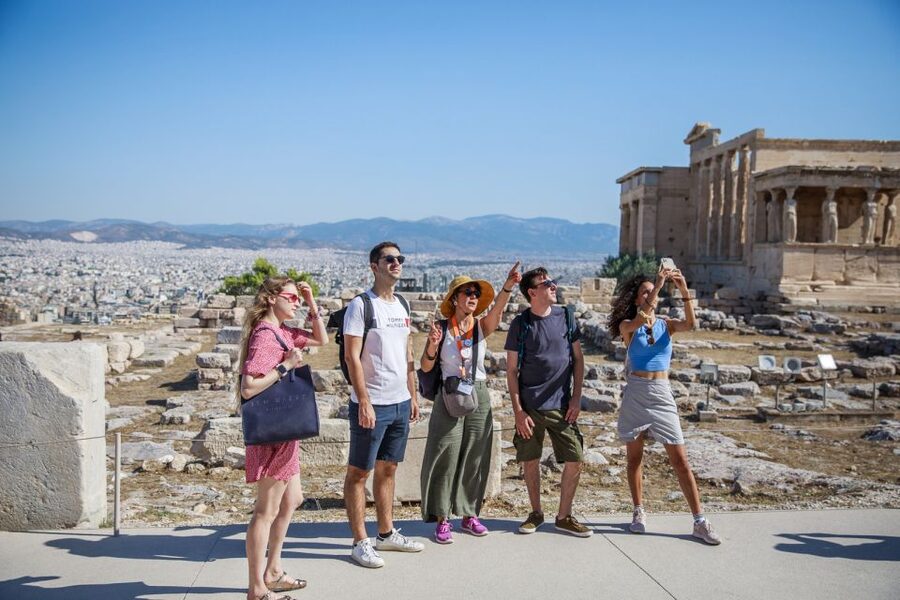
The climb becomes more demanding once you reach the Acropolis area. You walk over uneven ancient surfaces and uphill paths, with some stairs and limited shade. Good shoes are essential, and a hat and water bottle are sensible choices.
The Dionysus Theater is the first major stop on the slope. Your guide can use it to explain the role of drama in ancient Greek society and the physical setting in which performances took place. This is a place where context adds a great deal. Without explanation, you see curved stone seating. With a guide, you can begin to picture the theater as a central part of civic and religious life.
As you continue upward, the Odeon of Herodes Atticus comes into view. Its restored appearance makes it one of the more recognizable structures below the Acropolis, while the monument of Philopappos on the nearby hill adds another strong visual point across the city.
The views are a major part of the route. From the Acropolis, you look over Mars Hill, the Ancient Agora, and the Temple of Hephaestus. This is one of the places where a guide’s orientation is particularly useful. You can identify what you are seeing instead of taking a photograph of a distant cluster of stone and sorting it out later.
The Parthenon and the monuments of the Acropolis
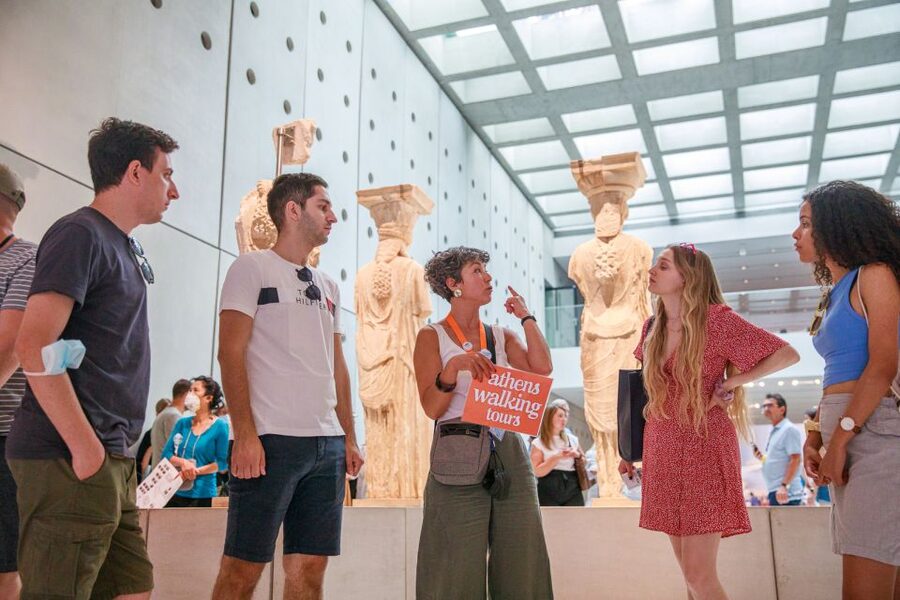
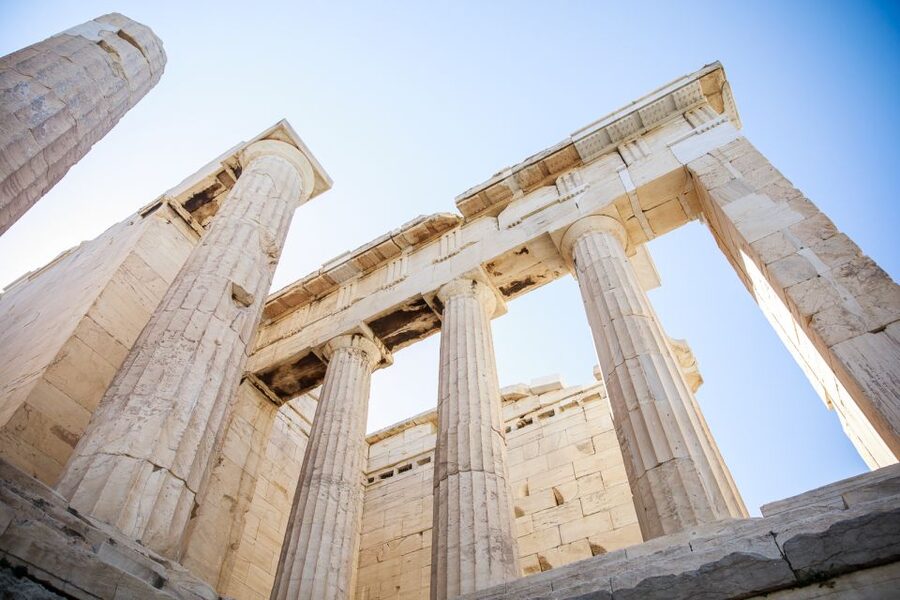
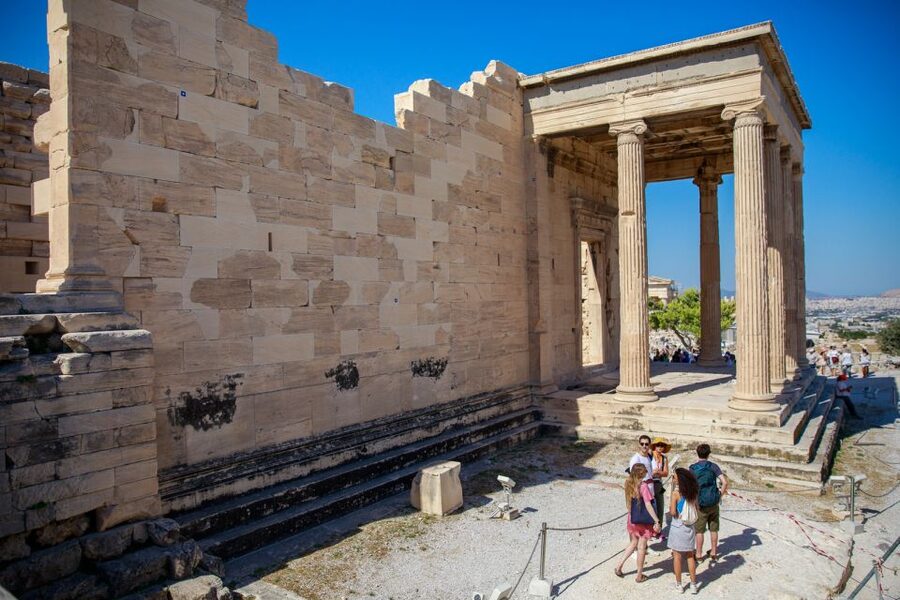
The hilltop visit includes the Temple of Athena Nike, the Propylaea, the Erechtheion, the Agrippa monument, and the Parthenon. Each has a different role, and a private guide has enough time to explain those differences.
The Temple of Athena Nike is small compared with the Parthenon, but its position near the entrance makes it an important welcome to the sanctuary. The Propylaea served as the monumental gateway. Its scale and placement help you understand that entering the Acropolis was meant to feel like moving into a special, elevated world.
The Erechtheion is famous for its unusual design and the Caryatid figures on its porch. It is a good place to ask questions because the building’s layout is less straightforward than the Parthenon’s. The Agrippa monument, near the approach, is another detail easy to overlook without someone pointing it out.
Then comes the Parthenon. It is tempting to treat it as the entire Acropolis, but the tour’s order helps you see it as one part of a larger sanctuary. Your guide discusses construction, religious purpose, damage, restoration, and the changing meaning of the site over time.
Guide quality matters greatly here. Tina has been praised for friendly, clear explanations and a well-judged pace. Nikoletta was especially good at finding shady spots on the route during high summer. Theodora brought archaeology, ancient history, and modern Athens together in a way that made the monuments more useful than a quick visit alone.
You get time after the formal Acropolis explanation to take photographs and look around. That pause is valuable. A guide can point out details, but you also need a few quiet minutes to absorb the scale of the hill and the view across Athens.
The Acropolis Museum and its glass-floor archaeology
After a short break for a snack or drink, the walking tour continues to the Acropolis Museum. Food and beverages are not included, so plan to pay for your own refreshment.
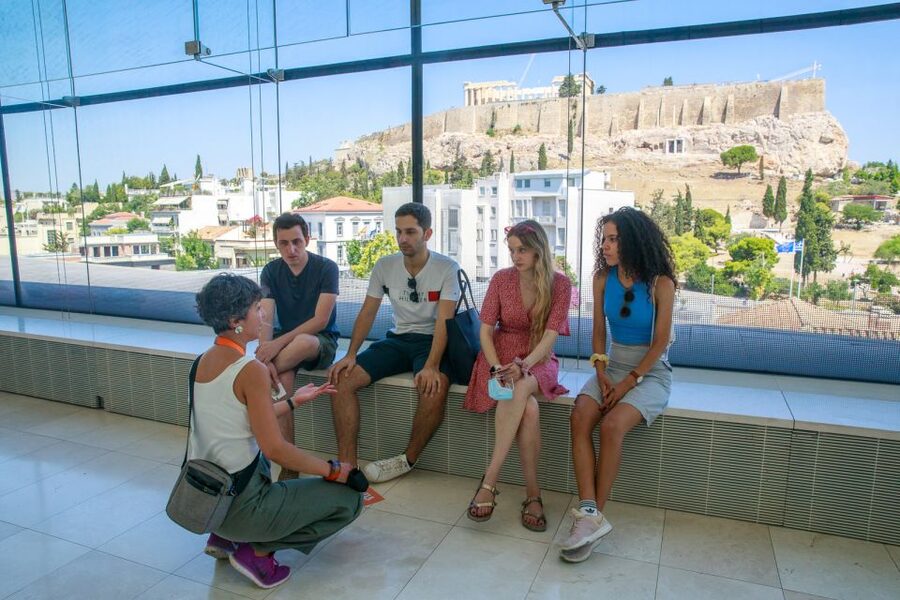
The museum was designed by Bernard Tschumi with Greek architect Michalis Photiadis. Its layout is part of the experience. Archaeological excavations beneath the building can be seen through glass floors, so the museum itself acknowledges the layers of Athens below.
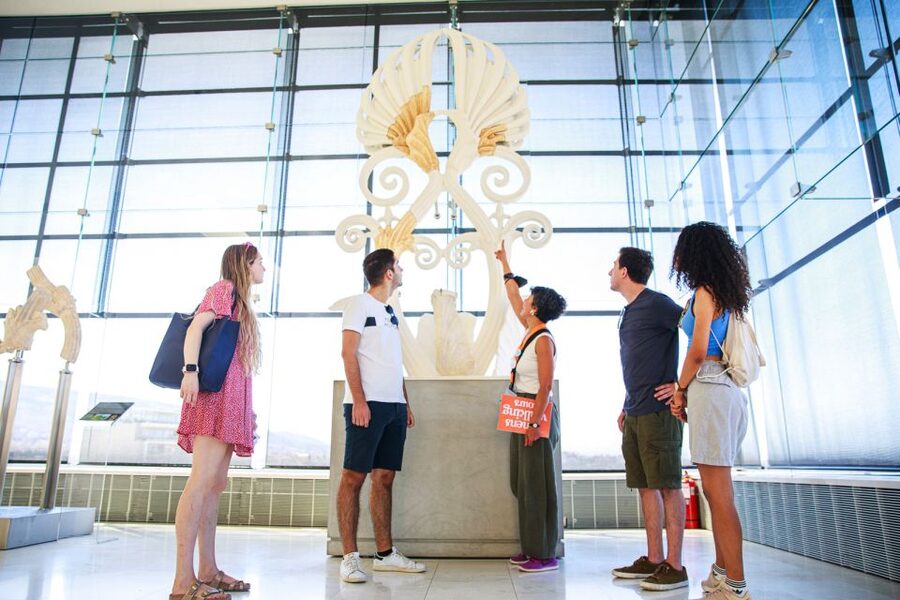
Inside, about 4,000 artifacts are displayed. Natural light, clear exhibition areas, views toward the Acropolis, and careful spacing help you study objects that can feel remote when seen only in photographs.
This visit is especially useful after the hilltop monuments. You can look closely at sculptures and architectural pieces, then connect them to the buildings you have just seen. The museum gives you a better sense of detail, craftsmanship, and color than the exposed ruins alone can provide.
If you are short on time in Athens, combining the Acropolis and museum is efficient. If you tire easily, though, the museum comes at the end of a substantial walk, not at the beginning. The five-and-a-half-hour duration is fixed, and the tour runs in rain or shine.
Walking demands, weather, and entry rules
This tour is not suitable for wheelchair users, people with mobility impairments, or visitors using baby strollers. Large bags and luggage are not allowed, and electric wheelchairs are specifically excluded.
The strict Acropolis entry times make punctuality essential. The guide cannot wait for late arrivals, and a missed entry does not bring a refund. Arrive at Syntagma with enough time to find the correct part of the metro station.
You must buy entrance tickets separately. Follow the ticket instructions carefully, select the correct category, and enter the booking reference number beginning with GYG. If you qualify for a student, age-based, or other reduced or free ticket, bring official proof and valid identification showing your age and nationality. Without the required ID, you may be refused entry or asked to pay the full price if tickets remain available.
There is no hotel pickup or drop-off. You make your own way to central Athens, and the meeting point is well placed for anyone already near Syntagma Square or using the metro. The guide speaks English, and the group is private rather than shared.
Who gets the best value from this tour?

I would recommend it most strongly to first-time visitors who want a clear introduction to Athens and have limited time in the city. It also suits families who need flexibility, couples marking a special trip, and people who would rather ask questions than listen through an earpiece in a large group.
History and archaeology fans will likely get the most from the price. You can ask about mythology, construction methods, philosophy, language origins, and modern Greek history, all subjects that guides such as Anna and Katerina have handled especially well.
The private format is less compelling if you already know the Acropolis well, prefer to explore alone, or are watching every euro. Since admission is extra and the tour includes no food or transport, the fee pays mainly for the guide’s time and the structure of the route.
I also would not book it for a slow sightseeing day. The pace can be adjusted, and one guide accommodated a visitor who needed to move slowly, but the route still covers a lot of ground. Comfortable shoes, water, cash, a hat, and clothing suited to the weather are basic requirements.
Should you book the Athens Acropolis private tour?
Book this tour if you want one well-organized morning or afternoon that ties together ancient, Roman, royal, Olympic, and modern Athens. The strongest feature is the guide: the best examples include Annie’s lively storytelling, Efie’s connection with teenagers, Tina’s pacing, and Theodora’s archaeology background.
Skip it if $318 per person feels too high, if you need a fully accessible route, or if you want a short visit focused only on the Parthenon. For everyone else, the combination of a private guide, south-slope entry, Acropolis monuments, and museum makes this a useful, time-saving introduction to Athens, provided you budget separately for tickets and prepare for a serious walk.
FAQ
How long does the tour last?
The tour lasts 5.5 hours.
What language is the tour offered in?
The live tour guide speaks English.
Is this a private tour?
Yes. It is offered as a private group experience.
Where do I meet the guide?
Meet inside Syntagma metro station, one level down, beside the ticket-validating machines beneath the large central hanging clock. The guide will have an orange Athens Walking Tours sign.
Are entrance tickets included?
No. You must purchase Acropolis and Acropolis Museum entrance tickets separately.
Is hotel pickup included?
No. Hotel pickup and drop-off are not included.
Does the tour include food or drinks?
No. Food and beverages are not included. There is a short break for a snack or drink during the route.
Can I bring a stroller or large bag?
No. Baby strollers, luggage, and large bags are not allowed.
Is the tour suitable for wheelchair users?
No. The tour is not suitable for wheelchair users or people with mobility impairments.
What should I bring?
Bring comfortable shoes, cash, a hat, and clothing suited to the weather. The tour operates in rain or shine, and the route involves extensive walking.
Recently reviewed around Athens
- Small-Group Women History in Ancient Greece Walking Tour★ 5.0 · 38 reviews
- Ceramic and Pottery Creative Workshop with Two Local Artists★ 4.0 · 57 reviews
- Athens: Wine Workshop Create your Own Wine under the Acropolis★ 5.0 · 77 reviews
- Athens: Greek Wines Tasting with Sommelier and Acropolis Views★ 5.0 · 88 reviews
- Hydra Private Day Trip by Ferry from Athens with Transfers★ 4.0 · 30 reviews
- Small-Group Wine Tour in Athens with Tasting★ 5.0 · 33 reviews
- Wine Trails Private Tour/ Nemea visit 3 wineries from Athens or Nafplion (10 h)★ 5.0 · 44 reviews
- Private Athens Transfer Airport/Port -Greek Tours-Hourly service★ 5.0 · 88 reviews
Acropolis & Acropolis Museum Tours, compared.

Acropolis & up to 5 Archaeological Sites Combo Pass
Read our review →

Acropolis, Parthenon & Acropolis Museum Guided Tour
Read our review →
Acropolis, Parthenon & Acropolis Museum Guided Tour
Read our review →


Acropolis monuments & Parthenon Walking Tour with Optional Acropolis Museum
Read our review →Browse the lists this tour appears in