
Reviewed · ACROPOLIS & ACROPOLIS MUSEUM TOURS
Visit of the Acropolis with an official guide in Spanish
The best part of this Spanish-language Acropolis tour is the way it turns a pile of ancient marble into a living story. In about two hours, your guide connects mythology, politics, architecture, medicine, theater, war, and daily life, so you understand why these ruins mattered instead of simply photographing them.
I like the official guide and the wireless audio system, especially in a busy monument where it is easy to miss a good explanation. I also like the route beyond the Parthenon, including the Caryatids, the Theater of Dionysus, and the Odeon of Herod Atticus. The main drawback is simple: your entrance ticket is not included, so you must arrange and pay for admission separately.
In This Review
- Key points to know before you book
- Why a Spanish guide changes the Acropolis visit
- Meeting at Dionysiou Areopagitou Street
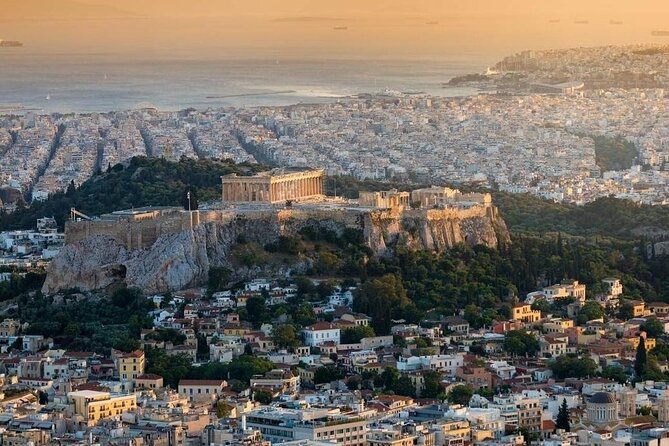
- The Acropolis: setting the story first
- The Parthenon: perfection, power, and change
- The Propylaea and the Temple of Athena Nike
- The Erechtheion and its famous Caryatids
- The Odeon of Herod Atticus
- The Temple of Asclepius and ancient medicine
- The Theater of Dionysus: where Greek drama began
- What the $44.03 price really covers
- Who will get the most from this tour
- Should you book the Spanish Acropolis tour?
- FAQ
- Is the Acropolis entry ticket included?
- How long does the guided visit last?
- What time does the tour begin?
- Is the tour conducted in Spanish?
- What monuments are included?
- Where does the tour begin?
- Where does the tour end?
- How many people can join the tour?
Key points to know before you book
- Spanish throughout: The tour is designed exclusively for Spanish-speaking visitors, with guides including Efi, Ari, Simon, and Maria assigned on different departures.
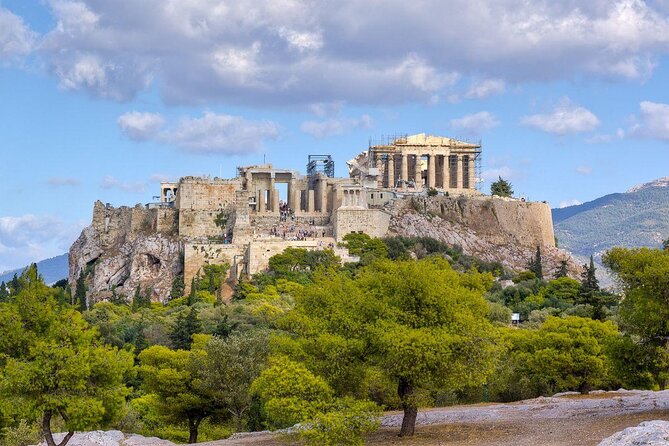
- More than the Parthenon: The route includes the Propylaea, Erechtheion, Odeon of Herod Atticus, Temple of Asclepius, and Theater of Dionysus.
- About two hours on foot: You will walk across ancient stone, slopes, and uneven ground, so moderate physical fitness is required.
- Early 8:30 am start: The morning departure gives you a useful head start at one of Athens’s busiest monuments.
- Admission costs extra: The tour price is $44.03 per person, but the Acropolis entry ticket must be purchased separately.
- Small-to-medium group size: The maximum is 27 people, with a wireless audio system to keep the guide audible.
Why a Spanish guide changes the Acropolis visit
The Acropolis is easy to admire and surprisingly easy to misunderstand. You see the Parthenon, take in the city views, and move on. A good guide gives you the missing links: why the buildings were placed where they are, how Athens used religion and architecture to express power, and how these structures changed long after classical Greece.
This tour is particularly useful if Spanish is your strongest language. Historical explanations can become tiring when you are translating in your head, especially under the Athenian sun. Here, the guide speaks Spanish throughout, and the audio system lets you hear the details without having to crowd around one person.
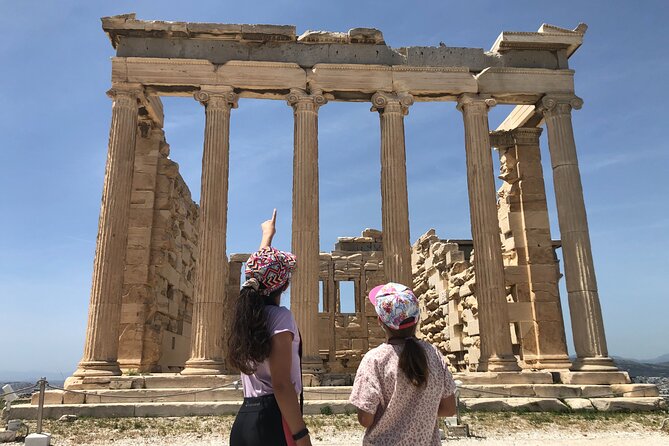
The guides named in the experience include Efi, Ari, Simon, and Maria. Efi receives especially warm praise for her ability to combine mythology, anthropology, geography, and history with a lively teaching style. Several comments also highlight her ability to involve children, ask questions, point out the best photo locations, and help with the ticket process. The exact guide may vary, but the tour clearly places a lot of weight on personal storytelling rather than a memorized list of dates.
The group can reach 27 people. That is not a private tour, and you should not expect every question to receive a long personal answer. Still, the audio equipment helps keep the experience organized and audible.
More Athens trips worth a second look
- Athens: Acropolis & up to 5 Archaeological Sites Combo Pass
★ 4.4 · 12,619 reviews - Athens: Acropolis Ticket with Optional Audio or Live Guide
★ 4.2 · 11,055 reviews - Athens: Acropolis, Parthenon & Acropolis Museum Guided Tour
★ 4.8 · 9,316 reviews
Meeting at Dionysiou Areopagitou Street
You meet at the Greek National Tourism Organisation Information Point at Dionysiou Areopagitou 18. The starting time is 8:30 am, and the entire visit takes place on foot.
That early hour matters. The Acropolis is one of Athens’s essential stops, and the main paths can become crowded later in the day. A morning start also makes sense in warmer months, when walking up exposed stone is more comfortable before the strongest heat.
You should arrive ready to walk rather than treating this as a quick viewing platform. The route includes slopes, steps, and uneven ancient surfaces. The operator asks for a moderate level of physical fitness, and that is a fair warning. This is not a vehicle-based sightseeing tour, and transfers are not included.
Bring water, wear practical shoes, and leave enough time to reach the meeting point. Those simple choices make a real difference when you are listening closely while moving over old marble.
The Acropolis: setting the story first
The visit begins with the Acropolis itself, not just the Parthenon. Your guide lays out the historical, mythological, social, and cultural setting before focusing on individual buildings.
That order is valuable. The Acropolis was not simply a collection of temples. It was a sacred hill, a political symbol, a place of public memory, and a physical expression of Athenian ambition. Starting with the larger setting helps you see the monuments as parts of one carefully planned religious center.
The guide’s job here is to give you a framework for the rest of the walk. You may hear how myths about Athena, Poseidon, and the early kings of Athens shaped the identity of the city. You also get a sense of why later societies reused, altered, damaged, or restored these buildings.
The experience is built for understanding rather than rushing. You will have time to listen, ask questions, and take photographs, though the two-hour schedule means the commentary at each stop is focused.
The Parthenon: perfection, power, and change
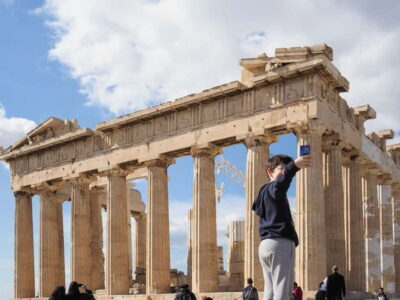
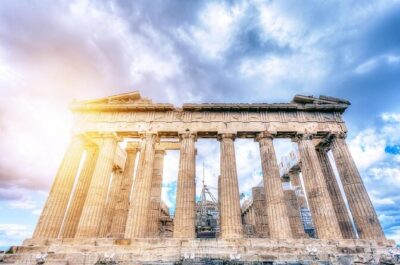
The Parthenon receives about 20 minutes of attention, and rightly so. It is the visual centerpiece of the Acropolis and one of antiquity’s most influential buildings.
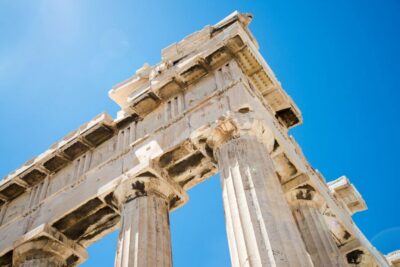
Your guide explains its construction around 2,500 years ago and points out its optical refinements. The temple may look perfectly straight, but its builders used subtle curves and adjustments to create that impression from the ground. These refinements are easy to miss without someone directing your eye toward them.
You also learn about the building’s decoration, its legends, and its later uses. The Parthenon became a church during the Byzantine period and a mosque during Ottoman rule. That change of purpose is a useful reminder that ancient buildings do not remain frozen in one historical moment.
The tour also addresses looting and the restoration work still in progress. You will not see a perfectly preserved temple. You will see a monument shaped by war, religion, occupation, collecting, weather, and modern conservation.
The limitation is that you cannot study every sculpture or architectural detail in depth during a 20-minute stop. If classical architecture is your main interest, you may want extra time at the Acropolis Museum after this tour.
A different kind of day out, same corner of Greece:
- Athens: Cape Sounion & Poseidon Temple Sunset Half-Day Trip
★ 4.8 · 8,241 reviews - Athens: Acropolis and Parthenon Guided Walking Tour
★ 4.6 · 5,882 reviews - All Day Cruise -3 Islands to Agistri,Moni, Aegina with lunch and drinks included
★ 5.0 · 4,958 reviews - Athens, Piraeus, and Coastline: Blue Hop-On Hop-Off Bus
★ 3.9 · 4,849 reviews
The Propylaea and the Temple of Athena Nike
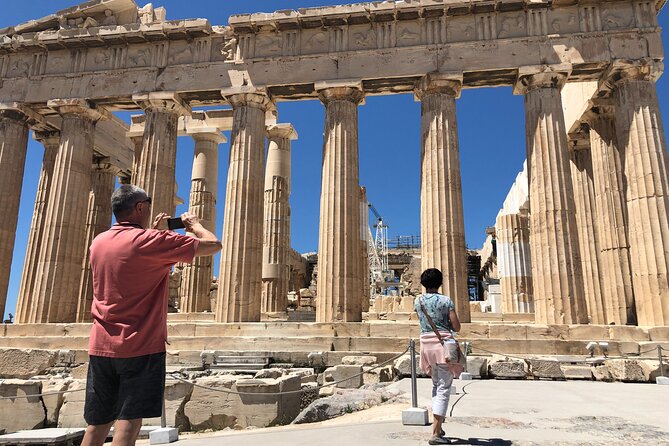
The Propylaea is the monumental entrance to the Acropolis. The tour allows about 10 minutes here, enough to explain why the gateway was designed to impress from the first step.
It was built largely from marble and uses different types of columns. Your guide explains the design choices and the strategic position of the entrance. Because the approach narrows and rises, the Propylaea could also act as a funnel during wartime.
This is a good example of the tour’s broader approach. You are not only told what a building is called. You are asked to think about how it worked, how people moved through it, and what message it sent.
The itinerary also includes the small temple dedicated to Athena Nike, described as a tribute to Athena Victorious. Its position above the approach gave it a powerful role in the entrance sequence. The temple commemorated Greek victories over the Persians and linked the Acropolis to the golden age of Athens.
The stop is short, but the setting is one of the places where a guide adds real value. Without context, it is easy to walk past the smaller structure while concentrating on the Parthenon.
The Erechtheion and its famous Caryatids
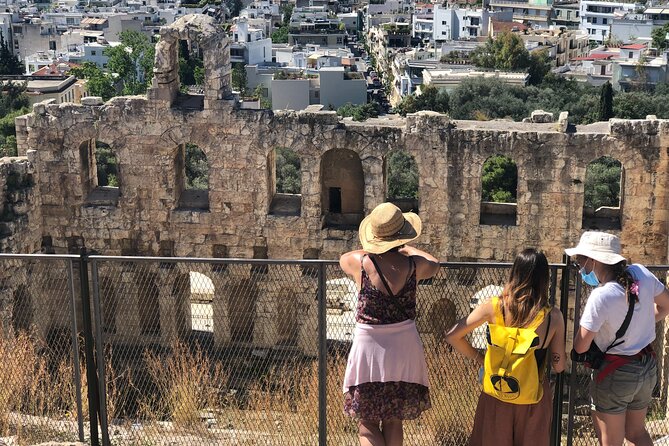
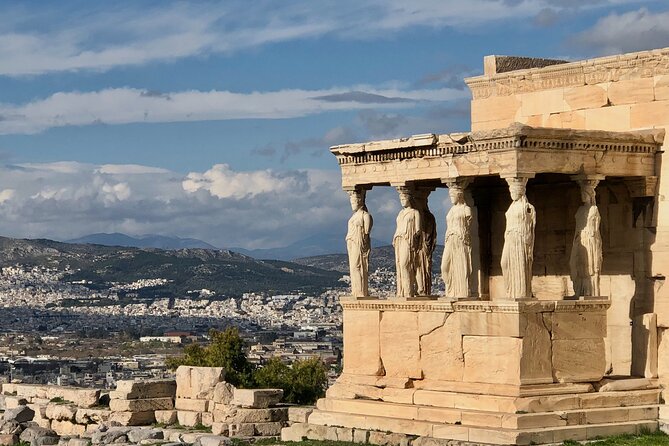
The Erechtheion gets about 10 minutes, but it may be the most photogenic stop on the hill. Its porch is supported by the Caryatids, female-shaped columns that have become one of the best-known images of ancient Greece.
Your guide connects the building to Athena, Poseidon, and Erechtheus, the mythological first king of Athens. That mixture of worship is important. The Erechtheion was not a simple replacement for the Parthenon. It served several sacred traditions within one complex.
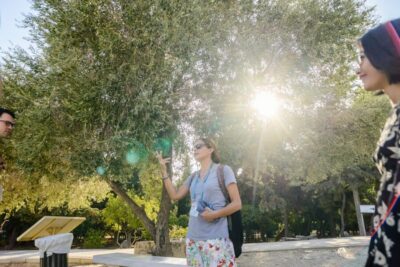
You also hear why the olive tree associated with the site was sacred. The olive was tied to Athena’s claim over the city and to the long agricultural life of Athens. A short explanation can make the tree and the surrounding ruins feel less like decorative scenery and more like part of a religious argument.
This is another place where photographs can distract you from the explanation. A useful tip is to listen first, then take your pictures when the guide identifies the best angles. Efi is specifically praised for pointing out precise photo spots while keeping the group focused on the story.
The Odeon of Herod Atticus
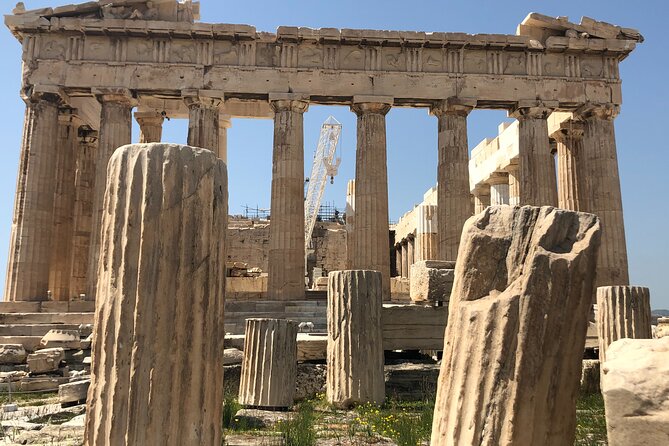
The Odeon of Herod Atticus is a Roman-era auditorium with room for about 5,000 spectators. The tour spends roughly 10 minutes here.
Built by the Roman governor Herod Atticus and dedicated to his wife, Regina, the auditorium is notable because it has been fully restored and remains in use. It hosts performances during the Athens Festival, giving you a direct link between ancient public entertainment and modern cultural life.
From the Acropolis, you view the theater rather than attend a performance. Still, the guide can help you picture how music, drama, and public gatherings once filled the space. Its steep seating and carefully designed shape also show how ancient builders thought about sound and sightlines.
The stop is brief, so do not expect a performance or a detailed architectural study. Its value is in showing that the Acropolis is not only about temples. It was also connected to civic ceremony, theater, and the wider public life of Athens.
The Temple of Asclepius and ancient medicine
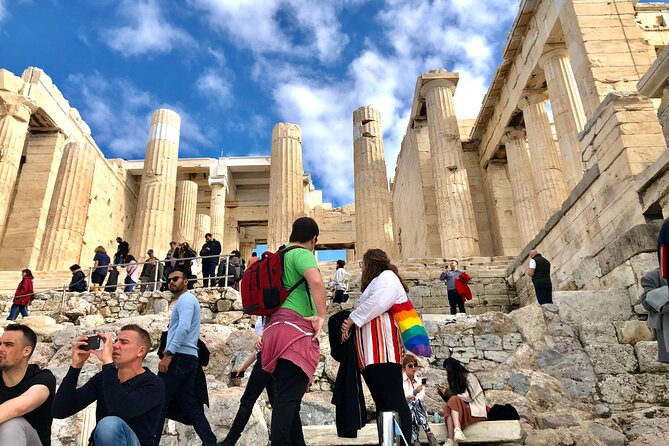
The Temple of Asclepius receives about five minutes, making it the shortest stop on the route. It was dedicated to Asclepius, the god of medicine.
Here, the guide explains how ancient Athenians treated patients and what kinds of votive offerings they left in thanks. This is a small but useful change of subject. After temples devoted to gods and victories, you get a glimpse of people visiting sacred spaces because they were sick and hoped to recover.
The short timing is understandable, since the remains are less visually dominant than the Parthenon or Erechtheion. Still, the stop helps broaden your view of ancient religion. Worship was not only about grand ceremonies. It also involved personal fears, illness, gratitude, and the hope for healing.
The Theater of Dionysus: where Greek drama began
The Theater of Dionysus Eleuthereus is one of the oldest theaters in the world and was built entirely of marble. The tour allows about 10 minutes here.
With a capacity of around 17,000 spectators, the theater used the slope of the Acropolis to support its seating and acoustics. This was the setting for early performances by Euripides, Aeschylus, Sophocles, and Aristophanes.
Even if you are not a theater specialist, this stop gives the Acropolis a human voice. The tragedies and comedies first performed here still shape modern drama. Standing above the rows of seats, you can better understand that these works were not written for private reading. They were public events watched by a large civic audience.
The route ends at Theorias 21, at the top of the Acropolis. You are not immediately put on a bus or led away from the site. You can use the remaining free time to photograph the monuments and enjoy the views on your own.
That ending is practical. The guided portion gives you structure, then you can linger without needing to keep pace with the group. Just remember that the formal visit is about two hours, so any extra time afterward is your own time rather than part of the guided commentary.
What the $44.03 price really covers
At $44.03 per person, the cost covers the Spanish official guide, wireless audio equipment, the guided walk through the listed Acropolis monuments, and state taxes. It does not cover the Acropolis admission ticket.
That separation is the key value question. You are not paying $44.03 for entry alone. You are paying for interpretation, a planned route, Spanish-language service, and the convenience of having the major buildings explained in sequence.
The price makes the most sense if you want context and do not want to read a guidebook while walking. It is less attractive if you already know Greek history well or prefer to explore silently at your own speed. Since admission is extra, calculate the total before booking.
The tour is often booked about 25 days ahead. That suggests you should not leave it until the last minute if your Athens schedule is fixed, especially if you need a Spanish departure on a particular morning.
Free cancellation is available when you cancel at least 24 hours before the start time. Changes or cancellations made inside that window are not refunded.
Who will get the most from this tour
I would choose this experience if you want a clear introduction to the Acropolis in Spanish, especially on a first visit to Athens. It suits couples, families, and solo visitors who prefer a guide to connect the ruins into one story.
It also works well for families with older children. Efi is praised for holding children’s attention, and the tour’s questions, myths, and stories give younger visitors more to follow than a string of architectural terms.
You should think twice if you have difficulty walking on uneven ground, dislike fixed start times, or want a long, highly technical study of the Parthenon. The group can include up to 27 people, and the tour keeps moving through several sites.
Service animals are allowed, and the meeting point is near public transportation. No transfers are provided, so you arrange your own way to the start and away from the Acropolis afterward.
Should you book the Spanish Acropolis tour?
Yes, if you want the Acropolis explained in Spanish and you value a strong guide more than total independence. The route covers the essential monuments, but it also gives time to the Propylaea, Theater of Dionysus, Temple of Asclepius, and Odeon of Herod Atticus.
The strongest reason to book is the guide-led storytelling. Names such as Efi, Ari, Simon, and Maria appear in connection with especially warm, passionate tours, though the assigned guide can vary. The main caution is to budget for the separate admission ticket and prepare for a two-hour walk over uneven ground.
For a first morning in Athens, this is a sensible way to get your bearings fast and understand why the Acropolis is more than one famous temple.
FAQ
Is the Acropolis entry ticket included?
No. Admission to the Acropolis is not included in the $44.03 tour price, and a separate entry ticket is required.
How long does the guided visit last?
The visit lasts approximately two hours.
What time does the tour begin?
The tour begins at 8:30 am.
Is the tour conducted in Spanish?
Yes. The tour is exclusively in Spanish and includes an official Spanish-speaking tourist guide.
What monuments are included?
The route includes the Acropolis, Parthenon, Propylaea, Temple of Athena Nike, Erechtheion, Odeon of Herod Atticus, Temple of Asclepius, and Theater of Dionysus Eleuthereus.
Where does the tour begin?
It begins at the Greek National Tourism Organisation Information Point, Dionysiou Areopagitou 18, Athens.
Where does the tour end?
It ends at Theorias 21, at the top of the Acropolis, where you can take photographs and enjoy free time.
How many people can join the tour?
The maximum group size is 27 people. A wireless audio system is included.
Recently reviewed around Athens
- Small-Group Women History in Ancient Greece Walking Tour★ 5.0 · 38 reviews
- Ceramic and Pottery Creative Workshop with Two Local Artists★ 4.0 · 57 reviews
- Athens: Wine Workshop Create your Own Wine under the Acropolis★ 5.0 · 77 reviews
- Athens: Greek Wines Tasting with Sommelier and Acropolis Views★ 5.0 · 88 reviews
- Small-Group Wine Tour in Athens with Tasting★ 5.0 · 33 reviews
- Wine Trails Private Tour/ Nemea visit 3 wineries from Athens or Nafplion (10 h)★ 5.0 · 44 reviews
- Hydra Private Day Trip by Ferry from Athens with Transfers★ 4.0 · 30 reviews
- Private Athens Transfer Airport/Port -Greek Tours-Hourly service★ 5.0 · 88 reviews
Acropolis & Acropolis Museum Tours, compared.
Acropolis & up to 5 Archaeological Sites Combo Pass
Read our review →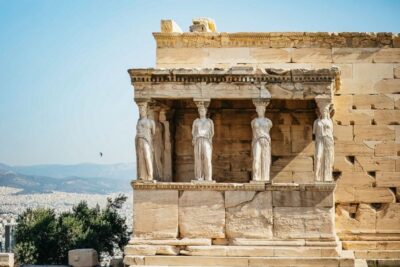
Acropolis, Parthenon & Acropolis Museum Guided Tour
Read our review →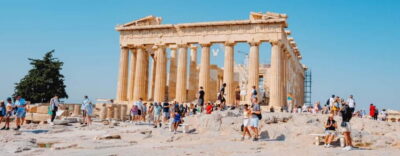
Acropolis, Parthenon & Acropolis Museum Guided Tour
Read our review →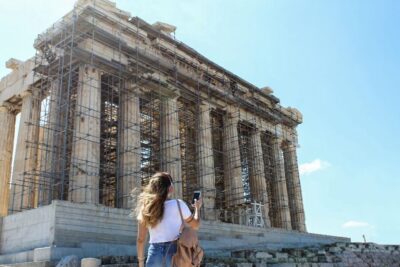
Acropolis monuments & Parthenon Walking Tour with Optional Acropolis Museum
Read our review →Browse the lists this tour appears in